Thank you for visiting SNEWPapers!
Sign up free
Editorial
March 28, 1844
The Daily Madisonian
Washington, District Of Columbia
What is this article about?
This editorial discusses Texas annexation, mocking British opposition and threats of secession, praises a defender of President Tyler, declines to publish an unjust attack on him, and defends Tyler's legitimate ascension to the presidency against critics like Henry Clay.
Clipping
OCR Quality
98%
Excellent
Full Text
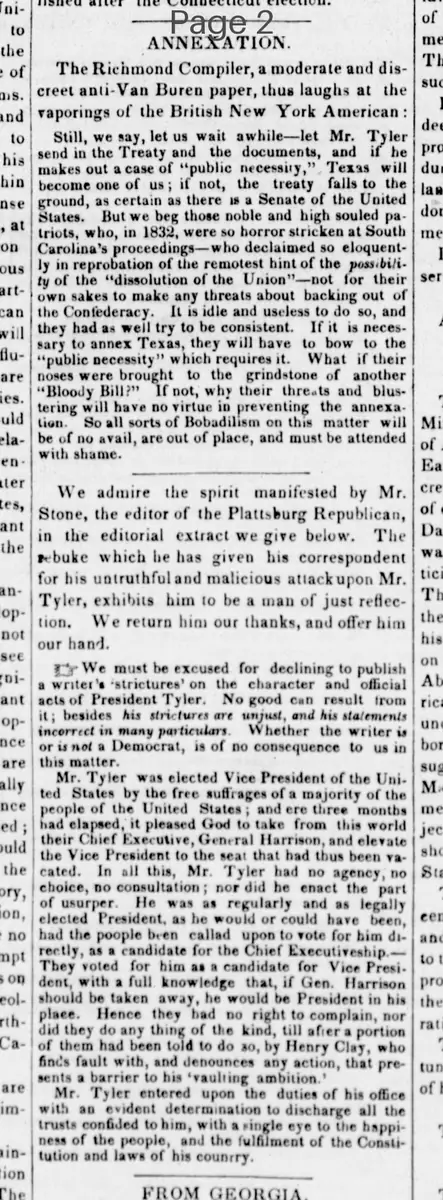
ANNEXATION.
The Richmond Compiler, a moderate and discreet anti-Van Buren paper, thus laughs at the vaporings of the British New York American:
Still, we say, let us wait awhile—let Mr. Tyler send in the Treaty and the documents, and if he makes out a case of "public necessity," Texas will become one of us; if not, the treaty falls to the ground, as certain as there is a Senate of the United States. But we beg those noble and high souled patriots, who, in 1832, were so horror stricken at South Carolina's proceedings—who declaimed so eloquently in reprobation of the remotest hint of the possibility of the "dissolution of the Union"—not for their own sakes to make any threats about backing out of the Confederacy. It is idle and useless to do so, and they had as well try to be consistent. If it is necessary to annex Texas, they will have to bow to the "public necessity" which requires it. What if their noses were brought to the grindstone of another "Bloody Bill?" If not, why their threats and blustering will have no virtue in preventing the annexation. So all sorts of Bobadilism on this matter will be of no avail, are out of place, and must be attended with shame.
We admire the spirit manifested by Mr. Stone, the editor of the Plattsburg Republican, in the editorial extract we give below. The rebuke which he has given his correspondent for his untruthful and malicious attack upon Mr. Tyler, exhibits him to be a man of just reflection. We return him our thanks, and offer him our hand.
We must be excused for declining to publish a writer's strictures on the character and official acts of President Tyler. No good can result from it; besides his strictures are unjust, and his statements incorrect in many particulars. Whether the writer is or is not a Democrat, is of no consequence to us in this matter.
Mr. Tyler was elected Vice President of the United States by the free suffrages of a majority of the people of the United States; and ere three months had elapsed, it pleased God to take from this world their Chief Executive, General Harrison, and elevate the Vice President to the seat that had thus been vacated. In all this, Mr. Tyler had no agency, no choice, no consultation; nor did he enact the part of usurper. He was as regularly and as legally elected President, as he would or could have been, had the people been called upon to vote for him directly, as a candidate for the Chief Executiveship.— They voted for him as a candidate for Vice President, with a full knowledge that, if Gen. Harrison should be taken away, he would be President in his place. Hence they had no right to complain, nor did they do any thing of the kind, till after a portion of them had been told to do so, by Henry Clay, who finds fault with, and denounces any action, that presents a barrier to his 'vaulting ambition.'
Mr. Tyler entered upon the duties of his office with an evident determination to discharge all the trusts confided to him, with a single eye to the happiness of the people, and the fulfilment of the Constitution and laws of his country.
The Richmond Compiler, a moderate and discreet anti-Van Buren paper, thus laughs at the vaporings of the British New York American:
Still, we say, let us wait awhile—let Mr. Tyler send in the Treaty and the documents, and if he makes out a case of "public necessity," Texas will become one of us; if not, the treaty falls to the ground, as certain as there is a Senate of the United States. But we beg those noble and high souled patriots, who, in 1832, were so horror stricken at South Carolina's proceedings—who declaimed so eloquently in reprobation of the remotest hint of the possibility of the "dissolution of the Union"—not for their own sakes to make any threats about backing out of the Confederacy. It is idle and useless to do so, and they had as well try to be consistent. If it is necessary to annex Texas, they will have to bow to the "public necessity" which requires it. What if their noses were brought to the grindstone of another "Bloody Bill?" If not, why their threats and blustering will have no virtue in preventing the annexation. So all sorts of Bobadilism on this matter will be of no avail, are out of place, and must be attended with shame.
We admire the spirit manifested by Mr. Stone, the editor of the Plattsburg Republican, in the editorial extract we give below. The rebuke which he has given his correspondent for his untruthful and malicious attack upon Mr. Tyler, exhibits him to be a man of just reflection. We return him our thanks, and offer him our hand.
We must be excused for declining to publish a writer's strictures on the character and official acts of President Tyler. No good can result from it; besides his strictures are unjust, and his statements incorrect in many particulars. Whether the writer is or is not a Democrat, is of no consequence to us in this matter.
Mr. Tyler was elected Vice President of the United States by the free suffrages of a majority of the people of the United States; and ere three months had elapsed, it pleased God to take from this world their Chief Executive, General Harrison, and elevate the Vice President to the seat that had thus been vacated. In all this, Mr. Tyler had no agency, no choice, no consultation; nor did he enact the part of usurper. He was as regularly and as legally elected President, as he would or could have been, had the people been called upon to vote for him directly, as a candidate for the Chief Executiveship.— They voted for him as a candidate for Vice President, with a full knowledge that, if Gen. Harrison should be taken away, he would be President in his place. Hence they had no right to complain, nor did they do any thing of the kind, till after a portion of them had been told to do so, by Henry Clay, who finds fault with, and denounces any action, that presents a barrier to his 'vaulting ambition.'
Mr. Tyler entered upon the duties of his office with an evident determination to discharge all the trusts confided to him, with a single eye to the happiness of the people, and the fulfilment of the Constitution and laws of his country.
What sub-type of article is it?
Partisan Politics
Foreign Affairs
Imperialism
What keywords are associated?
Texas Annexation
President Tyler
Henry Clay
Partisan Politics
Union Dissolution
Constitutional Succession
What entities or persons were involved?
Mr. Tyler
Richmond Compiler
British New York American
Mr. Stone
Plattsburg Republican
Henry Clay
General Harrison
Editorial Details
Primary Topic
Texas Annexation And Defense Of President Tyler
Stance / Tone
Supportive Of Tyler And Annexation, Mocking Opponents
Key Figures
Mr. Tyler
Richmond Compiler
British New York American
Mr. Stone
Plattsburg Republican
Henry Clay
General Harrison
Key Arguments
Wait For Tyler's Treaty On Texas Annexation Before Deciding
Threats Of Secession Over Annexation Are Idle And Inconsistent
Praise For Mr. Stone's Defense Of Tyler Against Malicious Attacks
Decline To Publish Unjust Strictures On Tyler
Tyler's Presidency Is Legitimate Via Election And Constitutional Succession
Criticism Of Tyler Stems From Henry Clay's Ambition
Tyler Acts For The People's Happiness And Constitutional Duty