Thank you for visiting SNEWPapers!
Sign up free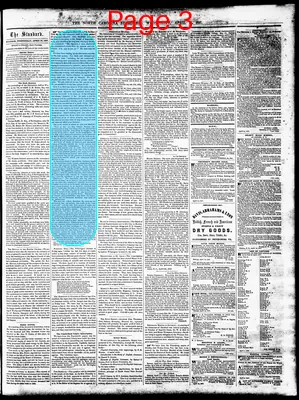
Editorial
April 15, 1857
Semi Weekly Standard
Raleigh, Wake County, North Carolina
What is this article about?
This editorial endorses the 'pay as you go' principle, citing John Randolph and Dr. Johnson, and criticizes the credit system for fostering extravagance, dissipation, bankruptcy, and widespread social suffering, urging a shift to cash transactions for financial and societal stability.
Clipping
OCR Quality
98%
Excellent
Full Text
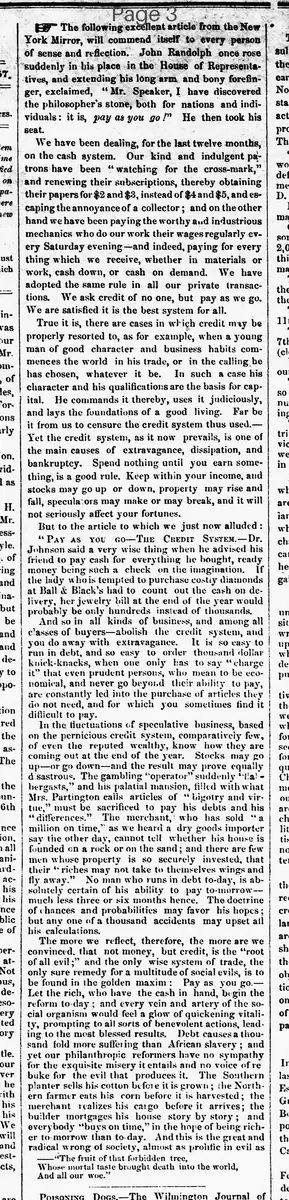
The following excellent article from the New York Mirror, will commend itself to every person of sense and reflection. John Randolph once rose suddenly in his place in the House of Representatives, and extending his long arm and bony forefinger, exclaimed, "Mr. Speaker, I have discovered the philosopher's stone, both for nations and individuals: it is, pay as you go!" He then took his seat.
We have been dealing, for the last twelve months, on the cash system. Our kind and indulgent patrons have been "watching for the cross-mark," and renewing their subscriptions, thereby obtaining their papers for $2 and $3, instead of $4 and $5, and escaping the annoyance of a collector; and on the other hand we have been paying the worthy and industrious mechanics who do our work their wages regularly every Saturday evening-and indeed, paying for everything which we receive, whether in materials or work, cash down, or cash on demand. We have adopted the same rule in all our private transactions. We ask credit of no one, but pay as we go. We are satisfied it is the best system for all.
True it is, there are cases in which credit may be properly resorted to, as for example, when a young man of good character and business habits commences the world in his trade, or in the calling he has chosen, whatever it be. In such a case his character and his qualifications are the basis for capital. He commands it thereby, uses it judiciously and lays the foundations of a good living. Far be it from us to censure the credit system thus used.-
Yet the credit system, as it now prevails, is one of the main causes of extravagance, dissipation, and bankruptcy. Spend nothing until you earn something, is a good rule. Keep within your income, and stocks may go up or down, property may rise and fall, speculators may make or may break, and it will not seriously affect your fortunes.
But to the article to which we just now alluded:
"PAY AS YOU GO-THE CREDIT SYSTEM.-Dr. Johnson said a very wise thing when he advised his friend to pay cash for everything he bought, ready money being such a check on the imagination. If the lady who is tempted to purchase costly diamonds at Ball & Black's had to count out the cash on delivery, her jewelry bill at the end of the year would probably be only hundreds instead of thousands.
And so in all kinds of business, and among all classes of buyers-abolish the credit system, and you do away with extravagance. It is so easy to run in debt, and so easy to order thousand dollar knick-knacks, when one only has to say "charge it" that even prudent persons, who mean to be economical, and never go beyond their ability to pay, are constantly led into the purchase of articles they do not need, and for which you sometimes find it difficult to pay.
In the fluctuations of speculative business, based on the pernicious credit system, comparatively few of even the reputed wealthy, know how they are coming out at the end of the year. Stocks may go up-or go down-and the result may prove equally disastrous. The gambling "operator" suddenly "tumbles," and his palatial mansion, filled with what Mrs. Partington calls articles of "bigotry and virtue," must be sacrificed to pay his debts and his "differences." The merchant, who has sold "a million on time," as we heard a dry goods importer say the other day, cannot tell whether his house is founded on a rock or on the sand; and there are few men whose property is so securely invested, that their "riches may not take to themselves wings and fly away." No man who runs in debt to-day, is absolutely certain of his ability to pay to-morrow-- much less three or six months hence. The doctrine of chances and probabilities may favor his hopes; but any one of a thousand accidents may upset all his calculations.
The more we reflect, therefore, the more are we convinced, that not money, but credit, is the "root of all evil;" and the only wise system of trade, the only sure remedy for a multitude of social evils, is to be found in the golden maxim: Pay as you go.-
Let the rich, who have the cash in hand, begin the reform to-day: and every vein and artery of the social organism would feel a glow of quickening vitality, prompting to all sorts of benevolent actions, leading to the most blessed results. Debt causes a thousand fold more suffering than African slavery; and yet our philanthropic reformers have no sympathy for the exquisite misery it entails and no voice of rebuke for the evil that produces it. The Southern planter sells his cotton before it is grown; the Northern farmer eats his corn before it is harvested; the merchant realizes his cargo before it arrives; the builder mortgages his house story by story; and everybody "buys on time," in the hope of being richer to-morrow than to-day. And this is the great and radical wrong of society, almost as prolific in evil as
"The fruit of that forbidden tree,
Whose mortal taste
Brought death into the world,
And all our woe."
We have been dealing, for the last twelve months, on the cash system. Our kind and indulgent patrons have been "watching for the cross-mark," and renewing their subscriptions, thereby obtaining their papers for $2 and $3, instead of $4 and $5, and escaping the annoyance of a collector; and on the other hand we have been paying the worthy and industrious mechanics who do our work their wages regularly every Saturday evening-and indeed, paying for everything which we receive, whether in materials or work, cash down, or cash on demand. We have adopted the same rule in all our private transactions. We ask credit of no one, but pay as we go. We are satisfied it is the best system for all.
True it is, there are cases in which credit may be properly resorted to, as for example, when a young man of good character and business habits commences the world in his trade, or in the calling he has chosen, whatever it be. In such a case his character and his qualifications are the basis for capital. He commands it thereby, uses it judiciously and lays the foundations of a good living. Far be it from us to censure the credit system thus used.-
Yet the credit system, as it now prevails, is one of the main causes of extravagance, dissipation, and bankruptcy. Spend nothing until you earn something, is a good rule. Keep within your income, and stocks may go up or down, property may rise and fall, speculators may make or may break, and it will not seriously affect your fortunes.
But to the article to which we just now alluded:
"PAY AS YOU GO-THE CREDIT SYSTEM.-Dr. Johnson said a very wise thing when he advised his friend to pay cash for everything he bought, ready money being such a check on the imagination. If the lady who is tempted to purchase costly diamonds at Ball & Black's had to count out the cash on delivery, her jewelry bill at the end of the year would probably be only hundreds instead of thousands.
And so in all kinds of business, and among all classes of buyers-abolish the credit system, and you do away with extravagance. It is so easy to run in debt, and so easy to order thousand dollar knick-knacks, when one only has to say "charge it" that even prudent persons, who mean to be economical, and never go beyond their ability to pay, are constantly led into the purchase of articles they do not need, and for which you sometimes find it difficult to pay.
In the fluctuations of speculative business, based on the pernicious credit system, comparatively few of even the reputed wealthy, know how they are coming out at the end of the year. Stocks may go up-or go down-and the result may prove equally disastrous. The gambling "operator" suddenly "tumbles," and his palatial mansion, filled with what Mrs. Partington calls articles of "bigotry and virtue," must be sacrificed to pay his debts and his "differences." The merchant, who has sold "a million on time," as we heard a dry goods importer say the other day, cannot tell whether his house is founded on a rock or on the sand; and there are few men whose property is so securely invested, that their "riches may not take to themselves wings and fly away." No man who runs in debt to-day, is absolutely certain of his ability to pay to-morrow-- much less three or six months hence. The doctrine of chances and probabilities may favor his hopes; but any one of a thousand accidents may upset all his calculations.
The more we reflect, therefore, the more are we convinced, that not money, but credit, is the "root of all evil;" and the only wise system of trade, the only sure remedy for a multitude of social evils, is to be found in the golden maxim: Pay as you go.-
Let the rich, who have the cash in hand, begin the reform to-day: and every vein and artery of the social organism would feel a glow of quickening vitality, prompting to all sorts of benevolent actions, leading to the most blessed results. Debt causes a thousand fold more suffering than African slavery; and yet our philanthropic reformers have no sympathy for the exquisite misery it entails and no voice of rebuke for the evil that produces it. The Southern planter sells his cotton before it is grown; the Northern farmer eats his corn before it is harvested; the merchant realizes his cargo before it arrives; the builder mortgages his house story by story; and everybody "buys on time," in the hope of being richer to-morrow than to-day. And this is the great and radical wrong of society, almost as prolific in evil as
"The fruit of that forbidden tree,
Whose mortal taste
Brought death into the world,
And all our woe."
What sub-type of article is it?
Economic Policy
Social Reform
What keywords are associated?
Pay As You Go
Credit System
Extravagance
Bankruptcy
Cash Payments
Economic Reform
Social Evils
What entities or persons were involved?
John Randolph
Dr. Johnson
New York Mirror
Editorial Details
Primary Topic
Advocacy For Pay As You Go System
Stance / Tone
Strongly Against Credit System
Key Figures
John Randolph
Dr. Johnson
New York Mirror
Key Arguments
Pay As You Go Is The Philosopher's Stone For Nations And Individuals
Cash System Prevents Extravagance And Bankruptcy
Credit Leads To Unnecessary Purchases And Financial Uncertainty
Abolish Credit To Promote Economic Stability
Debt Causes More Suffering Than Slavery