Thank you for visiting SNEWPapers!
Sign up free
Daily National Intelligencer
Washington, District Of Columbia
What is this article about?
In a letter to the National Intelligencer, 'HOMO' proposes a government-issued $10 million in small notes secured by stock and land to alleviate currency shortages from war and growth, with interest supporting education, hospitals, and infrastructure like canals and roads. Dated Washington, December 5, 1814.
Clipping
OCR Quality
Full Text
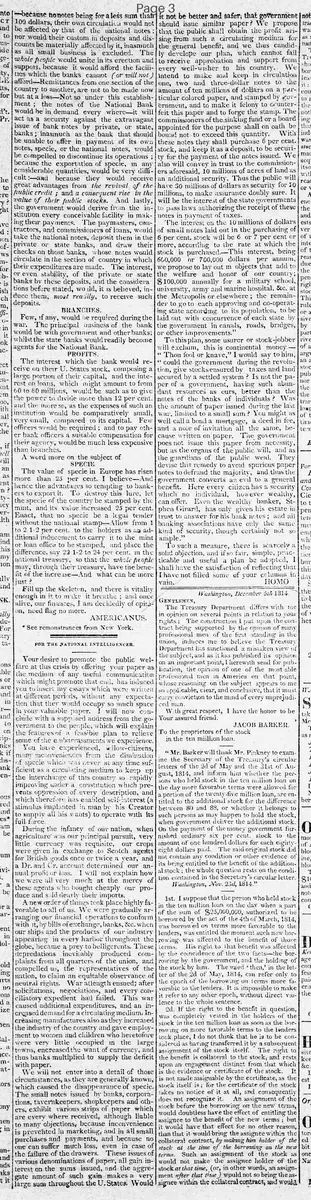
Your desire to promote the public welfare at this crisis by offering your paper as the medium of any useful communication which might promote that end, has induced you to insert my essays which were written at different periods, without any expectation that they would occupy so much space in your valuable paper. I will now conclude with a supposed address from the government to the people, which will explain the features of a feasible plan to relieve some of the embarrassments we experience.
You have experienced, fellow-citizens, many inconveniences from the diminution of specie which was never at any time sufficient as a circulating medium to keep up the interchange of this country so rapidly improving under a constitution which prevents oppression of every description, and which therefore has enabled self-interest (a stimulus implanted in man by his Creator to supply all his wants) to operate with its full force.
During the infancy of our nation, when agriculture was our principal pursuit, very little currency was requisite, our crops were given in exchange to Scotch agents for British goods once or twice a year, and a Dr. and Cr. account determined our annual profit or loss. I will not explain how we were all very much at the mercy of these agents who bought cheaply our produce and sold dearly their imports.
A new order of things took place highly favorable to all of us. We were gradually arranging our financial operations to conform with it, by bills of exchange, banks, &c. when our ships and the products of our industry appearing in every harbor throughout the globe, became a prey to belligerents. These depredations inevitably produced complaints from all quarters of the union, and compelled us, the representatives of the nation, to claim an equitable observance of neutral rights. War at length ensued; after solicitations, negotiations, and every conciliatory expedient had failed. This war caused additional expenditures, and an increased demand for a circulating medium. Increasing manufactures also as they increased the industry of the country and gave employment to women and children who heretofore were very little occupied in the large towns, increased the want of currency, and thus banks multiplied to supply the deficit with paper.
We will not enter into a detail of those circumstances, as they are generally known, which caused the disappearance of specie. The small notes issued by banks, corporations, tavernkeepers, shopkeepers and others, exhibit various strips of paper which are every where received, although liable to many objections, because inconvenience is prevented in marketing, and in all small purchases and payments, and because no one can suffer much loss, even in case of the failure of the drawers. These issues of various denominations of paper, all gain interest on the sums issued, and the aggregate amount of such gain makes a very large sum throughout the U. States. Would it not be better and safer; that government should issue similar paper? We propose that the public shall obtain the profit arising from such a circulating medium for the general benefit, and we thus candidly develope our plan, which cannot fail to receive approbation and support from every well-wisher to his country. We intend to make and keep in circulation one, two and three-dollar notes to the amount of ten millions of dollars on a particular colored paper, and stamped by government, and to make it felony to counterfeit this paper and to forge the stamp. The commissioners of the sinking fund or a board appointed for the purpose shall on oath be bound not to exceed this quantity. With these notes they shall purchase 6 per cent. stock, and keep it as a deposit, to be security for the payment of the notes issued. We also will convey in trust to the commissioners aforesaid, 10 millions of acres of land as an additional security. Thus the public will have 30 millions of dollars as security for 10 millions. to make assurance doubly sure. It will be the interest of the state governments to pass laws authorizing the receipt of these notes in payment of taxes.
The interest on the 10 millions of dollars of small notes laid out in the purchasing of 6 per cent. stock will be 6 or 7 per cent or more, according to the rate at which the stock is purchased.—This interest, being 660,000 or 700,000 dollars per annum, we propose to lay out in objects that add to the welfare and honor of our country; $100,000 annually for a military school, university, army and marine hospital, &c. at the Metropolis or elsewhere; the remainder to go to each approving and co-operating state according to its population, to be laid out with concurrence of each state by the government in canals, roads, bridges. or other improvements.
To this plan, some usurer or stock-jobber will exclaim, this is continental money—“Thou fool or knave.” I would say to him. “could the government during the revolution, give stocks secured by taxes and land secured by a settled system? Is not the paper of a government, having such abundant resources as ours, better than the notes of the banks of individuals? Was the amount of paper issued during the last war, limited to a small sum? You might as well call a bond a mortgage, a deed in fee, and a note of invitation all the same, because written on paper. The government does not issue this paper from necessity. but as the organs of the public will, and as the guardians of the public weal. They devise this remedy to avoid spurious paper notes to defraud the majority, and thus the government converts an evil to a general benefit. Here every citizen has a security which no individual, however wealthy. can offer. Even the wealthy banker, Stephen Girard, has only given his estate in trust to answer for his bank notes; and all banking associations have only the same kind of security, though certainly not so ample."
To such a measure, there is scarcely a solid objection, and if so fair, simple, practicable and useful a plan be adopted, I shall have the satisfaction of reflecting that I have not filled some of your columns in vain,
HOMO
Washington, December 5th 1814
What sub-type of article is it?
What themes does it cover?
What keywords are associated?
What entities or persons were involved?
Letter to Editor Details
Author
Homo
Recipient
National Intelligencer
Main Argument
the government should issue $10 million in one, two, and three-dollar notes on special paper, secured by $10 million in 6% stock and 10 million acres of land, to provide a safe circulating medium and replace unreliable private notes; the interest earned would fund public improvements like military schools, hospitals, canals, and roads.
Notable Details