Thank you for visiting SNEWPapers!
Sign up free
Phenix Gazette
Alexandria, Virginia
What is this article about?
Complaints in Western papers about Jackson Congress members abusing franking privilege to distribute anti-Administration slander and transport personal dry goods like gingham via mail, disguised as public documents, including a case involving slave Daniel Chipman in Kentucky last winter.
Clipping
OCR Quality
Full Text
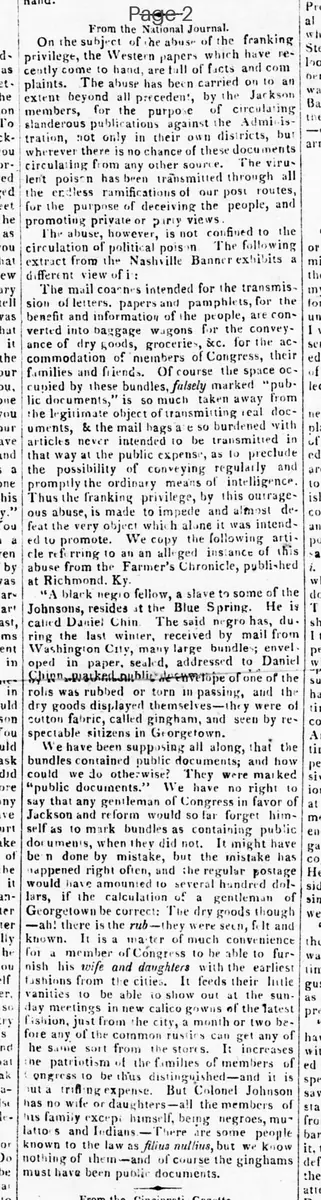
On the subject of the abuse of the franking privilege, the Western papers which have recently come to hand, are full of facts and complaints. The abuse has been carried on to an extent beyond all precedent, by the Jackson members, for the purpose of circulating slanderous publications against the Administration, not only in their own districts, but wherever there is no chance of these documents circulating from any other source. The virulent poison has been transmitted through all the endless ramifications of our post routes, for the purpose of deceiving the people, and promoting private or party views.
The abuse, however, is not confined to the circulation of political poison. The following extract from the Nashville Banner exhibits a different view of it.
The mail carriages intended for the transmission of letters, papers and pamphlets, for the benefit and information of the people, are converted into baggage wagons for the conveyance of dry goods, groceries, &c. for the accommodation of members of Congress, their families and friends. Of course the space occupied by these bundles, falsely marked "public documents," is so much taken away from the legitimate object of transmitting real documents, & the mail bags are so burdened with articles never intended to be transmitted in that way at the public expense, as to preclude the possibility of conveying regularly and promptly the ordinary means of intelligence.
Thus the franking privilege, by this outrageous abuse, is made to impede and almost defeat the very object which alone it was intended to promote. We copy the following article referring to an alleged instance of this abuse from the Farmer's Chronicle, published at Richmond. Ky.
"A black negro fellow, a slave to some of the Johnsons, resides at the Blue Spring. He is called Daniel Chipman. The said negro has, during the last winter, received by mail from Washington City, many large bundles; enveloped in paper, sealed, addressed to Daniel Chipman, packed in public document envelopes. One of the rolls was rubbed or torn in passing, and the dry goods displayed themselves—they were of cotton fabric, called gingham, and seen by respectable citizens in Georgetown.
We have been supposing all along, that the bundles contained public documents; and how could we do otherwise? They were marked "public documents."
We have no right to say that any gentleman of Congress in favor of Jackson and reform would so far forget himself as to mark bundles as containing public documents, when they did not. It might have been done by mistake, but the mistake has happened right often, and the regular postage would have amounted to several hundred dollars, if the calculation of a gentleman of Georgetown be correct: The dry goods though—ah! there is the rub—they were seen, felt and known. It is a matter of much convenience for a member of Congress to be able to furnish his wife and daughters with the earliest fashions from the cities. It feeds their little vanities to be able to show out at the Sunday meetings in new calico gowns of the latest fashion, just from the city, a month or two before any of the common rustics can get any of the same sort from the stores. It increases the patriotism of the families of members of Congress to be thus distinguished—and it is just a trifling expense. But Colonel Johnson has no wife or daughters—all the members of his family except himself, being negroes, mulattos and Indians.—There are some people known to the law as filius nullius, but we know nothing of them—and of course the ginghams must have been public documents."
What sub-type of article is it?
What keywords are associated?
What entities or persons were involved?
Where did it happen?
Domestic News Details
Primary Location
Richmond, Kentucky
Event Date
Last Winter
Key Persons
Outcome
bundles of dry goods disguised as public documents received by mail, potentially costing several hundred dollars in regular postage; no arrests or resolutions mentioned
Event Details
Reports detail abuse of franking privilege by Jackson members to circulate slanderous publications against the Administration via post routes. Additionally, mail carriages are used to transport dry goods and groceries for members of Congress and families, marked falsely as public documents, impeding legitimate mail. Specific instance: Slave Daniel Chipman at Blue Spring received multiple large bundles from Washington City containing gingham fabric, seen by citizens in Georgetown.