Thank you for visiting SNEWPapers!
Sign up free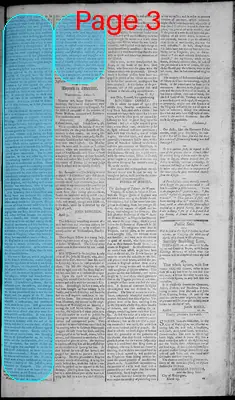
Editorial
April 6, 1803
Alexandria Advertiser And Commercial Intelligencer
Alexandria, Virginia
What is this article about?
This editorial criticizes Republican opposition to Federalist policies, including the funding system, protective duties on shipping favoring Northern commerce, and Washington's neutrality amid the French Revolution. It praises Federal measures and condemns pro-French influences from figures like Jefferson, Madison, and Genet.
Clipping
OCR Quality
80%
Good
Full Text
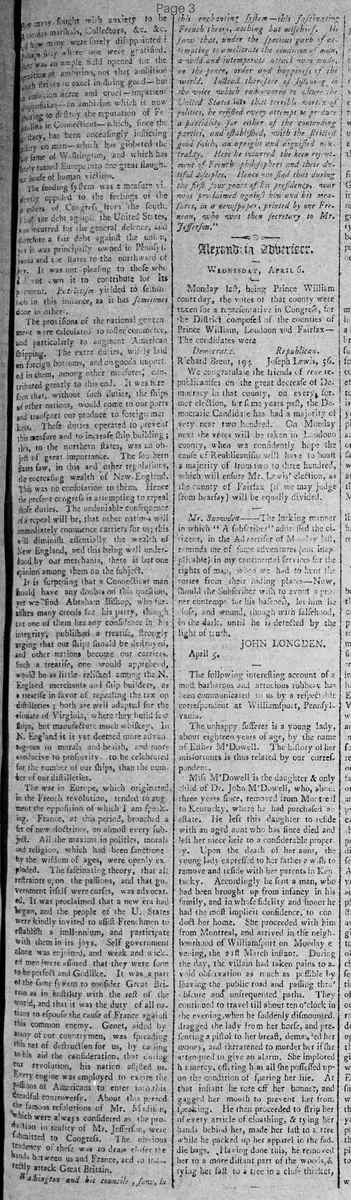
For many bought with anxiety to be perhaps happy, where one were gratified. And how many were sorely disappointed? Courtiers, marshals, Collectors, &c. &c. Here was an ample field opened for the operation of ambition, not that ambition here is fierce and cruel—impatient to excel in doing good—but realists in Connecticut—which, since the flooring to destroy the reputation of Federal opposition—in ambition which is now ever tacitly, has been incessantly inflicting misery on man—which has gibbeted the name of Washington, and which has lately turned Europe into one great slaughter house of human victims.
The funding system was a measure violently opposed to the feelings of the members of Congress from the South. Though the debt against the United States, was incurred for the general defense, and therefore a fair debt against the union, yet it was principally owned in Pennsylvania and the states to the northward of her. It was not pleasing to those who did not own it to contribute to its payment. Patriotism yielded to selfishness in this instance, as it has sometimes done in others.
The provisions of the national government were calculated to foster commerce, and particularly to augment American shipping. The extra duties, wisely laid on foreign bottoms, and on goods imported in them, among other measures, contributed greatly to this end. It was foreseen that, without such duties, the ships of other nations, would come to our ports and transport our produce to foreign markets. These duties operated to prevent this measure and to increase ship building: this, to the northern states, was an object of great importance. The southern states saw, in this and other regulations, the increasing wealth of New-England. This was no consolation to them. Hence the present congress is attempting to repeal those duties. The undeniable consequence of a repeal will be, that other nations will immediately commence carriers for us: this will diminish essentially the wealth of New England, and this being well understood by our merchants, there is but one opinion among them on the subject.
It is surprising that a Connecticut man should have any doubts on this question, yet we find Abraham Bishop, who supplies many creeds for his party, though not one of them has any confidence in his integrity, published a treatise, strongly urging that our ships should be destroyed, and other nations become our carriers. Such a treatise, one would apprehend, would be as little relished among the New England merchants and ship builders, as a treatise in favor of repealing the tax on distilleries; both are well adapted for the climate of Virginia, where they build few ships, but manufacture much whiskey. In New England it is yet deemed more advantageous to morals and health, and more conducive to prosperity, to be celebrated for the number of our ships, than the number of our distilleries.
The war in Europe, which originated in the French revolution, tended to augment the opposition of which I am speaking. France, at this period, broached a set of new doctrines, on almost every subject. All the maxims in politics, morals and religion, which had been sanctioned by the wisdom of ages, were openly exploded. The fascinating theory, that all restraints upon the passions, and that government itself were curses, was advocated. It was proclaimed that a new era had begun, and the people of the U. States were kindly invited to act Frenchmen to establish a millennium, and participate with them in its joys. Self government alone was enjoined, and weak and wicked men were assured that they were soon to be perfect and Godlike.
It was a part of the same system to consider Great Britain as in hostility with the rest of the world, and that it was the duty of all nations to espouse the cause of France against this common enemy. Genet, aided by many of our countrymen, was spreading this net of destruction for us, by calling to his aid the consideration, that during our revolution, his nation aided us. Every engine was employed to excite the passions of Americans to enter into this dreadful controversy.
About this period the famous resolutions of Mr. Madison, which were always considered as the production in reality of Mr. Jefferson, were submitted to Congress. The obvious tendency of these was to draw closer the bands between us and France, and to indirectly attack Great Britain.
Washington and his councils, saw, in this enchanting system—this fascinating French theory, nothing but mischief. He saw that, under the specious garb of attempting to ameliorate the condition of man, a wild and intemperate attack was made, on the peace, order and happiness of the world. Instead therefore of listening to the voice which endeavored to allure the United States into that terrible vortex of politics, he resisted every attempt to produce a partiality for either of the contending parties, and established, with the strictest good faith, an upright and dignified neutrality. Here he incurred the keen resentment of French philosophers and their misguided disciples. Hence we find that during the first four years of his presidency, war was proclaimed against him and his measures, in a newspaper, printed by one Frenchman, who was then secretary to Mr. Jefferson.
The funding system was a measure violently opposed to the feelings of the members of Congress from the South. Though the debt against the United States, was incurred for the general defense, and therefore a fair debt against the union, yet it was principally owned in Pennsylvania and the states to the northward of her. It was not pleasing to those who did not own it to contribute to its payment. Patriotism yielded to selfishness in this instance, as it has sometimes done in others.
The provisions of the national government were calculated to foster commerce, and particularly to augment American shipping. The extra duties, wisely laid on foreign bottoms, and on goods imported in them, among other measures, contributed greatly to this end. It was foreseen that, without such duties, the ships of other nations, would come to our ports and transport our produce to foreign markets. These duties operated to prevent this measure and to increase ship building: this, to the northern states, was an object of great importance. The southern states saw, in this and other regulations, the increasing wealth of New-England. This was no consolation to them. Hence the present congress is attempting to repeal those duties. The undeniable consequence of a repeal will be, that other nations will immediately commence carriers for us: this will diminish essentially the wealth of New England, and this being well understood by our merchants, there is but one opinion among them on the subject.
It is surprising that a Connecticut man should have any doubts on this question, yet we find Abraham Bishop, who supplies many creeds for his party, though not one of them has any confidence in his integrity, published a treatise, strongly urging that our ships should be destroyed, and other nations become our carriers. Such a treatise, one would apprehend, would be as little relished among the New England merchants and ship builders, as a treatise in favor of repealing the tax on distilleries; both are well adapted for the climate of Virginia, where they build few ships, but manufacture much whiskey. In New England it is yet deemed more advantageous to morals and health, and more conducive to prosperity, to be celebrated for the number of our ships, than the number of our distilleries.
The war in Europe, which originated in the French revolution, tended to augment the opposition of which I am speaking. France, at this period, broached a set of new doctrines, on almost every subject. All the maxims in politics, morals and religion, which had been sanctioned by the wisdom of ages, were openly exploded. The fascinating theory, that all restraints upon the passions, and that government itself were curses, was advocated. It was proclaimed that a new era had begun, and the people of the U. States were kindly invited to act Frenchmen to establish a millennium, and participate with them in its joys. Self government alone was enjoined, and weak and wicked men were assured that they were soon to be perfect and Godlike.
It was a part of the same system to consider Great Britain as in hostility with the rest of the world, and that it was the duty of all nations to espouse the cause of France against this common enemy. Genet, aided by many of our countrymen, was spreading this net of destruction for us, by calling to his aid the consideration, that during our revolution, his nation aided us. Every engine was employed to excite the passions of Americans to enter into this dreadful controversy.
About this period the famous resolutions of Mr. Madison, which were always considered as the production in reality of Mr. Jefferson, were submitted to Congress. The obvious tendency of these was to draw closer the bands between us and France, and to indirectly attack Great Britain.
Washington and his councils, saw, in this enchanting system—this fascinating French theory, nothing but mischief. He saw that, under the specious garb of attempting to ameliorate the condition of man, a wild and intemperate attack was made, on the peace, order and happiness of the world. Instead therefore of listening to the voice which endeavored to allure the United States into that terrible vortex of politics, he resisted every attempt to produce a partiality for either of the contending parties, and established, with the strictest good faith, an upright and dignified neutrality. Here he incurred the keen resentment of French philosophers and their misguided disciples. Hence we find that during the first four years of his presidency, war was proclaimed against him and his measures, in a newspaper, printed by one Frenchman, who was then secretary to Mr. Jefferson.
What sub-type of article is it?
Partisan Politics
Economic Policy
Foreign Affairs
What keywords are associated?
Federalist Defense
Republican Opposition
Funding System
Shipping Duties
French Revolution
Washington Neutrality
Economic Sectionalism
Pro French Sentiments
What entities or persons were involved?
Washington
Jefferson
Madison
Abraham Bishop
Genet
France
Great Britain
New England
Southern States
Connecticut
Editorial Details
Primary Topic
Critique Of Republican Opposition To Federalist Economic And Foreign Policies
Stance / Tone
Pro Federalist And Pro Washington Neutrality, Anti Jeffersonian And Anti Pro French
Key Figures
Washington
Jefferson
Madison
Abraham Bishop
Genet
France
Great Britain
New England
Southern States
Connecticut
Key Arguments
Ambition In Opposition Inflicts Misery And Attacks Washington's Reputation.
Southern Opposition To Funding System Stemmed From Selfishness As Debt Was Mostly Northern Owned.
Protective Duties On Foreign Shipping Boosted American Commerce And Northern Shipbuilding, Opposed By South.
Repealing Duties Would Harm New England Economy By Making Foreign Nations Our Carriers.
Abraham Bishop's Treatise Advocating Destruction Of American Ships Is Unpalatable In New England.
French Revolution Doctrines Promoted Dangerous Ideas Of Unrestrained Passions And Anti British Alliance.
Madison's Resolutions, Influenced By Jefferson, Aimed To Align Us With France Against Britain.
Washington Wisely Maintained Neutrality, Resisting Pro French Allurements Despite Opposition.