Thank you for visiting SNEWPapers!
Sign up free
Story
June 2, 1888
The Grenada Sentinel
Grenada, Grenada County, Mississippi
What is this article about?
An English critique in The Lancet of an American dental theory claiming universal vegetarianism would cause jaw atrophy and tooth loss over generations, countering with evidence from vegetarian races, ancient mummies, and advances in dental care.
Clipping
OCR Quality
98%
Excellent
Full Text
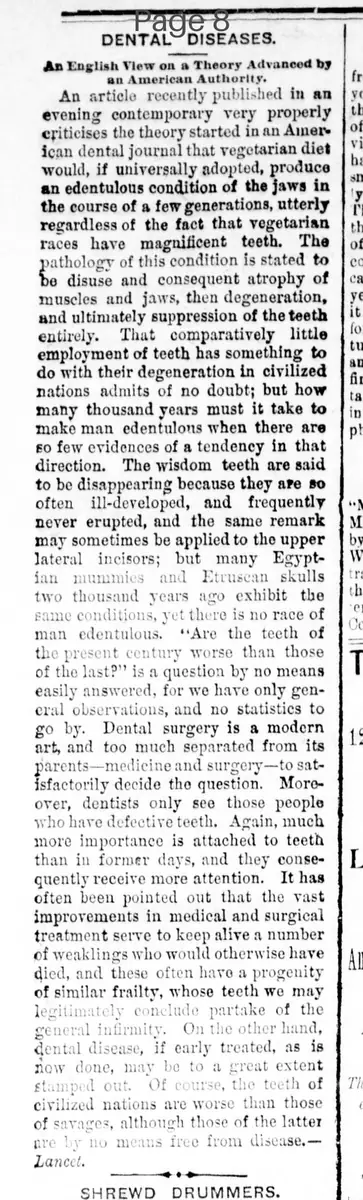
DENTAL DISEASES.
An English View on a Theory Advanced by an American Authority.
An article recently published in an evening contemporary very properly criticises the theory started in an American dental journal that vegetarian diet would, if universally adopted, produce an edentulous condition of the jaws in the course of a few generations, utterly regardless of the fact that vegetarian races have magnificent teeth. The pathology of this condition is stated to be disuse and consequent atrophy of muscles and jaws, then degeneration, and ultimately suppression of the teeth entirely. That comparatively little employment of teeth has something to do with their degeneration in civilized nations admits of no doubt; but how many thousand years must it take to make man edentulous when there are so few evidences of a tendency in that direction. The wisdom teeth are said to be disappearing because they are so often ill-developed, and frequently never erupted, and the same remark may sometimes be applied to the upper lateral incisors; but many Egyptian mummies and Etruscan skulls two thousand years ago exhibit the same conditions, yet there is no race of man edentulous. Are the teeth of the present century worse than those of the last? is a question by no means easily answered, for we have only general observations, and no statistics to go by. Dental surgery is a modern art, and too much separated from its parents—medicine and surgery—to satisfactorily decide the question. Moreover, dentists only see those people who have defective teeth. Again, much more importance is attached to teeth than in former days, and they consequently receive more attention. It has often been pointed out that the vast improvements in medical and surgical treatment serve to keep alive a number of weaklings who would otherwise have died, and these often have a progeny of similar frailty, whose teeth we may legitimately conclude partake of the general infirmity. On the other hand, dental disease, if early treated, as is now done, may be to a great extent stamped out. Of course, the teeth of civilized nations are worse than those of savages, although those of the latter are by no means free from disease.
— Lancet.
An English View on a Theory Advanced by an American Authority.
An article recently published in an evening contemporary very properly criticises the theory started in an American dental journal that vegetarian diet would, if universally adopted, produce an edentulous condition of the jaws in the course of a few generations, utterly regardless of the fact that vegetarian races have magnificent teeth. The pathology of this condition is stated to be disuse and consequent atrophy of muscles and jaws, then degeneration, and ultimately suppression of the teeth entirely. That comparatively little employment of teeth has something to do with their degeneration in civilized nations admits of no doubt; but how many thousand years must it take to make man edentulous when there are so few evidences of a tendency in that direction. The wisdom teeth are said to be disappearing because they are so often ill-developed, and frequently never erupted, and the same remark may sometimes be applied to the upper lateral incisors; but many Egyptian mummies and Etruscan skulls two thousand years ago exhibit the same conditions, yet there is no race of man edentulous. Are the teeth of the present century worse than those of the last? is a question by no means easily answered, for we have only general observations, and no statistics to go by. Dental surgery is a modern art, and too much separated from its parents—medicine and surgery—to satisfactorily decide the question. Moreover, dentists only see those people who have defective teeth. Again, much more importance is attached to teeth than in former days, and they consequently receive more attention. It has often been pointed out that the vast improvements in medical and surgical treatment serve to keep alive a number of weaklings who would otherwise have died, and these often have a progeny of similar frailty, whose teeth we may legitimately conclude partake of the general infirmity. On the other hand, dental disease, if early treated, as is now done, may be to a great extent stamped out. Of course, the teeth of civilized nations are worse than those of savages, although those of the latter are by no means free from disease.
— Lancet.
What sub-type of article is it?
Medical Curiosity
Curiosity
What themes does it cover?
Misfortune
Recovery
What keywords are associated?
Dental Diseases
Vegetarian Diet
Tooth Degeneration
Medical Theory
Edentulous Condition
Story Details
Story Details
Critique of American theory that vegetarian diet leads to toothless jaws via disuse atrophy; argues against it citing vegetarian races' good teeth, ancient examples, and modern treatments improving outcomes despite civilized decline.