Thank you for visiting SNEWPapers!
Sign up free
The Times
Washington, District Of Columbia
What is this article about?
An editorial on US foreign commerce at the close of the 19th century, analyzing export imbalances toward Europe, growth surpassing Britain, key inventions like steamships and railways, and the need for the Fifty-sixth Congress to build trade with Asia and Latin America while developing a merchant marine.
Clipping
OCR Quality
Full Text
No parliamentary body in this or any other country, ancient or modern, ever had before it questions of such far-reaching and world-wide importance as those the Fifty-sixth Congress will have for consideration. It has a rare opportunity to contribute to American history a record of practical and constructive statesmanship of the broadest and highest order—a record that will leave its imprint upon the history of civilization.
It is, therefore, an appropriate time to invite attention to a few facts relating to the defects in our foreign commerce, and its requirements for the coming century.
As there is no better way to judge the future than by the past, a brief review of some peculiarities and defects of the foreign commerce of the closing century may be useful.
19th Century Commerce.
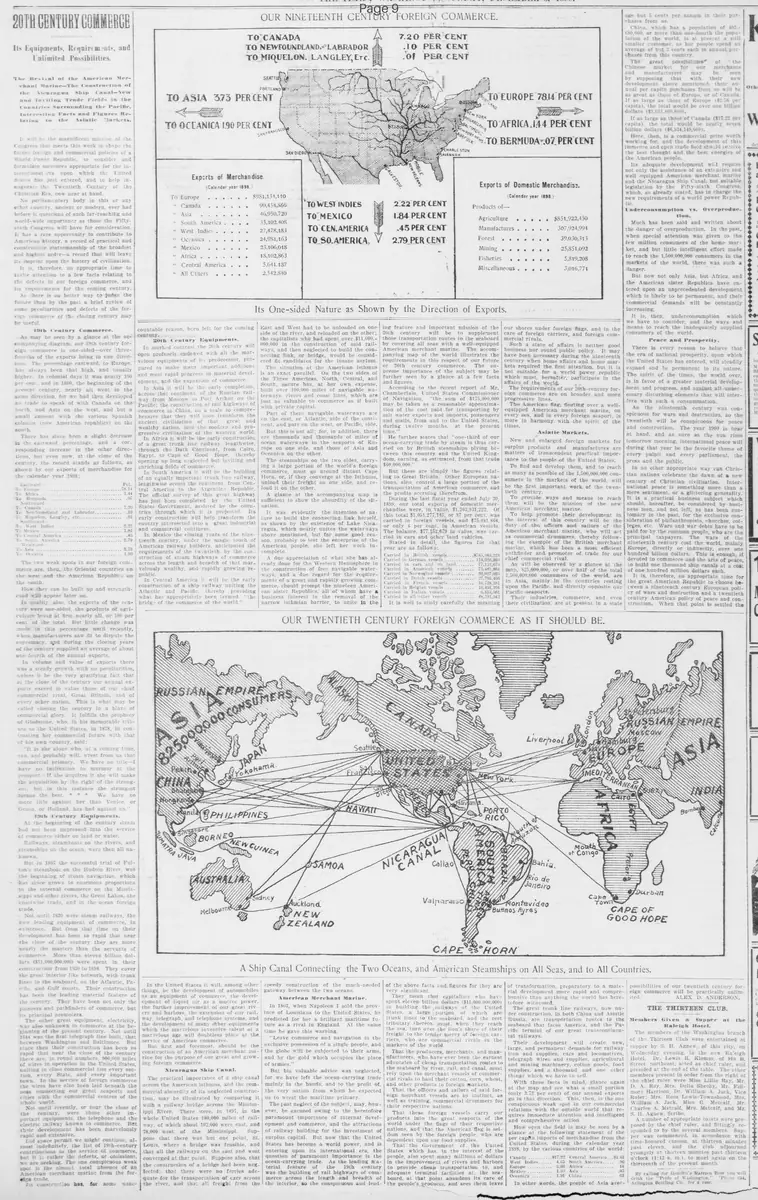
As may be seen by a glance at the accompanying diagram, our 19th century foreign commerce is one-sided—over three-fourths of the exports being in one direction. The percentage eastward, to Europe, has always been that high, and usually higher. In colonial days it was nearly 100 per cent and in 1800, the beginning of the present century, nearly all went in the same direction for we had then developed no trade to speak of with Canada on the north and Asia on the west, and but a small amount with the various Spanish colonies (now American republics) on the south.
There has since been a slight decrease in the eastward percentage, and a corresponding increase in the other directions but even now, at the close of the century, the record stands as follows, as shown by our exports of merchandise for the calendar year 1898:
Eastward
Pct.
To Europe 78.11
To Africa 1.44
To Bermuda .00
Northward
To Canada 7.20
To Newfoundland and Labrador .10
To St. Michaels, Langley, etc .01
Southward
To West Indies 2.22
To Mexico 1.84
To Central America .45
To South America 2.79
Westward
To Asia 3.73
To Australia 1.90
The two weak spots in our foreign commerce are, then, the Oriental countries on the west and the American Republics on the south. How they can be built up and strengthened will appear later on.
In quality, also the exports of the century were one-sided the products of agriculture being at first nearly all, or 100 per cent of the total. But little change was made in this percentage until recently, when manufacturers saw fit to dispute the supremacy, and during the closing years of the century supplied an average of about one fourth of the annual exports.
In volume and value of exports there was a steady growth with no peculiarities, unless it be the very gratifying fact that at the close of the century our annual exports exceed in value those of our chief commercial rival, Great Britain, and of every other nation. This is what may be called closing the century in a blaze of commercial glory. It fulfils the prophecy of Gladstone, who in his memorable tribute to the United States, in 1878, in contrasting her commercial future with that of his own country, said:
"It is she alone who at a coming time, can and probably will wrest from us that commercial primacy. We have no title—I have no inclination to murmur at the prospect. If she acquires it she will make the acquisition by the right of the strongest: but in this instance the strongest means the best."
"We have no more cause to complain of her than Venice or Genoa, or Holland, has had against us."
19th Century Equipments.
At the beginning of the century steam had not been impressed into the service of commerce either on land or water. Railways, steamboats on the rivers, and steamships on the ocean, were then all unknown.
But in 1807 the successful trial of Fulton's steamboat on the Hudson River, was the beginning of steam navigation, which has since grown to enormous proportions in the internal commerce on the Mississippi and other rivers, the Great Lakes, the coastwise trade, and in the ocean foreign trade.
Not until 1830 were steam railways, the now leading equipment of commerce, in existence. But from that time on their development has been so rapid that near the close of the century they are more nearly the masters than the servants of commerce More than eleven billion dollars ($11,000,000,000) were spent in their construction from 1830 to 1898. They cover the great interior like a network, with trunk lines to the seaboard, on the Atlantic, Pacific and Gulf coasts. Their construction has been the leading material feature of the century. They have been not only the pioneers and pathfinders of commerce, but its principal promoters.
The other great equipment, electricity, was also unknown to commerce at the beginning of the present century. Not until 1844 was the first telegraph line built, that between Washington and Baltimore. But since then their construction has been so rapid that near the close of the century there are, in round numbers, 900,000 miles of wires in operation in the United States, uniting in close commercial ties every section, every State, and every important town. In the service of foreign commerce the wires have also been laid beneath the seas connecting our great seaports and cities with the commercial centres of the whole world.
Not until recently, or near the close of the century, were those other important equipments, the telephone and the electric railway known to commerce. But their development has been marvelously rapid and extensive.
Did space permit we might continue, almost indefinitely, the list of 19th-century contributions to the service of commerce, but it is rather the defects, or omissions, we are seeking. The one conspicuous weak spot is the almost total absence of an American merchant marine from the foreign trade.
Its construction has, for some unaccountable reason, been left for the coming century.
What sub-type of article is it?
What themes does it cover?
What keywords are associated?
What entities or persons were involved?
Where did it happen?
Story Details
Key Persons
Location
United States
Event Date
1898
Story Details
The article reviews the one-sided nature of 19th-century US foreign commerce, dominated by exports to Europe, with weaknesses in trade to Asia and South American republics. It highlights growth in exports surpassing Britain, technological advancements like steam and railways, but notes the lack of an American merchant marine. The Fifty-sixth Congress is urged to address these for the 20th century.