Thank you for visiting SNEWPapers!
Sign up free
The National Era
Washington, District Of Columbia
What is this article about?
A correspondent praises East Florida's mild climate, particularly St. Augustine, for alleviating pulmonary complaints in northern invalids. Describes low living costs, abundant food, health benefits observed in over 160 patients, and practical advice for winter residence to extend life.
Clipping
OCR Quality
Full Text
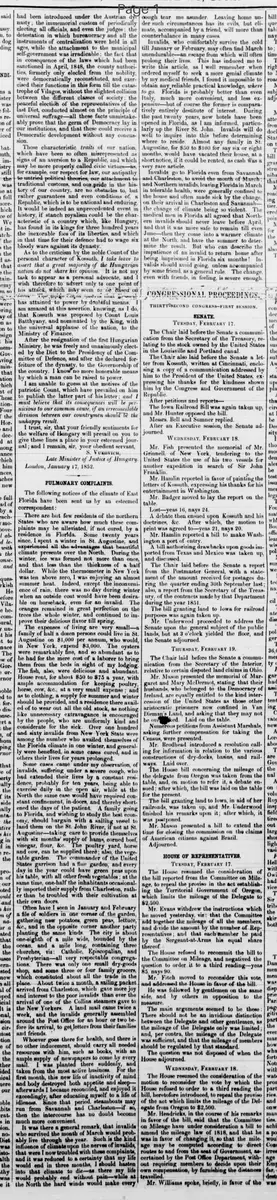
The following notices of the climate of East Florida have been sent us by an esteemed correspondent:
There are but few residents of the northern States who are aware how much these complaints may be alleviated, if not cured, by a residence in Florida. Some twenty years since, I spent a winter in St. Augustine, and experienced all the advantages that beautiful climate presents over the North. During the winter, ice was formed not more than once, and that less than the thickness of a half dollar. While the thermometer in New York was ten above zero, I was enjoying an almost summer heat. Indeed, except the inconvenience of rain, there was no day during winter when an outside coat would have been desirable on horseback, even for an invalid. The oranges remained in great perfection on the trees the whole winter, and continued to improve their delicious flavor till spring.
The expenses of living are very small—a family of half a dozen persons could live in St. Augustine on $1,000 per annum, who would, in New York, expend $3,000. The oysters were remarkably fine, and so abundant as to be had for the mere cost of a laborer to bring them from the beds in sight of my lodging. The fish, also, were delicious and abundant. House rent, for about $50 to $75 a year, with ample accommodation for keeping poultry, horse, cow, &c., at a very small expense; and as to clothing, a supply for summer and winter should be provided, and a residence there availed of to wear out all the old stock, as nothing like unnecessary extravagance is encouraged by the people, who are uniformly kind and considerate for the sick. Over one hundred and sixty invalids from New York State were among the number who availed themselves of the Florida climate in one winter, and generally were benefited, in some cases cured, and in others their lives for years prolonged.
Some cases came under my observation, of invalids, suffering under a severe cough, who had extended their lives by a constant residence, probably for ten years, being able to exercise daily in the open air, while at the North the same case would have required constant confinement in-doors, and thereby shortened the days of the patient. A family going to Florida, and wishing to study the best economy, should bargain with a sailing vessel to land them on the St. John River, if not at St. Augustine—taking care to provide themselves with six months' supply of hams, corned beef, vinegar, flour, &c. The poultry yard, horse and cow, can be supplied there; also, the vegetable garden. The commander of the United States garrison had a fine garden, and every day in the year could have green peas upon his table, with all other fresh vegetables: at the same time, one-half the inhabitants occasionally imported their supply from Charleston, rather than be troubled with their cultivation at their own doors.
Often have I seen in January and February a file of soldiers in one corner of the garden, gathering new potatoes, green peas, lettuce, &c., and in the opposite corner another party planting the same kinds. The city is about one-eighth of a mile wide, bounded by the ocean, and a mile long, containing three churches, viz: Catholic, Episcopalian, and Presbyterian—all very respectable congregations. There was only one small dry-goods shop, and some three or four family grocers, which constituted about all the trade in the place. About twice a month, a sailing packet arrived from Charleston, which gave more joy and interest to the poor invalids than ever the arrival of one of the Collins steamers gave to the New Yorkers. A land mail came twice a week, and the invalids generally assembled around the Post Office for an hour or two before its arrival, to get letters from their families and friends.
Whoever goes there for health, and there is no other inducement, should carry all needed resources with him, such as books, with an ample supply of newspapers to come by every mail. I was planted there suddenly, and taken from the most active business. For the first month, this new life of inactivity of mind and body destroyed both appetite and sleep—afterwards I became reconciled, and enjoyed it exceedingly, after educating myself to a life of idleness. Since that period, steamboats may run from Savannah and Charleston—if so, then the intercourse has no doubt become much more convenient.
It was there a general remark, that invalids who survived the month of March would probably live through the year. Such is the kind influence of climate upon the nerves of invalids, that were I now troubled with these complaints, and it was reduced to a certainty that my life would end in three months, I should hasten into that climate to die—as there my life would probably end without pain—while at the North the hard winds would make every cough tear me asunder. Leaving home under such circumstances has its evils, but climate, accompanied by a friend, will more than counterbalance in many cases.
Invalids, who comfortably survive the cold till January or February, may often find March unendurable—an escape from which will often prolong their lives. This has induced me to write this article, as I well remember when ordered myself to seek a more genial climate by my medical friends. I found it impossible to obtain any reliable practical knowledge, where to go. Florida is probably better than even Italy, much more convenient, and less expensive—but of course the former is comparatively entirely destitute of interest. During the past twenty years, new hotels have been opened in Florida, as I am informed, particularly up the River St. John. Invalids will do well to inquire into this before determining where to reside. Almost any family in St. Augustine, for $50 to $100 for say six or eight months, would have vacated their house, at a short notice, if it could be rented, as cash was a very rare article.
Invalids go to Florida even from Savannah and Charleston, to avoid the month of March; and Northern invalids, leaving Florida in March in tolerable health, were generally confined to the house and often made sick by the change, on their arrival in Charleston and Savannah—the change of climate being so violent. The medical men in Florida all agreed that Northern invalids should never leave before April, and that it was more safe to remain till even June—then they come into a warmer climate at the North, and have the summer to determine the result. But who can describe the impatience of an invalid to return home after being imprisoned in Florida six months! Invalids should avoid going, unless accompanied by some friend, as a general rule. The change, even with friends, in feeling, is severe enough.
What sub-type of article is it?
What keywords are associated?
Where did it happen?
Domestic News Details
Primary Location
St. Augustine, East Florida
Outcome
over 160 invalids from new york benefited, some cured, others' lives prolonged by years; invalids surviving march likely to live through the year.
Event Details
Correspondent recounts personal experience and observations of Florida's winter climate aiding pulmonary sufferers: minimal ice, summer-like warmth, low living expenses ($1,000/year for family vs. $3,000 in New York), abundant oysters and fish, affordable housing; advises bringing supplies, staying until April or June; notes new hotels up St. John River.