Thank you for visiting SNEWPapers!
Sign up free
Shepherdstown Register
Shepherdstown, Jefferson County, West Virginia
What is this article about?
Article discusses poor farming practice of leaving manure heaps exposed in fields during fall or winter, especially in dry weather, leading to loss of gases. Recommends large compact heaps covered with soil or storing under cover until spring spreading.
Clipping
OCR Quality
Full Text
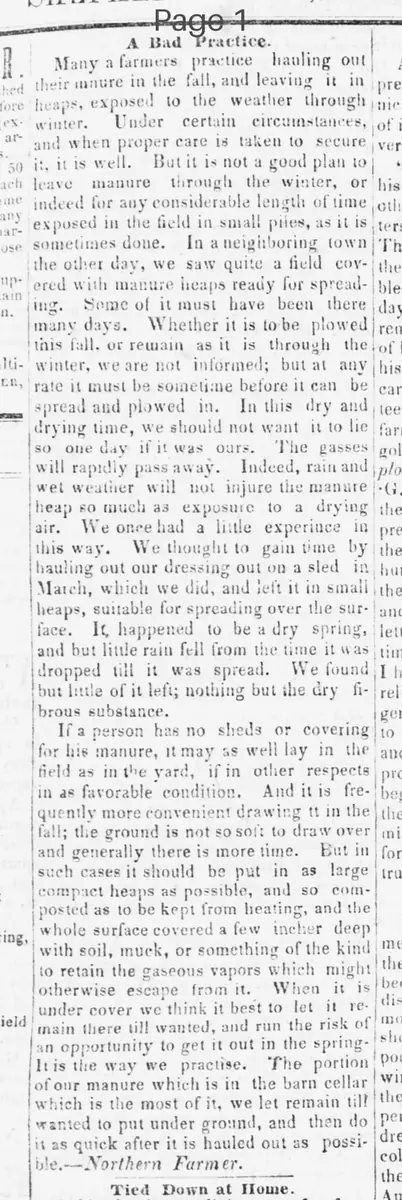
Many a farmer's practice hauling out their manure in the fall, and leaving it in heaps, exposed to the weather through winter. Under certain circumstances, and when proper care is taken to secure it, it is well. But it is not a good plan to leave manure through the winter, or indeed for any considerable length of time exposed in the field in small piles, as it is sometimes done. In a neighboring town the other day, we saw quite a field covered with manure heaps ready for spreading. Some of it must have been there many days. Whether it is to be plowed this fall, or remain as it is through the winter, we are not informed; but at any rate it must be sometime before it can be spread and plowed in. In this dry and drying time, we should not want it to lie so one day if it was ours. The gasses will rapidly pass away. Indeed, rain and wet weather will not injure the manure heap so much as exposure to a drying air. We once had a little experience in this way. We thought to gain time by hauling out our dressing out on a sled in March, which we did, and left it in small heaps, suitable for spreading over the surface. It happened to be a dry spring, and but little rain fell from the time it was dropped till it was spread. We found but little of it left; nothing but the dry fibrous substance.
If a person has no sheds or covering for his manure, it may as well lay in the field as in the yard, if in other respects in as favorable condition. And it is frequently more convenient drawing it in the fall; the ground is not so soft to draw over and generally there is more time. But in such cases it should be put in as large compact heaps as possible, and so composed as to be kept from heating, and the whole surface covered a few inches deep with soil, muck, or something of the kind to retain the gaseous vapors which might otherwise escape from it. When it is under cover we think it best to let it remain there till wanted, and run the risk of an opportunity to get it out in the spring—It is the way we practice. The portion of our manure which is in the barn cellar which is the most of it, we let remain till wanted to put under ground, and then do it as quick after it is hauled out as possible.—Northern Farmer.
What sub-type of article is it?
What keywords are associated?
Domestic News Details
Event Details
Many farmers haul manure out in fall and leave in exposed heaps through winter, which is not advisable especially in small piles or dry weather as gases escape rapidly. Observed field in neighboring town with heaps left for days. Personal experience in dry March spring showed most manure lost to drying. Recommend large compact heaps covered with soil if no cover available, or store under cover until spring.