Thank you for visiting SNEWPapers!
Sign up free
The Daily Sentinel
Grand Junction, Mesa County, Colorado
What is this article about?
E. R. Bennett of Colorado Experiment Station reports on Fusarium fungus causing potato rot in fields and storage, affecting up to 90% of seed; no direct remedy, prevention via crop rotation, whole seed, and good ventilation. (198 characters)
Clipping
OCR Quality
Full Text
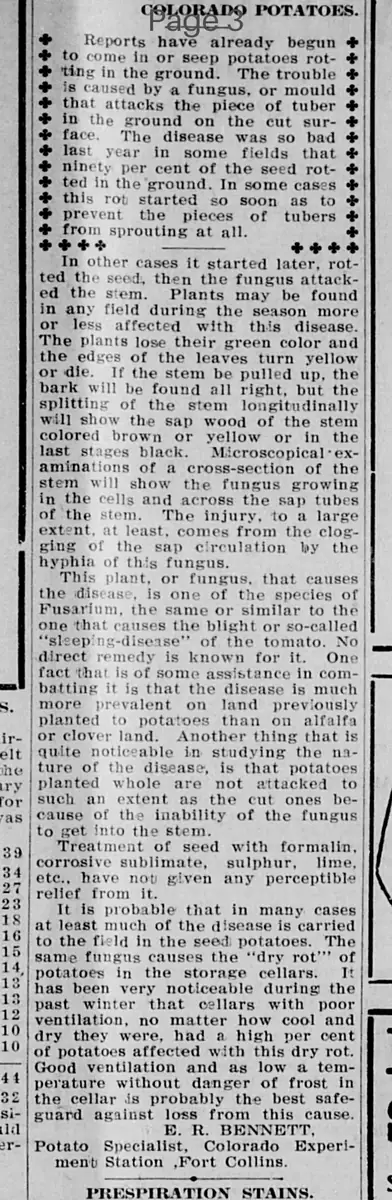
to come in of seed potatoes rotting
in the ground. The trouble
is caused by a fungus, or mould
that attacks the piece of the tuber
in the ground on the cut surface.
The disease was so bad
last year in some fields that
ninety per cent of the seed rotted
in the ground. In some cases
this rot started so soon as to
prevent the pieces of tubers
from sprouting at all.
In other cases it started later, rotted
the seed, then the fungus attacked
the stem. Plants may be found
in any field during the season more
or less affected with this disease.
The plants lose their green color and
the edges of the leaves turn yellow
or die. If the stem be pulled up, the
bark will be found all right, but the
splitting of the stem longitudinally
will show the sap wood of the stem
colored brown or yellow or in the
last stages black. Microscopical examinations
of a cross-section of the stem will show the fungus
growing in the cells and across the sap tubes
of the stem. The injury, to a large
extent, at least, comes from the clogging
of the sap circulation by the hyphia of this fungus.
This plant, or fungus, that causes
the disease, is one of the species of
Fusarium, the same or similar to the
one that causes the blight or so-called
"sleeping-disease" of the tomato. No
direct remedy is known for it. One
fact that is of some assistance in combating
it is that the disease is much
more prevalent on land previously
planted to potatoes than on alfalfa
or clover land. Another thing that is
quite noticeable in studying the nature
of the disease, is that potatoes
planted whole are not attacked to
such an extent as the cut ones because
of the inability of the fungus
to get into the stem.
Treatment of seed with formalin,
corrosive sublimate, sulphur, lime,
etc., have not given any perceptible
relief from it.
It is probable that in many cases
at least much of the disease is carried
to the field in the seed potatoes. The
same fungus causes the "dry rot" of
potatoes in the storage cellars. It
has been very noticeable during the
past winter that cellars with poor
ventilation, no matter how cool and
dry they were, had a high per cent
of potatoes affected with this dry rot.
Good ventilation and as low a temperature
without danger of frost in
the cellar is probably the best safeguard
against loss from this cause.
E. R. BENNETT.
Potato Specialist, Colorado Experiment
Station Fort Collins.
What sub-type of article is it?
What keywords are associated?
What entities or persons were involved?
Where did it happen?
Domestic News Details
Primary Location
Fort Collins, Colorado
Key Persons
Outcome
up to ninety per cent of seed potatoes rotted in the ground in some fields last year; plants lose green color, leaves turn yellow or die; stem sap wood colored brown, yellow, or black; no direct remedy known; disease less prevalent on alfalfa or clover land; whole potatoes less affected than cut ones; treatments with formalin, corrosive sublimate, sulphur, lime ineffective; disease carried in seed potatoes; dry rot in poorly ventilated storage cellars.
Event Details
Reports of seed potatoes rotting in the ground due to a Fusarium fungus attacking the cut surface of tubers. Disease prevented sprouting in some cases and later rotted seed and attacked stems. Plants affected show loss of green color, yellowing or dying leaf edges, and discolored or blackened stem sap wood from fungus clogging sap circulation. Similar to tomato blight. Less prevalent on non-potato previous crops; whole potatoes less susceptible. No effective chemical treatments. Disease also causes dry rot in storage, worsened by poor ventilation.