Thank you for visiting SNEWPapers!
Sign up free
Editorial
September 30, 1904
The Herald Advance
Milbank, Grant County, South Dakota
What is this article about?
Editorial analogizes a lawsuit against a restaurant for false food promises to the Democratic Party's unfulfilled economic pledges in 1892, blaming them for the 1893-1897 depression via low tariffs, contrasting with Republican prosperity, and warns against electing Parker in 1904.
Clipping
OCR Quality
98%
Excellent
Full Text
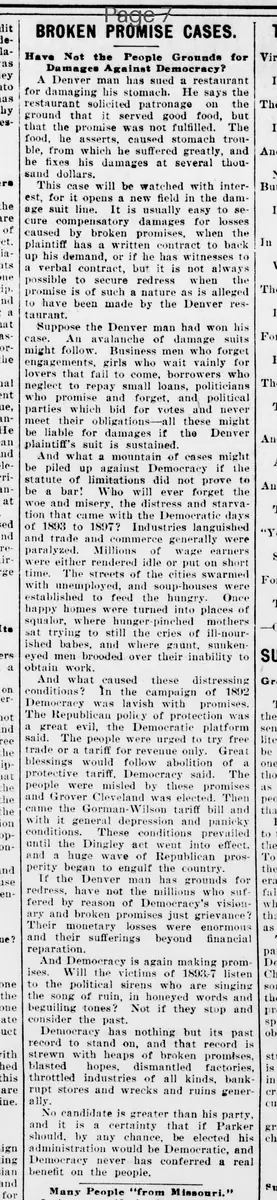
BROKEN PROMISE CASES.
Have Not the People Grounds for Damages Against Democracy?
A Denver man has sued a restaurant for damaging his stomach. He says the restaurant solicited patronage on the ground that it served good food, but that the promise was not fulfilled. The food, he asserts, caused stomach trouble, from which he suffered greatly, and he fixes his damages at several thousand dollars. This case will be watched with interest, for it opens a new field in the damage suit line. It is usually easy to secure compensatory damages for losses caused by broken promises, when the plaintiff has a written contract to back up his demand, or if he has witnesses to a verbal contract, but it is not always possible to secure redress when the promise is of such a nature as is alleged to have been made by the Denver restaurant. Suppose the Denver man had won his case. An avalanche of damage suits might follow. Business men who forget engagements, girls who wait vainly for lovers that fail to come, borrowers who neglect to repay small loans, politicians who promise and forget, and political parties which bid for votes and never meet their obligations—all these might be liable for damages if the Denver plaintiff's suit is sustained. And what a mountain of cases might be piled up against Democracy if the statute of limitations did not prove to be a bar! Who will ever forget the woe and misery, the distress and starvation that came with the Democratic days of 1893 to 1897? Industries languished and trade and commerce generally were paralyzed. Millions of wage earners were either rendered idle or put on short time. The streets of the cities swarmed with unemployed, and soup-houses were established to feed the hungry. Once happy homes were turned into places of squalor, where hunger-pinched mothers sat trying to still the cries of ill-nourished babes, and where gaunt, sunken-eyed men brooded over their inability to obtain work. And what caused these distressing conditions? In the campaign of 1892 Democracy was lavish with promises. The Republican policy of protection was a great evil, the Democratic platform said. The people were urged to try free trade or a tariff for revenue only. Great blessings would follow abolition of a protective tariff, Democracy said. The people were misled by these promises and Grover Cleveland was elected. Then came the Gorman-Wilson tariff bill and with it general depression and panicky conditions. These conditions prevailed until the Dingley act went into effect, and a huge wave of Republican prosperity began to engulf the country. If the Denver man has grounds for redress, have not the millions who suffered by reason of Democracy's visionary and broken promises just grievance? Their monetary losses were enormous and their sufferings beyond financial reparation. And Democracy is again making promises. Will the victims of 1893-7 listen to the political sirens who are singing the song of ruin, in honeyed words and beguiling tones? Not if they stop and consider the past. Democracy has nothing but its past record to stand on, and that record is strewn with heaps of broken promises, blasted hopes, dismantled factories, throttled industries of all kinds, bankrupt stores and wrecks and ruins generally. No candidate is greater than his party, and it is a certainty that if Parker should, by any chance, be elected his administration would be Democratic, and Democracy never has conferred a real benefit on the people.
Have Not the People Grounds for Damages Against Democracy?
A Denver man has sued a restaurant for damaging his stomach. He says the restaurant solicited patronage on the ground that it served good food, but that the promise was not fulfilled. The food, he asserts, caused stomach trouble, from which he suffered greatly, and he fixes his damages at several thousand dollars. This case will be watched with interest, for it opens a new field in the damage suit line. It is usually easy to secure compensatory damages for losses caused by broken promises, when the plaintiff has a written contract to back up his demand, or if he has witnesses to a verbal contract, but it is not always possible to secure redress when the promise is of such a nature as is alleged to have been made by the Denver restaurant. Suppose the Denver man had won his case. An avalanche of damage suits might follow. Business men who forget engagements, girls who wait vainly for lovers that fail to come, borrowers who neglect to repay small loans, politicians who promise and forget, and political parties which bid for votes and never meet their obligations—all these might be liable for damages if the Denver plaintiff's suit is sustained. And what a mountain of cases might be piled up against Democracy if the statute of limitations did not prove to be a bar! Who will ever forget the woe and misery, the distress and starvation that came with the Democratic days of 1893 to 1897? Industries languished and trade and commerce generally were paralyzed. Millions of wage earners were either rendered idle or put on short time. The streets of the cities swarmed with unemployed, and soup-houses were established to feed the hungry. Once happy homes were turned into places of squalor, where hunger-pinched mothers sat trying to still the cries of ill-nourished babes, and where gaunt, sunken-eyed men brooded over their inability to obtain work. And what caused these distressing conditions? In the campaign of 1892 Democracy was lavish with promises. The Republican policy of protection was a great evil, the Democratic platform said. The people were urged to try free trade or a tariff for revenue only. Great blessings would follow abolition of a protective tariff, Democracy said. The people were misled by these promises and Grover Cleveland was elected. Then came the Gorman-Wilson tariff bill and with it general depression and panicky conditions. These conditions prevailed until the Dingley act went into effect, and a huge wave of Republican prosperity began to engulf the country. If the Denver man has grounds for redress, have not the millions who suffered by reason of Democracy's visionary and broken promises just grievance? Their monetary losses were enormous and their sufferings beyond financial reparation. And Democracy is again making promises. Will the victims of 1893-7 listen to the political sirens who are singing the song of ruin, in honeyed words and beguiling tones? Not if they stop and consider the past. Democracy has nothing but its past record to stand on, and that record is strewn with heaps of broken promises, blasted hopes, dismantled factories, throttled industries of all kinds, bankrupt stores and wrecks and ruins generally. No candidate is greater than his party, and it is a certainty that if Parker should, by any chance, be elected his administration would be Democratic, and Democracy never has conferred a real benefit on the people.
What sub-type of article is it?
Economic Policy
Partisan Politics
What keywords are associated?
Broken Promises
Democratic Party
Tariff Policy
Economic Depression
Protectionism
Gorman Wilson Bill
Dingley Act
What entities or persons were involved?
Democratic Party
Grover Cleveland
Gorman Wilson Tariff Bill
Dingley Act
Parker
Editorial Details
Primary Topic
Criticism Of Democratic Party's Broken Promises On Tariff And Economic Policy
Stance / Tone
Strongly Anti Democratic And Pro Republican Protectionism
Key Figures
Democratic Party
Grover Cleveland
Gorman Wilson Tariff Bill
Dingley Act
Parker
Key Arguments
Democratic Promises Of Free Trade Or Tariff For Revenue Only Led To Economic Depression In 1893 1897
Republican Protectionism Caused Prosperity After Dingley Act
Millions Suffered Unemployment, Hunger, And Distress Due To Democratic Policies
Businesses And Industries Were Ruined Under Democratic Administration
Voters Should Remember Past Democratic Failures And Not Trust Current Promises