Thank you for visiting SNEWPapers!
Sign up free
Editorial
May 11, 1849
The Lancaster Gazette
Lancaster, Fairfield County, Ohio
What is this article about?
Editorial from a Whig county newspaper appealing to readers for subscriptions, prompt payments, and promotion to sustain it as a party organ, contrasting supportive patrons with delinquent ones and urging community involvement.
Clipping
OCR Quality
98%
Excellent
Full Text
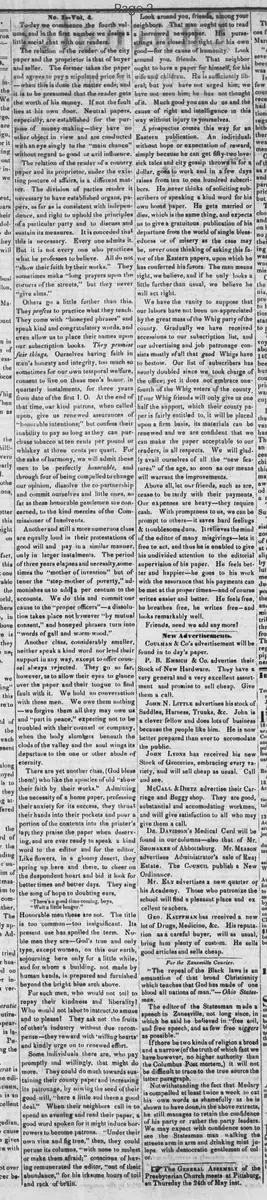
To-day we commence the fourth volume, and in the first number we desire a little social chat with our readers.
The relation of the reader of the city paper and the proprietor is that of buyer and seller. The former takes the paper and agrees to pay a stipulated price for it—when this is done the matter ends; and it is to be presumed that the reader gets the worth of his money. If not the fault lies at his own door. Neutral papers, especially, are established for the purpose of money-making—they have no other object in view and are conducted with an eye singly to the "main chance" without regard to good or evil influence.
The relation of the reader of a country paper and its proprietor, under the existing posture of affairs, is a different matter. The division of parties render it necessary to have established organs, papers, as far as is consistent with independence, and right to uphold the principles of a particular party and to discuss and sustain its measures. It is conceded that this is necessary. Every one admits it. But it is not every one who practices what he professes to believe. All do not "show their faith by their works." They sometimes make "long prayers upon the corners of the streets," but they never "give alms."
Others go a little further than this. They profess to practice what they teach. They come with "honeyed phrases" and speak kind and congratulatory words, and even allow us to place their names upon our subscription books. They promise fair things. Ourselves having faith in men's honesty and integrity, too much so sometimes for our own temporal welfare, consent to live on these men's honor, in quarterly instalments, for three years from date of the first I. O. U. At the end of that time, our kind patrons, when called upon, give us renewed assurances of "honorable intentions;" but confess their inability to pay so long as they can purchase tobacco at ten cents per pound or whiskey at three cents per quart. For the sake of harmony, we will admit these men to be perfectly honorable, and through fear of being compelled to change our opinion, dissolve the co-partnership and commit ourselves and little ones, so far as these honorable gentlemen are concerned, to the kind mercies of the Commissioner of Insolvents.
Another and still a more numerous class are equally loud in their protestations of good will and pay in a similar manner, only in larger instalments. The period of three years elapses and necessity, sometimes the "mother of invention" but oftener the "step-mother of poverty," admonishes us to add a per centum to the accounts. We do this and commit our cause to the "proper officers"—a dissolution takes place not however "by mutual consent," and honeyed phrases turn into "words of gall and wormwood."
Another class, considerably smaller, neither speak a kind word nor lend their support in any way, except to offer counsel always rejected. They go so far, however, as to allow their eyes to glance over the paper and their tongue to find fault with it. We hold no conversation with these men. We owe them nothing—we forgive them all they may owe us and "part in peace," expecting not to be troubled with their counselor company, when the body slumbers beneath the clods of the valley and the soul wings its departure to the one or other abode of eternity.
There are yet another class. (God bless them!) who like the apostles of old "show their faith by their works." Admitting the necessity of a home paper, professing their anxiety for its success, they thrust their hands into their pockets and pour a portion of the contents into the printer's lap; they praise the paper when deserving, and are ever ready to speak a kind word to the editor and for the editor. Like flowers, in a gloomy desert, they spring up here and there, to cheer on the despondent heart and bid it look for better times and better days. They sing the song of hope to doubting ears, "There's a good time coming, boys, "Wait a little longer."
Honorable men these are not. The title is too common—too insignificant. Its present use has spoiled the term. Noble men they are—God's true and only type, except women, on this our earth, sojourning here only for a little while, and for whom a building, not made by human hands, is prepared and furnished beyond the bright blue arch above.
For such men, who would not toil to repay their kindness and liberality? Who would not labor to instruct, to amuse and to please? They ask not the fruits of other's industry without due recompense—they reward with 'willing hearts' and kindly urge on to renewed effort.
Some individuals there are, who pay promptly and willingly, that might do more. They could do much towards sustaining their county paper and increasing its patronage, by sowing the seed of their good-will, "here a little and there a good deal." When their neighbors call in to spend an evening and read their paper, a good word spoken for it might induce borrowers to become patrons. "Under their own vine and fig tree," then, they could peruse its columns, "with none to molest or make them afraid;" conscious of having remunerated the editor, "out of their abundance," for his irksome hours of toil and rack of-brain.
Look around you, friends, among your neighbors. That man ought not to read a borrowed newspaper. His purse-strings are closed too tight for his own good—for the cause of humanity. Look around you, friends. That neighbor ought to have a paper for himself, for his wife and children. He is sufficiently liberal; but you have not urged him; we have not seen him; he has not thought of it. Much good you can do us and the cause of right and intelligence in this way without injury to yourselves.
A prospectus comes this way for an Eastern publication. An individual, without hope or expectation of reward, simply because he can get fifty-two love-sick tales and city gossip thrown in for a dollar, goes to work and in a few days raises from ten to one hundred subscribers. He never thinks of soliciting subscribers or speaking a kind word for his own home paper. He gets married or dies, which is the same thing, and expects us to give a gratuitous publication of his departure from the world of single blessedness or of misery as the case may be, never once thinking of asking this favor of the Eastern papers, upon which he has conferred his favors. The man means right, we believe, and if he only looks a little further than usual, we believe he will act right.
We have the vanity to suppose that our labors have not been un-appreciated by the great mass of the Whig party of the county. Gradually we have received accessions to our subscription list, and our advertising and job patronage consists mostly of all that good Whigs have to bestow. Our list of subscribers has nearly doubled since we took charge of the office; yet it does not embrace one-fourth of the Whig voters of the county. If our Whig friends will only give us one half the support, which their county paper is fairly entitled to, it will be placed upon a firm basis, its materials can be renewed and we are confident that we can make the paper acceptable to our readers, in all respects. We will gladly avail ourselves of all the "new features" of the age, so soon as our means will warrant the improvements.
Above all, let our friends, such as are, cease to be tardy with their payments. Our expenses are heavy—they require cash. With promptness to us, we can be prompt to others—it saves hard feelings and troublesome duns. It relieves the mind of the editor of many misgivings—lets it free to act, and thus he is enabled to give his undivided attention to the editorial supervision of his paper. He feels better and happier—he goes to his work with the assurance that his payments can be met at the proper times—and of course writes easier and better. He feels free, he breathes free, he writes free—and looks remarkably well.
Friends, need we add any more?
The relation of the reader of the city paper and the proprietor is that of buyer and seller. The former takes the paper and agrees to pay a stipulated price for it—when this is done the matter ends; and it is to be presumed that the reader gets the worth of his money. If not the fault lies at his own door. Neutral papers, especially, are established for the purpose of money-making—they have no other object in view and are conducted with an eye singly to the "main chance" without regard to good or evil influence.
The relation of the reader of a country paper and its proprietor, under the existing posture of affairs, is a different matter. The division of parties render it necessary to have established organs, papers, as far as is consistent with independence, and right to uphold the principles of a particular party and to discuss and sustain its measures. It is conceded that this is necessary. Every one admits it. But it is not every one who practices what he professes to believe. All do not "show their faith by their works." They sometimes make "long prayers upon the corners of the streets," but they never "give alms."
Others go a little further than this. They profess to practice what they teach. They come with "honeyed phrases" and speak kind and congratulatory words, and even allow us to place their names upon our subscription books. They promise fair things. Ourselves having faith in men's honesty and integrity, too much so sometimes for our own temporal welfare, consent to live on these men's honor, in quarterly instalments, for three years from date of the first I. O. U. At the end of that time, our kind patrons, when called upon, give us renewed assurances of "honorable intentions;" but confess their inability to pay so long as they can purchase tobacco at ten cents per pound or whiskey at three cents per quart. For the sake of harmony, we will admit these men to be perfectly honorable, and through fear of being compelled to change our opinion, dissolve the co-partnership and commit ourselves and little ones, so far as these honorable gentlemen are concerned, to the kind mercies of the Commissioner of Insolvents.
Another and still a more numerous class are equally loud in their protestations of good will and pay in a similar manner, only in larger instalments. The period of three years elapses and necessity, sometimes the "mother of invention" but oftener the "step-mother of poverty," admonishes us to add a per centum to the accounts. We do this and commit our cause to the "proper officers"—a dissolution takes place not however "by mutual consent," and honeyed phrases turn into "words of gall and wormwood."
Another class, considerably smaller, neither speak a kind word nor lend their support in any way, except to offer counsel always rejected. They go so far, however, as to allow their eyes to glance over the paper and their tongue to find fault with it. We hold no conversation with these men. We owe them nothing—we forgive them all they may owe us and "part in peace," expecting not to be troubled with their counselor company, when the body slumbers beneath the clods of the valley and the soul wings its departure to the one or other abode of eternity.
There are yet another class. (God bless them!) who like the apostles of old "show their faith by their works." Admitting the necessity of a home paper, professing their anxiety for its success, they thrust their hands into their pockets and pour a portion of the contents into the printer's lap; they praise the paper when deserving, and are ever ready to speak a kind word to the editor and for the editor. Like flowers, in a gloomy desert, they spring up here and there, to cheer on the despondent heart and bid it look for better times and better days. They sing the song of hope to doubting ears, "There's a good time coming, boys, "Wait a little longer."
Honorable men these are not. The title is too common—too insignificant. Its present use has spoiled the term. Noble men they are—God's true and only type, except women, on this our earth, sojourning here only for a little while, and for whom a building, not made by human hands, is prepared and furnished beyond the bright blue arch above.
For such men, who would not toil to repay their kindness and liberality? Who would not labor to instruct, to amuse and to please? They ask not the fruits of other's industry without due recompense—they reward with 'willing hearts' and kindly urge on to renewed effort.
Some individuals there are, who pay promptly and willingly, that might do more. They could do much towards sustaining their county paper and increasing its patronage, by sowing the seed of their good-will, "here a little and there a good deal." When their neighbors call in to spend an evening and read their paper, a good word spoken for it might induce borrowers to become patrons. "Under their own vine and fig tree," then, they could peruse its columns, "with none to molest or make them afraid;" conscious of having remunerated the editor, "out of their abundance," for his irksome hours of toil and rack of-brain.
Look around you, friends, among your neighbors. That man ought not to read a borrowed newspaper. His purse-strings are closed too tight for his own good—for the cause of humanity. Look around you, friends. That neighbor ought to have a paper for himself, for his wife and children. He is sufficiently liberal; but you have not urged him; we have not seen him; he has not thought of it. Much good you can do us and the cause of right and intelligence in this way without injury to yourselves.
A prospectus comes this way for an Eastern publication. An individual, without hope or expectation of reward, simply because he can get fifty-two love-sick tales and city gossip thrown in for a dollar, goes to work and in a few days raises from ten to one hundred subscribers. He never thinks of soliciting subscribers or speaking a kind word for his own home paper. He gets married or dies, which is the same thing, and expects us to give a gratuitous publication of his departure from the world of single blessedness or of misery as the case may be, never once thinking of asking this favor of the Eastern papers, upon which he has conferred his favors. The man means right, we believe, and if he only looks a little further than usual, we believe he will act right.
We have the vanity to suppose that our labors have not been un-appreciated by the great mass of the Whig party of the county. Gradually we have received accessions to our subscription list, and our advertising and job patronage consists mostly of all that good Whigs have to bestow. Our list of subscribers has nearly doubled since we took charge of the office; yet it does not embrace one-fourth of the Whig voters of the county. If our Whig friends will only give us one half the support, which their county paper is fairly entitled to, it will be placed upon a firm basis, its materials can be renewed and we are confident that we can make the paper acceptable to our readers, in all respects. We will gladly avail ourselves of all the "new features" of the age, so soon as our means will warrant the improvements.
Above all, let our friends, such as are, cease to be tardy with their payments. Our expenses are heavy—they require cash. With promptness to us, we can be prompt to others—it saves hard feelings and troublesome duns. It relieves the mind of the editor of many misgivings—lets it free to act, and thus he is enabled to give his undivided attention to the editorial supervision of his paper. He feels better and happier—he goes to his work with the assurance that his payments can be met at the proper times—and of course writes easier and better. He feels free, he breathes free, he writes free—and looks remarkably well.
Friends, need we add any more?
What sub-type of article is it?
Partisan Politics
Press Freedom
What keywords are associated?
Newspaper Support
Whig Party
Subscriptions
Prompt Payment
Party Organ
Subscriber Classes
What entities or persons were involved?
Whig Party
County Paper
Subscribers
Editor
Editorial Details
Primary Topic
Appeal For Support Of The Local Whig County Newspaper
Stance / Tone
Urging Financial Support And Prompt Payments From Whig Readers
Key Figures
Whig Party
County Paper
Subscribers
Editor
Key Arguments
Country Papers Serve As Party Organs To Uphold Principles And Measures
Many Profess Support But Fail To Pay Subscriptions Promptly
True Supporters Demonstrate Faith Through Works And Payments
Readers Should Promote The Paper To Neighbors To Increase Patronage
Prompt Payments Enable Better Editorial Content And Sustainability