Thank you for visiting SNEWPapers!
Sign up free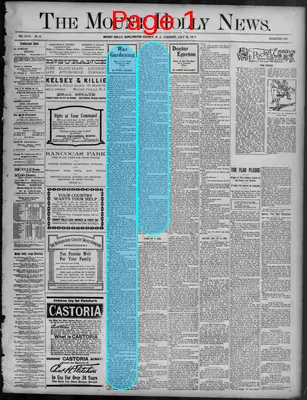
Story
July 10, 1917
The Mount Holly News
Mount Holly, Burlington County, New Jersey
What is this article about?
During World War I, rising food prices prompt Minna Gregory to learn gardening from a seemingly rustic plowman on her family's land. She discovers he is actually Joseph Crosby, an educated agricultural professor, leading to romance and marriage.
Clipping

OCR Quality
95%
Excellent
Full Text
War
Gardening
How a Girl Took
Lessons In the
Craft
By ETHEL HOLMES
Prices had been rising for a number of years, and as soon as it was announced that war was declared between the United States and Germany prices shot up with lightning rapidity. As soon as spring came everybody who possessed a back yard prepared to establish a kitchen garden.
Stephen Gregory one morning, after reading in his newspaper that potatoes were selling at $4 a bushel, said to his daughter, Minna:
"We have here four acres of virgin soil that should be cultivated. If I could hire help I would raise what vegetables we need for the coming summer. But I can't hire help; there is none to be hired. Any man who is able to work can do better than work for what I could afford to pay him."
"Couldn't you turn over the ground to be worked by some one on shares?" asked the young lady.
"I could give it to some one outright I suppose, but there is so much idle land that-I doubt if I could get any one to work our ground and pay me a royalty. However, I'll advertise it and see what I can do."
"I want to do something to help in this season of necessity," said Minna. "What can I do?"
"You might make a list of those articles of food that we Americans should go without in order that they may be shipped abroad. You can't ship perishable goods, like fish, you know."
"I see."
Minna made her list and showed it to her father. He smiled. The first article to be eaten at home was chickens. "Why, they're 40 cents a pound," was his criticism. The next was lobsters, 50 cents a pound. Then came ducks, mushrooms and such delicacies.
"That's a very good list as to what can't be sent abroad," said the father, but it would require the income of a nabob to feed on it."
Mr. Gregory advertised his land and succeeded in leasing it for 10 per cent of the crop, which was the best he could do. One morning Minna looked out through her window to see a man in a woolen shirt, corduroy trousers and a faded straw hat plowing up the ground in the rear of the house. She was not near enough to him to see whether he was old or young. Indeed, the matter did not interest her. He was evidently a plowman, and a plowman was too far removed from her to warrant her paying attention to him.
Nevertheless there was something to awaken an interest in her in the land she had so long regarded as useful only for a lawn tennis court being turned into something productive. For awhile she watched the man turning the sod in furrows and wondered what he would do next. She had no idea whatever as to the methods of raising fruits from the earth and became curious as to what they were. Presently, becoming desirous of a nearer view of this plowing process, she put on a broad brimmed hat and went to the scene of earth turning. The plowman when she approached him was nearing the end of a furrow and before starting back on another said:
"Good morning, miss."
"Good morning," was the reply.
Minna's first object of observation was the plowman. He was a stalwart young fellow of twenty-one and despite his farm apparel was good looking. His skin was tanned by the sun, denoting that his occupation was out of doors. There were no furrows in his face such as come from exposure to wind and weather. However, he was too young for furrows, even though a soil tiller.
"Do you know anything about gardening?" asked the man.
"Nothing. I shall be much interested to see how you do it. Do you scatter the seeds in those crevices between the sods you have curled over?"
"Oh, no. The ground must be harrowed first."
"What's that?"
"The sod must be torn apart and mingled with the soil."
"Then what do you do?"
"If you would like to learn something about gardening I think you would do well to come out here and watch me while I work. Telling one how a thing is to be done is not equal to showing how it is done."
Minna realized the truth of this and said that if he didn't mind her watching him she would do so occasionally. It was not to be expected that a young man would object to a pretty girl being a companion to him while he was making his garden, and Minna was not averse to taking lessons in gardening from a good looking rustic. She watched him plow for awhile, but since there is no variety in plowing she soon went back to the house.
When the ground was in condition to receive the seed Minna's interest was awakened in earnest. The first seed he put in was for radishes and the next for peas. She asked him if he was more anxious to get these vegetables than the others, and he replied that they required cooler weather and could not be raised late in the season. She wondered why he did not put in the potatoes immediately, since she had heard that potatoes were a very important crop. To this he replied that potatoes required dry ground, and the season had been wet. He was waiting for warmer, drier weather.
Minna became desirous of making a garden of her own, and the man prepared a small bit of ground for her. She desired to raise just such vegetables as she preferred to eat, and her favorite was asparagus, which requires several seasons to develop. However, the farmer whom by this time she had come to call Joe, made an asparagus bed for her and procured the roots.
One morning she went out to the garden and saw these roots lying by the bed intended for them. They looked to her like a Medusa's hair of snakes. She supposed she should plant them, putting them in so that the snakes should grow up in the air. When she was finishing her work Joe came along and, looking down at her plants, began to laugh.
"What's the matter?" asked Minna anxiously.
"You've planted them roots uppermost," was the reply.
This was Minna's first effort at planting and, since asparagus does not grow in the earth like potatoes, Joe righted them for her. After that she relied more on her preceptor and made no other such serious mistake.
While dressing one morning after a warm rain she looked out through her window and saw, or thought she saw, a faint line of pale green where she had put in her radish seed. Hurriedly finishing dressing, she went downstairs and ran out to her garden. True enough, there were the little green points peeping from the surface.
This was Minna's first sight of something coming from seed that she had planted with her own hand, and she was delighted. Looking up, she saw Joe coming, with the garden tools on his shoulder, and, running toward him clapping her hands, she cried out as though announcing some happy event:
"My radishes have come up!"
"And there are your string beans," said Joe pointing.
Minna went to her bean bed and saw a queer looking something pushing aside the earth above it.
"Why, it's like a chicken trying to get out of its shell!" she exclaimed.
What we produce ourselves, or, rather, what we put nature in a way to produce, gives us a very pleasurable sensation. When Minna went out to her garden early one morning and with great care pulled up half a dozen bright red radishes she was more delighted than if she had received a legacy. Taking them into the house, she put them into water in a little cut glass dish and gave one at breakfast to each member of the family. No morsel prepared by an experienced cook ever pleased her palate as did that radish.
Minna was used to seeing Joe working in his garden and often noticed him weeding. Her own little tract did not seem to need weeding. At this she wondered.
"Why is it, Joe," she asked him, "that no weeds grow in my beds?"
"They do," said Joe. "Weeds grow wherever there is ground for them to grow on. I think that some fairy godmother comes in the night and takes them all out of your beds."
This was the first thing he said to his pupil that sounded different from what might be expected of a rustic. Minna looked at him inquiringly, but he stooped to use his trowel and she did not see his face.
From this time Joe began to give Minna bits of information about agriculture that surprised her. They sounded rather as coming from a college professor than a simple countryman. One day when he was telling her how plants breathe through their leaves, absorbing oxygen and giving out carbon, she looked at him astonished and asked him where he had learned that.
Joe turned away, putting his foot on his spade to hide the fact that he had forgotten himself, letting out something that he had not intended to divulge.
But Minna, having had a peep at what was stored up in Joe's brain, was not to be denied a further view. She told him that she would like to hear more of "that sort of thing," as she expressed it, and Joe began the unfolding of processes of nature, making it all perfectly plain and often illustrating what he told her by the plants themselves. During the spring and early summer Minna was listening to "fairy tales of science" and, though she was not aware of it, was becoming interested in the story teller as well as his tales.
When the crop was ready to be gathered, one morning Minna, looking out from her room, saw a gentleman in a tweed suit and a straw hat in the garden directing some youngsters who were plucking the fruits of Joe's labor. She was not near enough to detect the gentleman's lineaments, but he had Joe's walk. Minna went out to investigate. As she approached the man directing the gathering of the vegetables turned, lifted his hat and bade her good morning.
He was Joe.
Well, to make a long story short, Joe, who was Joseph Crosby, recent graduate and assistant professor at Winterton Agricultural college, when Mr. Gregory's advertisement appeared was looking for a vacant plot of ground to cultivate for vegetables. Intending to do the work himself, he had appeared in working costume and had not taken the trouble to reveal his identity.
Minna was much confused at remembering that she had called one who was entitled to be addressed as professor by the familiar name of Joe, but she was much delighted at discovering that he was an educated gentleman. She married Joe, and when her first baby came her husband said that there was only one other thing that had as much delighted her—her first crop of radishes.
Gardening
How a Girl Took
Lessons In the
Craft
By ETHEL HOLMES
Prices had been rising for a number of years, and as soon as it was announced that war was declared between the United States and Germany prices shot up with lightning rapidity. As soon as spring came everybody who possessed a back yard prepared to establish a kitchen garden.
Stephen Gregory one morning, after reading in his newspaper that potatoes were selling at $4 a bushel, said to his daughter, Minna:
"We have here four acres of virgin soil that should be cultivated. If I could hire help I would raise what vegetables we need for the coming summer. But I can't hire help; there is none to be hired. Any man who is able to work can do better than work for what I could afford to pay him."
"Couldn't you turn over the ground to be worked by some one on shares?" asked the young lady.
"I could give it to some one outright I suppose, but there is so much idle land that-I doubt if I could get any one to work our ground and pay me a royalty. However, I'll advertise it and see what I can do."
"I want to do something to help in this season of necessity," said Minna. "What can I do?"
"You might make a list of those articles of food that we Americans should go without in order that they may be shipped abroad. You can't ship perishable goods, like fish, you know."
"I see."
Minna made her list and showed it to her father. He smiled. The first article to be eaten at home was chickens. "Why, they're 40 cents a pound," was his criticism. The next was lobsters, 50 cents a pound. Then came ducks, mushrooms and such delicacies.
"That's a very good list as to what can't be sent abroad," said the father, but it would require the income of a nabob to feed on it."
Mr. Gregory advertised his land and succeeded in leasing it for 10 per cent of the crop, which was the best he could do. One morning Minna looked out through her window to see a man in a woolen shirt, corduroy trousers and a faded straw hat plowing up the ground in the rear of the house. She was not near enough to him to see whether he was old or young. Indeed, the matter did not interest her. He was evidently a plowman, and a plowman was too far removed from her to warrant her paying attention to him.
Nevertheless there was something to awaken an interest in her in the land she had so long regarded as useful only for a lawn tennis court being turned into something productive. For awhile she watched the man turning the sod in furrows and wondered what he would do next. She had no idea whatever as to the methods of raising fruits from the earth and became curious as to what they were. Presently, becoming desirous of a nearer view of this plowing process, she put on a broad brimmed hat and went to the scene of earth turning. The plowman when she approached him was nearing the end of a furrow and before starting back on another said:
"Good morning, miss."
"Good morning," was the reply.
Minna's first object of observation was the plowman. He was a stalwart young fellow of twenty-one and despite his farm apparel was good looking. His skin was tanned by the sun, denoting that his occupation was out of doors. There were no furrows in his face such as come from exposure to wind and weather. However, he was too young for furrows, even though a soil tiller.
"Do you know anything about gardening?" asked the man.
"Nothing. I shall be much interested to see how you do it. Do you scatter the seeds in those crevices between the sods you have curled over?"
"Oh, no. The ground must be harrowed first."
"What's that?"
"The sod must be torn apart and mingled with the soil."
"Then what do you do?"
"If you would like to learn something about gardening I think you would do well to come out here and watch me while I work. Telling one how a thing is to be done is not equal to showing how it is done."
Minna realized the truth of this and said that if he didn't mind her watching him she would do so occasionally. It was not to be expected that a young man would object to a pretty girl being a companion to him while he was making his garden, and Minna was not averse to taking lessons in gardening from a good looking rustic. She watched him plow for awhile, but since there is no variety in plowing she soon went back to the house.
When the ground was in condition to receive the seed Minna's interest was awakened in earnest. The first seed he put in was for radishes and the next for peas. She asked him if he was more anxious to get these vegetables than the others, and he replied that they required cooler weather and could not be raised late in the season. She wondered why he did not put in the potatoes immediately, since she had heard that potatoes were a very important crop. To this he replied that potatoes required dry ground, and the season had been wet. He was waiting for warmer, drier weather.
Minna became desirous of making a garden of her own, and the man prepared a small bit of ground for her. She desired to raise just such vegetables as she preferred to eat, and her favorite was asparagus, which requires several seasons to develop. However, the farmer whom by this time she had come to call Joe, made an asparagus bed for her and procured the roots.
One morning she went out to the garden and saw these roots lying by the bed intended for them. They looked to her like a Medusa's hair of snakes. She supposed she should plant them, putting them in so that the snakes should grow up in the air. When she was finishing her work Joe came along and, looking down at her plants, began to laugh.
"What's the matter?" asked Minna anxiously.
"You've planted them roots uppermost," was the reply.
This was Minna's first effort at planting and, since asparagus does not grow in the earth like potatoes, Joe righted them for her. After that she relied more on her preceptor and made no other such serious mistake.
While dressing one morning after a warm rain she looked out through her window and saw, or thought she saw, a faint line of pale green where she had put in her radish seed. Hurriedly finishing dressing, she went downstairs and ran out to her garden. True enough, there were the little green points peeping from the surface.
This was Minna's first sight of something coming from seed that she had planted with her own hand, and she was delighted. Looking up, she saw Joe coming, with the garden tools on his shoulder, and, running toward him clapping her hands, she cried out as though announcing some happy event:
"My radishes have come up!"
"And there are your string beans," said Joe pointing.
Minna went to her bean bed and saw a queer looking something pushing aside the earth above it.
"Why, it's like a chicken trying to get out of its shell!" she exclaimed.
What we produce ourselves, or, rather, what we put nature in a way to produce, gives us a very pleasurable sensation. When Minna went out to her garden early one morning and with great care pulled up half a dozen bright red radishes she was more delighted than if she had received a legacy. Taking them into the house, she put them into water in a little cut glass dish and gave one at breakfast to each member of the family. No morsel prepared by an experienced cook ever pleased her palate as did that radish.
Minna was used to seeing Joe working in his garden and often noticed him weeding. Her own little tract did not seem to need weeding. At this she wondered.
"Why is it, Joe," she asked him, "that no weeds grow in my beds?"
"They do," said Joe. "Weeds grow wherever there is ground for them to grow on. I think that some fairy godmother comes in the night and takes them all out of your beds."
This was the first thing he said to his pupil that sounded different from what might be expected of a rustic. Minna looked at him inquiringly, but he stooped to use his trowel and she did not see his face.
From this time Joe began to give Minna bits of information about agriculture that surprised her. They sounded rather as coming from a college professor than a simple countryman. One day when he was telling her how plants breathe through their leaves, absorbing oxygen and giving out carbon, she looked at him astonished and asked him where he had learned that.
Joe turned away, putting his foot on his spade to hide the fact that he had forgotten himself, letting out something that he had not intended to divulge.
But Minna, having had a peep at what was stored up in Joe's brain, was not to be denied a further view. She told him that she would like to hear more of "that sort of thing," as she expressed it, and Joe began the unfolding of processes of nature, making it all perfectly plain and often illustrating what he told her by the plants themselves. During the spring and early summer Minna was listening to "fairy tales of science" and, though she was not aware of it, was becoming interested in the story teller as well as his tales.
When the crop was ready to be gathered, one morning Minna, looking out from her room, saw a gentleman in a tweed suit and a straw hat in the garden directing some youngsters who were plucking the fruits of Joe's labor. She was not near enough to detect the gentleman's lineaments, but he had Joe's walk. Minna went out to investigate. As she approached the man directing the gathering of the vegetables turned, lifted his hat and bade her good morning.
He was Joe.
Well, to make a long story short, Joe, who was Joseph Crosby, recent graduate and assistant professor at Winterton Agricultural college, when Mr. Gregory's advertisement appeared was looking for a vacant plot of ground to cultivate for vegetables. Intending to do the work himself, he had appeared in working costume and had not taken the trouble to reveal his identity.
Minna was much confused at remembering that she had called one who was entitled to be addressed as professor by the familiar name of Joe, but she was much delighted at discovering that he was an educated gentleman. She married Joe, and when her first baby came her husband said that there was only one other thing that had as much delighted her—her first crop of radishes.
What sub-type of article is it?
Romance
Personal Triumph
What themes does it cover?
Love
Triumph
What keywords are associated?
Wartime Gardening
Victory Garden
Romance
Agricultural Education
Food Prices
Self Sufficiency
What entities or persons were involved?
Minna Gregory
Stephen Gregory
Joe
Joseph Crosby
Where did it happen?
Family Home With Four Acres Of Land
Story Details
Key Persons
Minna Gregory
Stephen Gregory
Joe
Joseph Crosby
Location
Family Home With Four Acres Of Land
Event Date
Spring During War Between United States And Germany
Story Details
Minna learns gardening from a disguised professor tenant on her family's land amid wartime food shortages, develops feelings for him upon discovering his true identity, and marries him.