Thank you for visiting SNEWPapers!
Sign up free
Story
February 25, 1935
Henderson Daily Dispatch
Henderson, Vance County, North Carolina
What is this article about?
Article on Dr. Benjamin Rush's 1814 pamphlet on alcohol's harms, reprinted in a modern book, highlighting his role in Washington's army and anecdotes of curing intemperance via resentment or illness.
Clipping
OCR Quality
95%
Excellent
Full Text
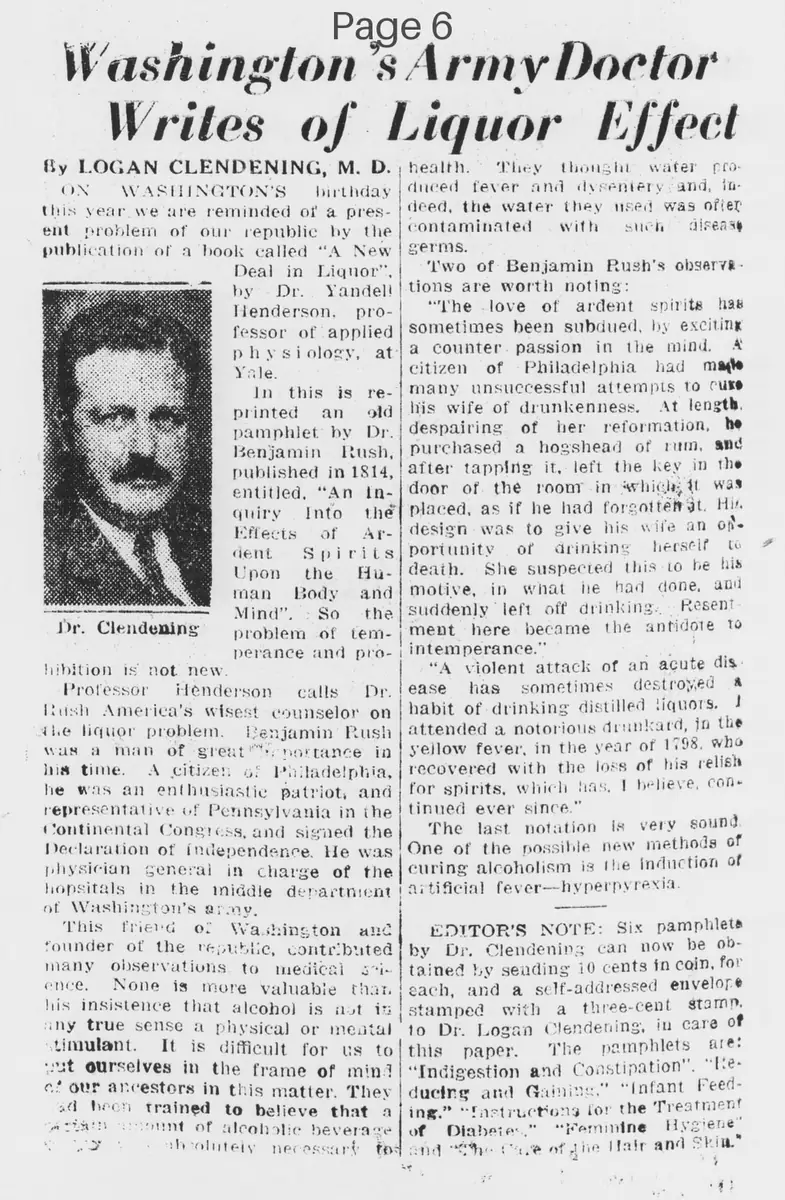
Washington's Army Doctor
Writes of
Liquor
Effect
By LOGAN CLENDENING, M. D.
ON WASHINGTON'S birthday this year we are reminded of a present problem of our republic by the publication of a book called "A New Deal in Liquor"
by
Dr.
Yandell
Henderson, professor of applied physiology, at Yale.
In this
is reprinted
an
old
pamphlet by Dr.
Benjamin
Rush,
published in 1814,
entitled, "An
Inquiry
Into
the
Effects
of
Ardent
Spirits
Upon
the
Human
Body
and
Mind".
So
Dr. Clendening
the
problem of
temperance and prohibition is not new
Professor
Henderson
calls
Dr.
Rush America's wisest counselor on the liquor problem. Benjamin Rush was a man of great importance in his time. A citizen of Philadelphia, he was an enthusiastic patriot, and representative of Pennsylvania in the Continental Congress, and signed the Declaration of Independence. He was physician general in charge of the hospitals in the middle department of Washington's army.
This friend of Washington and founder of the republic, contributed many observations to medical science. None is more valuable than his insistence that alcohol is not in any true sense a physical or mental stimulant. It is difficult for us to put ourselves in the frame of mind of our ancestors in this matter. They had been trained to believe that a certain amount of alcoholic beverage was absolutely necessary to health. They thought water produced fever and dysentery and, indeed, the water they used was often contaminated with such disease germs.
Two of Benjamin Rush's observations are worth noting:
"The love of ardent spirits has sometimes been subdued, by exciting a counter passion in the mind. A citizen of Philadelphia had made many unsuccessful attempts to cure his wife of drunkenness. At length, despairing of her reformation, he purchased a hogshead of rum, and after tapping it, left the key in the door of the room in which it was placed, as if he had forgotten it. His design was to give his wife an opportunity of drinking herself to death. She suspected this to be his motive, in what he had done, and suddenly left off drinking. Resentment here became the antidote to intemperance."
"A
violent attack of an acute disease
has sometimes destroyed a
habit of drinking distilled liquors. I
attended a notorious drunkard, in the
yellow fever, in the year of 1793, who
recovered with the loss of his relish
for spirits, which has, I believe, continued ever since."
The last notation is very sound. One of the possible new methods of curing alcoholism is the induction of artificial fever—hyperpyrexia.
EDITOR'S NOTE: Six pamphlets by Dr. Clendening can now be obtained by sending 10 cents in coin, for each, and a self-addressed envelope stamped with a three-cent stamp, to Dr. Logan Clendening, in care of this paper. The pamphlets are: "Indigestion and Constipation", "Reducing and Gaining," "Infant Feeding," "Instructions for the Treatment of Diabetes" "Feminine Hygiene" and "Care of the Hair and Scalp."
Writes of
Liquor
Effect
By LOGAN CLENDENING, M. D.
ON WASHINGTON'S birthday this year we are reminded of a present problem of our republic by the publication of a book called "A New Deal in Liquor"
by
Dr.
Yandell
Henderson, professor of applied physiology, at Yale.
In this
is reprinted
an
old
pamphlet by Dr.
Benjamin
Rush,
published in 1814,
entitled, "An
Inquiry
Into
the
Effects
of
Ardent
Spirits
Upon
the
Human
Body
and
Mind".
So
Dr. Clendening
the
problem of
temperance and prohibition is not new
Professor
Henderson
calls
Dr.
Rush America's wisest counselor on the liquor problem. Benjamin Rush was a man of great importance in his time. A citizen of Philadelphia, he was an enthusiastic patriot, and representative of Pennsylvania in the Continental Congress, and signed the Declaration of Independence. He was physician general in charge of the hospitals in the middle department of Washington's army.
This friend of Washington and founder of the republic, contributed many observations to medical science. None is more valuable than his insistence that alcohol is not in any true sense a physical or mental stimulant. It is difficult for us to put ourselves in the frame of mind of our ancestors in this matter. They had been trained to believe that a certain amount of alcoholic beverage was absolutely necessary to health. They thought water produced fever and dysentery and, indeed, the water they used was often contaminated with such disease germs.
Two of Benjamin Rush's observations are worth noting:
"The love of ardent spirits has sometimes been subdued, by exciting a counter passion in the mind. A citizen of Philadelphia had made many unsuccessful attempts to cure his wife of drunkenness. At length, despairing of her reformation, he purchased a hogshead of rum, and after tapping it, left the key in the door of the room in which it was placed, as if he had forgotten it. His design was to give his wife an opportunity of drinking herself to death. She suspected this to be his motive, in what he had done, and suddenly left off drinking. Resentment here became the antidote to intemperance."
"A
violent attack of an acute disease
has sometimes destroyed a
habit of drinking distilled liquors. I
attended a notorious drunkard, in the
yellow fever, in the year of 1793, who
recovered with the loss of his relish
for spirits, which has, I believe, continued ever since."
The last notation is very sound. One of the possible new methods of curing alcoholism is the induction of artificial fever—hyperpyrexia.
EDITOR'S NOTE: Six pamphlets by Dr. Clendening can now be obtained by sending 10 cents in coin, for each, and a self-addressed envelope stamped with a three-cent stamp, to Dr. Logan Clendening, in care of this paper. The pamphlets are: "Indigestion and Constipation", "Reducing and Gaining," "Infant Feeding," "Instructions for the Treatment of Diabetes" "Feminine Hygiene" and "Care of the Hair and Scalp."
What sub-type of article is it?
Biography
Historical Event
Medical Curiosity
What themes does it cover?
Moral Virtue
Recovery
Misfortune
What keywords are associated?
Alcohol Effects
Temperance
Benjamin Rush
Historical Pamphlet
Curing Alcoholism
What entities or persons were involved?
Benjamin Rush
Logan Clendening
Yandell Henderson
George Washington
Where did it happen?
Philadelphia
Story Details
Key Persons
Benjamin Rush
Logan Clendening
Yandell Henderson
George Washington
Location
Philadelphia
Event Date
1814
Story Details
Dr. Benjamin Rush, physician in Washington's army and signer of the Declaration of Independence, wrote a 1814 pamphlet arguing alcohol is not a stimulant and detailing observations on curing drunkenness, including through resentment or disease like yellow fever.