Thank you for visiting SNEWPapers!
Sign up free
Story
August 27, 1863
The Central Presbyterian
Richmond, Virginia
What is this article about?
A reflection on Jesus healing a palsied man in the temple after 38 years of affliction, warning him to sin no more lest a worse thing befall him, emphasizing the greater danger of spiritual hardness and eternal perdition over physical suffering.
Clipping
OCR Quality
98%
Excellent
Full Text
"A WORSE THING."
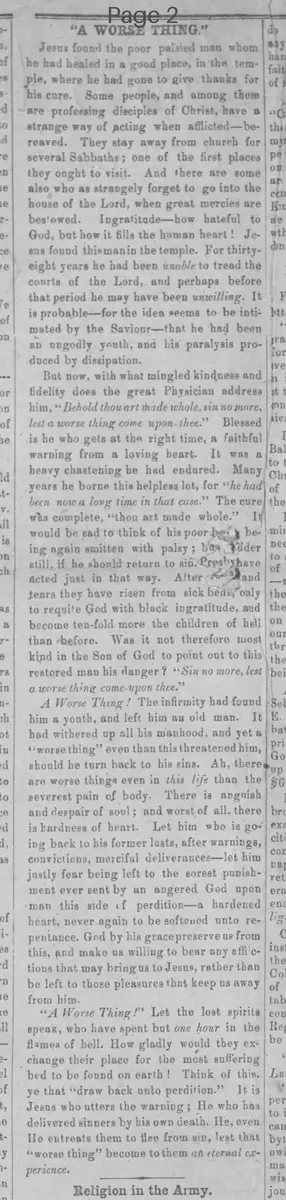
Jesus found the poor palsied man whom he had healed in a good place, in the temple, where he had gone to give thanks for his cure. Some people, and among them are professing disciples of Christ, have a strange way of acting when afflicted—bereaved. They stay away from church for several Sabbaths; one of the first places they ought to visit. And there are some also who as strangely forget to go into the house of the Lord, when great mercies are bestowed. Ingratitude—how hateful to God, but how it fills the human heart! Jesus found this man in the temple. For thirty-eight years he had been unable to tread the courts of the Lord, and perhaps before that period he may have been unwilling. It is probable—for the idea seems to be intimated by the Saviour—that he had been an ungodly youth, and his paralysis produced by dissipation.
But now, with what mingled kindness and fidelity does the great Physician address him, "Behold thou art made whole, sin no more. lest a worse thing come upon thee." Blessed is he who gets at the right time, a faithful warning from a loving heart. It was a heavy chastening he had endured. Many years he borne this helpless lot, for "he had been now a long time in that case." The cure was complete, "thou art made whole." It would be sad to think of his poor body being again smitten with palsy; but sadder still, if he should return to sin. Presbyterians have acted just in that way. After tears they have risen from sick beds, only to requite God with black ingratitude, and become ten-fold more the children of hell than before. Was it not therefore most kind in the Son of God to point out to this restored man his danger? "Sin no more, lest a worse thing come upon thee."
A Worse Thing! The infirmity had found him a youth, and left him an old man. It had withered up all his manhood, and yet a "worse thing" even than this threatened him. should he turn back to his sins. Ah, there are worse things even in this life than the severest pain of body. There is anguish and despair of soul; and worst of all, there is hardness of heart. Let him who is going back to his former lusts, after warnings, convictions, merciful deliverances—let him justly fear being left to the sorest punishment ever sent by an angered God upon man this side of perdition—a hardened heart, never again to be softened unto repentance. God by his grace preserve us from this, and make us willing to bear any afflictions that may bring us to Jesus, rather than be left to those pleasures that keep us away from him.
"A Worse Thing!" Let the lost spirits speak, who have spent but one hour in the flames of hell. How gladly would they exchange their place for the most suffering bed to be found on earth! Think of this. ye that "draw back unto perdition." It is Jesus who utters the warning; He who has delivered sinners by his own death. He, even He entreats them to flee from sin, lest that "worse thing" become to them an eternal experience.
Jesus found the poor palsied man whom he had healed in a good place, in the temple, where he had gone to give thanks for his cure. Some people, and among them are professing disciples of Christ, have a strange way of acting when afflicted—bereaved. They stay away from church for several Sabbaths; one of the first places they ought to visit. And there are some also who as strangely forget to go into the house of the Lord, when great mercies are bestowed. Ingratitude—how hateful to God, but how it fills the human heart! Jesus found this man in the temple. For thirty-eight years he had been unable to tread the courts of the Lord, and perhaps before that period he may have been unwilling. It is probable—for the idea seems to be intimated by the Saviour—that he had been an ungodly youth, and his paralysis produced by dissipation.
But now, with what mingled kindness and fidelity does the great Physician address him, "Behold thou art made whole, sin no more. lest a worse thing come upon thee." Blessed is he who gets at the right time, a faithful warning from a loving heart. It was a heavy chastening he had endured. Many years he borne this helpless lot, for "he had been now a long time in that case." The cure was complete, "thou art made whole." It would be sad to think of his poor body being again smitten with palsy; but sadder still, if he should return to sin. Presbyterians have acted just in that way. After tears they have risen from sick beds, only to requite God with black ingratitude, and become ten-fold more the children of hell than before. Was it not therefore most kind in the Son of God to point out to this restored man his danger? "Sin no more, lest a worse thing come upon thee."
A Worse Thing! The infirmity had found him a youth, and left him an old man. It had withered up all his manhood, and yet a "worse thing" even than this threatened him. should he turn back to his sins. Ah, there are worse things even in this life than the severest pain of body. There is anguish and despair of soul; and worst of all, there is hardness of heart. Let him who is going back to his former lusts, after warnings, convictions, merciful deliverances—let him justly fear being left to the sorest punishment ever sent by an angered God upon man this side of perdition—a hardened heart, never again to be softened unto repentance. God by his grace preserve us from this, and make us willing to bear any afflictions that may bring us to Jesus, rather than be left to those pleasures that keep us away from him.
"A Worse Thing!" Let the lost spirits speak, who have spent but one hour in the flames of hell. How gladly would they exchange their place for the most suffering bed to be found on earth! Think of this. ye that "draw back unto perdition." It is Jesus who utters the warning; He who has delivered sinners by his own death. He, even He entreats them to flee from sin, lest that "worse thing" become to them an eternal experience.
What sub-type of article is it?
Extraordinary Event
Biography
What themes does it cover?
Moral Virtue
Providence Divine
Misfortune
What keywords are associated?
Healing Miracle
Sin Warning
Moral Lesson
Biblical Healing
Spiritual Danger
What entities or persons were involved?
Jesus
Palsied Man
Where did it happen?
Temple
Story Details
Key Persons
Jesus
Palsied Man
Location
Temple
Story Details
Jesus heals a man paralyzed for 38 years, finds him in the temple giving thanks, and warns him against returning to sin to avoid a worse fate of spiritual hardness and eternal perdition.