Thank you for visiting SNEWPapers!
Sign up free
Phenix Gazette
Alexandria, Virginia
What is this article about?
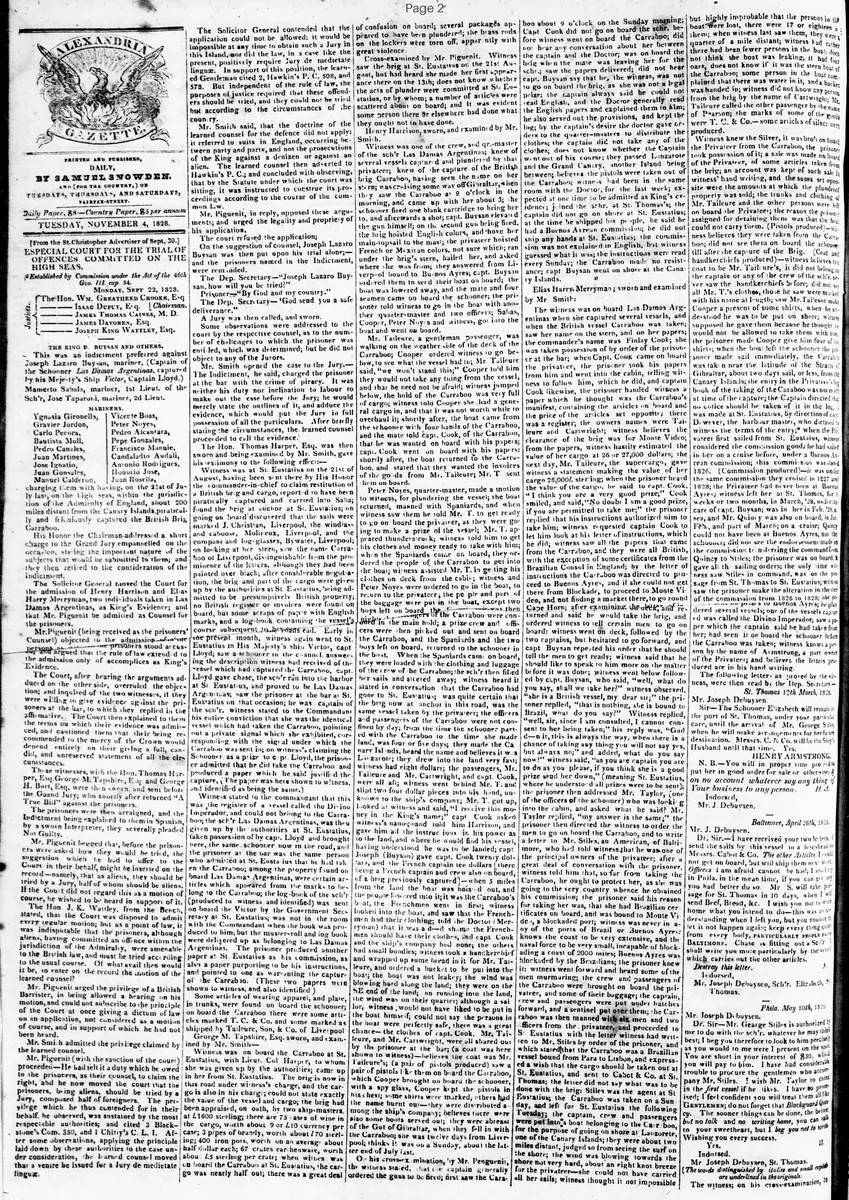
In St. Christopher, a special court under British Admiralty jurisdiction tries Joseph Lazaro Buysan, captain of schooner Las Damas Argentinas, and crew for piratically capturing British brig Carraboo on high seas near Canary Islands on July 21, 1828. Buysan and most crew convicted and sentenced to death; one acquitted.
Merged-components note: This is a continuation of the detailed foreign news story about the piracy trial of the brig Carraboo, spanning pages 2 and 3. The second component was initially labeled 'story' but fits as foreign_news due to its international content.
Clippings
1 of 2
OCR Quality
Full Text
FAIRFAX-STREET.
Daily Paper, $8--Country Paper, $5 per annum
TUESDAY, NOVEMBER 4, 1828.
[From the St. Christopher Advertiser of Sept. 30.]
SPECIAL COURT FOR THE TRIAL OF
OFFENCES COMMITTED ON THE
HIGH SEAS.
Established by Commission under the Act of the 46th
Geo. III. cap. 54.
Monday, Sept. 22, 1828.
The Hon. Wm. Greatheed Crooke, Esq.
Isaac Dupcv, Esq. [Chairman.]
James Thomas Caines, M. D.
James Davoren, Esq.
Joseph King Wartley, Esq.
THE KING v. BUYSAN AND OTHERS.
This was an indictment preferred against
Joseph Lazaro Buysan, mariner, (Captain of
the Schooner Las Damas Argentinas, captured
by his Majesty's Ship Victor, Captain Lloyd.)
Mamerto Sabals, mariner, 1st Lieut. of the
Sch'r, Jose Taparoni, mariner, 2d Lieut.
MARINERS.
Ygnasio Gironella,
Vicente Boas,
Gravier Jordon,
Peter Noyes,
Carlo Pecora,
Pedro Alcantara,
Bautista Moll,
Pepe Gonzales,
Pedro Canales,
Francisco Mannie,
Juan Martines,
Candalario Audali,
Jose Ignacio,
Antonio Rodrigues,
Juan Gonzales,
Honorio Jose,
Manuel Calderon,
Juan Rosella,
charging them with having, on the 21st of Ju-
ly last, on the high seas, within the jurisdic-
tion of the Admiralty of England, about 200
miles distant from the Canary Islands, piratically
and feloniously captured the British Brig
Carraboo.
His Honor the Chairman addressed a short
charge to the Grand Jury empannelled on the
occasion, stating the important nature of the
subjects that would be submitted to them; and
they then retired to the consideration of the
indictment.
The Solicitor General moved the Court for
the admission of Henry Harrison and Elias
Harry Merryman, two individuals taken in Las
Damas Argentinas, as King's Evidence; and
that Mr. Piguenit be admitted as Counsel for
the prisoners.
Mr. Piguenit (being received as the prisoners'
Counsel) objected to the admission of any
prisoners stood accused-
per se, and argued that the rule of law extended to
the admission only of accomplices as King's
Evidence.
The Court, after hearing the arguments ad-
duced on the other side, overruled the objection;
and inquired of the two witnesses, if they
were willing to give evidence against the pri-
soners at the bar, to which they replied in the
affirmative. The Court then explained to them
the terms on which their evidence was admit-
ted, and cautioned them that their being re-
commended to the mercy of the Crown would
depend entirely on their giving a full, can-
did, and unreserved statement of all the cir-
circumstances.
These witnesses, with the Hon. Thomas Har-
per, Esq. George M. Tapshire, Esq. and George
H. Bort, Esq. were then sworn, and sent before
the Grand Jury; who shortly after returned "A
True Bill" against the prisoners.
The prisoners were then arraigned, and the
Indictment being explained to them in Spanish,
by a sworn Interpreter, they severally pleaded
Not Guilty.
Mr. Piguenit begged that, before the prison-
ers were asked how they would be tried, the
suggestion which he had to offer to the
Court in their behalf, might be entered on the
record—namely, that as aliens, they should be
tried by a Jury, half of whom should be aliens.
If the Court did not regard this as a motion of
course, he wished to be heard in support of it.
The Hon. J. K. Wartley, from the Bench,
stated, that the Court was disposed to admit
every regular motion; but as a point of law, it
was indisputable that the prisoners, although
aliens, having committed an offence within the
jurisdiction of the Admiralty, were amenable
to the British law, and must be tried according
to the usual course. Of what avail then would
it be, to enter on the record the motion of the
learned counsel?
Mr. Piguenit urged the privilege of a British
Barrister, in being allowed a hearing on his
motion, and could not subscribe to the principle
of the Court at once giving a dictum of law
on an application, not considered as a motion
of course, and in support of which he had not
been heard.
Mr. Smith admitted the privilege claimed by
the learned counsel.
Mr. Piguenit (with the sanction of the Court)
proceeded—He had felt it a duty which he owed
to the prisoners, as their counsel, to claim the
right, and he now moved the court that the
prisoners, being aliens, should be tried by a
Jury, composed half of foreigners. The pri-
vilege which he thus contended for in their
behalf, he observed, was sustained by the most
respectable authorities; and cited 3 Black-
stone's Com. 350, and 1 Chitty's C. L. 1. Af-
ter some observations, applying the principle
laid down by these authorities to the case un-
der consideration, the learned counsel moved
that a venire be issued for a Jury de medietate
linguae.
The Solicitor General contended that the
application could not be allowed: it would be
impossible at any time to obtain such a Jury in
this Island, nor did the law, in a case like the
present, positively require Jury de medietate
linguae. In support of this position, the learn-
ed Gentleman cited 2. Hawkins' P. C. 508, and
578. But independent of the rule of law, the
purposes of justice required that these offenders
should be tried, and they could not be tried
but according to the circumstances of the
country.
Mr. Smith said, that the doctrine of the
learned counsel for the defence did not apply:
it referred to suits in England, occurring be-
tween party and party, and not the prosecutions
of the King against a denizen or against an
alien. The learned counsel then adverted to
Hawkins' P. C.: and concluded with observing,
that by the Statute under which the court was
sitting, it was instructed to construe its pros-
ceedings according to the course of the com-
mon law.
Mr. Piguenit, in reply, opposed these argu-
ments; and urged the legality and propriety of
his application.
The court refused the application;
On the suggestion of counsel, Joseph Lazaro
Buysan was then put upon his trial alone;-
and the prisoners named in the Indictment,
were remanded.
The Dep. Secretary—“Joseph Lazaro Buy-
san, how will you be tried?”
Prisoner—“By God and my country.”
The Dep. Secretary— “God send you a safe
deliverance.”
A Jury was then called, and sworn.
Some observations were addressed to the
court by the respective counsel, as to the num-
ber of challenges to which the prisoner was
entitled, which was determined; but he did not
object to any of the Jurors.
Mr. Smith opened the case to the Jury.—
The Indictment, he said, charged the prisoner
at the bar with the crime of piracy. It was
neither his duty nor inclination to labour to
make out the case before the Jury: he would
merely state the outlines of it, and adduce the
evidence, which would put the Jury in full
possession of all the particulars. After briefly
stating the circumstances, the learned counsel
proceeded to call the evidence.
The Hon. Thomas Harper, Esq. was then
sworn and being examined by Mr. Smith, gave
his testimony to the following effect:——
Witness was at St. Eustatius on the 21st of
August, having been sent there by His Honor
the commander-in-chief to claim restitution of
a British brig and cargo, reported to have been
piratically captured and carried into Saba;
found the brig at anchor at St. Eustatius; on
going on board discovered that the sails were
marked J. Christian, Liverpool, the windlass
and caboose, Molyneux, Liverpool, and the
compass and log-glasses, Bywater, Liverpool:
on looking at her stern, saw the name Carra-
boo of Liverpool, distinguishable from the pro-
minence of the letters, although they had been
painted over black; after considerable negotiation, the brig and part of the cargo were given
up by the authorities at St. Eustatius, being ad-
mitted to be presumptively British property;
no British register or invoices were found on
board, but some scraps of paper with English
marks, and a log-book containing the vessel's
course subsequent to Lisbon roads. Early in
the present month, witness again went to St.
Eustatius in His Majesty's ship Victor, capt.
Lloyd; saw a schooner in the channel, answer-
ing the description witness had received of the
vessel which had captured the Carraboo, capt.
Lloyd gave chase, the sch'r ran into the harbor
at St. Eustatius, and proved to be Las Damas
Argentinas; saw the prisoner at the bar at St.
Eustatius on that occasion; he was captain of
the sch'r. witness stated to the Commandant
his entire conviction that she was the identical
vessel which had taken the Carraboo, pointing
out a private signal which she exhibited, cor-
responding with the signal under which the
Carraboo was sent in; on witness's claiming the
Schooner, as a prize to capt. Lloyd, the prison-
er admitted that he did take the Carraboo and
produced a paper which he said justified the
capture, (The paper was here shown to witness,
and identified as being the same.) Witness stated to the commandant that this
was the register of a vessel called the Divino
Imperador, and could not belong to the Carra-
boo: the sch'r Las Damas Argentinas, was then
given up by the authorities at St. Eustatius,
taken possession of by capt. Lloyd and brought
here, the same schooner now in the road, and
the prisoner at the bar was the same person
who admitted at St. Eustatius that he had tak-
en the Carraboo; among the property found on
board Las Damas Argentinas, were certain ar-
ticles which appeared from the marks to be-
long to the Carraboo; the log-book of the sch'r
(produced to witness and identified) was sent
on board the Victor by the Government Sec-
retary at St. Eustatius; was not in the room
with the Commandant when the book was pro-
duced to him; but the muster-roll and logbook
were delivered up as belonging to Las Damas
Argentinas. The prisoner produced another
paper at St. Eustatius as his commission, as
also a paper purporting to be his instructions,
and pointed to one as warranting the captur-
of the Carraboo. (These two papers were
shown to witness, and also identified)
Some articles of wearing apparel, and plate,
in trunks, were found on board the schooner;
on board the Carraboo there were some arti-
cles marked T. C. & Co. and some marked as
shipped by Tailleur, Son, & Co. of Liverpool
George M. Tapshire, Esq. sworn, and exan-
ined by Mr. Smith——
Witness was on board the Carraboo at St.
Eustatius, with Lieut. Col. Harper, to whom
she was given up by the authorities; came up
in her from St. Eustatius. The brig is now in
this road under witness's charge, and the car-
go is also in his charge; could not state exactly
the value of the vessel and cargo; the brig had
been appraised, on oath, by two ship-masters,
at £1600 sterling; there are 75 cases of wine in
the cargo, worth about 9 or 10 currency per
case; 3 pipes of brandy, worth about £170 sterl-
ing; 400 iron pots, worth on an average about
half dollar each; 67 crates earthenware, worth
about £1.5 sterling per crate; when witness was
on board the Carraboo at St. Eustatius, the car-
go was nearly half out; there was a great deal
of confusion on board: several packages ap-
peared to have been plundered; the brass rods
on the lockers were torn off, apparently with
great violence.
saw the brig at St. Eustatius on the 21st Au-
gust, but had heard she made her first appear-
ance there on the 13th: does not know whether
the acts of plunder were committed at St. Eu-
statuis, or by whom; a number of articles were
scattered about on board; and it was evident
some person there or elsewhere had done what
they ought not to have done.
Cross-examined by Mr. Piguenit. Witness
Henry Harrison, sworn, and examined by Mr.
Smith.
Witness was one of the crew, and qr.-master
of the sch'r Las Damas Argentinas; knew of
several vessels captured and plundered by that
privateer; knew of the capture of the British
brig Carraboo, having seen the name on her
stern; was cruising some way off Gibraltar, when
they saw the Carraboo at 9 o'clock in the
morning, and came up with her about 3; he
schooner fired one blank cartridge to bring her
to, and afterwards a shot; capt. Buysan elevated
the gun himself; on the second gun being fired.
the brig hoisted English colors, and hove her
main-topsail to the mast; the privateer hoisted
French or Mexican colors, not sure which; ran
under the brig's stern, hailed her, and asked
where she was from; they answered from Li-
verpool bound to Buenos Ayres; capt. Buysan
ordered them to send their boat on board; the
boat was lowered away, and the mate and four
seamen came on board the schooner; the pri-
soner told witness to go in the boat with ano-
ther quarter-master and two officers; Sabals,
Cooper, Peter Noyes and witness, got into the
boat and went on board.
Mr. Taileure, a gentleman passenger, was
walking on the weather side of the deck of the
Carraboo; Cooper ordered witness to go be-
low, to see what the vessel had in; Mr. Taileure
said, "we won't stand this;" Cooper told him
they would not take any thing from the vessel,
and that he need not be afraid; witness jumped
below, the hold of the Carraboo was very full
of cargo; witness told Cooper she had a gene-
ral cargo in, and that it was not worth while to
overhaul it; shortly after, the boat came from
the schooner with four hands of the Carraboo,
and the mate told capt. Cook, of the Carraboo,
that he was wanted on board with his papers;
capt. Cook went on board with his papers:
shortly after, the boat returned to the Carra-
boo, and stated that they wanted the invoices
of the goods from Mr. Taileure; Mr. T sent
them on board.
Peter Noyes, quarter-master, made a motion
to witness, for plundering the vessel; the boat
returned, manned with Spaniards, and when
witness saw them he told Mr. T. to get ready
to go on board the privateer, as they were go-
ing to make a prize of the vessel; Mr. T. ap-
peared thunderstruck; witness told him to get
his clothes and money ready to take with him;
when the Spaniards came on board, they or-
dered the people of the Carraboo to get into
the boat; witness assisted Mr. T. in getting his
clothes on deck from the cabin: witness and
Peter Noyes were ordered to go in the boat, to
return to the privateer; the people and part of
the baggage were put in the boat, except two
boys left on board the Carraboo were con-
fined in the main hold; a prize crew and offi-
cers were then picked out and sent on board
the Carraboo, and the Spaniards and the two
boys left on board, returned to the schooner in
the boat. When the Spaniards came on board,
they were loaded with the clothing and luggage
of the crew of the Carraboo: the sch'r then filled
her sails and steered away; witness heard it
stated in conversation that the Carraboo had
gone to St. Eustatius: was quite certain that
the brig now at anchor in this road, was the
same vessel taken by the privateer; the officers
and passengers of the Carraboo were not con-
fined by day; from the time the schooner part-
ed with the Carraboo to the time she made
land, was four or five days: they made the Ca-
nary Islands, heard the name and believes it was
Lanzarote; they drew into the land very fast;
witness had eight dollars; the passengers, Mr.
Taileure and Mr. Cartwright, and capt. Cook,
were all aft; witness went behind Mr. T. and
slipped two four dollar pieces into his hand, un-
known to the ship's company; Mr. T. got up,
looked at witness and said, "I receive this mo-
ey in the King's name:" capt Cook asked
witness's name and told him Harrison, and
gave him all the instructions in his power as
to the land, and where he would find his vessel,
having understood he was to be landed; capt.
Joseph (Buysan) gave capt. Cook twenty dol-
lars, and the French captain ten dollars there
being a French captain and crew also on board,
of a brig previously captured—when 5 miles
from the land the boat was hoisted out, and
the people lowered into it; it was the Carraboo's
boat, the Frenchmen went in first: witness
looked into the boat, and saw that the French-
men had their clothing: told the Doctor (Mer-
ryman) that it was a d--d shame the French-
men should have their clothes, and capt Cook
and the ship's company had none; the others
had small bundles; witness took a handkerchief
and wrapped up some bread in it for Mr. Tai-
leure, and ordered a bucket to be put into the
boat; the boat was not leaky; the wind was
blowing hard along the land; they were on the
SE end of the land; on running into the land,
the wind was on their quarter; although a sai-
lor, witness would not have liked to be put in
the boat himself; could not say the persons in
the boat were perfectly safe, there was a great
chance—the clothes of capt. Cook, Mr. Tai-
leure, and Mr. Cartwright, were all shared out
by the prisoner at the bar; (a coat was here
shown to witness)—believes the coat was Mr.
Taileure's; (a pair of pistols produced) saw a
pair of pistols like them on board the Carraboo,
which Cooper brought on board the schooner,
with a spy glass, Cooper kept the pistols in
his chest; some shirts were marked, others had
the name burnt out—they were distributed a-
mong the ship's company; believes there were
also some boots served out; they were abreast
of the Gut of Gibraltar, when they fell in with
the Carraboo; she was twelve days from Liver-
pool; thinks it was on a Sunday, about the lat-
ter end of July last.
On his cross-examination, by Mr. Piguenit,
the witness stated, that the captain generally
ordered the guns to be fired; first saw the Cara-
boo about 9 o'clock on the Sunday morning;
Capt Cook did not go on board the schr. be-
fore witness went on board the Carraboo; did
not hear any conversation about her between
the captain and the Doctor; was on board the
brig when the mate was leaving her for the
schr.; saw the papers delivered; did not hear
capt. Buysan say that he, the witness, was not
to go on board the brig, as she was not a legal
prize: the captain always said he could not
read English, and the Doctor generally read
the English papers and explained them to him;
he also served out the provisions, and kept the
log; by the captain's desire the doctor gave or-
ders to the quarter-masters to distribute the
clothes; the captain did not take any of the
clothes; does not know whether the Captain
went out of his course: they passed Lanzarote
and the Grand Canary, another Island being
between; believes the pistols were taken out of
the Carraboo; witness had been in the same
room with the Doctor, for the last week; ex-
pected at one time to be admitted as King's ev-
idence; joined the schr. at St. Thomas's; the
captain did not go on shore at St. Eustatius;
at the time he shipped his people, he said he
had a Buenos Ayrean commission; he did not
ship any hands at St. Eustatius; the commis-
sion was not explained in English, but witness
guessed what it was; the instructions were read
every Sunday: the Carraboo made no resist-
ance; capt Buysan went on shore at the Cana-
ry Islands.
o
Elias Harry Merryman, sworn and examined
by Mr.
Smith:
The witness was on board Las Damas Argen-
atinas when she captured several vessels, and
when the British vessel Carraboo was taken;
saw her name on the stern, and on her papers;
the commander's name was Finlay Cook; she
was taken possession of by order of the prison-
er at the bar: when Capt. Cook came on board
the privateer, the prisoner took his papers
from him and went into the cabin, telling wit-
ness to follow him, which he did, and captain
Cook likewise, the prisoner handed witness a
paper which he thought was the Carraboo's
manifest, containing the articles on board and
the price of the articles set opposite; there
was a register; the owners names were
Tail-
leure and Cartwright; witness believes the
clearance of the brig was for Monte Video;
from the papers, witness hastily estimated the
value of her cargo at 26 or 27,000 dollars; the
next day, Mr. Taileure, the supercargo, gave
witness a statement making the value of her
cargo 28,000l. sterling; when the prisoner heard
the value of the cargo, he said to capt. Cook,
"I think you are a very good prize;" Cook
smiled, and said, "No doubt I am a good prize,
if you are permitted to take me;" the prisoner
replied that his instructions authorized him to
take him; witness requested captain Cook to
let him look at his letter of instructions, which
he did; witness saw all the papers that came
from the Carraboo, and they were all British,
with the exception of some certificates from the
Brazilian Consul in England; by the letter of
instructions the Carraboo was directed to pro-
ceed to Buenos Ayres, and if she could not get
there from Blockade, to proceed to Monte Vi-
deo, and not finding a market there, to go round
Cape Horn; after examining, [illegible], and re-
turned and said he would take the brig, and
ordered witness to tell certain men to go on
board: witness went on deck, followed by the
two captains, but hesitated to go forward, and
capt Buysan repeated his order that he should
tell the men to get ready; witness said that he
should like to speak to him more on the matter
before it was done; witness went below follow-
ed by capt. Buysan, who said, "well, what do
you say, shall we take her?" witness observed.
"she is a British vessel, my dear sir;" the pri-
soner replied, "that is nothing, she is bound to
Brazil, what do you say?" Witness replied,
"well, sir, since I am consulted, I cannot con-
sent to her being taken;" his reply was, "God
d--n it, this is always the way, when there is a
chance of taking anything you will not say yes,
but always no;" and added, what do you say
now?" witness said, "as you are captain you are
to do as you please, if you think she is a good
prize send her down," (meaning St. Eustatius,
where he understood all prizes were to be sent);
the prisoner then addressed Mr. Taylor, (one
of the officers of the schooner) who was looking
into the cabin, and asked what he said? Mr.
Taylor replied, "my answer is the same:" the
prisoner then directed the witness to order the
men to go on board the Carraboo, and to write
a letter to Mr. Stiles, an American, of Balti-
more, who had told witness that he was one of
the principal owners of the privateer; after a
great deal of conversation with the prisoner,
witness told him that, so far from taking the
Carraboo, he ought to protect her, as she was
going to the very country whence he obtained
his commission; the prisoner said his reason
for taking her was, that she had Brazilian cer-
tificates on board, and was bound to Monte Vi-
deo, a blockaded port; witness was never in a-
ny of the ports of Brazil or Buenos Ayres:
knows the coast to be very extensive, and the
naval force to be very small, incapable of block-
ading a coast of 2000 miles; Buenos Ayres was
blockaded by the Brazilians; the prisoner knew
it: witness went forward and heard some of the
men murmuring; the crew and passengers of
the Carraboo were brought on board the pri-
vateer, and some of their baggage; the captain,
crew and passengers were put under hatches
forward, and a sentinel put over them; the Car-
raboo was then manned with six men and two
officers from the privateer, and proceeded to
St. Eustatius with the letter witness had writ-
ten to Mr. Stiles by order of the prisoner, and
which stated that the Carraboo was a Brazilian
vessel bound from Para to Lisbon, and ex-
pressed a wish that the cargo should be taken out at
St. Eustatius, and sent to Cabot & Co. at St.
Thomas; the letter did not say what was to be
done with the brig: Stiles was the agent at St.
Eustatius; the Carraboo was taken on a Sun-
day, and left for St. Eustatius the following
Tuesday; the captain, crew and passengers
were put into a boat belonging to the Carraboo,
for the purpose of going on shore at Lanzarote,
one of the Canary Islands; they were about two
miles distant, judged so from seeing the surf on
the shore; the wind was blowing towards the
shore but very hard, about an eight knot breeze
on the privateer—she could not have carried
her sails: witness thought it not impossible
but highly improbable that the persons in the
boat were lost, there were 17 or eighteen
when witness last saw them, they were a
quarter of a mile distant, witness had rather
there had been fewer persons in the boat, does
not think the boat was leaking, it had four
oars, does not know if it was the stern boat of the Carraboo, some person in the boat com-
plained that there was water in it, and a bucket was handed in, witness did not know any person from the brig by the name of Cartwright, Mr. Taileure called the other passenger by the name of Pearson, the marks of some of the goods were T. C. & Co.— some articles of silver were produced. Witness knew the Silver, it was bro't on board the Privateer from the Carraboo, the prisoner took possession of it, sale was made on board of the Privateer, of some articles taken from the brig, an account was kept of such sale in witness' hand writing, and the sums set oppo- site were the amounts at which the plundered property was sold; the trunks and clothing of Mr. Taileure and the other persons were left on board the Privateer; the reason the prisoner assigned for detaining them was that the boat could not carry them. (Pistols produced)—wil- ness believes they were taken from the Carra- boo; did not see them on board the schooner till after the capture of the Brig. (Coat and handkerchicfs produced)—witness believes the coat to be Mr. Taileure's, it did not belong to the captain or any of the crew of the sch'r. ne- ver saw the handkerchiefs before; did not see all Mr. T.'s clothes, those he saw were marked with his name at length; saw Mr. Taileure make Cooper a present of some shirts, when he un- derstood he was to be put on shore; witness supposed he gave them because he thought he would not be allowed to take them with him, the prisoner made Cooper give him four of the shirts: when the boat left the schooner the pri- soner made sail immediately, the Carraboo was taken near the latitude of the Straits of Gibraltar, about two days sail, or less, from the Canary Islands; the entry in the Privateer's log book of the taking of the Carraboo was not made at time of the capture; the Captain directed that no notice should be taken of it in the log, was made at St. Eustatius, by direction of capt. Dewever, the harbour master, who dictated to witness the terms of the entry;" when the Privateer first sailed from St. Eustatius, witness considered the commission good; he had sailed in her on a cruise before, under a Buenos Ay- rean commission; his commission was dated 1826. (Commission produced)—it was under the same commission they cruised in 1827 and 1828; the Privateer had never been at Buenos Ayres; witness left her at St. Thomas. for 6 weeks or two months, in March, '28, under the care of capt. Buysan; was in her in Feb. '28. at sea, and Mr. Quincy was also on board, in Jan- uary, Feb., and part of March; on a cruise; Quincy could not have been at Buenos Ayres, nor the schooner; did not see the endorsement made on the commission transferring the command from witness to Stiles; witness saw Stiles in command, was on the passage from St. Thomas to St. Eustatius; witness saw the transfer from Quincy to Stiles; the prisoner was on board. & gave all the sailing orders; the only time wit- ness saw the prisoner make the alteration in the date of the commission from 1826 to 1828; the pri- soner said he had been to Buenos Ayres; he plu- ndered several vessels; one of the vessels captured was called the Divino Imperador; saw a pa- per which the captain said he had taken from her; had seen it on board the schooner before the Carraboo was taken; witness knows a per- son by the name of Armstrong, a part owner of the Privateer; and believes the letters pro- duced are in his hand writing. The following letter, as proved by the wit- ness, were then read by the Dep. Secretary— St. Thomas 12th March. 1828. Mr. Joseph Debuysen. Sir—The Schooner Elizabeth will remain in the port of St. Thomas, under your particular care, until the arrival of Mr. George Stiles when he will make arrangements for her future destination. Messrs. C. & Co. will be the Ship's Husband until that time. Yrs. HENRY ARMSTRONG N. B.—You will in proper time provide to put her in good order for sale or otherwise; on no account whatever say anything of Your business to any person. H. A. Indorsed, Mr. J. Debuysen. Baltimore, April 26th, 1828. Mr. J. Debuysen. Dr. Sir.—I have received your two letters. send the sails by this vessel in a hogshead to Messrs. Cabot & Co. The other Articles I would not get on board, but will ship them next week Officers I am afraid cannot be had; I shall try in Philadelphia, in the mean time, if you can get any you had better do so. Mr S. will take passage for St. Thomas in 10 days. when I will send Beef, Bread, &c. I wish you not to write home what you intend to do—this was an un- derstanding when I left you, but you Forgot let it not happen again; keep every thing quiet from every body, PARTICULARLY PEOPLE FROM Baltimore. Chase is fitting out a Sc'r shall write you more particularly by the vessel which carries out the other articles. Destroy this letter. A Indorsed, Mr. Joseph Debuyseo, Sch'r. Elizabeth, St. Thomas. Phila. May 10th, 1828. Mr. Joseph Drbuysen. Dr. Sir—Mr. George Stiles is authorized by me to do with the sch'r. whatever he may think best; I beg you therefore to look to him precisely as you would to me were I present on the spot You are short in your interest of $50. which you will pay to him have had considerable com- pany Mr. Stiles. I wish Mr. Taylor to come trouble to procure the gentlemen who accom- panied him as officers Gentlemen; do not forget that Blackguard Quincy is promised a passage in the first vessel if he likes. I have so prom- ised cy. The sooner things can be done, the better, but no talk and no writing home you can talk to your sweetheart, but I beg you not to write Wishing you every success. Yrs. H. Indoised. (The words distinguished by italics and small capitals are underlined in the originals Mr Joseph Debuvsen. St. Thomas. The witness: on his cross-examination, by
ten to Mr. Stiles was sent by the Carraboo; did Mr. Piguenit, said, that the letter he had written absence, the prisoner does not write English; not know who was to open it in case of Stiles witness shipped on board the Privateer, at the solicitation of Mr. Armstrong and capt. Buysan, as Physician, Purser and captain's Clerk; at Baltimore, the Carraboo was taken on a witness had taken out professional certificates Sanday; first hove in sight at 9 in the morning; when Capt. Buysan wished to put Taparonion witness recollects no argument used by him board the Brig, as prize-master, to induce him to put Taylor on board; Taylor is an American; object to Sabala's going; does not recollect witness did not urge Taylor's being sent, nor cargo without the prisoner's knowledge; did having written a letter for the disposal of the not, after looking over the Carraboo's papers, advise the captain that she was a Brazilian vessel; during the first night the crew were kept under the hatches; they were off the coast of Africa the day before they made Lanzarote; witness did not distribute the clothing among the Privateer's crew; the prisoner ordered lots to be drawn, and drew them himself from a hat; witness was on board the Sch'r. at St. Eustatius, before the late cruise, when Taylor of the commission; the Sch'r was supplied and others went on shore, did not see them bring with provisions from Baltimore, and by Mr. Monezat St. Thomas, with ammunition. commission was to continue in force for one By Mr. Smith.-Witness understood, the rear; the Carraboo's papers were thrown over- of instructions, which he was informed was board by witness, with the exception of a letter taken out of his pocket. By Mr. Piguenit.-The prisoner gave capt. Conk Seo, and said he would have no objection to give up the clothes, if the boat could carry them. The commission was then given in evidence, and translated by the interpreter; it authorised a cruise for one year, from the day of the privateer's sailing from the port of equipment.- By endorsements on the back, the command was transferred from Quincy (to whom the commission was originally granted) to Stiles, and from Stiles to Buysan The "particular instruction." of the Privateer were also read in evidence, and translated. Mr. Smith then addressed the jury, and cited the following authorities in explanation of the law respecting the crime of piracy: -Archibald's P. C. 410; Comyn's Digest, 88s; Sir Lionel Jenkins, 94-6. The learned gentleman then proceeded to comment on the evidence, and spoke at considerable length, shewing that all the facts of the case.--the capture of a British vessel going to the very place where the prisoner alleged he had received his commission; a vessel of that nation which had done more for Buenos Ayres and the South American States than they had done for themselves; the subduction of her papers, the captain, crew and passengers plundered, and put in fear of their lives, the sending of the vessel to St. Eustatius, a neutral Island, in amity both with Great Britain and Buenos Ayres; the date of the Portuguese register which the prisoner had ted was found on board the Carraboo; the distance at which she was taken from the port sand to be under blockade; his not-sending her to some port for legal adjudication, but ordering the cargo to be sold through the agency of porties resident at a place which, from the circumstances before the court, might be well called a nest of iniquity, and where the parties may ultimately receive the just reward of their conduct; that alteration of the commission originally granted for twelve months only,-all these facts so clearly proved the animo depredandi, and so completely brought home to the prisoner the offence with which he was charged, that it would be impossible for the Jury, on their consciences and on their oaths, to do otherwise than find him guilty of piracy. Mr. Mardenbrough said, that the law on the subject having been clearly laid down by his learned friend, he would merely enter into a full review of the evidence; which, he observed, had proved the prisoner at the bar to be a roaming pirate in every respect, but particularly with regard to the Carraboo. The distance from Brazil to the place where this vessel was captured, was not less than 7000 miles; and the scheme of the prisoner at the bar was, to allege that she was from Para bound to Lisbon, in order that she might escape if fallen in with by a French or Buenos man-of-war But how could it be supposed that a vessel from the Brazil, should have bales of European goods on board, & a consul's certificate dated in London not twenty days before? The whole scheme was hastily got up, and was a most audacious attempt to further the ends of piracy. With respect to the testimony of accomplices, the learned counsel explained the law, and cited an authority we believe Phillips' law of Evd 40) on the subject. The English, he added were not only the friends of the Brazilians and Buenos Ay- reas, but were that nation to whom peculiarly belongs the empire of the seas. In this case, a bona fide British vessel, with a cargo worth 15,000l. sterling, performing a legal voyage, was captured, and quietly sent down, as it is termed, to certain persons at St Eustatius- those land rats who are said to be worse than the water rats; and it would turn out that the parties encouraging & practising such schemes on shore, are still more culpable and deserving of punishment than men like captain Buysan, who periled their lives in such adventures. The learned gentleman then commented on the letters of Armstrong. and adverted to the alteration in the commission,' with respect to which, he asserted, within the judgment of the court that any alteration in a deed amounted to a forgery If indeed the prisoner's papers had been all legal his taking out the crew of The Carraboo, despoiling her of her papers, and sending her to St Eustatius was no competent jurisdiction would prove act of piracy against him The learned counsel concluded with expressing his conviction, that in the just judgement of the jury there could be no possibility of the prisoner's escape ing the provisions of the law. Mr. Piguenit said that as a loyal subject of the King, beholding with the utmost abhorrence every act of piracy he stood in no situation as counsel for the defence pacity however he was bound to lay before the Jury any doubts which arose in his mind the charge against the prisoner, and they would determine whether those doubts were of any advantage to the prisoner at the bar. The unfortunate prisoner it should be remembered. owed no allegiance to the British Crown, the public prints had teemed with statements to his prejudice, and he had not the benefit of one witness in his favor; but the laws of God and man forbade that any prejudice should exist against him in the situation in which he then stood; and he trusted that the Jury would dis- miss from their minds any feeling of that nature, and that if they erred, it would be on the side of mercy. The evidence in this case was to be received within the rule of the law. The learned counsel for the prosecution had cited some cases from Hawkins, &c and proceeding, as they said, according to the com- mon law and not according to the Statute, the prisoner must be convicted of piracy. But if the rules of the common law were to prevail, the prisoner could not be found guilty; for it was distinctly laid down that the felonious in- tention, the animus furandi, must be proved or conviction could not ensue. The commission under which the court was sitting, directs that all offenders committed at sea, should be tried like those of a similar nature committed on land according to the rules of the common law.-- The learned counsel here read a part of the commission, in support of his argument. The only evidence against the prisoner, which imputed to him a wrong intention, was that of accomplices, nay principals, whose testimony the Jury could not receive with too much caution. An individual transgressing as the prisoner was alleged to have done, should be sent to his own country. and restoration of the property demanded in the name of the King of Great Britain. The learned Gentleman cited an authority (Brown 119)-and went on to argue that the commission of a for- eign State could not be the subject of inves- tigation in that court: Great Britain was in amity with the South American States, and having recognised them, they had become a nation and a people. If a foreigner transgress- ed his authority, he was not to be brought into that court for punishment, but was to be turned over to his own Government, to whom exclusively belonged that power. The learned coun- sel then referred to Sir Lionel Jenkins' Report to the King. on a case which he considered an- alogous, and his definition of piracy. He ad- ded, that the prisoner at the bar charged in the indictment with an act of piracy, com- mitted on the 21st of July; that the witness proved that the Carraboo was taken on a Sun- day in July last, and that the 21st of July was Monday. He then cited an authority to show that this was a strong point in favor of the prisoner.' The learned counsel concluded a long and very ingenious defence, with observ- ing, that, in submitting these points, he thought The prisoner entitled to their due considera- tion by the Jury, on whose impartial and dis- creet judgment, he placed every reliance. The Solicitor-General, in reply expressed his satisfaction, that in a case of this highly im- portant nature, the law should have been so clearly investigated, and that the prisoner had every advantage which it afforded him. The learned Gentleman recurred to some of the authorities which had been adduced to shew that the prisoner, though a foreigner, was a- menable to the jurisdiction of the Court; that it was the proper tribunal for the investigation of the charge. and that the time of the com- mission of the offence as laid in the indictment, was the time according to the nautical reckon- ing, & that the objection on that score was im- material. The evidence had indisputably estab- lished the fact against the prisoner; he had been proved to belong to that class of persons just- ly designated as hostes humani generis: and the Jury, however painful it may be to their feel- ings. were bound to return a verdict conso- nant with the principles of law and justice. The court (by the Hon. J. K. Waitley) brief- ly summed up the case to the Jury; who re- tired, and in a few minutes returned a verdict of Guilty. Tuesday, September 23. On the re-assembling of the Court, by ad- journment, Joseph Luzaro Buysan was brought up, and being asked what he had to say why sentence of death should not be passed upon him, the prisoner made a long appeal to the Court. in extenuation of his conduct. The sentence of the law was then pronounced. The other prisoners named in the Indictment with Buysan, were then put upon their trial .The same witnesses examined yesterday. were brought forward, and bore testimony to all the leading facts.-Henry Harrison and Elias Harry Merryman identified the prisoners as part of the crew of Las Damas Argentinas concerned in the capture of the Carraboo,- with the exception of one of them. Honorio Jose, who it was proved had been taken out of a Portuguese Sch'r and made to serve as cook on board the Privateer It was also proved that the crew did not ship for monthly wages, but on shares of the prize money. The evidence being gone through at consid- erable length, The Counsel for the prosecution and the de- fence, respectively addressed the Jury, the for- mer directing them to acquit Honorio Jose who had been forcibly taken on board the Pri- vateer. The Jury then retired, and soon returned a verdict of Guilty against all the prisoners, with the exception of Honorio Jose whom they ac- quitted, and recommended the boy, Pepe Gon- zales. to the merciful interposition of the Court, on account of his youth and inexperience. Wednesday Sept 24. The King, vs. Martinez and another. This was also an indictment charging the prisoners, Jose Martinez and Manuel Gonzalez, with the same offence of piracy, in capturing the British brig Carraboo. After the examination of the witnesses, and hearing the arguments of Counsel, the Jury re- turned a verdict of Guilty. The other prisoners convicted yesterday, were then brought up, and with these two men sentenced for execution. The King vs. Cooper and others. This indictment charged the prisoners, Al- fred Cooper. William Ogle, Peter White, Neill M'Neill, Daniel Holland, Thomas Hennessy, William Phillips alias Miller, William Hanton, and Joseph Fleming, in the same terms as the others, with the piratical capture of the brig Carraboo. The act of their having been on board the privateer at the time of that capture, and engaged therein, was proved. The witnesses, Har- rison and Merryman, stated, however that the prisoners had expressed some dissatisfaction at a British vessel being taken, and a wish to rise against the Spaniards, if they had an oppor- tunity; and that Neill M'Neill lay sick during the whole of the cruise. The other circumstan- ces given in evidence, were similar to those on the previous trials. The Counsel for the prosecution, and Mr. Pi. guenit, for the prisoners respectively argued the case, at considerable length; and the latter urged in behalf of the prisoners, every redeeming circumstance which had transpired in ev- idence. The Jury in this case also, returned a ver- dict of Guilty-recommending William Ogle to mercy on account of his youth. Thursday, September 25. The prisoners named in the last Indictment were brought up this afternoon, and sentence of death passed upon them. Friday, September 26. The Grand Jury this day made a present- ment to the court, of all the circumstances con- nected with the capture of the Carraboo. The facts stated are of great importance; but it is not expedient to give them publicity at this moment. [This post entry in the log-book is as follows.- "Sunday 20th to Sunday 21st [July]- descried a sail, gave chase, and made her to be the Brig Carraboo, from Liverpool to Buenos Ayres-Finding her to be a good prize, sent her down."]
What sub-type of article is it?
What keywords are associated?
What entities or persons were involved?
Where did it happen?
Foreign News Details
Primary Location
St. Christopher
Event Date
Sept. 22 26, 1828 (Trial); July 21, 1828 (Capture)
Key Persons
Outcome
joseph lazaro buysan and most crew convicted of piracy and sentenced to death; honorio jose acquitted; recommendations for mercy for pepe gonzales and william ogle.
Event Details
Special court in St. Christopher tries crew of schooner Las Damas Argentinas for piratical capture of British brig Carraboo on high seas near Canary Islands. Evidence from witnesses details capture, plunder, and sending vessel to St. Eustatius. Defenses argue validity of Buenos Ayrean commission and common law requirements. Jury finds captain and most crew guilty after multi-day trials.