Thank you for visiting SNEWPapers!
Sign up free
Editorial
May 22, 1856
Lynchburg Daily Virginian
Lynchburg, Virginia
What is this article about?
The editorial critiques the Democratic National Convention in Cincinnati for deep internal divisions on slavery, tariffs, secession, and other issues, predicts conflicts over New York delegations and Southern demands for a pro-slavery platform, and advocates supporting Millard Fillmore over any Democratic nominee.
Clipping
OCR Quality
95%
Excellent
Full Text
The Cincinnati Convention.
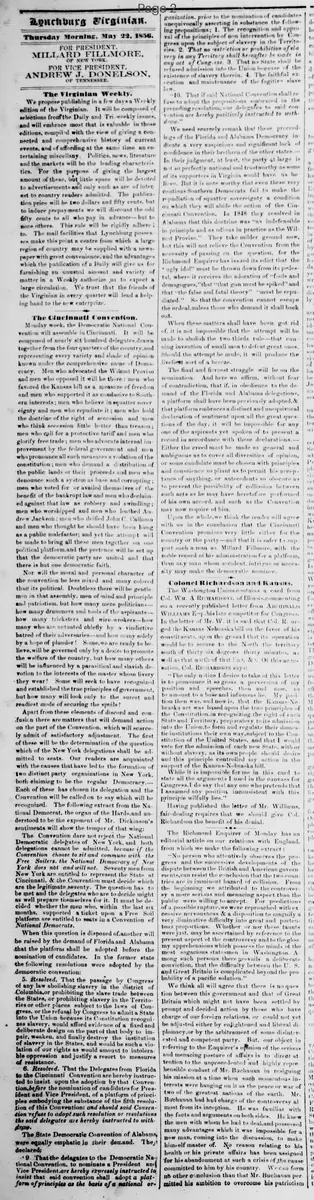
Monday week, the Democratic National Convention will assemble in Cincinnati. It will be composed of nearly six hundred delegates, drawn together from the four quarters of the country, and representing every variety and shade of opinion known under the comprehensive name of Democracy. Men who advocated the Wilmot Proviso and men who opposed it will be there: men who favored the Kansas bill as a measure of freedom and men who supported it as conducive to Southern interests; men who believe in squatter sovereignty and men who repudiate it; men who hold the doctrine of the right of secession and men who think secession little better than treason: men who call for a protective tariff and men who glorify free trade; men who advocate internal improvement by the federal government and men who pronounce all such measures a violation of the constitution; men who demand a distribution of the public lands or their proceeds and men who denounce such a system as base and corrupting; men who voted for or availed themselves of the benefit of the bankrupt law and men who declaimed against that law as robbery and swindling; men who worshipped and men who loathed Andrew Jackson; men who deified John C. Calhoun and men who thought he should have been hung as a public malefactor; and yet the attempt will be made to bring all these men together on one political platform, and the pretence will be set up that the democratic party are united and that there is but one democratic faith.
Nor will the moral and personal character of the convention be less mixed and many colored than its political. Doubtless there will be gentle men in that assembly, men of mind and principle and patriotism, but how many mere politicians—how many drummers and tools of the aspirants—how many tricksters and wire workers—how many who are actuated chiefly by a vindictive hatred of their adversaries—and how many solely by a hope of plunder! Some, we are ready to believe, will be governed only by a desire to promote the welfare of the country, but how many others will be influenced by a parasitical and slavish devotion to the interests of the master whose livery they wear! Some will seek to have recognized and established the true principles of government, but how many will look only to the surest and readiest mode of securing the spoils!
Apart from these elements of discord and confusion there are matters that will demand action on the part of the Convention, which will scarcely admit of satisfactory adjustment. The first of these will be the determination of the question which of the New York delegations shall be admitted to seats. Our readers are acquainted with the causes that have led to the formation of two distinct party organizations in New York, both claiming to be the regular Democracy. Each of these has chosen its delegation and the Convention will be called on to say which will be recognized. The following extract from the National Democrat, the organ of the Hards, and understood to be the exponent of Mr. Dickinson's sentiments will show the temper of that wing:
The Convention dare not reject the National Democratic delegates of New York, and both delegations cannot be admitted, because if the Convention choose to sit and commune with the Free Soilers, the National Democracy of New York does not and will not. Seventy men from New York are entitled to represent the State at Cincinnati, & the Convention must decide which are the legitimate seventy. The question has to be met and the delegates who are to decide might as well prepare themselves for it. It must be decided whether the men who, within the last six months, supported a ticket upon a Free Soil platform are entitled to seats in a Convention of National Democrats.
When this question is disposed of, another will be raised by the demand of Florida and Alabama that the platform shall be adopted before the nomination of candidates. In the former state the following resolutions were adopted by the democratic convention:
5. Resolved, That the passage by Congress of any law abolishing slavery in the district of Columbia, or prohibiting the slave trade between the States, or prohibiting slavery in the Territories or other places subject to the laws of Congress, or the refusal by Congress to admit a State into the Union because its Constitution recognizes slavery, would afford evidence of a fixed and deliberate design on the part of that body to impair, weaken, and finally destroy the institution of slavery in the States, and would be such a violation of our rights as would amount to intolerable oppression and justify a resort to measures of resistance.
6. Resolved. That the Delegates from Florida to the Cincinnati Convention are hereby instructed to insist upon the adoption by that Convention, before the nomination of candidates for President and Vice President, of a platform of principles embodying the substance of the fifth resolution of this Convention: and should said Convention refuse to adopt such resolution or resolutions the said delegates are hereby instructed to withdraw.
The State Democratic Convention of Alabama were equally emphatic in their demand. They declared;
9. 'That the delegates to the Democratic National Convention, to nominate a President and Vice President, are hereby expressly instructed to insist that said convention shall adopt a platform of principles as the basis of a national organization, prior to the nomination of candidates, unequivocally asserting in substance the following propositions; 1. The recognition and approval of the principles of non intervention by Congress upon the subject of slavery in the Territories. 2. That no restriction or prohibition of slavery in any Territory shall hereafter be made in any act of Congress. 3 That no State shall be refused admission into the Union because of the existence of slavery therein. 4. The faithful execution and maintenance of the fugitive slave law.
"10. That if said National Convention shall refuse to adopt the propositions embraced in the preceding resolution, our delegates to said convention are hereby positively instructed to withdraw."
We need scarcely remark that these proceedings of the Florida and Alabama Democracy indicate a very suspicious and significant lack of confidence in their brethren of the other states. In their judgment, at least, the party at large is not so perfectly national and trustworthy as some of its supporters in Virginia would have us believe. But it is noteworthy that even these very cautious Southern Democrats fail to make the repudiation of squatter sovereignty a condition on which they will abide the action of the Cincinnati Convention. In 1848 they resolved in Alabama that this doctrine was "as indefensible in principle and as odious in practice as the Wilmot Proviso." They take milder ground now. but this will not relieve the Convention from the necessity of passing on the question, for the Richmond Enquirer has issued its edict that the "ugly idol" must be thrown down from its pedestal, where it receives the adoration of "fools and demagogues," that "that gun must be spiked" and that "the false and fatal theory" "must be repudiated." So that the convention cannot escape the ordeal, unless those who demand it shall back out.
When these matters shall have been got rid of, it is not impossible that the attempt will be made to abolish the two-thirds rule—that cunning invention of small men to defeat great ones. Should the attempt be made, it will produce the liveliest sort of a breeze.
The final and fiercest struggle will be on the nomination. And here we affirm, without fear of contradiction, that if, in obedience to the demand of the Florida and Alabama delegations, a platform shall have been previously adopted, & that platform embraces a distinct and unequivocal declaration of sentiment upon all the great questions of the day, it will be impossible for any one of the aspirants yet spoken of to present a record in accordance with these declarations. Either the creed must be made so general and ambiguous as to cover all diversities of opinion, or some candidate must be chosen with principles and conscience so pliant as to permit his acceptance of anything, or antecedents so obscure as to prevent the possibility of collision between such acts as he may have heretofore performed of his own accord, and such as the Convention may now require of him.
Upon the whole, we think the reader will agree with us in the conclusion that the Cincinnati Convention promises very little either for the country or the party—and that it is safer to support such a man as Millard Fillmore, with the noble record of his administration for a platform, than any man whom accident, intrigue or necessity may make the democratic nominee.
Monday week, the Democratic National Convention will assemble in Cincinnati. It will be composed of nearly six hundred delegates, drawn together from the four quarters of the country, and representing every variety and shade of opinion known under the comprehensive name of Democracy. Men who advocated the Wilmot Proviso and men who opposed it will be there: men who favored the Kansas bill as a measure of freedom and men who supported it as conducive to Southern interests; men who believe in squatter sovereignty and men who repudiate it; men who hold the doctrine of the right of secession and men who think secession little better than treason: men who call for a protective tariff and men who glorify free trade; men who advocate internal improvement by the federal government and men who pronounce all such measures a violation of the constitution; men who demand a distribution of the public lands or their proceeds and men who denounce such a system as base and corrupting; men who voted for or availed themselves of the benefit of the bankrupt law and men who declaimed against that law as robbery and swindling; men who worshipped and men who loathed Andrew Jackson; men who deified John C. Calhoun and men who thought he should have been hung as a public malefactor; and yet the attempt will be made to bring all these men together on one political platform, and the pretence will be set up that the democratic party are united and that there is but one democratic faith.
Nor will the moral and personal character of the convention be less mixed and many colored than its political. Doubtless there will be gentle men in that assembly, men of mind and principle and patriotism, but how many mere politicians—how many drummers and tools of the aspirants—how many tricksters and wire workers—how many who are actuated chiefly by a vindictive hatred of their adversaries—and how many solely by a hope of plunder! Some, we are ready to believe, will be governed only by a desire to promote the welfare of the country, but how many others will be influenced by a parasitical and slavish devotion to the interests of the master whose livery they wear! Some will seek to have recognized and established the true principles of government, but how many will look only to the surest and readiest mode of securing the spoils!
Apart from these elements of discord and confusion there are matters that will demand action on the part of the Convention, which will scarcely admit of satisfactory adjustment. The first of these will be the determination of the question which of the New York delegations shall be admitted to seats. Our readers are acquainted with the causes that have led to the formation of two distinct party organizations in New York, both claiming to be the regular Democracy. Each of these has chosen its delegation and the Convention will be called on to say which will be recognized. The following extract from the National Democrat, the organ of the Hards, and understood to be the exponent of Mr. Dickinson's sentiments will show the temper of that wing:
The Convention dare not reject the National Democratic delegates of New York, and both delegations cannot be admitted, because if the Convention choose to sit and commune with the Free Soilers, the National Democracy of New York does not and will not. Seventy men from New York are entitled to represent the State at Cincinnati, & the Convention must decide which are the legitimate seventy. The question has to be met and the delegates who are to decide might as well prepare themselves for it. It must be decided whether the men who, within the last six months, supported a ticket upon a Free Soil platform are entitled to seats in a Convention of National Democrats.
When this question is disposed of, another will be raised by the demand of Florida and Alabama that the platform shall be adopted before the nomination of candidates. In the former state the following resolutions were adopted by the democratic convention:
5. Resolved, That the passage by Congress of any law abolishing slavery in the district of Columbia, or prohibiting the slave trade between the States, or prohibiting slavery in the Territories or other places subject to the laws of Congress, or the refusal by Congress to admit a State into the Union because its Constitution recognizes slavery, would afford evidence of a fixed and deliberate design on the part of that body to impair, weaken, and finally destroy the institution of slavery in the States, and would be such a violation of our rights as would amount to intolerable oppression and justify a resort to measures of resistance.
6. Resolved. That the Delegates from Florida to the Cincinnati Convention are hereby instructed to insist upon the adoption by that Convention, before the nomination of candidates for President and Vice President, of a platform of principles embodying the substance of the fifth resolution of this Convention: and should said Convention refuse to adopt such resolution or resolutions the said delegates are hereby instructed to withdraw.
The State Democratic Convention of Alabama were equally emphatic in their demand. They declared;
9. 'That the delegates to the Democratic National Convention, to nominate a President and Vice President, are hereby expressly instructed to insist that said convention shall adopt a platform of principles as the basis of a national organization, prior to the nomination of candidates, unequivocally asserting in substance the following propositions; 1. The recognition and approval of the principles of non intervention by Congress upon the subject of slavery in the Territories. 2. That no restriction or prohibition of slavery in any Territory shall hereafter be made in any act of Congress. 3 That no State shall be refused admission into the Union because of the existence of slavery therein. 4. The faithful execution and maintenance of the fugitive slave law.
"10. That if said National Convention shall refuse to adopt the propositions embraced in the preceding resolution, our delegates to said convention are hereby positively instructed to withdraw."
We need scarcely remark that these proceedings of the Florida and Alabama Democracy indicate a very suspicious and significant lack of confidence in their brethren of the other states. In their judgment, at least, the party at large is not so perfectly national and trustworthy as some of its supporters in Virginia would have us believe. But it is noteworthy that even these very cautious Southern Democrats fail to make the repudiation of squatter sovereignty a condition on which they will abide the action of the Cincinnati Convention. In 1848 they resolved in Alabama that this doctrine was "as indefensible in principle and as odious in practice as the Wilmot Proviso." They take milder ground now. but this will not relieve the Convention from the necessity of passing on the question, for the Richmond Enquirer has issued its edict that the "ugly idol" must be thrown down from its pedestal, where it receives the adoration of "fools and demagogues," that "that gun must be spiked" and that "the false and fatal theory" "must be repudiated." So that the convention cannot escape the ordeal, unless those who demand it shall back out.
When these matters shall have been got rid of, it is not impossible that the attempt will be made to abolish the two-thirds rule—that cunning invention of small men to defeat great ones. Should the attempt be made, it will produce the liveliest sort of a breeze.
The final and fiercest struggle will be on the nomination. And here we affirm, without fear of contradiction, that if, in obedience to the demand of the Florida and Alabama delegations, a platform shall have been previously adopted, & that platform embraces a distinct and unequivocal declaration of sentiment upon all the great questions of the day, it will be impossible for any one of the aspirants yet spoken of to present a record in accordance with these declarations. Either the creed must be made so general and ambiguous as to cover all diversities of opinion, or some candidate must be chosen with principles and conscience so pliant as to permit his acceptance of anything, or antecedents so obscure as to prevent the possibility of collision between such acts as he may have heretofore performed of his own accord, and such as the Convention may now require of him.
Upon the whole, we think the reader will agree with us in the conclusion that the Cincinnati Convention promises very little either for the country or the party—and that it is safer to support such a man as Millard Fillmore, with the noble record of his administration for a platform, than any man whom accident, intrigue or necessity may make the democratic nominee.
What sub-type of article is it?
Partisan Politics
Slavery Abolition
Constitutional
What keywords are associated?
Cincinnati Convention
Democratic Party
Slavery Platform
Party Divisions
New York Delegation
Squatter Sovereignty
Millard Fillmore
Wilmot Proviso
What entities or persons were involved?
Democratic National Convention
Millard Fillmore
Florida Democrats
Alabama Democrats
New York Hards
Daniel Dickinson
Andrew Jackson
John C. Calhoun
Richmond Enquirer
Editorial Details
Primary Topic
Critique Of Divisions In The Democratic National Convention
Stance / Tone
Critical Of Democratic Party Disunity And Pro Slavery Extremism, Supportive Of Millard Fillmore
Key Figures
Democratic National Convention
Millard Fillmore
Florida Democrats
Alabama Democrats
New York Hards
Daniel Dickinson
Andrew Jackson
John C. Calhoun
Richmond Enquirer
Key Arguments
Democratic Party Encompasses Contradictory Views On Wilmot Proviso, Kansas Nebraska Act, Squatter Sovereignty, Secession, Tariffs, Internal Improvements, Public Lands, Bankruptcy Law.
Convention Delegates Include Principled Men But Also Politicians, Tricksters, And Plunder Seekers Driven By Hatred Or Spoils.
Conflict Over Seating New York Delegations: Hards Vs. Softs/Free Soilers.
Southern States (Florida, Alabama) Demand Pro Slavery Platform Before Nominations, Threatening Withdrawal If Refused.
Convention Must Address Squatter Sovereignty Despite Southern Softening.
Possible Attempt To Abolish Two Thirds Rule For Nominations.
No Candidate Can Align With A Clear Platform Due To Past Records; Better To Support Fillmore's Administration Record.