Thank you for visiting SNEWPapers!
Sign up free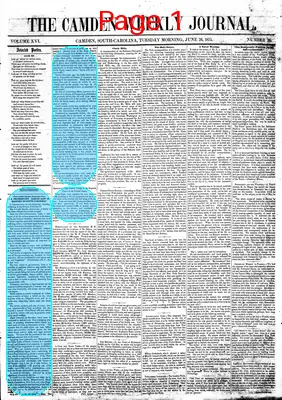
The Camden Weekly Journal
Camden, Kershaw County, South Carolina
What is this article about?
A South Carolina temperance tract argues that intemperance causes widespread societal harm and demands a prohibitory liquor law. It asserts the state's constitutional right to enact such legislation, cites successes in other states, criticizes current liquor sellers, and quotes Chief Justice Taney affirming states' authority to regulate or prohibit alcohol traffic.
Merged-components note: Continuation of the temperance tract article on prohibitory liquor law in South Carolina, including the quoted opinion of Chief Justice Taney on regulating the traffic in spirits.
Clipping
OCR Quality
Full Text
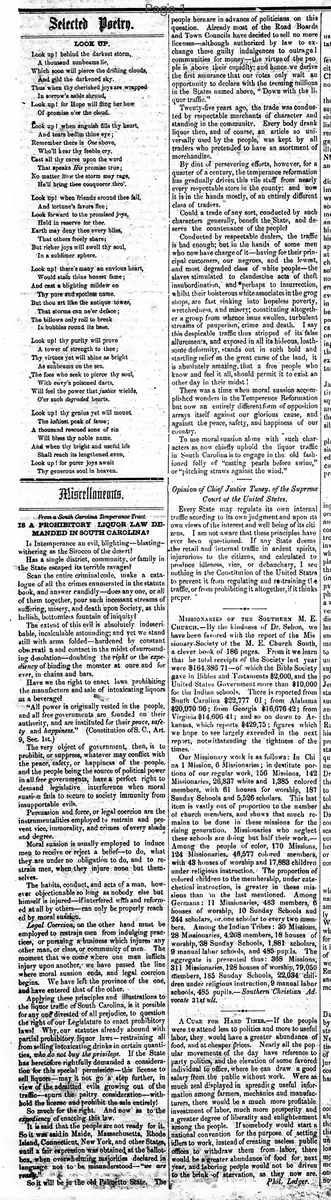
From a South Carolina Temperance Tract.
IS A PROHIBITORY LIQUOR LAW DEMANDED IN SOUTH CAROLINA?
Is Intemperance an evil, blighting—blasting—withering as the Sirocco of the desert?
Has a single district, community, or family in this State escaped its terrible ravages?
Scan the entire criminal code, make a catalogue of all the crimes enumerated in the statute book, and answer candidly—does any one, or all of them together, pour such incessant streams of suffering, misery, and death upon Society, as this hellish, bottomless fountain of iniquity?
The extent of this evil is absolutely indescribable, incalculable, astounding; and yet we stand still with arms folded—hardened by constant observation and contact in the midst of surrounding desolation—doubting the right or the expediency of binding the monster at once and forever, in chains and bars.
Have we the right to enact laws prohibiting the manufacture and sale of intoxicating liquors as a beverage?
"All power is originally rested in the people, and all free governments are founded on their authority, and are instituted for their peace, safety and happiness." (Constitution of S. C., Art. 9, Sec. 1st.)
The very object of government, then, is to prohibit, or suppress, whatever may conflict with the peace, safety, or happiness of the people; and the people being the source of political power in all free governments, have a perfect right to demand legislative interference when moral suasion fails to secure to society immunity from insupportable evils.
Persuasion and force, or legal coercion are the instrumentalities employed to restrain and prevent vice, immorality, and crimes of every shade and degree.
Moral suasion is usually employed to induce men to receive or reject a belief—to do, what they are under no obligation to do, and to restrain men, when they injure none but themselves.
The habits, conduct, and acts of a man, however objectionable so long as nobody else but himself is injured—if interfered with and reformed at all by others—can only be properly reached by moral suasion.
Legal Coercion, on the other hand must be employed to restrain men from indulging practices, or pursuing a business which injures any other man, or class, or community of men. The moment that we come where one man inflicts injury upon another, we have passed the line where moral suasion ends, and legal coercion begins. We have left the province of the one, and have entered that of the other.
Applying these principles and illustrations to the liquor traffic of South Carolina, is it possible for any one divested of all prejudice, to question the right of our Legislature to enact prohibitory laws? Why, our statutes already abound with partial prohibitory liquor laws—restraining all from selling intoxicating drinks in certain quantities, who do not buy the privilege. If the State has heretofore rightfully demanded a consideration for this special permission—this license to sell liquors—may it not go a step further, in view of the admitted evils growing out of the traffic—spurn the paltry consideration—withhold the license and prohibit the sale entirely!
So much for the right. And now as to the expediency of enacting this law.
It is said that the people are not ready for it.
So it was said in Maine, Massachusetts, Rhode Island, Connecticut, New York, and other States, until a fair expression was obtained at the ballot-box, when overwhelming majorities declared in language not to be misunderstood—“we are ready.”
So it will be in the old Palmetto State: The people here are in advance of politicians on this question. Already most of the Road Boards and Town Councils have decided to sell no more licenses—although authorized by law to exchange these guilty indulgences to outrage communities for money—the virtue of the people is above their cupidity; and hence we derive the first assurance that our votes only wait an opportunity to declare with the teeming millions in the States named above, "Down with the liquor traffic."
Twenty-five years ago, the trade was conducted by respectable merchants of character and standing in the community. Every body drank liquor then, and of course, an article so universally used by the people, was kept by all traders who pretended to have an assortment of merchandize.
By dint of persevering efforts, however, for a quarter of a century, the temperance reformation has gradually driven this vile stuff from nearly every respectable store in the county: and now it is in the hands mostly, of an entirely different class of traders.
Could a trade of any sort, conducted by such characters generally, benefit the State, and deserve the countenance of the people?
Conducted by respectable dealers, the traffic is bad enough; but in the hands of some men who now have charge of it—having for their principal customers, our negroes, and the lowest, and most degraded class of white people—the slaves stimulated to clandestine acts of theft, insubordination, and perhaps to insurrection, whilst their boisterous white associates in the grog shops, are fast sinking into hopeless poverty, wretchedness, and misery; constituting altogether a group from whence issue swollen, turbulent streams of pauperism, crime and death. I say this despicable traffic thus stripped of its false allurements, and exposed in all its hideous, loathsome deformity, stands out in such bold and startling relief as the great curse of the land, it is absolutely amazing, that a free people who know and feel it all, should permit it to exist another day in their midst!
There was a time when moral suasion accomplished wonders in the Temperance Reformation but now an entirely different form of opposition arrays itself against our glorious cause, and against the peace, safety, and happiness of our country.
To use moral suasion alone with such characters as now chiefly uphold the liquor traffic in South Carolina is to engage in the old fashioned folly of "casting pearls before swine," or "pitching straws against the wind."
Opinion of Chief Justice Taney, of the Supreme Court of the United States.
Every State may regulate its own internal traffic according to its own judgment and upon its own views of the interest and well being of its citizens. I am not aware that these principles have ever been questioned. If any State deems the retail and internal traffic in ardent spirits, injurious to the citizens, and calculated to produce idleness, vice, or debauchery, I see nothing in the Constitution of the United States to prevent it from regulating and restraining the traffic, or from prohibiting it altogether, if it thinks proper.
What sub-type of article is it?
What keywords are associated?
What entities or persons were involved?
Where did it happen?
Domestic News Details
Primary Location
South Carolina
Key Persons
Event Details
A temperance tract argues for a prohibitory liquor law in South Carolina, emphasizing the societal harms of intemperance, the constitutional right to legislate against it, the expediency based on other states' examples, and the shift in liquor trade to disreputable sellers affecting slaves and the poor.