Thank you for visiting SNEWPapers!
Sign up free
Editorial
August 4, 1807
The Enquirer
Richmond, Henrico County, Virginia
What is this article about?
Thomas Paine, under 'Common Sense,' argues that gun-boats are superior to large ships of war and fortifications for defending the United States' extensive coastline, citing lower costs, greater firepower distribution, mobility, and historical failures of fortifications during the Revolution.
Clipping
OCR Quality
98%
Excellent
Full Text
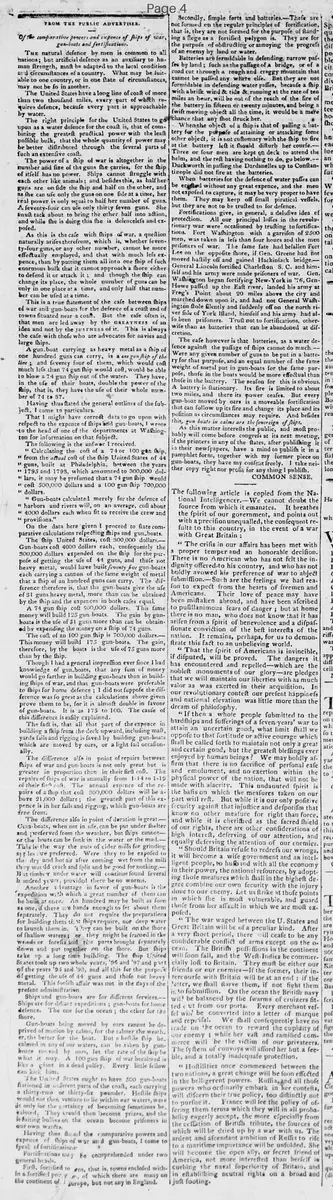
FROM THE PUBLIC ADVERTISER.
Of the comparative powers and expense of ships of war, gun-boats and fortifications.
The natural defence by men is common to all nations: but artificial defence as an auxiliary to human strength, must be adapted to the local conditions and circumstances of a country. What may be suitable to one country, or in one state of circumstances, may not be so in another.
The United States have a long line of coast of more than two thousand miles, every part of which requires defence, because every part is approachable by water.
The right principle for the United States to go upon as a water defence for the coast is, that of combining the greatest practical power with the least possible bulk, that the whole quantity of power may be better distributed through the several parts of such an extensive coast.
The power of a ship of war is altogether in the number and size of the guns she carries, or the ship itself has no power. Ships cannot struggle with each other like animals; and besides this, as half her guns are on one side the ship and half on the other, and as she can use only the guns on one side at a time, her real power is only equal to half her number of guns.
A seventy-four can use only thirty-seven guns. She must tack about to bring the other half into action, and while she is doing this she is defenceless and exposed.
As this is the case with ships of war, a question naturally arises therefrom, which is, whether seventy-four guns, or any other number, cannot be more effectually employed, and that with much less expense, than by putting them all into one ship of such enormous bulk that it cannot approach a shore either to defend it or attack it; and though the ship can change its place, the whole number of guns can be only in one place at a time, and only half that number can be used at a time.
This is a true statement of the case between ships of war and gun-boats for the defence of a coast and of towns situated near a coast. But the case often is, that men are led away by the greatness of an idea and not by the justness of it. This is always the case with those who are advocates for navies and large ships.
A gun-boat carrying as heavy metal as a ship of one hundred guns can carry, is a regular ship of the line; and seventy-four of them, which would cost much less than a 74 gun ship would cost, would be able to blow a 74 gun ship out of the water. They have, in the use of their boats, double the power of the ship, that is, they have the use of their whole number of 74 to 37.
Having thus stated the general outlines of the subject, I come to particulars.
That I might have correct data to go upon with respect to the expense of ships and gun-boats, I wrote to the head of one of the departments at Washington for information on that subject.
The following is the answer I received.
"Calculating the cost of a 74 or 100 gun ship, from the actual cost of the Ship United States of 44 guns, built at Philadelphia, between the years 1795 and 1798, which amounted to 300,000 dollars, it may be presumed that a 74 gun ship would cost 500,000 dollars and a 100 gun ship 700,000 dollars."
"Gun-boats calculated merely for the defence of harbors and rivers will, on an average, cost about 4,000 dollars each when fit to receive the crew and provisions."
On the data here given I proceed to state comparative calculations respecting ships and gun-boats.
The ship United States, cost 300,000 dollars.—Gun-boats cost 4,000 dollars each, consequently the 300,000 dollars expended on the ship for the purpose of getting the use of 44 guns, and those not heavy metal, would have built seventy-five gun-boats each carrying a cannon of the same weight of metal that a ship of an hundred guns can carry. The difference therefore is, that the gun-boats give the use of 81 guns heavy metal, more than can be obtained by the ship and the expenses in both cases equal.
A 74 gun ship cost 500,000 dollars. This same money will build 125 gun boats. The gain by gun-boats is the use of 51 guns more than can be obtained by expending the money on a ship of 74 guns.
The cost of a 100 gun ship is 700,000 dollars.—This money will build 175 gun-boats. The gain, therefore, by the boats is the use of 75 guns more than by the ship.
Though I had a general impression ever since I had knowledge of gun-boats, that any sum of money would go farther in building gun-boats than in building ships of war, and that gun-boats were preferable to ships for home defence; I did not suppose the difference was so great as the calculations above given prove them to be, for it is almost double in favour of gun-boats. It is as 175 to 100. The cause of this difference is easily explained.
The fact is, that all that part of the expense in building a ship from the deck upward, including mast, yards, sails and rigging is saved by building gun-boats which are moved by oars, or a light sail occasionally.
The difference also in point of repairs between ships of war and gun-boats is not only great but is greater in proportion than in their first cost. The repairs of ships of war is annually from 1-14 to 1-19 of their first cost. The annual expense of the repairs of a ship that cost 300,000 dollars will be above 21,000 dollars; the greatest part of this expense is in her sails and rigging, which gun-boats are free from.
The difference also in point of duration is great. Gun-boats, when not in use, can be put under shelter and preserved from the weather, but ships cannot—or the boats can be sunk in the water or the mud.—This is the way the nuts of cider mills for grinding are preserved. Were they to be exposed to the dry and hot air after coming wet from the mill they would crack and split and be good for nothing.—But timber under water will continue sound several hundred years, provided there be no worms.
Another advantage in favor of gun-boats is the expedition with which a great number of them can be built at once. An hundred may be built as soon as one, if there are hands enough to set about them separately. They do not require the preparations for building them that ships require, nor deep water to launch them in. They can be built on the shore of shallow waters; or they might be framed in the woods or forests and the parts brought separately down and put together on the shore. But ships take up a long time building. The ship United States took up two whole years, '96 and '97 and part of the years '95 and '98, and all this for the purpose of getting the use of 44 guns and those not heavy metal. This foolish affair was not in the days of the present administration.
Ships and gun-boats are for different services.—Ships are for distant expeditions; gun-boats for home defence. The one for the ocean; the other for the shore.
Gun-boats being moved by oars cannot be deprived of motion by calms, for the calmer the weather, the better for the boat. But a hostile ship becalmed in any of our waters, can be taken by gun-boats moved by oars, let the rate of the ship be what it may. A 100 gun ship of war becalmed is like a giant in a dead palsy. Every little fellow can kick him.
The United States ought to have 500 gun-boats stationed in different parts of the coast, each carrying a thirty-two or thirty-six pounder. Hostile ships would not then venture to lie within our waters, were it only for the certainty of becoming sometimes becalmed. They should then become prizes, and the insulting bullies on the ocean become prisoners in our own waters.
Having thus stated the comparative powers and expense of ships of war and gun-boats, I come to speak of fortifications.
Fortifications may be comprehended under two general heads.
First, fortified towns, that is, towns enclosed within a fortified polygon, of which there are many on the continent of Europe, but not any in England.
Secondly, Simple forts and batteries.—These are not formed on the regular principles of fortification, that is, they are not formed for the purpose of standing a siege as a fortified polygon is. They are for the purpose of obstructing or annoying the progress of an enemy by land or water.
Batteries are formidable in defending narrow passes by land: such as the passage of a bridge, or of a road cut through a rough and craggy mountain that cannot be passed any where else. But they are not formidable in defending water passes, because a ship with a brisk wind & tide & running at the rate of ten miles an hour, will be out of the reach of the fire of the battery in fifteen or twenty minutes, and being a swift moving object all the time, it would be a mere chance that any shot struck her.
When the object of a ship is that of passing a battery for the purpose of attaining or attacking some other object, it is not customary with the ship to fire at the battery lest it should disturb her course.—Three or four men are kept on deck to attend the helm, and the rest having nothing to do, go below.—Duckworth in passing the Dardanelles up to Constantinople did not fire at the batteries.
When batteries for the defence of water passes can be erected without any great expense, and the men not exposed to capture, it may be very proper to have them. They may keep off small piratical vessels, but they are not to be trusted to for defence.
Fortifications give, in general, a delusive idea of protection. All our principal losses in the revolutionary war were occasioned by trusting to fortifications. Fort Washington with a garrison of 2500 men, was taken in less than four hours and the men prisoners of war. The same fate had befallen Fort Lee on the opposite shore, if Gen. Greene had not moved hastily off and gained Hackensack bridge.—General Lincoln fortified Charleston S. C. and himself and his army were made prisoners of war. Gen. Washington began fortifying New-York in 76, Gen. Howe passed up the East river, landed his army at Frog's Point about 20 miles above the city and marched down upon it, and had not General Washington stole silently and suddenly off on the north river side of York Island, himself and his army had also been prisoners. Trust not to fortifications, otherwise than as batteries that can be abandoned at discretion.
The case however is that batteries, as a water defence against the passage of ships cannot do much.—Were any given number of guns to be put in a battery for that purpose, and an equal number of the same weight of metal put in gun-boats for the same purpose, those in the boats would be more effectual than those in the battery. The reason for this is obvious.
A battery is stationary. Its fire is limited to about two miles, and there its power ceases. But every gun-boat moved by oars is a moveable fortification that can follow up its fire and change its place and its position as circumstances may require. And besides this, gun boats in calms are the sovereign of ships.
As this matter interests the public, and most probably will come before congress at its next meeting, if the printers in any of the states, after publishing it in their newspapers, have a mind to publish it in a pamphlet form, together with my former piece on gun-boats, they have my consent freely. I take neither copy right nor profit for any thing I publish.
COMMON SENSE.
Of the comparative powers and expense of ships of war, gun-boats and fortifications.
The natural defence by men is common to all nations: but artificial defence as an auxiliary to human strength, must be adapted to the local conditions and circumstances of a country. What may be suitable to one country, or in one state of circumstances, may not be so in another.
The United States have a long line of coast of more than two thousand miles, every part of which requires defence, because every part is approachable by water.
The right principle for the United States to go upon as a water defence for the coast is, that of combining the greatest practical power with the least possible bulk, that the whole quantity of power may be better distributed through the several parts of such an extensive coast.
The power of a ship of war is altogether in the number and size of the guns she carries, or the ship itself has no power. Ships cannot struggle with each other like animals; and besides this, as half her guns are on one side the ship and half on the other, and as she can use only the guns on one side at a time, her real power is only equal to half her number of guns.
A seventy-four can use only thirty-seven guns. She must tack about to bring the other half into action, and while she is doing this she is defenceless and exposed.
As this is the case with ships of war, a question naturally arises therefrom, which is, whether seventy-four guns, or any other number, cannot be more effectually employed, and that with much less expense, than by putting them all into one ship of such enormous bulk that it cannot approach a shore either to defend it or attack it; and though the ship can change its place, the whole number of guns can be only in one place at a time, and only half that number can be used at a time.
This is a true statement of the case between ships of war and gun-boats for the defence of a coast and of towns situated near a coast. But the case often is, that men are led away by the greatness of an idea and not by the justness of it. This is always the case with those who are advocates for navies and large ships.
A gun-boat carrying as heavy metal as a ship of one hundred guns can carry, is a regular ship of the line; and seventy-four of them, which would cost much less than a 74 gun ship would cost, would be able to blow a 74 gun ship out of the water. They have, in the use of their boats, double the power of the ship, that is, they have the use of their whole number of 74 to 37.
Having thus stated the general outlines of the subject, I come to particulars.
That I might have correct data to go upon with respect to the expense of ships and gun-boats, I wrote to the head of one of the departments at Washington for information on that subject.
The following is the answer I received.
"Calculating the cost of a 74 or 100 gun ship, from the actual cost of the Ship United States of 44 guns, built at Philadelphia, between the years 1795 and 1798, which amounted to 300,000 dollars, it may be presumed that a 74 gun ship would cost 500,000 dollars and a 100 gun ship 700,000 dollars."
"Gun-boats calculated merely for the defence of harbors and rivers will, on an average, cost about 4,000 dollars each when fit to receive the crew and provisions."
On the data here given I proceed to state comparative calculations respecting ships and gun-boats.
The ship United States, cost 300,000 dollars.—Gun-boats cost 4,000 dollars each, consequently the 300,000 dollars expended on the ship for the purpose of getting the use of 44 guns, and those not heavy metal, would have built seventy-five gun-boats each carrying a cannon of the same weight of metal that a ship of an hundred guns can carry. The difference therefore is, that the gun-boats give the use of 81 guns heavy metal, more than can be obtained by the ship and the expenses in both cases equal.
A 74 gun ship cost 500,000 dollars. This same money will build 125 gun boats. The gain by gun-boats is the use of 51 guns more than can be obtained by expending the money on a ship of 74 guns.
The cost of a 100 gun ship is 700,000 dollars.—This money will build 175 gun-boats. The gain, therefore, by the boats is the use of 75 guns more than by the ship.
Though I had a general impression ever since I had knowledge of gun-boats, that any sum of money would go farther in building gun-boats than in building ships of war, and that gun-boats were preferable to ships for home defence; I did not suppose the difference was so great as the calculations above given prove them to be, for it is almost double in favour of gun-boats. It is as 175 to 100. The cause of this difference is easily explained.
The fact is, that all that part of the expense in building a ship from the deck upward, including mast, yards, sails and rigging is saved by building gun-boats which are moved by oars, or a light sail occasionally.
The difference also in point of repairs between ships of war and gun-boats is not only great but is greater in proportion than in their first cost. The repairs of ships of war is annually from 1-14 to 1-19 of their first cost. The annual expense of the repairs of a ship that cost 300,000 dollars will be above 21,000 dollars; the greatest part of this expense is in her sails and rigging, which gun-boats are free from.
The difference also in point of duration is great. Gun-boats, when not in use, can be put under shelter and preserved from the weather, but ships cannot—or the boats can be sunk in the water or the mud.—This is the way the nuts of cider mills for grinding are preserved. Were they to be exposed to the dry and hot air after coming wet from the mill they would crack and split and be good for nothing.—But timber under water will continue sound several hundred years, provided there be no worms.
Another advantage in favor of gun-boats is the expedition with which a great number of them can be built at once. An hundred may be built as soon as one, if there are hands enough to set about them separately. They do not require the preparations for building them that ships require, nor deep water to launch them in. They can be built on the shore of shallow waters; or they might be framed in the woods or forests and the parts brought separately down and put together on the shore. But ships take up a long time building. The ship United States took up two whole years, '96 and '97 and part of the years '95 and '98, and all this for the purpose of getting the use of 44 guns and those not heavy metal. This foolish affair was not in the days of the present administration.
Ships and gun-boats are for different services.—Ships are for distant expeditions; gun-boats for home defence. The one for the ocean; the other for the shore.
Gun-boats being moved by oars cannot be deprived of motion by calms, for the calmer the weather, the better for the boat. But a hostile ship becalmed in any of our waters, can be taken by gun-boats moved by oars, let the rate of the ship be what it may. A 100 gun ship of war becalmed is like a giant in a dead palsy. Every little fellow can kick him.
The United States ought to have 500 gun-boats stationed in different parts of the coast, each carrying a thirty-two or thirty-six pounder. Hostile ships would not then venture to lie within our waters, were it only for the certainty of becoming sometimes becalmed. They should then become prizes, and the insulting bullies on the ocean become prisoners in our own waters.
Having thus stated the comparative powers and expense of ships of war and gun-boats, I come to speak of fortifications.
Fortifications may be comprehended under two general heads.
First, fortified towns, that is, towns enclosed within a fortified polygon, of which there are many on the continent of Europe, but not any in England.
Secondly, Simple forts and batteries.—These are not formed on the regular principles of fortification, that is, they are not formed for the purpose of standing a siege as a fortified polygon is. They are for the purpose of obstructing or annoying the progress of an enemy by land or water.
Batteries are formidable in defending narrow passes by land: such as the passage of a bridge, or of a road cut through a rough and craggy mountain that cannot be passed any where else. But they are not formidable in defending water passes, because a ship with a brisk wind & tide & running at the rate of ten miles an hour, will be out of the reach of the fire of the battery in fifteen or twenty minutes, and being a swift moving object all the time, it would be a mere chance that any shot struck her.
When the object of a ship is that of passing a battery for the purpose of attaining or attacking some other object, it is not customary with the ship to fire at the battery lest it should disturb her course.—Three or four men are kept on deck to attend the helm, and the rest having nothing to do, go below.—Duckworth in passing the Dardanelles up to Constantinople did not fire at the batteries.
When batteries for the defence of water passes can be erected without any great expense, and the men not exposed to capture, it may be very proper to have them. They may keep off small piratical vessels, but they are not to be trusted to for defence.
Fortifications give, in general, a delusive idea of protection. All our principal losses in the revolutionary war were occasioned by trusting to fortifications. Fort Washington with a garrison of 2500 men, was taken in less than four hours and the men prisoners of war. The same fate had befallen Fort Lee on the opposite shore, if Gen. Greene had not moved hastily off and gained Hackensack bridge.—General Lincoln fortified Charleston S. C. and himself and his army were made prisoners of war. Gen. Washington began fortifying New-York in 76, Gen. Howe passed up the East river, landed his army at Frog's Point about 20 miles above the city and marched down upon it, and had not General Washington stole silently and suddenly off on the north river side of York Island, himself and his army had also been prisoners. Trust not to fortifications, otherwise than as batteries that can be abandoned at discretion.
The case however is that batteries, as a water defence against the passage of ships cannot do much.—Were any given number of guns to be put in a battery for that purpose, and an equal number of the same weight of metal put in gun-boats for the same purpose, those in the boats would be more effectual than those in the battery. The reason for this is obvious.
A battery is stationary. Its fire is limited to about two miles, and there its power ceases. But every gun-boat moved by oars is a moveable fortification that can follow up its fire and change its place and its position as circumstances may require. And besides this, gun boats in calms are the sovereign of ships.
As this matter interests the public, and most probably will come before congress at its next meeting, if the printers in any of the states, after publishing it in their newspapers, have a mind to publish it in a pamphlet form, together with my former piece on gun-boats, they have my consent freely. I take neither copy right nor profit for any thing I publish.
COMMON SENSE.
What sub-type of article is it?
Military Affairs
Economic Policy
What keywords are associated?
Gun Boats
Ships Of War
Coastal Defense
Fortifications
Military Expense
Revolutionary War
Thomas Paine
What entities or persons were involved?
United States
Congress
Gen. Washington
Gen. Greene
Gen. Lincoln
Gen. Howe
Duckworth
Editorial Details
Primary Topic
Advantages Of Gun Boats Over Ships And Fortifications For Us Coastal Defense
Stance / Tone
Strong Advocacy For Gun Boats As Cost Effective Home Defense
Key Figures
United States
Congress
Gen. Washington
Gen. Greene
Gen. Lincoln
Gen. Howe
Duckworth
Key Arguments
Ships Of War Have Ineffective Power Due To Only Using Half Guns At A Time
Gun Boats Provide Double The Firepower Of Ships For Same Cost
Building Gun Boats Is Cheaper And Faster Than Ships
Fortifications Failed In Revolutionary War Leading To Captures
Gun Boats Are Mobile And Effective In Calms Against Becalmed Ships
Recommend 500 Gun Boats For Us Coast