Thank you for visiting SNEWPapers!
Sign up free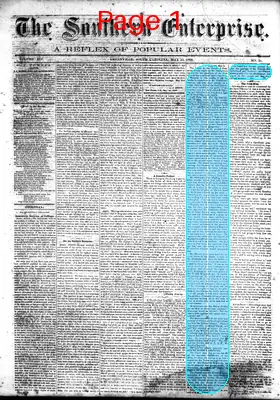
The Southern Enterprise
Greenville, Greenville County, South Carolina
What is this article about?
On May 4, 1868, the British House of Commons continued debating William Gladstone's resolutions to disestablish the Irish Church. Key speakers included Walpole, Lord Elcho, Gladstone, and Disraeli. The first resolution passed 330-265, prompting Disraeli to adjourn for government consultation. Papers view it as decisive, with dissolution rumors.
Clipping
OCR Quality
Full Text
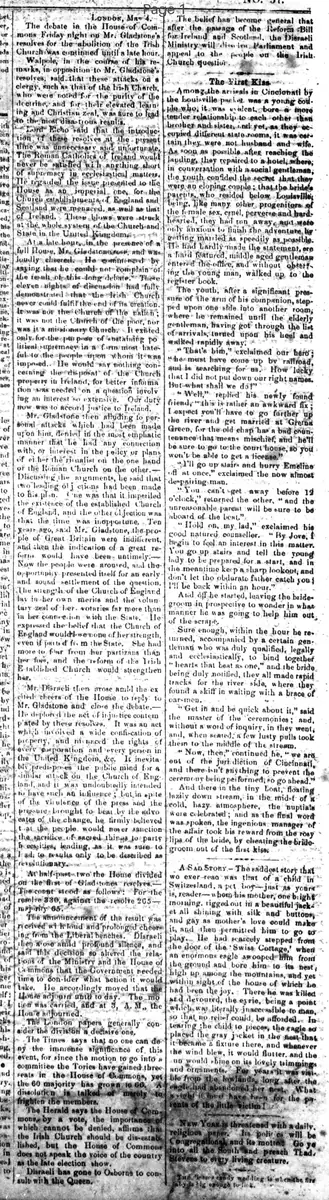
The debate in the House of Commons Friday night on Mr. Gladstone's resolves for the abolition of the Irish Church was continued until a late hour. Walpole, in the course of his remarks, in opposition to Mr. Gladstone's resolves, said that these attacks on a clergy, such as that of the Irish Church, who were noted for the purity of their doctrine, and for their elevated learning and Christian zeal, was sure to lead to the most disastrous results.
Lord Elcho said that the introduction of these resolves at the present time was unnecessary and unfortunate. The Roman Catholics of Ireland would never be satisfied with anything short of supremacy in ecclesiastical matters. He regarded the issue presented to the House as a special one, for the Churches in establishment of England and Scotland were menaced, as well as that of Ireland. These blows were struck at the whole system of the Church and State in the United Kingdom.
Again the hour in the presence of a full House, Mr. Gladstone rose and was loudly cheered. He commenced by saying that he could not complain of the length of this long debate. These eleven nights of discussion had fully demonstrated that the Irish Church never could fulfill the end of its creation. It was not the Church of the nation: it was not the Church of the poor, nor was it a missionary Church? It existed only for the purpose of maintaining political supremacy in a form most hateful to the people on whom it was imposed. He would say nothing concerning the disposition of the Church property in Ireland, for better information was needed on a question involving an interest so extensive. Our duty now was to accord justice to Ireland.
Mr. Gladstone then alluding to personal attacks which had been made upon him, denied in the most emphatic manner that he had any connection with, or interest in the policy or plans of either the ritualist on the one hand of the Roman Church on the other.
Discussing the arguments, he said that two leading objections had been made to his plan. One was that it imperiled the existence of the established Church of England, and the other objection was that the time was inopportune. Ten years ago, said Mr. Gladstone, the people of Great Britain were indifferent, and then the indication of a great reform would have been untimely: Now the people were aroused, and the opportunity presented itself for an early and sound settlement of the question.
The strength of the Church of England lay in her own merits and the voluntary zeal of her votaries far more than in her connection with the State. He expressed the belief that the Church of England would lose none of her strength, even if parted from the State. She had more to fear from her partisans than her foes, and the reform of the Irish Established Church would strengthen her.
Mr. Disraeli then arose amid the excited cheers of the House to reply to Mr. Gladstone and close the debate. He deplored the act of injustice contemplated by these resolves." It was an act which involved a wide confiscation of property, and menaced the rights of every corporation and every person in the United Kingdom, &c. It inevitably predisposes the public mind for a similar attack on the Church of England, and it was undoubtedly intended to have such an influence; but in spite of the virulence of the press and the pressure brought to bear by the advocates of the change, he firmly believed that the people would never sanction the sacrifice of sacred things to party necessities, leading, as it was sure to lead; to results only to be described as revolutionary.
At half-past two the House divided on the first of Gladstone's "resolves."
The count stood as follows: For the resolve 330, against the resolve 265—majority 65.
The announcement of the result was received with loud and prolonged cheering from the Liberal benches. Disraeli then arose amid profound silence, and said this decision so altered the relations of the Ministry and the House of Commons that the Government needed time to consider what action it would take. He accordingly moved that the House adjourn until to-day. The motion was carried, and at 3 A. M. the House adjourned.
The London papers generally consider the division a decisive one. The Times says that no one can deny the immense significance of this event, for since the motion to go into a committee the Tories have gained three seats in the House of Commons, yet the 50 majority has grown to 65. A dissolution is talked of merely to frighten the members.
The Herald says the House of Commons, by a vote, the importance of which cannot be denied, affirms that the Irish Church should be disestablished, but the House of Commons does not speak the voice of the country as the late election show.
Disraeli has gone to Osborne to consult with the Queen.
The belief has become general that after the passage of the reform Bill for Ireland and Scotland, the Disraeli Ministry will dissolve Parliament and appeal to the people on the Irish Church question.
What sub-type of article is it?
What keywords are associated?
What entities or persons were involved?
Where did it happen?
Foreign News Details
Primary Location
Ireland
Event Date
May 4
Key Persons
Outcome
first resolve passed 330-265 (majority 65); government to consider action, potential dissolution of parliament.
Event Details
The House of Commons debated Mr. Gladstone's resolves for abolishing the Irish Church over eleven nights. Opponents like Walpole and Lord Elcho argued it threatened the Church and State system. Gladstone defended the need for justice to Ireland, denying personal biases. Disraeli criticized it as unjust confiscation. The vote on the first resolve resulted in a Liberal victory, leading to adjournment for government consultation. London papers deemed it decisive, with Disraeli consulting the Queen and rumors of dissolution after reform bills.