Thank you for visiting SNEWPapers!
Sign up free
Literary
November 22, 1827
The Virginian
Lynchburg, Virginia
What is this article about?
A gothic prose tale of Frederick Oldenbert, whose youthful enthusiasm leads him to Germany, where he embraces skepticism and infidelity under the influence of the blasphemous student Faustendorff. They plot against a nobleman's lover, leading to a fatal duel where Oldenbert kills the Baron and Faustendorff is struck by lightning. Wracked by guilt, Oldenbert returns home, descends into alcoholism, and suicides; his forsaken lover dies soon after.
Clipping
OCR Quality
70%
Good
Full Text
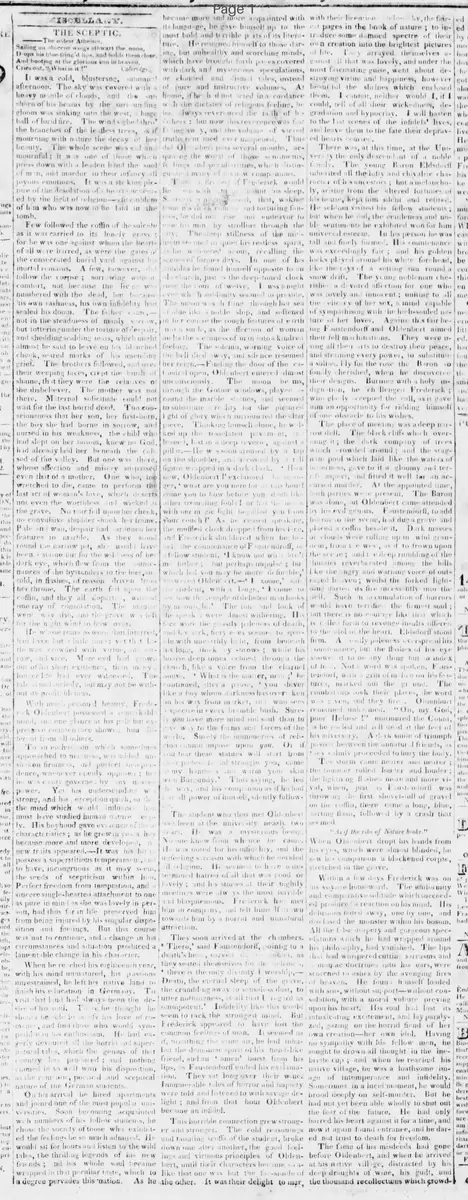
THE SCEPTIC.
-The oldest Atheism.
Sailing on obscene wings athwart the noon,
Drops his blue-fring'd lips, and holds them close
And hooting at the glorious sun in heaven.
Cries out, 'What is it?'
Coleridge
It was a cold, blustering, autumn
afternoon. The sky was covered with
heavy masses of clouds, and the sun
shorn of his beams by the surrounding
gloom was sinking into the west, a huge
ball of lurid fire. The wind sighed through
the branches of the leafless trees, as if
mourning with nature the decay of her
beauty. The whole scene was sad and
mournful; it was one of those when
depression weighs down with a leaden hand the soul
of man, and murders in their infancy
joyous emotions. It was a striking picture
of the desolation of heaven occasioned
by the light of religion—a fit emblem
of him who was now to be laid in the
tomb.
Few followed the coffin of his remains
as it was carried to its lonely grave:
for he was one against whom the hearts
of all were barred, as were the gates of
the consecrated burial yard against his
mortal remains. A few, however, did
follow the corpse; sorrowing with pity
not because the youth was
numbered with the dead, but because
his own rashness, his own infidelity had
sealed his doom. The father came,
not in the steadiness of manly sorrow,
but tottering under the torture of despair.
and shedding scalding tears, which might
almost be said to leave on his blanched
cheek, seared marks of his unending
grief. The brothers followed, and over
their weeping faces, crept the blush of
shame, that they wore the relatives of
the disbeliever. The mother was not
there. Maternal solicitude could not
want for the last horrid deed. The consciousness that her son, her first-born,
the boy she had borne in sorrow, and
nursed in his weakness, the child who
had slept on her bosom, knew no God,
had already laid her beneath the cold
sod of the valley. But one was there,
whose affection and misery surpassed
even that of a mother. One who, too
wretched to live, came to perform the
last act of woman's love, which deserts
not even the worthless and wicked in
the grave. No tear fell upon her cheek,
no convulsive shudder shook her frame.
Pale and wan, despair had hardened her
features to marble. As they stood
round the narrow pit, she would have
been taken for the lifeless of her
lover, but for the dark eye, which dwelt from the countenances of the bystanders to the bier, in
wild, in flashes, of reason driven from
her throne. The earth fell upon the
coffin, and they all departed, without
one ray of consolation. The man
whom we have now described, Frederick Oldenbert, possessed a quick but
erratic mind, and one glance at his person but
exhibited how deeply
he was tainted from his birth. In youth his
enthusiasm sometimes
approached to madness, was allied to
shaken firmness, and perfect impetuosity, whenever keenly opposed; but
in adversity governed by no motive
power. Yet his understanding was
strong, and his perception quick, with
the mind which would ruin one must have studied human nature
closely. His boyhood gave evidence of these
characteristics; as he grew in years he
became more and more developed,
new traits appeared,—It was his lot
to possess a superstitious temperament,
to have, incongruous as it may seem,
the seeds of scepticism within him.
Perfect freedom from temptation, and
sincere single-hearted attachment to one
as pure in mind as she was lovely in person, had thus far in life preserved him
from being injured by his singular disposition and foibles. But this course
was not to continue, and change in his
circumstances and situation produced a
lamentable change in his character.
When he reached his eighteenth year,
with his mind untainted, his passions
unrestrained, he left his native land to
finish his education in Germany. To
visit that land had always been the desire of his soul. The thought he
should be able to enjoy his love of romance, and find those who would sympathize with his enthusiasm. He had eagerly devoured all the horrible and supernatural tales, which the genius of that
country produced; and nothing
chimed in so well with his disposition,
as the romantic, poetic and sceptical
nature of the German students.
On his arrival he hired apartments
and joined one of the most popular universities. Soon becoming acquainted
with numbers of his fellow students, he
chose the society of those who exhibited the feelings he so much admired. He
would sit for hours and listen to the wild
tales, the thrilling legends of his new
friends; and his whole soul became
wrapped in that peculiar taste, which to
a daemon revels this satire
As he
became more and more acquainted with
its language, he gave himself up to the
most bold and terrible parts of its literature.
He resigned himself to those daring,
but unhealthy and scorching minds.
which have brought forth pages covered
with dark and mysterious speculations,
or clouded and dismal fables, instead
of pure and instructive volumes. At
home, if he had not acted in accordance
with the dictates of religious feeling, he
had always reverenced the faith of his
parents: his now his reverence was fast
failing away. In the volumes of sacred
truths reposed ever unopened. Thus
did Oldenbert pass several months, ac-
quainting the worst of those soirees,
the orgies and eccentricities, which distinguished his new companions.
The demon of Frederick would
lie awake nights in sleep.
Satan, with him
from a pathless wood, and torturing fall-
acies, he did more than endeavor to
sow his mind by strolling through the
city. The deep stillness of the midnight
scene most to quell his restless spirit,
as he wandered about, recalling the
scenes of former days. In one of his
rambles he found himself opposite to an
ancient church, just as the deep-toned clock
struck the hour of twelve. It was a night
when sublimity seemed to preside.
The moon was diffusing through her sea
of shade like a noble ship, and softened
in her course the rough features of earth
into a smile, as the feeling of woman
and the sternness of man to a kindred
feeling. The solemn, warning voice of
the bell died away, and silence resumed
her reign.—Finding the door of the ca-
thedral open, Oldenbert entered almost
unconsciously. The moon beams,
through the Gothic windows, played
round the marble statues, and seemed
to substitute by their pictured
light of glory which surrounded these storied
piece. Thinking himself alone, he walked up the tessellated pavement, to
lean, lost in a deep reverie, against a
pillar,—He was soon aroused by a tap
on the shoulder, and a voice by his
side 'How
now, Oldenbert' exclaimed he sternly.
'What are you here at this hour? What
come you to bow before yon dumb idol
that tempting fool? or has the old
witch with her magic fright beguiled
your conscience?' As he ceased speaking,
the muffled cloak dropped from his face.
and Frederick shuddered when he beheld the countenance of Faustendorff, his
fellow student. 'I know not why
I come hither; but perhaps impulse; but
which led you may be more definable,.
'ew Oldenbert.—'I come' said
he with a laugh, 'I come to
mock the temple old eldritch looks
by ton b Ie.' The tone and look of
the speaker were most unearthly His
face wore the ghastly paleness of death,
and his dark, fiery eyes seemed to sparkle with unearthly light, from beneath
his long, thick eye-brows; while his
hoarse deep tones echoed through the
church, like a voice from the charnel
house. 'What is the matter,' he
continued, after a pause, 'you shiver
like a boy whom darkness has overtaken
on his way from school, who sees
spectres in every bramble bush. Surely
you have more mind and soul than to
bow to the forms and forces of the
world. Surely the mummeries of religion cannot impose upon you. Or if
you fear these statues will start from
their pedestals and strangle you, come
my hand is now warm youth shall
vanquish bugbears.' Thus saying, he took
his arm, and his companion as if he had
no will power of himself, silently followed
The student who thus met Oldenbert
had been at the university nearly two
years. He was a mysterious being.
No one knew from whence he came.
He was noted for his misanthropy, and the
withering sarcasm with which he ridiculed
religion. He seemed to have a
determined hatred of all that was good or
lovely; and his stories at their nightly
meetings were always the most terrible
and blasphemous. Frederick had met
him in company, and felt himself drawn
towards him by a blind and unnatural
attraction.
They soon arrived at the chambers.
There,' said Faustendorff, pointing to a
dead man's head, carved
above, as
they seated themselves by the Bible,
there is the only deity I worship,—
Death, the eternal sleep of the grave,
the crumbling away of senseless dust, to
utter nothingness, still I urge as
omnipotent.' Infidelity like this would
seem to rack the strongest mind. But
Frederick appeared to have lost the
common feelings of man. It seemed as
if, listening to these wild airs, he had inhaled the demoniac spirit of his friend, and an amen burst from his
lips, as Faustendorff ended his exclamation. They sat long over their wine.
Innumerable tales of horror and impiety
were told and listened to with savage delight: and from that hour Oldenbert
became an infidel.
This horrible connection grew stronger
and stronger. The cold reasonings
and taunting scoffs of the student, broke
down one after another, the good feelings and virtuous principles of Oldenbert, until their characters became so alike that one was but the facsimile of
the other. It was their delight to mar.
with their licentious tongues, the fairest
pages in the book of nature; to introduce some damned spectre of their
own creation into the brightest pictures
of life. They arrayed themselves against all that was lovely, and under the
most fascinating guise, went about destroying virtue and happiness, however
beautiful the shrines which enclosed
them. I cannot, neither would I, if I
could, tell of all their wickedness, degradation and hypocrisy. I will hasten
to the last scenes of the infidels' lives,
and leave them to the fate their depraved hearts counseled.
There was, at this time, at the University the only descendant of a noble
family. The young Baron Eldsdorff
inherited all the lofty and chivalric character of his ancestors; but melancholy,
arising from the altered fortunes of
his house, kept him silent and retired.
He seldom visited his fellow students:
but when he did, the gentleness and noble sentiments he exhibited won for him
universal esteem. In his person he was
tall and finely formed. His countenance
was exceedingly fair; and his golden
locks played around his white forehead
like the rays of a setting sun round a
snow drift. The young nobleman cherished a devoted affection for one who
was lovely and innocent: uniting to all
the loveliness of her sex, a mind capable
of sympathizing with the high-souled nature of her lover. Against this fair being, Faustendorff and Oldenbert aimed
their fell machinations. They were using all their wits to destroy their peace,
and straining every power, to substitute
a sullen ivy for the rose the Baron so
fondly cherished, when he discovered
their designs. Burning with a holy indignation, he challenged Frederick;
who gladly accepted the call, as it gave
him an opportunity for ridding himself
of an obstacle to his wishes.
The place of meeting was a deep narrow dell. The black cliffs which over-
hung it; the dark company of trees
which crowded around; and the stagnant pool which lay like the waters of
Lethe, gave to it a gloomy and terrible
aspect, and fitted it well for an accursed murder. At the appointed time,
both parties were present. The Baron
was alone, but Oldenbert came attended
by his evil genius, Faustendorff, to add
horror to the scene, he dug a grave and
placed a coffin beside it. Dark masses
of clouds were rolling up with wild grandeur, from the west, and to frown upon
the scene; and the deep rumbling of the
thunder reverberated among the hills
like the angry and warning voice of outraged heaven; whilst the forked lightning darted its fire incessantly into the
dell. Such a cumulation of horrors
would have terrified the firmest soul;
But there is no courage like that which
is born to revenge insults offered
to the pride of the heart. Eldsdorff stood
firm. A deadly paleness overspread his
countenance, but the flashes of his eye
showed to the enemy nothing but a thirst
of blood. Not a word was spoken. Faustendorff, with a grin of malignant ferocity, measured out the ground. The
combatants took their places, the word
was given, and they fired. Oldenbert
remained unharmed. 'Oh, my God,
poor Heloise!' murmured the Baron,
as he reeled and fell at the feet of his adversary. A dark smile of triumph
passed between the unnatural friends, as
they calmly proceeded to bury the body.
The storm came nearer and nearer;
the thunder rolled louder and louder;
the lightning flashed more and more vividly, when, just as Faustendorff was
throwing the first shovelful of gravel
on the coffin, there came a long, blue,
strong flash, followed by a crash that
seemed
'As of the ribs of Nature broke.'
When Oldenbert dropped his hands from
his eyes, which were almost blinded, he
saw his companion a blackened corpse,
stretched in the grave.
Within a few days Frederick was on
his voyage homeward. The uniformity
and comparative solitude which succeeded
produced a reaction on his mind. His
delusions faded away, one by one, and
disclosed the monster within his bosom.
All the false drapery and gorgeous speculations which he had wrapped around
his philosophy, had vanished. The lips
that had whispered cunning sarcasms and
deceitful doctrines into his ears, were
scorched to ashes by the avenging fires
of heaven. He found himself loaded
with sins, without support—without consolation, with a moral vulture preying
upon his heart. His soul had lost its
intoxicating excitement, and lay paralyzed, gazing on the horrid fiend of her
own creation—her own idol. Having
no sympathy with his fellow men, he
sought to drown all thought in the inebriating cup; and when he reached his
native village, he was a loathsome image of intemperance and infidelity.
Sometimes in a lucid moment, he would
brood deeply on self-murder. But he
had not yet been able wholly to shut out
the fear of the future. He had only
barred his heart against it for a time, and
now it again found entrance, and he dared not trust to death for freedom.
The time of his misdeeds had gone
before Oldenbert, and when he arrived
at his native village, distracted by his
deep draughts of wine, his guilt, and
the thousand recollections which crowded around his heart, he saw hate painted on every countenance. He passed
by the church-yard, and the grave of his
mother met his view. He reached his
home, and saw his father ready to lie
down in sorrow by her side. His brothers avoided him, his friends had forgotten him, while the sight of him, the
abandoned, outcast one, was all that
was wanting to lay waste the intellect of
the maiden who had loved him with her
whole soul. There was no place, no
comfort, no joy for him. He could not
live, he could not even endure existence.
He wandered about for a few days in
misery, when one morning the report of
a pistol was heard in his room,—and
Frederick Oldenbert was no more. In
his bible, presented by his mother, when
he enjoyed the innocence of childhood,
were found the following lines;
Driven by my destiny, self-murder
must close the catalogue of my sins. Before this is read, I shall be no more.
What am I that I should live? An outcast, going about like the wandering Jew,
with the burning cross stamped upon my
brow. I am a second Judas. If there
be a God—I know no God.—But what
comes after death? No matter. Let
this bible, never opened by me, be given
to her who has been as constant to
me as I have been false to all. F. O.
One beautiful summer's evening,
nearly a year from the funeral of Frederick, the maniac was seen to go up the
little hill on whose summit he was buried.
When her friends, from whom she
had wandered, came to the spot, they
found her clasping the cold marble with
the unrelaxing grasp of death. The bible had fallen from her hand—a
smile seemed still to linger on her pale
and beautiful countenance: but her soul
had winged its way to that peace forever.
-The oldest Atheism.
Sailing on obscene wings athwart the noon,
Drops his blue-fring'd lips, and holds them close
And hooting at the glorious sun in heaven.
Cries out, 'What is it?'
Coleridge
It was a cold, blustering, autumn
afternoon. The sky was covered with
heavy masses of clouds, and the sun
shorn of his beams by the surrounding
gloom was sinking into the west, a huge
ball of lurid fire. The wind sighed through
the branches of the leafless trees, as if
mourning with nature the decay of her
beauty. The whole scene was sad and
mournful; it was one of those when
depression weighs down with a leaden hand the soul
of man, and murders in their infancy
joyous emotions. It was a striking picture
of the desolation of heaven occasioned
by the light of religion—a fit emblem
of him who was now to be laid in the
tomb.
Few followed the coffin of his remains
as it was carried to its lonely grave:
for he was one against whom the hearts
of all were barred, as were the gates of
the consecrated burial yard against his
mortal remains. A few, however, did
follow the corpse; sorrowing with pity
not because the youth was
numbered with the dead, but because
his own rashness, his own infidelity had
sealed his doom. The father came,
not in the steadiness of manly sorrow,
but tottering under the torture of despair.
and shedding scalding tears, which might
almost be said to leave on his blanched
cheek, seared marks of his unending
grief. The brothers followed, and over
their weeping faces, crept the blush of
shame, that they wore the relatives of
the disbeliever. The mother was not
there. Maternal solicitude could not
want for the last horrid deed. The consciousness that her son, her first-born,
the boy she had borne in sorrow, and
nursed in his weakness, the child who
had slept on her bosom, knew no God,
had already laid her beneath the cold
sod of the valley. But one was there,
whose affection and misery surpassed
even that of a mother. One who, too
wretched to live, came to perform the
last act of woman's love, which deserts
not even the worthless and wicked in
the grave. No tear fell upon her cheek,
no convulsive shudder shook her frame.
Pale and wan, despair had hardened her
features to marble. As they stood
round the narrow pit, she would have
been taken for the lifeless of her
lover, but for the dark eye, which dwelt from the countenances of the bystanders to the bier, in
wild, in flashes, of reason driven from
her throne. The earth fell upon the
coffin, and they all departed, without
one ray of consolation. The man
whom we have now described, Frederick Oldenbert, possessed a quick but
erratic mind, and one glance at his person but
exhibited how deeply
he was tainted from his birth. In youth his
enthusiasm sometimes
approached to madness, was allied to
shaken firmness, and perfect impetuosity, whenever keenly opposed; but
in adversity governed by no motive
power. Yet his understanding was
strong, and his perception quick, with
the mind which would ruin one must have studied human nature
closely. His boyhood gave evidence of these
characteristics; as he grew in years he
became more and more developed,
new traits appeared,—It was his lot
to possess a superstitious temperament,
to have, incongruous as it may seem,
the seeds of scepticism within him.
Perfect freedom from temptation, and
sincere single-hearted attachment to one
as pure in mind as she was lovely in person, had thus far in life preserved him
from being injured by his singular disposition and foibles. But this course
was not to continue, and change in his
circumstances and situation produced a
lamentable change in his character.
When he reached his eighteenth year,
with his mind untainted, his passions
unrestrained, he left his native land to
finish his education in Germany. To
visit that land had always been the desire of his soul. The thought he
should be able to enjoy his love of romance, and find those who would sympathize with his enthusiasm. He had eagerly devoured all the horrible and supernatural tales, which the genius of that
country produced; and nothing
chimed in so well with his disposition,
as the romantic, poetic and sceptical
nature of the German students.
On his arrival he hired apartments
and joined one of the most popular universities. Soon becoming acquainted
with numbers of his fellow students, he
chose the society of those who exhibited the feelings he so much admired. He
would sit for hours and listen to the wild
tales, the thrilling legends of his new
friends; and his whole soul became
wrapped in that peculiar taste, which to
a daemon revels this satire
As he
became more and more acquainted with
its language, he gave himself up to the
most bold and terrible parts of its literature.
He resigned himself to those daring,
but unhealthy and scorching minds.
which have brought forth pages covered
with dark and mysterious speculations,
or clouded and dismal fables, instead
of pure and instructive volumes. At
home, if he had not acted in accordance
with the dictates of religious feeling, he
had always reverenced the faith of his
parents: his now his reverence was fast
failing away. In the volumes of sacred
truths reposed ever unopened. Thus
did Oldenbert pass several months, ac-
quainting the worst of those soirees,
the orgies and eccentricities, which distinguished his new companions.
The demon of Frederick would
lie awake nights in sleep.
Satan, with him
from a pathless wood, and torturing fall-
acies, he did more than endeavor to
sow his mind by strolling through the
city. The deep stillness of the midnight
scene most to quell his restless spirit,
as he wandered about, recalling the
scenes of former days. In one of his
rambles he found himself opposite to an
ancient church, just as the deep-toned clock
struck the hour of twelve. It was a night
when sublimity seemed to preside.
The moon was diffusing through her sea
of shade like a noble ship, and softened
in her course the rough features of earth
into a smile, as the feeling of woman
and the sternness of man to a kindred
feeling. The solemn, warning voice of
the bell died away, and silence resumed
her reign.—Finding the door of the ca-
thedral open, Oldenbert entered almost
unconsciously. The moon beams,
through the Gothic windows, played
round the marble statues, and seemed
to substitute by their pictured
light of glory which surrounded these storied
piece. Thinking himself alone, he walked up the tessellated pavement, to
lean, lost in a deep reverie, against a
pillar,—He was soon aroused by a tap
on the shoulder, and a voice by his
side 'How
now, Oldenbert' exclaimed he sternly.
'What are you here at this hour? What
come you to bow before yon dumb idol
that tempting fool? or has the old
witch with her magic fright beguiled
your conscience?' As he ceased speaking,
the muffled cloak dropped from his face.
and Frederick shuddered when he beheld the countenance of Faustendorff, his
fellow student. 'I know not why
I come hither; but perhaps impulse; but
which led you may be more definable,.
'ew Oldenbert.—'I come' said
he with a laugh, 'I come to
mock the temple old eldritch looks
by ton b Ie.' The tone and look of
the speaker were most unearthly His
face wore the ghastly paleness of death,
and his dark, fiery eyes seemed to sparkle with unearthly light, from beneath
his long, thick eye-brows; while his
hoarse deep tones echoed through the
church, like a voice from the charnel
house. 'What is the matter,' he
continued, after a pause, 'you shiver
like a boy whom darkness has overtaken
on his way from school, who sees
spectres in every bramble bush. Surely
you have more mind and soul than to
bow to the forms and forces of the
world. Surely the mummeries of religion cannot impose upon you. Or if
you fear these statues will start from
their pedestals and strangle you, come
my hand is now warm youth shall
vanquish bugbears.' Thus saying, he took
his arm, and his companion as if he had
no will power of himself, silently followed
The student who thus met Oldenbert
had been at the university nearly two
years. He was a mysterious being.
No one knew from whence he came.
He was noted for his misanthropy, and the
withering sarcasm with which he ridiculed
religion. He seemed to have a
determined hatred of all that was good or
lovely; and his stories at their nightly
meetings were always the most terrible
and blasphemous. Frederick had met
him in company, and felt himself drawn
towards him by a blind and unnatural
attraction.
They soon arrived at the chambers.
There,' said Faustendorff, pointing to a
dead man's head, carved
above, as
they seated themselves by the Bible,
there is the only deity I worship,—
Death, the eternal sleep of the grave,
the crumbling away of senseless dust, to
utter nothingness, still I urge as
omnipotent.' Infidelity like this would
seem to rack the strongest mind. But
Frederick appeared to have lost the
common feelings of man. It seemed as
if, listening to these wild airs, he had inhaled the demoniac spirit of his friend, and an amen burst from his
lips, as Faustendorff ended his exclamation. They sat long over their wine.
Innumerable tales of horror and impiety
were told and listened to with savage delight: and from that hour Oldenbert
became an infidel.
This horrible connection grew stronger
and stronger. The cold reasonings
and taunting scoffs of the student, broke
down one after another, the good feelings and virtuous principles of Oldenbert, until their characters became so alike that one was but the facsimile of
the other. It was their delight to mar.
with their licentious tongues, the fairest
pages in the book of nature; to introduce some damned spectre of their
own creation into the brightest pictures
of life. They arrayed themselves against all that was lovely, and under the
most fascinating guise, went about destroying virtue and happiness, however
beautiful the shrines which enclosed
them. I cannot, neither would I, if I
could, tell of all their wickedness, degradation and hypocrisy. I will hasten
to the last scenes of the infidels' lives,
and leave them to the fate their depraved hearts counseled.
There was, at this time, at the University the only descendant of a noble
family. The young Baron Eldsdorff
inherited all the lofty and chivalric character of his ancestors; but melancholy,
arising from the altered fortunes of
his house, kept him silent and retired.
He seldom visited his fellow students:
but when he did, the gentleness and noble sentiments he exhibited won for him
universal esteem. In his person he was
tall and finely formed. His countenance
was exceedingly fair; and his golden
locks played around his white forehead
like the rays of a setting sun round a
snow drift. The young nobleman cherished a devoted affection for one who
was lovely and innocent: uniting to all
the loveliness of her sex, a mind capable
of sympathizing with the high-souled nature of her lover. Against this fair being, Faustendorff and Oldenbert aimed
their fell machinations. They were using all their wits to destroy their peace,
and straining every power, to substitute
a sullen ivy for the rose the Baron so
fondly cherished, when he discovered
their designs. Burning with a holy indignation, he challenged Frederick;
who gladly accepted the call, as it gave
him an opportunity for ridding himself
of an obstacle to his wishes.
The place of meeting was a deep narrow dell. The black cliffs which over-
hung it; the dark company of trees
which crowded around; and the stagnant pool which lay like the waters of
Lethe, gave to it a gloomy and terrible
aspect, and fitted it well for an accursed murder. At the appointed time,
both parties were present. The Baron
was alone, but Oldenbert came attended
by his evil genius, Faustendorff, to add
horror to the scene, he dug a grave and
placed a coffin beside it. Dark masses
of clouds were rolling up with wild grandeur, from the west, and to frown upon
the scene; and the deep rumbling of the
thunder reverberated among the hills
like the angry and warning voice of outraged heaven; whilst the forked lightning darted its fire incessantly into the
dell. Such a cumulation of horrors
would have terrified the firmest soul;
But there is no courage like that which
is born to revenge insults offered
to the pride of the heart. Eldsdorff stood
firm. A deadly paleness overspread his
countenance, but the flashes of his eye
showed to the enemy nothing but a thirst
of blood. Not a word was spoken. Faustendorff, with a grin of malignant ferocity, measured out the ground. The
combatants took their places, the word
was given, and they fired. Oldenbert
remained unharmed. 'Oh, my God,
poor Heloise!' murmured the Baron,
as he reeled and fell at the feet of his adversary. A dark smile of triumph
passed between the unnatural friends, as
they calmly proceeded to bury the body.
The storm came nearer and nearer;
the thunder rolled louder and louder;
the lightning flashed more and more vividly, when, just as Faustendorff was
throwing the first shovelful of gravel
on the coffin, there came a long, blue,
strong flash, followed by a crash that
seemed
'As of the ribs of Nature broke.'
When Oldenbert dropped his hands from
his eyes, which were almost blinded, he
saw his companion a blackened corpse,
stretched in the grave.
Within a few days Frederick was on
his voyage homeward. The uniformity
and comparative solitude which succeeded
produced a reaction on his mind. His
delusions faded away, one by one, and
disclosed the monster within his bosom.
All the false drapery and gorgeous speculations which he had wrapped around
his philosophy, had vanished. The lips
that had whispered cunning sarcasms and
deceitful doctrines into his ears, were
scorched to ashes by the avenging fires
of heaven. He found himself loaded
with sins, without support—without consolation, with a moral vulture preying
upon his heart. His soul had lost its
intoxicating excitement, and lay paralyzed, gazing on the horrid fiend of her
own creation—her own idol. Having
no sympathy with his fellow men, he
sought to drown all thought in the inebriating cup; and when he reached his
native village, he was a loathsome image of intemperance and infidelity.
Sometimes in a lucid moment, he would
brood deeply on self-murder. But he
had not yet been able wholly to shut out
the fear of the future. He had only
barred his heart against it for a time, and
now it again found entrance, and he dared not trust to death for freedom.
The time of his misdeeds had gone
before Oldenbert, and when he arrived
at his native village, distracted by his
deep draughts of wine, his guilt, and
the thousand recollections which crowded around his heart, he saw hate painted on every countenance. He passed
by the church-yard, and the grave of his
mother met his view. He reached his
home, and saw his father ready to lie
down in sorrow by her side. His brothers avoided him, his friends had forgotten him, while the sight of him, the
abandoned, outcast one, was all that
was wanting to lay waste the intellect of
the maiden who had loved him with her
whole soul. There was no place, no
comfort, no joy for him. He could not
live, he could not even endure existence.
He wandered about for a few days in
misery, when one morning the report of
a pistol was heard in his room,—and
Frederick Oldenbert was no more. In
his bible, presented by his mother, when
he enjoyed the innocence of childhood,
were found the following lines;
Driven by my destiny, self-murder
must close the catalogue of my sins. Before this is read, I shall be no more.
What am I that I should live? An outcast, going about like the wandering Jew,
with the burning cross stamped upon my
brow. I am a second Judas. If there
be a God—I know no God.—But what
comes after death? No matter. Let
this bible, never opened by me, be given
to her who has been as constant to
me as I have been false to all. F. O.
One beautiful summer's evening,
nearly a year from the funeral of Frederick, the maniac was seen to go up the
little hill on whose summit he was buried.
When her friends, from whom she
had wandered, came to the spot, they
found her clasping the cold marble with
the unrelaxing grasp of death. The bible had fallen from her hand—a
smile seemed still to linger on her pale
and beautiful countenance: but her soul
had winged its way to that peace forever.
What sub-type of article is it?
Prose Fiction
Satire
What themes does it cover?
Religious
Moral Virtue
Death Mortality
What keywords are associated?
Skepticism
Atheism
Infidelity
Duel
Suicide
Gothic Tale
Moral Lesson
German University
Blasphemy
Literary Details
Title
The Sceptic. The Oldest Atheism.
Key Lines
Sailing On Obscene Wings Athwart The Noon,
Drops His Blue Fring'd Lips, And Holds Them Close
And Hooting At The Glorious Sun In Heaven.
Cries Out, 'What Is It?'
Driven By My Destiny, Self Murder
Must Close The Catalogue Of My Sins. Before This Is Read, I Shall Be No More.
What Am I That I Should Live? An Outcast, Going About Like The Wandering Jew,
With The Burning Cross Stamped Upon My
Brow. I Am A Second Judas. If There
Be A God—I Know No God.—But What
Comes After Death? No Matter. Let
This Bible, Never Opened By Me, Be Given
To Her Who Has Been As Constant To
Me As I Have Been False To All. F. O.
Oh, My God,
Poor Heloise!' Murmured The Baron,
As He Reeled And Fell At The Feet Of His Adversary.
There Is The Only Deity I Worship,—
Death, The Eternal Sleep Of The Grave,
The Crumbling Away Of Senseless Dust, To
Utter Nothingness, Still I Urge As
Omnipotent.'
But Her Soul
Had Winged Its Way To That Peace Forever.