Thank you for visiting SNEWPapers!
Sign up free
Staunton Spectator
Staunton, Virginia
What is this article about?
A detailed sketch of General John Echols' speech in the Virginia House of Delegates on January 30, 1879, opposing the Richmond and Alleghany Railroad bill. He argues against transferring the state's valuable James River & Kanawha Canal assets, including water power and tow path, to a private company without adequate compensation, emphasizing duty to the state's interests over local pressures.
Clipping
OCR Quality
Full Text
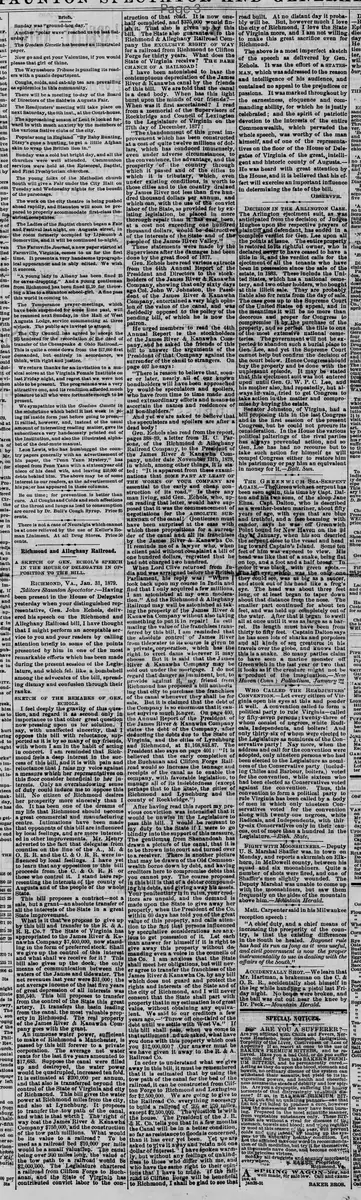
A SKETCH OF GEN. ECHOLS' SPEECH IN THE HOUSE OF DELEGATES IN OPPOSITION TO THE BILL.
RICHMOND, VA., Jan. 31, 1879.
Editors Staunton Spectator: Having been present in the House of Delegates yesterday when your distinguished representative, Gen. John Echols, delivered his speech on the Richmond and Alleghany Railroad bill, I have thought that I might perform an acceptable service to you and your readers by calling attention briefly to some of the points presented by him in one of the most remarkable efforts which has been made during the present session of the Legislature, and which fell like a bombshell among the advocates of the bill, spreading dismay and confusion through their ranks.
SKETCH OF THE REMARKS OF GEN. ECHOLS.
I feel deeply the gravity of this question, and regard it as second only in importance to that other great question now pressing upon us for solution. I say, with unaffected sincerity, that I oppose this bill with reluctance, supported as it is by so many of my friends, with whom I am in the habit of acting in concert. I am reminded that Richmond feels a deep interest in the success of this bill, and it is with pain and reluctance that I raise my voice against a measure which her representatives on this floor consider beneficial to her interests. Only an overshadowing sense of duty could induce me to oppose this bill. No citizen of Richmond desires her prosperity more sincerely than I do. It has been one of the dreams of my life that Richmond should become a great commercial and manufacturing centre. Intimations have been made that opponents of this bill are influenced by local feelings, and are more interested in other improvements. Mr. Henry adverted to the fact that delegates from counties on the line of the A., M. & O. R. R. and the C. & O. R. R. were influenced by local feelings. I have yet to learn that any opposition to this bill proceeds from the C. & O. R. R or those who control it. I stand here representing the interests of the county of Augusta and of the people of the whole State.
This bill proposes a contract - not a sale, but a grant - an absolute transfer of all the interests of the State in a great State improvement.
What is it that we propose to give up by this bill and transfer to the R. & A. R. R. Co.? The State of Virginia has appropriated to the James River & Kanawha Company $7,400,000, now standing in the form of preferred stock. Shall we give up the control of this interest and what shall we receive for it? This bill also gives up the dock, the only means of communication between the waters of the James and tidewater. The net revenues last year were $31,000; the net average income of the last five years of great depression of all interests was $36,540. This bill proposes to transfer from the control of the State this great artery. It transfers the basin leading from the canal, the most valuable property in Richmond. The real property of the James River & Kanawha Company goes with the grant.
An immense water power, sufficient to make of Richmond a Manchester, is passed by this bill forever to a private corporation. The average net water rents for the last five years amounted to $17,683. Suppose the canal were filled up and destroyed, the water power would be quadrupled, increased ten fold. It is estimated at $200,000 per annum, and that also is transferred beyond the control of the State of Virginia and city of Richmond. This bill gives the water power at Richmond miles from the city, and also at Lynchburg. It proposes to transfer the tow path of the canal, and what is that worth? The right of way cost the James River & Kanawha Company $750,000, and the construction of the tow path millions. What would be its value to a railroad? To be used as a railroad bed $10,000 per mile would be a small valuation. The canal being over 200 miles long, the value of the tow path to a railroad would be $2,000,000. The Legislature chartered a railroad from Clifton Forge to Buchanan, and the State of Virginia has contributed convict labor to the construction of that road. It is now one-half completed, and $375,000 would finish it. That also is given up by this bill. The State also guarantees to the Richmond & Alleghany Railroad Company the EXCLUSIVE RIGHT OF WAY for a railroad from Richmond to Clifton Forge for thirty years. What does the State of Virginia receive? THE BARE CHANCE OF A RAILROAD!
I have been astonished to learn the contemptuous depreciation of the James River & Kanawha canal by the friends of this bill. We are told that the canal is a dead body. When has this light burst upon the minds of our friends? When was it first ascertained? I read from a memorial of the Supervisors of Rockbridge and Council of Lexington to the Legislature of Virginia on the 27th day of December, 1877:
"The abandonment of this great improvement which has been constructed at a cost of quite twelve millions of dollars, which has conduced immensely, even under adverse circumstances, to the convenience, the advantage, and the prosperity of the country through which it passed and of the cities to which it is tributary; which, even under existing conditions, is worth to those cities and to the country drained by James River not less than five hundred thousand dollars per annum, and which can, with the use of the convict labor of the State, as provided for by existing legislation, be placed in more thorough repair than it has ever been at a cost not exceeding one hundred thousand dollars, would be destructive of the interests of the State and of the people of the James River Valley."
These statements were made by the Supervisors after the damages had been done by the great flood of 1877.
Gen. Echols here read various extracts from the 44th Annual Report of the President and Directors to the stockholders of the James River & Kanawha Company, showing that only sixty days ago Col. John W. Johnston, the President of the James River & Kanawha Company, entertained a very high opinion of the value of the canal, and was decidedly opposed to the policy of the pending bill, of which he is now the patron. He urged members to read the 44th Annual Report to the stockholders of the James River & Kanawha Company, and he asked the friends of this bill to answer the arguments of the President of that Company against the surrender of the canal to strangers. On page 407 he says:
"There is reason to believe that, sooner or later, nearly all of our known bondholders will have been approached by would-be speculators and spoilers, who have from time to time made and used extraordinary efforts and means to ascertain the names and residences of all bondholders."
And yet we are asked to believe that the speculators and spoilers are after a dead body!
Gen. Echols also read from the report, pages 388-89, a letter from H. C. Parsons, of the Richmond & Alleghany Railroad Company, to the President of the James River & Kanawha Company, under date November 13th, 1878, in which, among other things, it is stated: "It is apparent from these examinations that SOME PART AT LEAST OF THE WORKS OF YOUR COMPANY are essential to the early and cheap construction of its road." Is there any man living, said Gen. Echols, who, upon reading that letter, would have supposed that it was the commencement of negotiations for the ABSOLUTE SURRENDER of the canal! Gentlemen must have been surprised at the ease with which these propositions for a surrender of the canal and all its franchises by the James River & Kanawha Co. It reminds me of a lawyer who, when a client paid without complaint a bill of one hundred dollars, regretted that he had not charged two hundred.
When Lord Clive returned from India and was arraigned before the British Parliament, his reply was "When I look back upon my course in India and find that I only acquired a few millions, I am astonished at my own moderation." And the Richmond & Alleghany Railroad may well be astonished at taking the property of the James River & Kanawha Company without also taking something to put it in repair! In estimating the value of the franchises transferred by this bill, I am reminded that the absolute control of James River from tidewater to its source is given to a private corporation, which has the right to erect dams wherever it may choose. But it is said that the James River & Kanawha Company may be sold out under the mortgage. I do not regard that danger as imminent, but, to provide against it, my friend from Richmond has proposed a bill authorizing that city to purchase the franchises of the canal whenever they shall be for sale. But it is claimed that the debt of the Company is so enormous that it cannot survive much longer. On page 400, the Annual Report of the President of the James River & Kanawha Company states the debt of the Company, after deducting the debts due to the State of Virginia, and the cities of Lynchburg and Richmond, at $1,168,843.87. The President also says on page 401: "It is believed that the early completion of the Buchanan and Clifton Forge Railroad would so increase the tonnage and receipts of the canal as to enable the company, with favorable legislation, to manage all of its indebtedness (except perhaps that to the State, the cities of Richmond and Lynchburg and the county of Rockbridge.)"
After having read this report my previous conviction was intensified that it would be unwise in the Legislature to pass this bill. I would be recreant to my duty to the State if I were to go blindly into the support of this measure. The gentleman from Shenandoah has drawn a picture of the canal, that it is to be thrown into court and turned over to a receiver. There is another picture that may be drawn of the Old Commonwealth borne down by debt, and having creditors here to compromise debts that you cannot pay. The course proposed in this bill is that of a debtor compounding his debts, and giving away his assets. Your penitentiary is in ruins, your creditors are unpaid, and the demand is made upon the State to give away her property, when the President of the Co. within 60 days has told you of the great value of this property, and calls attention to the fact that persons influenced by speculative considerations are anxious to get possession of it. Let each man answer for himself if it is right to give away this property without demanding even a voice in the councils of the Co. I am anxious that the State shall meet her obligations, but will never agree to transfer the franchises of the James River & Kanawha Co. by any bill which does not guard and protect the rights and interests of the State and of the city of Richmond, and I will never consent that the State shall part with property that in my estimation is of great value, without obtaining any equivalent. We said to our creditors a few years ago, - "Throw off one-third of the debt until we settle with West Va." If this bill shall pass, when we come to that settlement and are asked, what have you done with this property which cost you $12,000,000? Our answer must be we have given it away to the R. & A. Railroad Co.
In order to understand what we give away in this bill, it must be remembered that it is estimated that by using the tow path of the canal for the bed of the railroad, it can be constructed from Clifton Forge to Richmond and Lexington for $2,500,000. We are going to give to the Railroad Co. everything necessary to build a railroad of 69 or 70 miles, except $2,500,000. The question is with the House. The President of the J. R. & K. Co. tells you that in a few months the Canal will be in a better condition, so far as resistance to floods is concerned, than it has ever yet been. Yet we are asked to give it away and retain not one dollar of interest. I have spoken warmly to those who differ with me, and kindly, but without any feelings of unkindness that I have to mind. If the bill to build a railroad from Richmond to Clifton Forge will be beneficial to Richmond, I shall be glad to see that road built. At no distant day it probably will be. But, however much I love the city of Richmond, I love the State of Virginia more, and I am not willing to make this great sacrifice even for Richmond.
The above is a most imperfect sketch of the speech as delivered by Gen. Echols. It was the effort of a STATESMAN, which was addressed to the reason and intelligence of his audience, and contained no appeal to the prejudices or passions. It was marked throughout by the earnestness, eloquence and commanding ability, for which he is justly celebrated; and the spirit of patriotic devotion to the interests of the entire Commonwealth, which pervaded the whole speech, was worthy of the man himself, and of one of the representatives on the floor of the House of Delegates of Virginia of the great, intelligent and historic county of Augusta. He was heard with great attention by the House, and it is believed that his effort will exercise an important influence in determining the fate of the bill.
OBSERVER.
What sub-type of article is it?
What themes does it cover?
What keywords are associated?
What entities or persons were involved?
Where did it happen?
Story Details
Key Persons
Location
Richmond, Va, House Of Delegates
Event Date
Jan. 30, 1879
Story Details
Gen. Echols delivers a speech opposing the Richmond and Alleghany Railroad bill, highlighting the value of the James River & Kanawha Canal's assets including water power, tow path, and revenues, arguing against their absolute transfer to a private company without compensation or state control, emphasizing duty to Virginia's interests.