Thank you for visiting SNEWPapers!
Sign up free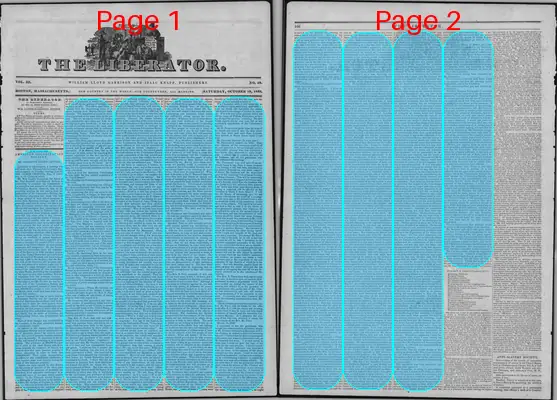
The Liberator
Boston, Suffolk County, Massachusetts
What is this article about?
On June 11, 1833, in London, William Lloyd Garrison delivered a lecture at Rev. Thomas Price's Chapel criticizing the American Colonization Society for supporting slavery, opposing immediate abolition, and harming free people of color. Rev. N. Paul and others spoke in support, resolutions condemned the society, and a debate with its agent Elliott Cresson was discussed but declined by him.
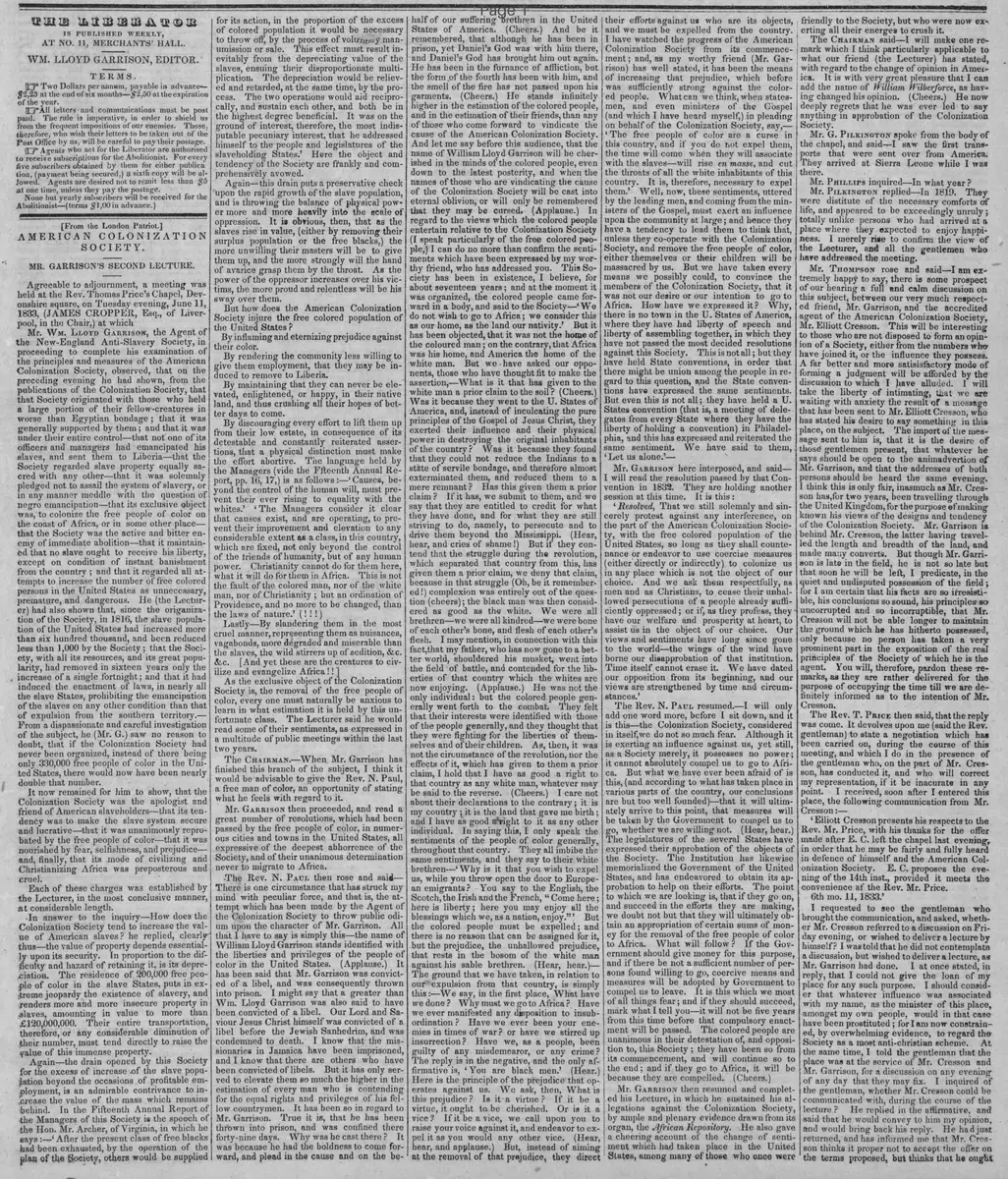
Merged-components note: This is a direct continuation of the report on Mr. Garrison's second lecture against the American Colonization Society, spanning multiple columns across pages 1 and 2 in sequential reading order.
Clippings
1 of 2
OCR Quality
Full Text
AMERICAN COLONIZATION SOCIETY.
MR. GARRISON'S SECOND LECTURE.
Agreeable to adjournment, a meeting was held at the Rev. Thomas Price's Chapel, Devonshire square, on Tuesday evening, June 11, 1833, (JAMES CROPPER, Esq., of Liverpool, in the Chair,) at which Mr. WM. LLOYD GARRISON, the Agent of the New-England Anti-Slavery Society, in proceeding to complete his examination of the principles and measures of the American Colonization Society, observed, that on the preceding evening he had shown, from the publications of the Colonization Society, that that Society originated with those who held a large portion of their fellow-creatures in worse than Egyptian bondage; that it was generally supported by them; and that it was under their entire control—that not one of its officers and managers had emancipated his slaves, and sent them to Liberia—that the Society regarded slave property equally sacred with any other—that it was solemnly pledged not to assail the system of slavery, or in any manner meddle with the question of negro emancipation—that its exclusive object was, to colonize the free people of color on the coast of Africa, or in some other place—that the Society was the active and bitter enemy of immediate abolition—that it maintained that no slave ought to receive his liberty, except on condition of instant banishment from the country; and that it regarded all attempts to increase the number of free colored persons in the United States as unnecessary, premature, and dangerous. He (the Lecturer) had also shown that, since the organization of the Society, in 1816, the slave population of the United States had increased more than six hundred thousand, and been reduced less than 1,000 by the Society; that the Society, with all its resources, and its great popularity, had removed in sixteen years only the increase of a single fortnight; and that it had induced the enactment of laws, in nearly all the slave States, prohibiting the emancipation of the slaves on any other condition than that of expulsion from the southern territory.
From a dispassionate and careful investigation of the subject, he (Mr. G.) saw no reason to doubt, that if the Colonization Society had never been organized, instead of there being only 330,000 free people of color in the United States, there would now have been nearly double that number.
It now remained for him to show, that the Colonization Society was the apologist and friend of American slaveholders—that its tendency was to make the slave system secure and lucrative—that it was unanimously reprobated by the free people of color—that it was nourished by fear, selfishness, and prejudice—and, finally, that its mode of civilizing and Christianizing Africa was preposterous and cruel.
Each of these charges was established by the Lecturer, in the most conclusive manner, at considerable length.
In answer to the inquiry—How does the Colonization Society tend to increase the value of American slaves? he replied, clearly thus—the value of property depends essentially upon its security. In proportion to the difficulty and hazard of retaining it, is its depreciation. The residence of 200,000 free people of color in the slave States, puts in extreme jeopardy the existence of slavery, and renders more and more insecure property in slaves, amounting in value to more than £120,000,000. Their entire transportation, therefore, or any considerable diminution of their number, must tend directly to raise the value of this immense property.
Again—the drain opened by this Society for the excess of increase of the slave population beyond the occasions of profitable employment, is an admirable contrivance to increase the value of the mass which remains behind. In the Fifteenth Annual Report of the Managers of this Society is the speech of the Hon. Mr. Archer, of Virginia, in which he says:—'After the present class of free blacks had been exhausted, by the operation of the plan of the Society, others would be supplied for its action, in the proportion of the excess of colored population it would be necessary to throw off, by the process of voluntary manumission or sale. This effect must result inevitably from the depreciating value of the slaves, ensuing their disproportionate multiplication. The depreciation would be relieved and retarded, at the same time, by the process. The two operations would aid reciprocally, and sustain each other, and both be in the highest degree beneficial. It was on the ground of interest, therefore, the most indisputable pecuniary interest, that he addressed himself to the people and legislatures of the slaveholding States.' Here the object and tendency of the Society are frankly and comprehensively avowed.
Again—this drain puts a preservative check upon the rapid growth of the slave population, and is throwing the balance of physical power more and more heavily into the scale of oppression. It is obvious, then, that as the slaves rise in value, (either by removing their surplus population or the free blacks,) the more unwilling their masters will be to give them up, and the more strongly will the hand of avarice grasp them by the throat. As the power of the oppressor increases over his victims, the more proud and relentless will be his sway over them.
But how does the American Colonization Society injure the free colored population of the United States?
By inflaming and eternizing prejudice against their color.
By rendering the community less willing to give them employment, that they may be induced to remove to Liberia.
By maintaining that they can never be elevated, enlightened, or happy, in their native land, and thus crushing all their hopes of better days to come.
By discouraging every effort to lift them up from their low estate, in consequence of its detestable and constantly reiterated assertions, that a physical distinction must make the effort abortive. The language held by the Managers (vide the Fifteenth Annual Report, pp. 16, 17,) is as follows:'Causes, beyond the control of the human will, must prevent their ever rising to equality with the whites.' 'The Managers consider it clear that causes exist, and are operating, to prevent their improvement and elevation to any considerable extent as a class, in this country, which are fixed, not only beyond the control of the friends of humanity, but of any human power. Christianity cannot do for them here, what it will do for them in Africa. This is not the fault of the colored man, nor of the white man, nor of Christianity: but an ordination of Providence, and no more to be changed, than the laws of nature.' (!!!)
Lastly—By slandering them in the most cruel manner, representing them as nuisances, vagabonds, more degraded and miserable than the slaves, the wild stirrers up of sedition, &c. &c. [And yet these are the creatures to civilize and evangelize Africa!!]
As the exclusive object of the Colonization Society is, the removal of the free people of color, every one must naturally be anxious to learn in what estimation it is held by this unfortunate class. The Lecturer said he would read some of their sentiments, as expressed in a multitude of public meetings within the last two years.
The CHAIRMAN.—When Mr. Garrison has finished this branch of the subject, I think it would be advisable to give the Rev. N. Paul, a free man of color, an opportunity of stating what he feels with regard to it.
Mr. Garrison then proceeded, and read a great number of resolutions, which had been passed by the free people of color, in numerous cities and towns in the United States, all expressive of the deepest abhorrence of the Society, and of their unanimous determination never to migrate to Africa.
The Rev. N. PAUL then rose and said—There is one circumstance that has struck my mind with peculiar force, and that is, the attempt which has been made by the Agent of the Colonization Society to throw public odium upon the character of Mr. Garrison. All that I have to say is simply this—the name of William Lloyd Garrison stands identified with the liberties and privileges of the people of color in the United States. (Applause.) It has been said that Mr. Garrison was convicted of a libel, and was consequently thrown into prison. I might say that a greater than Wm. Lloyd Garrison was also said to have been convicted of a libel. Our Lord and Saviour Jesus Christ himself was convicted of a libel before the Jewish Sanhedrim, and was condemned to death. I know that the missionaries in Jamaica have been imprisoned, and I know that there are others who have been convicted of libels. But it has only served to elevate them so much the higher in the estimation of every man who is contending for the equal rights and privileges of his fellow countrymen. It has been so in regard to Mr. Garrison. True it is, that he has been thrown into prison, and was confined there forty-nine days. Why was he cast there? It was because he had the boldness to come forward, and plead in the cause and on the behalf of our suffering brethren in the United States of America. (Cheers.) And be it remembered, that although he has been in prison, yet Daniel's God was with him there, and Daniel's God has brought him out again. He has been in the furnace of affliction, but the form of the fourth has been with him, and the smell of the fire has not passed upon his garments. (Cheers.) He stands infinitely higher in the estimation of the colored people, and in the estimation of their friends, than any of those who come forward to vindicate the cause of the American Colonization Society. And let me say before this audience, that the name of William Lloyd Garrison will be cherished in the minds of the colored people, even down to the latest posterity, and when the names of those who are vindicating the cause of the Colonization Society will be cast into eternal oblivion, or will only be remembered that they may be cursed. (Applause.) In regard to the views which the colored people entertain relative to the Colonization Society (I speak particularly of the free colored people,) I can do no more than confirm the sentiments which have been expressed by my worthy friend, who has addressed you. This Society has been in existence, I believe, for about seventeen years: and at the moment it was organized, the colored people came forward in a body, and said to the Society—'We do not wish to go to Africa; we consider this as our home, as the land our nativity.' But it has been objected, that it was not the home of the coloured man; on the contrary, that Africa was his home, and America the home of the white man. But we have asked our opponents, those who have thought fit to make the assertion,—What is it that has given to the white man a prior claim to the soil? (Cheers.) Was it because they went to the U. States of America, and, instead of inculcating the pure principles of the Gospel of Jesus Christ, they exerted their influence and their physical power in destroying the original inhabitants of the country? Was it because they found that they could not reduce the Indians to a state of servile bondage, and therefore almost exterminated them, and reduced them to a mere remnant? Has this given them a prior claim? If it has, we submit to them, and we say that they are entitled to credit for what they have done, and for what they are still striving to do, namely, to persecute and to drive them beyond the Mississippi. (Hear, hear, and cries of shame!) But if they contend that the struggle during the revolution, which separated that country from this, has given them a prior claim, we deny that claim, because in that struggle (Oh, be it remembered!) complexion was entirely out of the question (cheers); the black man was then considered as good as the white. We were all brethren—we were all kindred—we were bone of each other's bone, and flesh of each other's flesh. I may mention, in connection with this fact, that my father, who has now gone to a better world, shouldered his musket, went into the field of battle, and contended for the liberties of that country which the whites are now enjoying. (Applause.) He was not the only individual: but the colored people generally went forth to the combat. They felt that their interests were identified with those of the people generally, and they thought that they were fighting for the liberties of themselves and of their children. As, then, it was not the circumstance of the revolution, nor the effects of it, which has given to them a prior claim, I hold that I have as good a right to that country as any white man, whatever may be said to the reverse. (Cheers.) I care not about their declarations to the contrary; it is my country; it is the land that gave me birth; and I have as good a right to it as any other individual. In saying this, I only speak the sentiments of the people of color generally, throughout that country. They all imbibe the same sentiments, and they say to their white brethren—'Why is it that you wish to expel us, while you throw open the door to European emigrants? You say to the English, the Scotch, the Irish and the French, "Come here; here is liberty; here you may enjoy all the blessings which we, as a nation, enjoy."' But the colored people must be expelled; and there is no reason that can be assigned for it but the prejudice, the unhallowed prejudice, that rests in the bosom of the white man against his sable brethren. (Hear, hear.)—The ground that we have taken, in relation to our expulsion from that country, is simply this: We say, in the first place, What have we done? Why must we go to Africa? Have we ever manifested any disposition to insubordination? Have we ever been your enemies in times of war? or have we stirred up insurrection? Have we, as a people, been guilty of any misdemeanor, or any crime? The reply is in the negative, and the only affirmative is, 'You are black men.' (Hear.) Here is the principle of the prejudice that operates against us. We ask, then, What is this prejudice? Is it a virtue? If it be a virtue, it ought to be cherished. Or is it a vice? If it be a vice, we call upon you to raise your voice against it, and endeavor to expel it as you would any other vice. (Hear, hear, and applause.) But, instead of aiming at the removal of that prejudice, they direct their efforts against us who are its objects, and we must be expelled from the country.
I have watched the progress of the American Colonization Society from its commencement; and, as my worthy friend (Mr. Garrison) has well stated, it has been the means of increasing that prejudice, which before was sufficiently strong against the colored people. What can we think, when statesmen, and even ministers of the Gospel (and which I have heard myself,) in pleading on behalf of the Colonization Society, say,—'The free people of color are a curse in this country, and if you do not expel them, the time will come when they will associate with the slaves—will rise en masse, and cut the throats of all the white inhabitants of this country. It is, therefore, necessary to expel them.' Well, now, these sentiments, uttered by the leading men, and coming from the ministers of the Gospel, must exert an influence upon the community at large; and hence they have a tendency to lead them to think that, unless they co-operate with the Colonization Society, and remove the free people of color either themselves or their children will be massacred by us. But we have taken every means we possibly could, to convince the members of the Colonization Society, that it was not our desire or our intention to go to Africa. How have we expressed it? Why, there is no town in the U. States of America, where they have had liberty of speech and liberty of assembling together, in which they have not passed the most decided resolutions against this Society. This is not all; but they have held State conventions, in order that there might be union among the people in regard to this question, and the State conventions have expressed the same sentiments. But even this is not all; they have held a U. States convention (that is, a meeting of delegates from every State where they have the liberty of holding a convention) in Philadelphia, and this has expressed and reiterated the same sentiment. We have said to them, 'Let us alone.'
Mr. Garrison here interposed, and said—I will read the resolution passed by that Convention in 1830. They are holding another session at this time. It is this:
'Resolved, That we still solemnly and sincerely protest against any interference, on the part of the American Colonization Society, with the free colored population of the United States, so long as they shall countenance or endeavor to use coercive measures (either directly or indirectly) to colonize us in any place which is not the object of our choice. And we ask them respectfully, as men and as Christians, to cease their unhallowed persecutions of a people already sufficiently oppressed; or if, as they profess, they have our welfare and prosperity at heart, to assist us in the object of our choice. Our views and sentiments have long since gone to the world—the wings of the wind have borne our disapprobation of that institution. Time itself cannot erase it. We have dated our opposition from its beginning, and our views are strengthened by time and circumstances.'
The Rev. N. PAUL resumed.—I will only add one word more, before I sit down, and it is this—the Colonization Society, considered in itself, we do not so much fear. Although it is exerting an influence against us, yet still, as a Society merely, it possesses no power; it cannot absolutely compel us to go to Africa. But what we have ever been afraid of is this, (and according to what has taken place in various parts of the country, our conclusions are but too well founded)—that it will ultimately arrive to this point, that measures will be taken by the Government to compel us to go, whether we are willing not. (Hear, hear.) The legislatures of the several States have expressed their approbation of the objects of the Society. The Institution has likewise memorialized the Government of the United States, and has endeavored to obtain its approbation to help on their efforts. The point to which we are looking is, that if they go on, and succeed in the efforts they are making, we doubt not but that they will ultimately obtain an appropriation of certain sums of money for the removal of the free people of color to Africa. What will follow? If the Government should give money for this purpose, and if there be not a sufficient number of persons found willing to go, coercive means and measures will be adopted by Government to compel us to leave. It is this which we most of all things fear; and if they should succeed, mark what I tell you—it will not be five years from this time before that compulsory enactment will be passed. The colored people are unanimous in their detestation of, and opposition to, this Society; they have been so from its commencement, and will continue so to the end; and if they go to Africa, it will be because they are compelled. (Cheers.)
Mr. Garrison then resumed and completed his Lecture, in which he sustained his allegations against the Colonization Society, by ample and plenary evidence drawn from its organ, the African Repository. He also gave a cheering account of the change of sentiment which had taken place in the United States, among many of those who once were friendly to the Society, but who were now exerting all their energies to crush it.
The Chairman said—I will make one remark which I think particularly applicable to what our friend (the Lecturer) has stated, with regard to the change of opinion in America. It is with very great pleasure that I can add the name of William Wilberforce, as having changed his opinion. (Cheers.) He now deeply regrets that he was ever led to say anything in approbation of the Colonization Society.
Mr. G. Pilkington spoke from the body of the chapel, and said—I saw the first transports that were sent over from America. They arrived at Sierra Leone while I was there.
Mr. PHILLIPS inquired—In what year?
Mr. PILKINGTON replied—In 1819. They were destitute of the necessary comforts of life, and appeared to be exceedingly unruly; totally unlike persons who had arrived at a place where they expected to enjoy happiness. I merely rise to confirm the view of the Lecturer, and all the gentlemen who have addressed the meeting.
Mr. Thompson rose and said—I am extremely happy to say, there is some prospect of our hearing a full and calm discussion on this subject, between our very much respected friend, Mr. Garrison, and the accredited agent of the American Colonization Society, Mr. Elliott Cresson. This will be interesting to those who are not disposed to form an opinion of a Society, either from the numbers who have joined it, or the influence they possess. A far better and more satisfactory mode of forming a judgment will be afforded by the discussion to which I have alluded. I will take the liberty of intimating, that we are waiting with anxiety the result of a message that has been sent to Mr. Elliott Cresson, who has stated his desire to say something in this place, on the subject. The import of the message sent to him is, that it is the desire of those gentlemen present, that whatever he says should be open to the animadversion of Mr. Garrison, and that the addresses of both persons should be heard the same evening. I think this is only fair, inasmuch as Mr. Cresson has, for two years, been travelling through the United Kingdom, for the purpose of making known his views of the designs and tendency of the Colonization Society. Mr. Garrison is behind Mr. Cresson, the latter having travelled the length and breadth of the land, and made many converts. But though Mr. Garrison is late in the field, he is not so late but that soon he will be left, I predicate, in the quiet and undisputed possession of the field; for I am certain that his facts are so irresistible, his conclusions so sound, his principles so uncorrupted and so incorruptible, that Mr. Cresson will not be able longer to maintain the ground which he has hitherto possessed, only because no person has taken a very prominent part in the exposition of the real principles of the Society of which he is the agent. You will, therefore, pardon these remarks, as they are rather delivered for the purpose of occupying the time till we are definitely informed as to the intention of Mr. Cresson.
The Rev. T. Price then said, that the reply was come. It devolves upon me (said the Rev. gentleman) to state a negotiation which has been carried on, during the course of this meeting, and which I do in the presence of the gentleman who, on the part of Mr. Cresson, has conducted it, and who will correct my representation, if it be inaccurate in any point. I received, soon after I entered this place, the following communication from Mr. Cresson:-
Elliott Cresson presents his respects to the Rev. Mr. Price, with his thanks for the offer made after E. C. left the chapel last evening, in order that he may be fairly and fully heard in defence of himself and the American Colonization Society. E. C. proposes the evening of the 14th inst., provided it meets the convenience of the Rev. Mr. Price.
6th mo. 11, 1833.
I requested to see the gentleman who brought the communication, and asked, whether Mr. Cresson referred to a discussion on Friday evening, or wished to deliver a lecture by himself? I was told that he did not contemplate a discussion, but wished to deliver a lecture, as Mr. Garrison had done. I at once stated, in reply, that I could not give the loan of my place for any such purpose. I should consider that whatever influence was associated with my name, as the minister of this place, amongst my own people, would in that case have been prostituted; for I am now constrained, by overwhelming evidence, to regard the Society as a most anti-christian scheme. At the same time, I told the gentleman that the place was at the service of Mr. Cresson and Mr. Garrison, for a discussion on any evening of any day that they may fix. I inquired of the gentleman, whether Mr. Cresson could be communicated with, during the course of the lecture? He replied in the affirmative, and said that he would convey to him my opinion, and would bring back his reply. He had just returned, and has informed me that Mr. Cresson thinks it proper not to accept the offer on the terms proposed, but thinks that he ought
to have it for the purpose of delivering an exposition of his own case. Now, with my present views of the Colonization Society, I could no more grant the use of this place for the delivery of a lecture advocating its interests, than I could for the publication of any other views, or the advocacy of any other system, however reprehensible it might be. I should have been happy, in past times, to have seen any discussion, in this place, between an advocate for abolition and an advocate of the West Indian system: but I would never have given the use of the place for the delivery of a lecture by a pro-slavery man. On the same principle, I feel constrained to refuse its use for the delivery of a lecture by Mr. Cresson, who has declined it for a discussion. If my statement be not correct, the gentleman who has conducted the negociation will state to the meeting any point in which I am inaccurate.
The Gentleman referred to, said the statement was perfectly correct.
The Rev. T. Price resumed. I think the meeting should be distinctly informed on this point, in order that there may be no misapprehension in future. Before I sit down, I would submit for your adoption a resolution. I should not do justice to my own feelings, and to the conviction of my judgment, if I did not propose something of this sort. I have admitted, with extreme reluctance, the convictions which at present possess my mind. There was a time, when I regarded the Colonization Society with feelings of admiration, and with thankfulness to God. I esteemed it as the dawn of better days for the sons of Africa. I beheld it as the germ of a system more comprehensive than itself, which should embrace not merely one portion of the American colored population, but whose ample fold should enclose all the section of the family of Africa included in the United States. Subsequent examination has served to satisfy my mind, that the system is based on an unrighteous and detestable principle, and that in its proceedings, and in the influence which it exerts upon all classes of American society, whether white, or black, or colored, it must indicate by its fruits the nature of its origin, and must add strongly to the amount of that sorrow which sin has created in our world. I formerly wrote on behalf of the Society, but I shall now feel bound to employ all my energies in opposition to it. I am sorry to observe that in the present number of the Baptist Magazine there has been some communication inserted from Mr. Cresson. I shall feel bound, as a member of that denomination, to put a paper in the next number, correcting, as far as I am able, its numerous misrepresentations (cheers). The resolution which I have to propose is this—'Resolved, That this meeting having attentively listened to the statements of Mr. Garrison, in support of the following propositions: namely, 1. The American Colonization Society was conceived, perfected, and is principally managed, by those who retain a portion of their own countrymen as slaves and property. 2. Its avowed and exclusive object is, the colonization of the free people of color in Africa, or some other place. 3. It is the active, inveterate, uncompromising enemy of immediate abolition, and deprecates the liberation of the slaves, except on condition of their being simultaneously transported to Africa. 4. It maintains that the possessors of slaves, in the southern States, are not such from choice but necessity; and that of course they are not, under present circumstances, blameworthy for holding millions of human beings in servile bondage. 5. Its tendency is, to increase the value of the slaves, to confirm the power of the oppressors, and to injure the free colored population, by whom it is held in abhorrence wherever they possess liberty of speech and the means of intelligence. 6. It is influenced by fear, selfishness, and prejudice, and neither calls for any change of conduct on the part of the nation, nor has in itself any principle of reform. 7. Its mode of civilizing Africa is preposterous and cruel, and calculated rather to retard than promote the moral and spiritual improvement of her benighted children—this meeting is of opinion that he has fully established their truth by evidence drawn from the Reports and other publications of the American Colonization Society: and therefore most earnestly entreats all the friends of civil and religious liberty to withhold their sanction and assistance from the said Society. I feel (continued the Rev. gentleman) that, as we are bound to contribute of our pecuniary resources for the relief of our own bondsmen, who have been most cruelly held in servitude, we are equally bound, by every principle of duty, to attempt to arrest the progress of any person, who, under such representations as have been made to the British public by Mr. Cresson, seeks to secure its assistance on behalf of so unhallowed and cruel a system. Had the American Colonization Society been what its agent has represented it to be, I, for one, should gladly have beheld the most munificent donations made to its funds; but when it sustains such a character as its own publications attach to it, I cannot endure, for one moment, that the anti-slavery feeling of this country should be so misled as to be made the means of sustaining in America a system which, under God, it has demolished in the West Indies. (Cheers.)
Mr. Ball seconded the resolution, which was put by the Chairman, and carried, one hand only being held up against it.
Mr. Thompson then rose, and said: There is yet another resolution, which I think we are bound to pass before we separate, and I will do myself the honor of submitting it for the unanimous adoption of this assembly. I will simply state,—that I think we are imperatively called upon to offer to Mr. Wm. Lloyd Garrison our most cordial thanks for his luminous and fearless exposure of the pernicious designs and operations of the American Colonization Society. It is our duty, as lovers of universal liberty—as we desire to see the western hemisphere purged from its foulest stain, the curse of slavery—it is our duty, as those who are waiting to rejoice in the speedy and total overthrow of slavery in our own colonies, to strengthen the hands and cheer the heart of Mr. Garrison, by giving him our most unequivocal confidence, and our most cordial and zealous support (applause). We cannot too highly estimate the dauntless energy and disinterested devotion of the gentleman now before us. When we remember that only three years ago, he stood almost alone in the United States as the advocate of the principles he now professes; that, at that period, even the friends of emancipation were kept back from openly supporting him, by a fear that they should be called upon to sacrifice reputation, and connexions, and prospects in life; and that thus circumstanced he braved all consequences, and solemnly resolved, before his country and his God, to live upon bread and water, rather than forego the honor of being the champion of the injured and oppressed, and that he has thus far nobly and untiringly pursued his high object we shall, I am sure, be prepared not only to estimate, in our judgment, the value of his services, but to receive him into our inmost confidence, as a man deserving our warmest affection, and most unequivocal thanks (cheers). He has fully demonstrated the fiend-like design of the American Colonization Society. He has shown that its object is not the civilization of Africa—not the humanization of her wild inhabitants—but the annihilation of that connecting link between the free and enslaved population of the United States, which is constituted by the free people of color, lest happily, the electric shock of freedom should be conveyed to the two millions of their wretched slaves; and, from the condition of brutes, they should spring up into the loftiness and dignity of immortal beings (applause). What is the pretext of the Colonization Society for the course it is pursuing? It is, that there exists a prejudice too strong for humanity, legislation, and religion, to overcome. And shall this doctrine be preached in England, from whose shores a Morrison went forth to grapple single-handed with the prejudices of China? Shall this doctrine be preached to the people of England, who sent forth a Henry Martyn, freighted with their prayers and their blessings, to wage war with the prejudice of India? Shall this doctrine be preached in England, who has her missionaries amongst the cannibals of New Zealand and the Caffres of South Africa? No. It may be cherished by miscreant Americans, but can never be received by a Christian-minded Briton (applause). It is an impious doctrine. It is opposed to that faith which removes mountains. It defies the omnipotence of God. It libels that everlasting gospel which is to triumph over all the prejudices and superstitions of men, and all the abominations that defile the earth. If the influence which is now exerted to banish the men of color from America, were directed with equal energy, in a Christian spirit, to grapple with this prejudice, who is there who does not believe that Heaven would smile upon and bless such an effort? and, in seventeen years, instead of having to show a small colony on the coast of Africa, which, when described by its most partial friends, is contemptible in comparison with what might be achieved at home, they might point to prejudice and slavery expiring together, and call upon us to hail the dawning of a day of jubilee for two millions of slaves (cheers). Mr. Garrison recently related to me an anecdote, which I think strikingly illustrates the injustice and unreasonableness of calling upon the colored people of America to seek a dwelling-place on the shores of Africa, and of asserting that America is not the home of the black. Mr. Garrison was present at a conversation upon this subject, which took place under the roof of a highly respectable colored gentleman; who, after listening to the argument for some time, at last said, 'I can trace my ancestors upon this soil for 165 years. During that period they shared in all the eventful struggles of their times. For America my fathers and myself have fought and bled—for America we have assisted to achieve that Independence of which she proudly boasts—and I therefore ask, whether it is just that I should be told by one, who yesterday became a resident of this country, that Africa is my country, and I ought to seek my dwelling there?' (Cheers.) If the white may justly hold such language to his colored brethren, with how much more justice might it be applied by the Indian to the white? Might he not say, 'Depart from these shores—this is not your country! Ye are trespassers and murderers! There was a time ere yet the rapacious white had placed his foot upon our soil, when the red man was free and happy. You have cursed us with the ravages of war—you have desolated the dominions of our ancestors for a hundred generations—you have almost destroyed a race of beings, as noble and as immortal as yourselves. Begone! you are foreigners and aliens—leave us to ourselves and to Heaven, and let the remnants of our tribes die in peace, and slumber with the bones of our fathers?' (Cheers.) Amongst the most determined opponents of this Society, I find some of the best friends of human nature. Now, I ask, is it likely that an individual, for instance, like him whom I have the happiness to see presiding over this meeting, who has for years devoted his best energies to the promotion of an object so dear to us all—the annihilation of slavery in our own dominions—is it likely that he and others, who are lovers of schools, of the diffusion of the Scriptures, and of universal civilization, would oppose Mr. Cresson's designs, if they did not see in them something radically wrong and insufferably evil (hear, hear)? I will add no more on this subject. I am sure you will pass the vote which I have recommended to your adoption; you will tender to Mr. Garrison your best thanks, and you will believe what no one can help believing; viz.; that Mr. Cresson is afraid to meet him (hear, hear, and applause). He knows that the Garrison is too well defended (hear, hear); he believes it to be impregnable, and he dare not approach it for free and fair combat; he dare not mount his puny artillery opposite to that which defends our noble garrison. No. He wants an opportunity of firing off his pop-guns unopposed. He has done this, but now his race is ended. The day of the American Colonization Society in England is now waning and setting for ever. I do trust that we shall turn the tables upon this gentleman and his Society; and if in America they cannot learn their duty, we shall teach it them (cheers). I am sure that the influence of abolition in our own colonies will be so strong on the United States, that nothing more will be necessary than a fearless exposure of the horrors and evils of the system, to annihilate for ever the accursed practice in that country.
You will not only be called upon to pass this vote; but, if you respect the opinions and the principles of Mr. Garrison, if you approve of the object which he has in view, you will be expected, with steadiness and perseverance, to counteract the insinuating influence of Mr. Cresson, and those who have become his partisans in this country. It will be your duty to endeavor to dispel the delusion which he has cast over the minds of so many. It will be your duty, as you desire to extricate the people of color, whose wrongs have been so vividly portrayed by the gentleman now seated on this platform, from the fangs of the American Colonization Society, to counteract, by every influence you can command, the pernicious tendency of those doctrines and principles which have been disseminated by the Society. And bear this in mind, that Mr. Cresson has appeared in England with an expression upon his lips, for which he would be driven for ever from the American Colonization Society, if he were to utter it upon the shores of the United States. He has told the people of England that the main design is, the abolition of slavery in that hemisphere; but you have been told, again and again, by Mr. Garrison, and have had it demonstrated to you by the most unequivocal quotations, that the Society did not attempt anything like an infringement upon the sacred property of one man in another. Now, if this be the design of the Colonization Society: if it be to foster this unhallowed monopoly of human bones and human sinews; if it be to recognise the right of one human being to hold property in another, and to desecrate the image of God in the person of him upon whom he has stamped that image; if this, I say, be the object of the Society—if they have never denounced this property—if there be no forgery, if there be no libel in their own publications, while their agent professes in this country to aim at the extinction of slavery in the United States, then the charge is established beyond all doubt, and every shilling has been collected under false pretences. But I have already stated that it is only while ignorance prevails, that the advocates of this Society can obtain or retain any influence. That ignorance will be dissipated; for Mr. Cresson may rest assured, that the result of his declining to meet Mr. Garrison will be far worse than the defeat that he would have been sure to sustain, if he had engaged with him in honorable combat. It is a subterfuge to say, that he would not be treated with respect; it is a gross libel to say, that he has been unfairly treated; on the contrary, he has been too well treated by the Anti-Slavery Society—he has been too freely received into its confidence, and has partaken too largely of its influence. Now, however, that the Society perceives the design of the Colonization Institution, it can no longer patronize a man who is acting in such direct opposition to all its views and efforts. I will say no more in support of the motion. There is not a line that Mr. Garrison has written, there is not a sentiment which he has uttered, that does not bespeak that his heart and his understanding are alike influenced by the desire to effect, by Christian means, the annihilation of slavery in his own country. Although his expressions have been strong, yet they have been warranted by the occasion. He has shown no unfairness to individuals, but has done what it was right to do, and what he could not have abstained from doing, if he discharged his duty. He has spoken of sin as sin, of felony as felony, of robbery as robbery. He has not complimented a man, and called him great and good, when his greatness and goodness were built upon the degradation of his fellow-man (hear, hear). He has acted righteously; he has been prepared to give to Cæsar the things that are Cæsar's; but when he looked upon the face and the countenance of his colored brethren, and saw that there the image and the superscription of the Deity was impressed, and saw it basely used for human aggrandisement and the gratification of human power, he has done what every righteous man ought to do; he has said, 'Render unto God the things that are God's' (cheers). Up to this point we must be prepared to go; viz., that man can never become the property of man; for never, since the creation of the world, has God given to man an absolute power over his fellow-creatures. If, in the law and the gospel, the holding of man in bondage, to suit our own purposes and to gratify our own will, be condemned, and if we can proudly challenge every divine, every philosopher, every sophist, to show us a passage that gives this power to man, he does right who lifts up his voice against it; and if we have the authority and sanction of Heaven, we have a right to do justice, leaving the consequences to Him who has commanded us to do our duty. I will offer no apology for these sentiments. I believe they are your sentiments, and I had only to announce them to call forth the expressions of your feelings. It will be a source of great satisfaction to Mr. Garrison that he has with him the hearts, the understandings, the prayers, and the blessing of this assembly. I should like to hear upon what grounds the unit in this meeting objected to the resolution. I ask him, are the facts that Mr. Garrison has quoted, drawn from the publications of the Colonization Society, or are they not? Yea, out of their own mouths has he condemned them, and his conclusions have been irresistible; no other conclusions could have been come to (cheers). With these sentiments, I leave before you the vote which I have named, not doubting but that it will be unanimously passed, and thus Mr. Garrison will be assured that by you he is esteemed and appreciated as he ought to be (cheers).
Resolved, That the cordial thanks of this meeting be given to Mr. Wm. Lloyd Garrison, for his fearless exposure of the American Colonization Society, and for his effective efforts on behalf of the oppressed bondsmen of his own country.
The resolution was then seconded, and unanimously agreed to.
Mr. Garrison, in rising to acknowledge the vote, said, I cannot but feel deeply affected by the generous spirit that animates this meeting, so far as it relates to myself. I feel I am altogether unworthy of the remarks that have been made respecting me by my eloquent friend, but I do rejoice in view of the effects of a meeting like this upon the Colonization Society in the United States, and upon the atrocious system of American Slavery. I believe that it is only necessary that the united sentiments of the people of Great Britain against the Society should go forth in order to annihilate it.
Mr. Richard Ball, of Bristol, rose and said,—It has been suggested to me that there has been a little omission, which I am called upon to supply, on the ground of common justice; but it is enough for me to have recourse to the slighter claim of common courtesy: viz., that the grateful acknowledgments of this assembly be given to the minister of this place, who has kindly accommodated us with its use, for a purpose noble and important in itself, and in the prosecution of which we have all been so much gratified.
The resolution having been seconded by Mr. Garrison,
The Chairman rose and said, there could be no question but that the meeting would unanimously join in the resolution.
The motion was then put, and carried by acclamation.
The Rev. Thomas Price said—I need not acknowledge the kindness of my friends present, in the vote they have given. It was with the utmost pleasure that the use of this place was granted, and it will with equal pleasure be granted on any future similar occasion. I will state, for the information of the meeting, that in my communication with Mr. Cresson, I proposed, in order to secure perfect fairness for him in the proposed discussion, that two or three friends, on each side, should meet and arrange the mode of discussion, and also fix upon a chairman. I would also state, for the information of the meeting, (for I may not have another opportunity of so doing,) that I do trust a powerful agency will speedily be raised up auxiliary to Mr. Garrison's design. I know that consultations have been held by some of the members of the religious denominations of this country, with a view of memorializing their brethren in America, immediately after the emancipation of our own slaves is effected, and praying them to adopt the same principles, and to pursue the same measures that we have done. Slavery has fallen before the religious influence of this land, as Dagon fell before the ark of God: and I do trust, that when once the moral and religious energies of America are aroused to this important duty, the result will be equally felicitous with that which we have effected.
Mr. Thompson said—There is one other duty which we have to perform. It is not sufficient that we agree in the justice of those charges which Mr. Garrison has brought forward against the Colonization Society, and which he has so fully substantiated; but it is necessary that the world should know what we think of the Institution. I would, therefore, take the liberty of suggesting that those charges, and our opinion respecting the manner in which Mr. Garrison has substantiated them, should be made known to the world, through the medium of the public press; and that the proceedings of this meeting, as they are illustrated in the resolutions that have been passed, should be published in one or more of the daily papers; more particularly as Mr. Garrison desires publicity, and that all the world should know what he thinks of the Colonization Society. He will, therefore, have no objection, but will be prepared at any time, when others desire the same evidence that you have had, to lay that evidence before them.
The Chairman said, that publicity would be given to the proceedings of the meeting.
Mr. Moline said—It is with great deference that I would make a suggestion to the meeting; feeling, as I do, the great importance of the subject, I am anxious that it should not die here. We all know that what is every body's business is made no one's; and therefore, I think that this subject should be brought under the regulation and concurrence of a body, and that a committee should be formed.
The Chairman said—I hope the suggestion will be attended to. I think it is right that we should come forward; but, at present, we are so little prepared, that we could not form a committee at once. I think that an account of the proceedings should be given to the public, and Mr. Garrison's offer to meet Mr. Cresson.
What sub-type of article is it?
What themes does it cover?
What keywords are associated?
What entities or persons were involved?
Where did it happen?
Story Details
Key Persons
Location
Rev. Thomas Price's Chapel, Devonshire Square, London
Event Date
June 11, 1833
Story Details
William Lloyd Garrison lectures against the American Colonization Society, arguing it supports slavery, harms free people of color, and opposes immediate abolition. Rev. N. Paul affirms opposition from colored people. Resolutions condemn the society; debate with agent Elliott Cresson is proposed but declined by him.