Thank you for visiting SNEWPapers!
Sign up free
Letter to Editor
November 21, 1838
Danbury Times
Danbury, Fairfield County, Connecticut
What is this article about?
A pro-slavery letter signed by Veritas refutes abolitionist claims of slave mistreatment in the South, arguing that slaves are well-treated and better off than northern white laborers in factories or free blacks in cities, portraying abolitionists as dishonest agitators threatening the Union.
Clipping
OCR Quality
98%
Excellent
Full Text
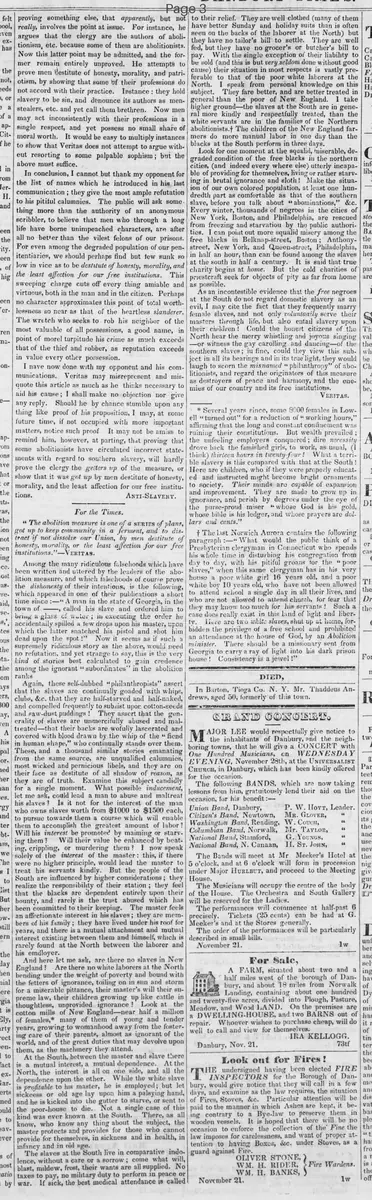
"The abolition measure is one of a series of plans, got up to keep community in a ferment, and to distract if not dissolve our Union, by men destitute of honesty, morality, or the least affection for our free institutions."—Veritas.
Among the many ridiculous falsehoods which have been written and uttered by the leaders of the abolition measure, and which falsehoods of course prove the dishonesty of their intentions, is the following, which appeared in one of their publications a short time since: "A man in the state of Georgia, in the town of —, called his slave and ordered him to bring a glass of water; in executing the order he accidentally spilled a few drops upon his master, upon which the latter snatched his pistol and shot him dead upon the spot!" Now it seems as if such a supremely ridiculous story as the above, would need no refutation, and yet strange to say, this is the very kind of stories best calculated to gain credence among the ignorant "subordinates" in the abolition ranks.
Again, these self-dubbed "philanthropists" assert that the slaves are continually goaded with whips, clubs, &c. that they are half-starved and half-naked, and compelled frequently to subsist upon cotton-seeds and saw-dust puddings! They assert that the generality of slaves are unmercifully abused and maltreated—that their backs are wofully lacerated and covered with blood drawn by the whip of the "fiend in human shape," who continually stands over them. These, and a thousand similar stories emanating from the same source, are unqualified calumnies, most wicked and pernicious libels, and they are on their face as destitute of all shadow of reason, as they are of truth. Examine this subject candidly for a single moment. What possible inducement, let me ask, could lead a man to abuse and maltreat his slaves? Is it not for the interest of the man who owns slaves worth from $1000 to $1500 each, to pursue towards them a course which will enable them to accomplish the greatest amount of labor? Will his interest be promoted by maiming or starving them? Will their value be enhanced by beating, crippling, or murdering them? I now speak solely of the interest of the master: this, if there were no higher principle, would lead the master to treat his servants kindly. But the people of the South are influenced by higher considerations; they realize the responsibility of their station; they feel that the blacks are dependent entirely upon their bounty, and rarely is the trust abused which has been committed to their keeping. The master feels an affectionate interest in his slaves; they are members of his family; they have lived under his roof for years, and there is a mutual attachment and mutual interest existing between them and himself, which is rarely found at the North between the laborer and his employer.
And here let me ask, are there no slaves in New England? Are there no white laborers at the North bending under the weight of poverty and bound with the fetters of ignorance, toiling on in sun and storm for a miserable pittance, their master's will their supreme law, their children growing up like cattle in thoughtless, unprovided ignorance? Look at the cotton mills of New England—near half a million of females,* many of them of young and tender years, growing to womanhood away from the fostering care of their parents, almost as ignorant of the world, and of the great duties that may devolve upon them, as the machinery they attend.
At the South, between the master and slave there is a mutual interest, a mutual dependence. At the North, the interest is all on one side, and all the dependence upon the other. While the white slave is profitable to his master, he is employed; but let sickness or old age lay upon him a palsying hand, and he is kicked into the gutter to starve, or sent to the poor-house to die. Not a single case of this kind was ever known at the South. There, as all know, who know any thing about the subject, the master protects and provides for those who cannot provide for themselves, in sickness and in health, in infancy and in old age.
The slaves at the South live in comparative indolence, without a care or a sorrow; come what will, blast, mildew, frost, their wants are all supplied. No taxes to pay, no military duty to perform in peace or war. If sick, the best medical attendance is called to their relief. They are well clothed (many of them have better Sunday and holiday suits than is often seen on the backs of the laborer at the North) but they have no tailor's bill to settle. They are well fed, but they have no grocer's or butcher's bill to pay. With the single exception of their liability to be sold (and this is but very seldom done without good cause) their situation in most respects is vastly preferable to that of the poor white laborers at the North. I speak from personal knowledge on this subject. They fare better, and are better treated in general than the poor of New England. I take higher ground—the slaves at the South are in general more kindly and respectfully treated, than the white servants are in the families of the Northern abolitionists. The children of the New England farmers do more manual labor in one day than the blacks at the South perform in three days.
Look for one moment at the squalid, miserable, degraded condition of the free blacks in the northern cities, (and indeed every where else) utterly incapable of providing for themselves, living or rather starving in brutal ignorance and sloth! Make the situation of our own colored population, at least one hundredth part as comfortable as that of the southern slave, before you talk about "abominations," &c.
Every winter, thousands of negroes in the cities of New York, Boston, and Philadelphia, are rescued from freezing and starvation by the public authorities. I can point out more squalid misery among the free blacks in Belknap-street, Boston; Anthony-street, New York, and Queen-street, Philadelphia, in half an hour, than can be found among the slaves at the south in half a century. It is said that true charity begins at home. But the cold charities of priestcraft seek for objects of pity as far from home as possible.
As an incontestible evidence that the free negroes at the South do not regard domestic slavery as an evil, I may cite the fact that they frequently marry female slaves, and not only voluntarily serve their masters through life, but also entail slavery upon their children! Could the honest citizens of the North hear the merry whistling and joyous singing—or witness the gay carolling and dancing—of the southern slaves; in fine, could they view this subject in all its bearings and in its true light, they would laugh to scorn the misnamed "philanthropy" of abolitionists, and regard the originators of this measure as destroyers of peace and harmony, and the enemies of our country and its free institutions.
VERITAS.
* Several years since, some 8000 females in Lowell "turned out" for a reduction of "working hours," affirming that the long and constant confinement was ruining their constitutions. But wealth prevailed; the unfeeling employers conquered; dire necessity drove back the famished girls, to work, as usual, (I think) thirteen hours in twenty-four! What a terrible slavery is this compared with that at the South!
Here are children, who if they were properly educated and instructed might become bright ornaments to society. Their minds are capable of expansion and improvement. They are made to grow up in ignorance, and perish by degrees under the eye of the purse-proud miser "whose God is his gold, whose bible is his ledger, and whose prayers are dollars and cents."
The last Norwich Aurora contains the following paragraph: "What would the public think of a Presbyterian clergyman in Connecticut who spends his whole time in disturbing his congregation from day to day, with his pitiful groans for the "poor slaves," when this same clergyman has in his very house a poor white girl 16 years old, and a poor white boy 10 years old, who have not been allowed to attend school a single day in all their lives, and who are not allowed to attend church, for fear that they may know too much for his servants! Such a case does really exist in this land of light and liberty. Here are two white slaves, shut up at home, forbidden the privilege of a free school and prohibited an attendance at the house of God, by an Abolition minister. There should be a missionary sent from Georgia to carry a ray of light into his dark prison house! Consistency is a jewel!"
Among the many ridiculous falsehoods which have been written and uttered by the leaders of the abolition measure, and which falsehoods of course prove the dishonesty of their intentions, is the following, which appeared in one of their publications a short time since: "A man in the state of Georgia, in the town of —, called his slave and ordered him to bring a glass of water; in executing the order he accidentally spilled a few drops upon his master, upon which the latter snatched his pistol and shot him dead upon the spot!" Now it seems as if such a supremely ridiculous story as the above, would need no refutation, and yet strange to say, this is the very kind of stories best calculated to gain credence among the ignorant "subordinates" in the abolition ranks.
Again, these self-dubbed "philanthropists" assert that the slaves are continually goaded with whips, clubs, &c. that they are half-starved and half-naked, and compelled frequently to subsist upon cotton-seeds and saw-dust puddings! They assert that the generality of slaves are unmercifully abused and maltreated—that their backs are wofully lacerated and covered with blood drawn by the whip of the "fiend in human shape," who continually stands over them. These, and a thousand similar stories emanating from the same source, are unqualified calumnies, most wicked and pernicious libels, and they are on their face as destitute of all shadow of reason, as they are of truth. Examine this subject candidly for a single moment. What possible inducement, let me ask, could lead a man to abuse and maltreat his slaves? Is it not for the interest of the man who owns slaves worth from $1000 to $1500 each, to pursue towards them a course which will enable them to accomplish the greatest amount of labor? Will his interest be promoted by maiming or starving them? Will their value be enhanced by beating, crippling, or murdering them? I now speak solely of the interest of the master: this, if there were no higher principle, would lead the master to treat his servants kindly. But the people of the South are influenced by higher considerations; they realize the responsibility of their station; they feel that the blacks are dependent entirely upon their bounty, and rarely is the trust abused which has been committed to their keeping. The master feels an affectionate interest in his slaves; they are members of his family; they have lived under his roof for years, and there is a mutual attachment and mutual interest existing between them and himself, which is rarely found at the North between the laborer and his employer.
And here let me ask, are there no slaves in New England? Are there no white laborers at the North bending under the weight of poverty and bound with the fetters of ignorance, toiling on in sun and storm for a miserable pittance, their master's will their supreme law, their children growing up like cattle in thoughtless, unprovided ignorance? Look at the cotton mills of New England—near half a million of females,* many of them of young and tender years, growing to womanhood away from the fostering care of their parents, almost as ignorant of the world, and of the great duties that may devolve upon them, as the machinery they attend.
At the South, between the master and slave there is a mutual interest, a mutual dependence. At the North, the interest is all on one side, and all the dependence upon the other. While the white slave is profitable to his master, he is employed; but let sickness or old age lay upon him a palsying hand, and he is kicked into the gutter to starve, or sent to the poor-house to die. Not a single case of this kind was ever known at the South. There, as all know, who know any thing about the subject, the master protects and provides for those who cannot provide for themselves, in sickness and in health, in infancy and in old age.
The slaves at the South live in comparative indolence, without a care or a sorrow; come what will, blast, mildew, frost, their wants are all supplied. No taxes to pay, no military duty to perform in peace or war. If sick, the best medical attendance is called to their relief. They are well clothed (many of them have better Sunday and holiday suits than is often seen on the backs of the laborer at the North) but they have no tailor's bill to settle. They are well fed, but they have no grocer's or butcher's bill to pay. With the single exception of their liability to be sold (and this is but very seldom done without good cause) their situation in most respects is vastly preferable to that of the poor white laborers at the North. I speak from personal knowledge on this subject. They fare better, and are better treated in general than the poor of New England. I take higher ground—the slaves at the South are in general more kindly and respectfully treated, than the white servants are in the families of the Northern abolitionists. The children of the New England farmers do more manual labor in one day than the blacks at the South perform in three days.
Look for one moment at the squalid, miserable, degraded condition of the free blacks in the northern cities, (and indeed every where else) utterly incapable of providing for themselves, living or rather starving in brutal ignorance and sloth! Make the situation of our own colored population, at least one hundredth part as comfortable as that of the southern slave, before you talk about "abominations," &c.
Every winter, thousands of negroes in the cities of New York, Boston, and Philadelphia, are rescued from freezing and starvation by the public authorities. I can point out more squalid misery among the free blacks in Belknap-street, Boston; Anthony-street, New York, and Queen-street, Philadelphia, in half an hour, than can be found among the slaves at the south in half a century. It is said that true charity begins at home. But the cold charities of priestcraft seek for objects of pity as far from home as possible.
As an incontestible evidence that the free negroes at the South do not regard domestic slavery as an evil, I may cite the fact that they frequently marry female slaves, and not only voluntarily serve their masters through life, but also entail slavery upon their children! Could the honest citizens of the North hear the merry whistling and joyous singing—or witness the gay carolling and dancing—of the southern slaves; in fine, could they view this subject in all its bearings and in its true light, they would laugh to scorn the misnamed "philanthropy" of abolitionists, and regard the originators of this measure as destroyers of peace and harmony, and the enemies of our country and its free institutions.
VERITAS.
* Several years since, some 8000 females in Lowell "turned out" for a reduction of "working hours," affirming that the long and constant confinement was ruining their constitutions. But wealth prevailed; the unfeeling employers conquered; dire necessity drove back the famished girls, to work, as usual, (I think) thirteen hours in twenty-four! What a terrible slavery is this compared with that at the South!
Here are children, who if they were properly educated and instructed might become bright ornaments to society. Their minds are capable of expansion and improvement. They are made to grow up in ignorance, and perish by degrees under the eye of the purse-proud miser "whose God is his gold, whose bible is his ledger, and whose prayers are dollars and cents."
The last Norwich Aurora contains the following paragraph: "What would the public think of a Presbyterian clergyman in Connecticut who spends his whole time in disturbing his congregation from day to day, with his pitiful groans for the "poor slaves," when this same clergyman has in his very house a poor white girl 16 years old, and a poor white boy 10 years old, who have not been allowed to attend school a single day in all their lives, and who are not allowed to attend church, for fear that they may know too much for his servants! Such a case does really exist in this land of light and liberty. Here are two white slaves, shut up at home, forbidden the privilege of a free school and prohibited an attendance at the house of God, by an Abolition minister. There should be a missionary sent from Georgia to carry a ray of light into his dark prison house! Consistency is a jewel!"
What sub-type of article is it?
Persuasive
Provocative
Social Critique
What themes does it cover?
Slavery Abolition
Social Issues
Morality
What keywords are associated?
Slavery Defense
Abolitionist Falsehoods
Southern Slaves
Northern Laborers
Free Blacks Poverty
New England Mills
What entities or persons were involved?
Veritas
Letter to Editor Details
Author
Veritas
Main Argument
abolitionist claims of slave mistreatment are false and dishonest; southern slaves are well-treated, cared for lifelong, and happier than northern white laborers in factories or free blacks in poverty, who suffer greater hardships.
Notable Details
Refutes Story Of Georgia Slave Shot For Spilling Water
Compares Southern Slaves To New England Cotton Mill Workers
Cites Free Blacks' Misery In Northern Cities Like Boston, New York, Philadelphia
Mentions Lowell Mill Strike For Shorter Hours
Quotes Norwich Aurora On Hypocritical Abolitionist Clergyman In Connecticut