Thank you for visiting SNEWPapers!
Sign up free
Editorial
December 1, 1807
The New Hampshire Gazette
Portsmouth, Rockingham County, New Hampshire
What is this article about?
This editorial from the Farmer's Register criticizes Federalists for their eagerness for war with France during John Adams' administration to appease England, contrasted with their current reluctance to confront British aggressions like the Chesapeake incident, accusing them of hypocrisy and pro-British bias amid rising tensions leading to potential war in 1807.
Clipping
OCR Quality
98%
Excellent
Full Text
POLITICAL.
From the Farmer's Register
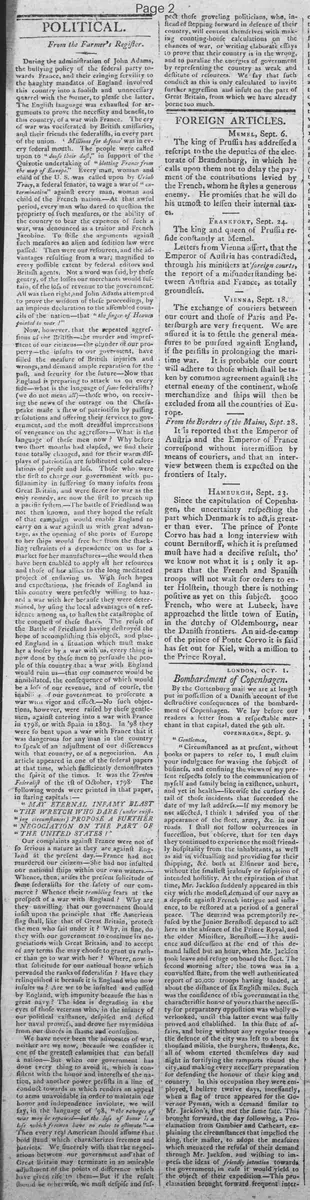
During the administration of John Adams, the bullying policy of the federal party towards France, and their cringing servility to the haughty mandates of England involved this country into a foolish and unnecessary quarrel with the former, to please the latter. The English language was exhausted for arguments to prove the necessity and benefit, to this country, of a war with France. The cry of war was vociferated by British emissaries and their friends the federalists, in every part of the union. "Millions for defence" was in every federal mouth. The people were called upon to "do their duty," in support of the Quixotic undertaking of "blotting France from the map of Europe." Every man, woman and child of the U. S. was called upon by Uriah Tracy, a federal senator, to wage a war of "extermination" against every man, woman and child of the French nation. At that awful period, every man who dared to question the propriety of such measures, or the ability of the country to bear the expenses of such a war, was denounced as a traitor and French Jacobin. To stifle the arguments against such measures an alien and sedition law were passed. Then were our resources, and the advantages resulting from a war; magnified to every possible extent by federal editors and British agents. Not a word was said, by these gentry, of the loss our merchants would sustain, of the loss of revenue to the government. All was then right, and John Adams attempted to prove the wisdom of these proceedings, by an impious declaration to the assembled councils of the nation-that "the finger of Heaven pointed to war!"
Now, however, that the repeated aggressions of the British-the murder and impressment of our citizens-the plunder of our property-the insults to our government, have filled the measure of British injuries and wrongs, and demand ample reparation for the past, and security for the future-Now that England is preparing to attack us on every side-what is the language of some federalists? (we do not mean all)-those who, on receiving the news of the outrage on the Chesapeake made a show of patriotism by passing resolutions and offering their services to government, and the most dreadful imprecations of vengeance on the aggressors-What is the language of these men now? Why before two short months had elapsed, we find their tone totally changed, and for their warm displays of patriotism are substituted cold calculations of profit and loss. Those who were the first to charge our government with pusillanimity in suffering so many insults from Great Britain, and were fierce for war as the only remedy, are now the first to preach up a pacific system. The battle of Friedland was not then known, and they hoped the result of that campaign would enable England to carry on a war against us with great advantage, as the opening of the ports of Europe to her ships would free her from the shackling restraints of a dependence on us for a market for her manufactures-they would then have been enabled to apply all her resources and those of her allies to the long meditated project of enslaving us. With such hopes and expectations, the friends of England in this country were perfectly willing to hazard a war with her because they were determined, by using the local advantages of a residence among us, to hasten the catastrophe of the conquest of these states. The result of the Battle of Friedland having destroyed the hope of accomplishing this object, and placed England in a situation which must make her a loser by a war with us, every thing is now done by these men to persuade the people of this country that a war with England would ruin us-that our commerce would be annihilated, the consequence of which would be a loss of our revenue, and of course, the inability of our government to prosecute a war with vigor and effect. No such objections, however, were raised by these gentlemen, against entering into a war with France in 1798, or with Spain in 1803. In '98 they were so bent upon a war with France that it was dangerous for any man in the country to speak of an adjustment of our differences with that country, or of a negotiation. An article appeared in one of the federal papers at that time, which sufficiently demonstrates the spirit of the times. It was the Trenton Federalist of the 1st of October, 1798. The following words were printed in that paper, in staring capitals:
"MAY ETERNAL INFAMY BLAST
"THE WRETCH WHO DARE (under existing
"circumstances) PROPOSE A FURTHER
"NEGOCIATION ON THE PART OF
"THE UNITED STATES!"
Our complaints against France were not of so serious a nature as they are against England at the present day. France had not murdered our citizens-She had not insulted our national ships within our own waters. Whence, then, arises the present solicitude of some federalists for the safety of our commerce? Whence their trembling fears at the prospect of a war with England? Why are they unwilling that our government should insist upon the principle that the American flag shall, like that of Great Britain, protect the men who sail under it? Why, in fine, do they wish our government to continue its negotiations with Great Britain, and to accept of any terms he may choose to grant us rather than go to war with her? Where, now is that solicitude for our national honor which pervaded the ranks of federalism? Have they relinquished it because it is England who now insults us? Are we to be insulted and cuffed by England, with impunity because she has a great navy? The idea is degrading in the eyes of those veterans who, in the infancy of our political existence, defied and defied her naval prowess, and drove her myrmidons from our shores in shame and confusion.
We have never been the advocates of war, neither are we now, because we consider it one of the greatest calamities that can befall a nation-But when our government has done every thing to avoid it, which is consistent with the honor and interests of the nation, and another power persists in a line of conduct towards us which renders an appeal to arms unavoidable in order to maintain our honor and independence inviolate, we will say, in the language of '98, "the ravages of war may be repaired-but the loss of honor is a loss which freemen have no rules to estimate."
Then every real American Should assume that bold stand which characterizes freemen and patriots. We sincerely wish that the negotiations between our government and that of Great Britain may terminate in an amicable adjustment of the points of difference which have given rise to them-But if this result should be otherwise, we must despise and suspect those groveling politicians, who, instead of stepping forward in defence of their country, will content themselves with making counting-house calculations on the chances of war, or writing elaborate essays to prove that their country is in the wrong, and to paralyze the energies of government by representing the country as weak and destitute of resources. We say that such conduct as this is only calculated to invite further aggression and insult on the part of Great Britain, from which we have already borne too much.
From the Farmer's Register
During the administration of John Adams, the bullying policy of the federal party towards France, and their cringing servility to the haughty mandates of England involved this country into a foolish and unnecessary quarrel with the former, to please the latter. The English language was exhausted for arguments to prove the necessity and benefit, to this country, of a war with France. The cry of war was vociferated by British emissaries and their friends the federalists, in every part of the union. "Millions for defence" was in every federal mouth. The people were called upon to "do their duty," in support of the Quixotic undertaking of "blotting France from the map of Europe." Every man, woman and child of the U. S. was called upon by Uriah Tracy, a federal senator, to wage a war of "extermination" against every man, woman and child of the French nation. At that awful period, every man who dared to question the propriety of such measures, or the ability of the country to bear the expenses of such a war, was denounced as a traitor and French Jacobin. To stifle the arguments against such measures an alien and sedition law were passed. Then were our resources, and the advantages resulting from a war; magnified to every possible extent by federal editors and British agents. Not a word was said, by these gentry, of the loss our merchants would sustain, of the loss of revenue to the government. All was then right, and John Adams attempted to prove the wisdom of these proceedings, by an impious declaration to the assembled councils of the nation-that "the finger of Heaven pointed to war!"
Now, however, that the repeated aggressions of the British-the murder and impressment of our citizens-the plunder of our property-the insults to our government, have filled the measure of British injuries and wrongs, and demand ample reparation for the past, and security for the future-Now that England is preparing to attack us on every side-what is the language of some federalists? (we do not mean all)-those who, on receiving the news of the outrage on the Chesapeake made a show of patriotism by passing resolutions and offering their services to government, and the most dreadful imprecations of vengeance on the aggressors-What is the language of these men now? Why before two short months had elapsed, we find their tone totally changed, and for their warm displays of patriotism are substituted cold calculations of profit and loss. Those who were the first to charge our government with pusillanimity in suffering so many insults from Great Britain, and were fierce for war as the only remedy, are now the first to preach up a pacific system. The battle of Friedland was not then known, and they hoped the result of that campaign would enable England to carry on a war against us with great advantage, as the opening of the ports of Europe to her ships would free her from the shackling restraints of a dependence on us for a market for her manufactures-they would then have been enabled to apply all her resources and those of her allies to the long meditated project of enslaving us. With such hopes and expectations, the friends of England in this country were perfectly willing to hazard a war with her because they were determined, by using the local advantages of a residence among us, to hasten the catastrophe of the conquest of these states. The result of the Battle of Friedland having destroyed the hope of accomplishing this object, and placed England in a situation which must make her a loser by a war with us, every thing is now done by these men to persuade the people of this country that a war with England would ruin us-that our commerce would be annihilated, the consequence of which would be a loss of our revenue, and of course, the inability of our government to prosecute a war with vigor and effect. No such objections, however, were raised by these gentlemen, against entering into a war with France in 1798, or with Spain in 1803. In '98 they were so bent upon a war with France that it was dangerous for any man in the country to speak of an adjustment of our differences with that country, or of a negotiation. An article appeared in one of the federal papers at that time, which sufficiently demonstrates the spirit of the times. It was the Trenton Federalist of the 1st of October, 1798. The following words were printed in that paper, in staring capitals:
"MAY ETERNAL INFAMY BLAST
"THE WRETCH WHO DARE (under existing
"circumstances) PROPOSE A FURTHER
"NEGOCIATION ON THE PART OF
"THE UNITED STATES!"
Our complaints against France were not of so serious a nature as they are against England at the present day. France had not murdered our citizens-She had not insulted our national ships within our own waters. Whence, then, arises the present solicitude of some federalists for the safety of our commerce? Whence their trembling fears at the prospect of a war with England? Why are they unwilling that our government should insist upon the principle that the American flag shall, like that of Great Britain, protect the men who sail under it? Why, in fine, do they wish our government to continue its negotiations with Great Britain, and to accept of any terms he may choose to grant us rather than go to war with her? Where, now is that solicitude for our national honor which pervaded the ranks of federalism? Have they relinquished it because it is England who now insults us? Are we to be insulted and cuffed by England, with impunity because she has a great navy? The idea is degrading in the eyes of those veterans who, in the infancy of our political existence, defied and defied her naval prowess, and drove her myrmidons from our shores in shame and confusion.
We have never been the advocates of war, neither are we now, because we consider it one of the greatest calamities that can befall a nation-But when our government has done every thing to avoid it, which is consistent with the honor and interests of the nation, and another power persists in a line of conduct towards us which renders an appeal to arms unavoidable in order to maintain our honor and independence inviolate, we will say, in the language of '98, "the ravages of war may be repaired-but the loss of honor is a loss which freemen have no rules to estimate."
Then every real American Should assume that bold stand which characterizes freemen and patriots. We sincerely wish that the negotiations between our government and that of Great Britain may terminate in an amicable adjustment of the points of difference which have given rise to them-But if this result should be otherwise, we must despise and suspect those groveling politicians, who, instead of stepping forward in defence of their country, will content themselves with making counting-house calculations on the chances of war, or writing elaborate essays to prove that their country is in the wrong, and to paralyze the energies of government by representing the country as weak and destitute of resources. We say that such conduct as this is only calculated to invite further aggression and insult on the part of Great Britain, from which we have already borne too much.
What sub-type of article is it?
Partisan Politics
Foreign Affairs
War Or Peace
What keywords are associated?
Federalist Hypocrisy
War With England
British Aggressions
Chesapeake Incident
National Honor
Partisan Politics
Foreign Policy
What entities or persons were involved?
John Adams
Federalists
England
France
Uriah Tracy
Chesapeake
Editorial Details
Primary Topic
Federalist Hypocrisy On War With France Versus England
Stance / Tone
Criticism Of Federalist Pro British Bias And Call For National Honor In Facing British Aggressions
Key Figures
John Adams
Federalists
England
France
Uriah Tracy
Chesapeake
Key Arguments
Federalists Pushed For Unnecessary War With France In 1798 To Please England
Current Federalist Reluctance To Confront British Aggressions Like Chesapeake Outrage Shows Hypocrisy
Federalists Ignore Potential Losses In Commerce And Revenue When Advocating War Against France But Emphasize Them Now Against England
Battle Of Friedland Weakened England, Making War Less Advantageous For Her
National Honor Demands Resistance To British Insults, Even If War Results
True Patriots Should Support Government If Negotiations Fail