Thank you for visiting SNEWPapers!
Sign up free
Midland Cooperator
Minneapolis, Hennepin County, Minnesota
What is this article about?
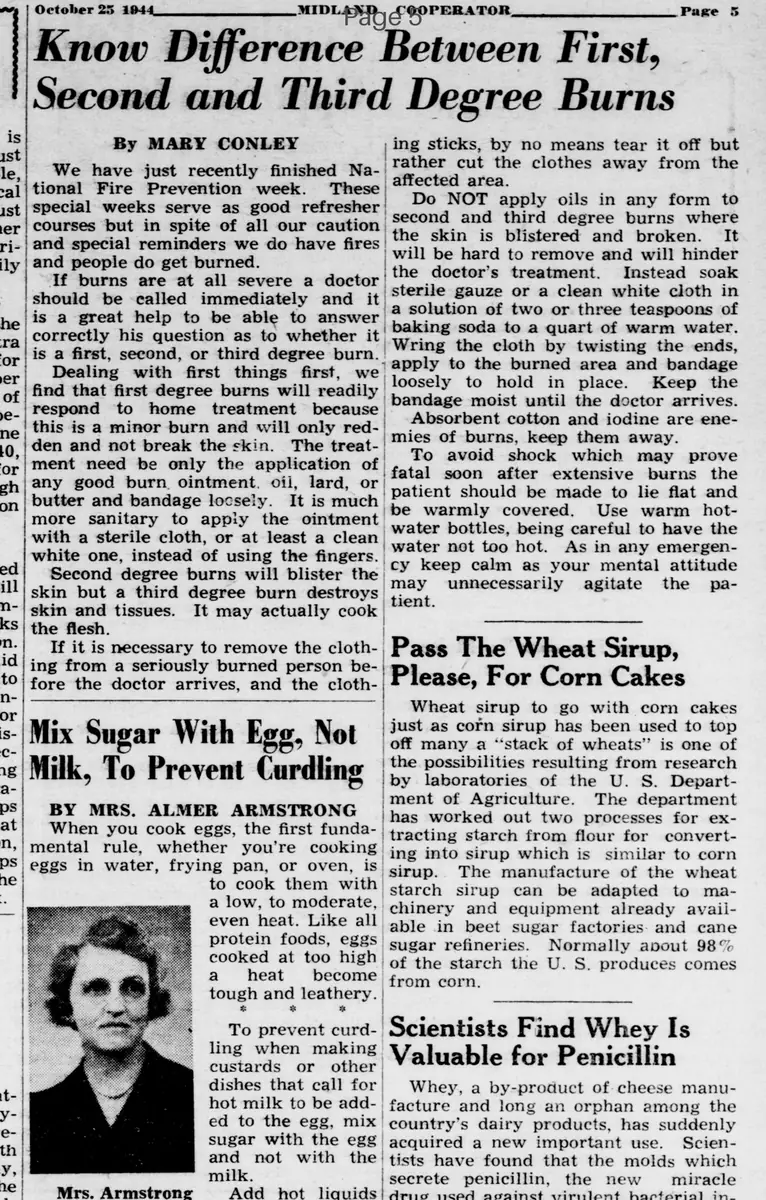
Educational article by Mary Conley on identifying and treating first, second, and third degree burns, post-National Fire Prevention Week. Advises home remedies for minor burns and professional help for severe ones, with tips to avoid shock.
Merged-components note: Merged image with story on burns due to spatial overlap.
Clipping
OCR Quality
Full Text
First,
Second and Third
Degree
Burns
By MARY CONLEY
We have just recently finished National Fire Prevention week. These special weeks serve as good refresher courses but in spite of all our caution and special reminders we do have fires and people do get burned.
If burns are at all severe a doctor should be called immediately and it is a great help to be able to answer correctly his question as to whether it is a first, second, or third degree burn.
Dealing with first things first, we find that first degree burns will readily respond to home treatment because this is a minor burn and will only redden and not break the skin. The treatment need be only the application of any good burn ointment, oil, lard, or butter and bandage loosely. It is much more sanitary to apply the ointment with a sterile cloth, or at least a clean white one, instead of using the fingers.
Second degree burns will blister the skin but a third degree burn destroys skin and tissues. It may actually cook the flesh.
If it is necessary to remove the clothing from a seriously burned person before the doctor arrives, and the clothing is sticking, by no means tear it off but rather cut the clothes away from the affected area.
Do NOT apply oils in any form to second and third degree burns where the skin is blistered and broken. It will be hard to remove and will hinder the doctor's treatment. Instead soak sterile gauze or a clean white cloth in a solution of two or three teaspoons of baking soda to a quart of warm water. Wring the cloth by twisting the ends, apply to the burned area and bandage loosely to hold in place. Keep the bandage moist until the doctor arrives.
Absorbent cotton and iodine are enemies of burns. Keep them away.
To avoid shock which may prove fatal soon after extensive burns the patient should be made to lie flat and be warmly covered. Use warm hot-water bottles, being careful to have the water not too hot. As in any emergency keep calm as your mental attitude may unnecessarily agitate the patient.
What sub-type of article is it?
What keywords are associated?
Story Details
Story Details
Article explains differences between first, second, and third degree burns and provides home treatment advice for minor burns while advising to call a doctor for severe ones. Recommends ointments for first degree, baking soda solution for second and third, and warns against oils, cotton, and iodine. Emphasizes keeping patient calm and warm to prevent shock.