Thank you for visiting SNEWPapers!
Sign up free
Letter to Editor
March 12, 1816
Daily National Intelligencer
Washington, District Of Columbia
What is this article about?
A letter to the National Intelligencer advocating for James Monroe as the next U.S. President, praising his purity and simplicity of character, Revolutionary War services in key battles, and extensive experience in high government offices including Senator, Governor of Virginia, and Secretary of State.
Clipping
OCR Quality
98%
Excellent
Full Text
FOR THE NATIONAL INTELLIGENCER.
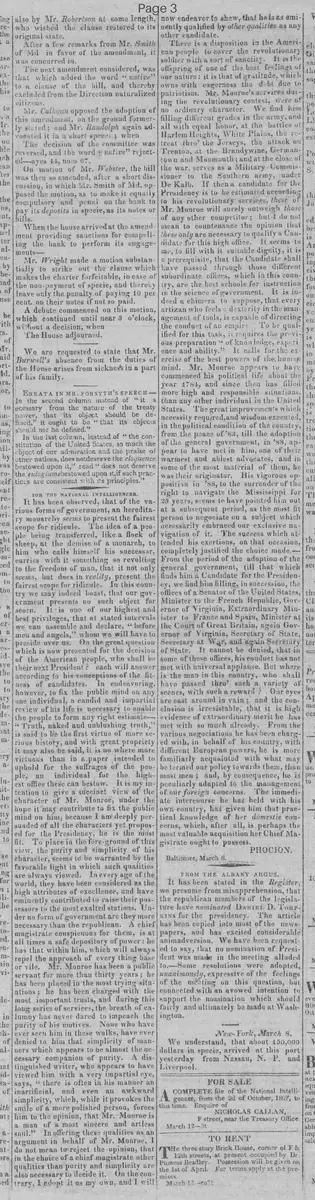
It has been observed, that of the various forms of government, an hereditary monarchy seems to present the fairest scope for ridicule. The idea of a people being transferred, like a flock of sheep, at the demise of a monarch, to him who calls himself his successor, carries with it something so revolting to the freedom of man, that it not only seems, but does in reality, present the fairest scope for ridicule. In this country we may indeed boast, that our government presents no such object for scorn. It is one of our highest and best privileges, that at stated intervals we can assemble and declare, "before men and angels," whom we will have to preside over us. On the great question which is now presented for the decision of the American people, who shall be their next President? each will answer according to his conceptions of the fitness of candidates. In endeavoring, however, to fix the public mind on any one individual, a candid and impartial review of his life is necessary to enable the people to form any right estimate— "Truth, naked and unblushing truth," is said to be the first virtue of more serious history, and with great propriety it may also be said, it is no where more virtuous than in a paper intended to uphold for the suffrages of the people, an individual for the highest office these can bestow. It is my intention to give a succinct view of the character of Mr. Monroe, under the hope it may contribute to fix the public mind on him, because I am deeply persuaded of all the characters yet proposed for the Presidency, he is the most fit. To place in the fore-ground of this view, the purity and simplicity of his character, seems to be warranted by the favorable light in which such qualities are always viewed. In every age of the world, they have been considered as the high attributes of excellence, and have eminently contributed to raise their possessors to the most exalted stations. Under no form of government are they more necessary than the republican. A chief magistrate conspicuous for them, is at all times a safe depository of power: he has that within him, which will always repel the approach of every thing base or vile. Mr. Monroe has been a public servant for more than thirty years; he has been placed in the most trying situations; he has been charged with the most important trusts, and during this long series of services, the breath of calumny has never dared to impeach the purity of his motives. None who have ever seen him in these walks, have ever denied to him that simplicity of manners which appears to be almost the necessary companion of purity. A distinguished writer, who appears to have viewed him with a very impartial eye, says, "there is often in his manner an inartificial, and even an awkward simplicity, which, while it provokes the smile of a more polished person, forces him to the opinion, that Mr. Monroe is a man of a most sincere and artless soul." In offering these qualities as an argument in behalf of Mr. Monroe, I do not mean to reject the opinion, that in the choice of a chief magistrate other qualities than purity and simplicity are also necessary to decide it. On the contrary, I adopt it as my own, and I will now endeavor to shew—that he is as eminently qualified by other qualities as any other candidate.
There is a disposition in the American people to cover the revolutionary soldier with a sort of sanctity. It as the offspring of one of the best feelings of our nature: it is that of gratitude. which owns with eagerness the debt due to patriotism. Mr. Monroe's services during the revolutionary contest. were of no ordinary character. We find him filling different grades in the army, and all with equal honor, at the battles of Harlem Heights, White Plains, the retreat thro' the Jerseys, the attack on Trenton, at the Brandywine, Germantown and Monmouth; and at the close of the war, serves as a Military Commissioner to the Southern army, under De Kalb. If then a candidate for the Presidency is to be estimated according to his revolutionary services, these of Mr. Monroe will surely outweigh those of any other competitor; but I do not mean to countenance the opinion that these only are necessary to qualify a Candidate for this high office. It seems to me, to fill with it suitable dignity, it is a prerequisite, that the Candidate shall have passed through those different subordinate offices, which in this country, are the best schools for instruction in the science of government. It is indeed a chimera to suppose, that every artizan who feels a dexterity in the management of tools, is capable of directing the conduct of an empire To be qualified for this task, it requires the previous preparation "of knowledge, experience and ability." It calls for the exercise of the best powers of the human mind. Mr. Monroe appears to have commenced his political life about the year 1784, and since then has filled more high and responsible situations. than any other individual in the United States. The great improvements which necessity required, and wisdom executed, in the political condition of the country, from the peace of '83, till the adoption of the general government, in '88, appear to have met in him, one of their warmest and ablest advocates, and in some of the most material of them, he was their originator. His vigorous opposition in '88, to the surrender of the right to navigate the Mississippi for 25 years, seems to have pointed him out at a subsequent period, as the most fit person to negociate on a subject which necessarily embraced our exclusive navigation of it. The success which attended his exertions, on that occasion, completely justified the choice made. From the period of the adoption of the general government, till that which finds him a Candidate for the Presidency, we find him filling, in succession, the offices of a Senator of the United States, Minister to the French Republic, Governor of Virginia, Extraordinary Minister to France and Spain, Minister at the Court of Great Britain, again Governor of Virginia, Secretary of State. Secretary at War, and again Secretary of State. It cannot be denied, that in some of these offices, his conduct has not met with universal applause. But where is the man in this country, who shall have passed thro' such a variety of scenes, with such a reward? Our eyes are cast around in vain; and the conclusion is irresistable, that it is high evidence of extraordinary merit he has met with so much already. From the various negociations he has been charged with, in behalf of his country, with different European powers, he is more familiarly acquainted with what may be termed our policy towards them, than most men ; and, by consequence, he is peculiarly adapted to the management of our foreign concerns. The immediate intercourse he has held with his own country, has given him that practical knowledge of her domestic concerns, which, after all, is perhaps the most valuable acquisition her Chief Magistrate ought to possess.
PHOCION.
It has been observed, that of the various forms of government, an hereditary monarchy seems to present the fairest scope for ridicule. The idea of a people being transferred, like a flock of sheep, at the demise of a monarch, to him who calls himself his successor, carries with it something so revolting to the freedom of man, that it not only seems, but does in reality, present the fairest scope for ridicule. In this country we may indeed boast, that our government presents no such object for scorn. It is one of our highest and best privileges, that at stated intervals we can assemble and declare, "before men and angels," whom we will have to preside over us. On the great question which is now presented for the decision of the American people, who shall be their next President? each will answer according to his conceptions of the fitness of candidates. In endeavoring, however, to fix the public mind on any one individual, a candid and impartial review of his life is necessary to enable the people to form any right estimate— "Truth, naked and unblushing truth," is said to be the first virtue of more serious history, and with great propriety it may also be said, it is no where more virtuous than in a paper intended to uphold for the suffrages of the people, an individual for the highest office these can bestow. It is my intention to give a succinct view of the character of Mr. Monroe, under the hope it may contribute to fix the public mind on him, because I am deeply persuaded of all the characters yet proposed for the Presidency, he is the most fit. To place in the fore-ground of this view, the purity and simplicity of his character, seems to be warranted by the favorable light in which such qualities are always viewed. In every age of the world, they have been considered as the high attributes of excellence, and have eminently contributed to raise their possessors to the most exalted stations. Under no form of government are they more necessary than the republican. A chief magistrate conspicuous for them, is at all times a safe depository of power: he has that within him, which will always repel the approach of every thing base or vile. Mr. Monroe has been a public servant for more than thirty years; he has been placed in the most trying situations; he has been charged with the most important trusts, and during this long series of services, the breath of calumny has never dared to impeach the purity of his motives. None who have ever seen him in these walks, have ever denied to him that simplicity of manners which appears to be almost the necessary companion of purity. A distinguished writer, who appears to have viewed him with a very impartial eye, says, "there is often in his manner an inartificial, and even an awkward simplicity, which, while it provokes the smile of a more polished person, forces him to the opinion, that Mr. Monroe is a man of a most sincere and artless soul." In offering these qualities as an argument in behalf of Mr. Monroe, I do not mean to reject the opinion, that in the choice of a chief magistrate other qualities than purity and simplicity are also necessary to decide it. On the contrary, I adopt it as my own, and I will now endeavor to shew—that he is as eminently qualified by other qualities as any other candidate.
There is a disposition in the American people to cover the revolutionary soldier with a sort of sanctity. It as the offspring of one of the best feelings of our nature: it is that of gratitude. which owns with eagerness the debt due to patriotism. Mr. Monroe's services during the revolutionary contest. were of no ordinary character. We find him filling different grades in the army, and all with equal honor, at the battles of Harlem Heights, White Plains, the retreat thro' the Jerseys, the attack on Trenton, at the Brandywine, Germantown and Monmouth; and at the close of the war, serves as a Military Commissioner to the Southern army, under De Kalb. If then a candidate for the Presidency is to be estimated according to his revolutionary services, these of Mr. Monroe will surely outweigh those of any other competitor; but I do not mean to countenance the opinion that these only are necessary to qualify a Candidate for this high office. It seems to me, to fill with it suitable dignity, it is a prerequisite, that the Candidate shall have passed through those different subordinate offices, which in this country, are the best schools for instruction in the science of government. It is indeed a chimera to suppose, that every artizan who feels a dexterity in the management of tools, is capable of directing the conduct of an empire To be qualified for this task, it requires the previous preparation "of knowledge, experience and ability." It calls for the exercise of the best powers of the human mind. Mr. Monroe appears to have commenced his political life about the year 1784, and since then has filled more high and responsible situations. than any other individual in the United States. The great improvements which necessity required, and wisdom executed, in the political condition of the country, from the peace of '83, till the adoption of the general government, in '88, appear to have met in him, one of their warmest and ablest advocates, and in some of the most material of them, he was their originator. His vigorous opposition in '88, to the surrender of the right to navigate the Mississippi for 25 years, seems to have pointed him out at a subsequent period, as the most fit person to negociate on a subject which necessarily embraced our exclusive navigation of it. The success which attended his exertions, on that occasion, completely justified the choice made. From the period of the adoption of the general government, till that which finds him a Candidate for the Presidency, we find him filling, in succession, the offices of a Senator of the United States, Minister to the French Republic, Governor of Virginia, Extraordinary Minister to France and Spain, Minister at the Court of Great Britain, again Governor of Virginia, Secretary of State. Secretary at War, and again Secretary of State. It cannot be denied, that in some of these offices, his conduct has not met with universal applause. But where is the man in this country, who shall have passed thro' such a variety of scenes, with such a reward? Our eyes are cast around in vain; and the conclusion is irresistable, that it is high evidence of extraordinary merit he has met with so much already. From the various negociations he has been charged with, in behalf of his country, with different European powers, he is more familiarly acquainted with what may be termed our policy towards them, than most men ; and, by consequence, he is peculiarly adapted to the management of our foreign concerns. The immediate intercourse he has held with his own country, has given him that practical knowledge of her domestic concerns, which, after all, is perhaps the most valuable acquisition her Chief Magistrate ought to possess.
PHOCION.
What sub-type of article is it?
Persuasive
Political
Informative
What themes does it cover?
Politics
Military War
Constitutional Rights
What keywords are associated?
James Monroe
Presidential Election
Revolutionary War
Government Experience
Purity Simplicity
Political Offices
Foreign Policy
What entities or persons were involved?
Phocion
For The National Intelligencer
Letter to Editor Details
Author
Phocion
Recipient
For The National Intelligencer
Main Argument
james monroe is the most fit candidate for president due to his purity and simplicity of character, distinguished revolutionary war services, and extensive experience in high government offices, making him uniquely qualified to manage both foreign and domestic affairs.
Notable Details
Quotes A Distinguished Writer On Monroe's 'Awkward Simplicity' Indicating Sincerity.
Lists Revolutionary Battles: Harlem Heights, White Plains, Retreat Through The Jerseys, Trenton, Brandywine, Germantown, Monmouth.
Details Offices: Senator, Minister To France, Governor Of Virginia (Twice), Minister To Spain And Britain, Secretary Of State (Twice), Secretary At War.
Opposition To Mississippi Navigation Surrender In 1788.