Thank you for visiting SNEWPapers!
Sign up free
The Providence News
Providence, Providence County, Rhode Island
What is this article about?
Intense racial and political violence in St. Landry Parish, Louisiana, ahead of the April 21 state election, pitting the Fontenot White Supremacists against the Thompson faction allied with black voters. Acadian expansion displaces African Americans through intimidation, killings, and suppression of black registration and voting.
Clipping
OCR Quality
Full Text
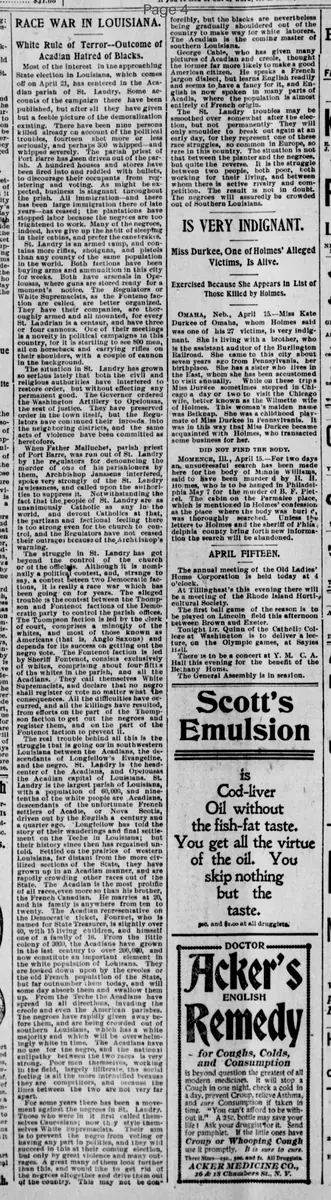
White Rule of Terror--Outcome of Acadian Hatred of Blacks.
Most of the interest in the approaching State election in Louisiana, which comes off on April 21, has centered in the Acadian parish of St. Landry. Some accounts of the campaign there have been published, but after all they have given but a feeble picture of the demoralization existing. There have been nine persons killed already on account of the political troubles, fourteen shot more or less seriously, and perhaps 30 whipped-and whipped severely. The parish priest of Port Barre has been driven out of the parish. A hundred houses and stores have been fired into and riddled with bullets, to discourage their occupants from registering and voting. As might be expected, business is stagnant throughout the parish. All immigration and there has been large immigration there of late years-has ceased; the plantations have stopped labor because the negroes are too frightened to work. Many of the negroes, indeed, have given up the habit of sleeping in their cabins, and prefer the canebrakes. St. Landry is an armed camp, and contains more rifles, shotguns, and pistols than any county of the same population in the world. Both factions have been buying arms and ammunition in this city for weeks. Both have arsenals in Opelousas, where guns are stored ready for a moment's notice. The Regulators or White Supremacists, as the Fontenot faction are called, are better organized. They have their companies, are thoroughly armed and all mounted, for every St. Landrian is a centaur, and have three or four cannons. One of their meetings is a novelty in political campaigns in this country, for it is startling to see 500 men, all on horseback and carrying rifles on their shoulders, with a couple of cannon in the background. The situation in St. Landry has grown so serious lately that both the civil and religious authorities have interfered to restore order, but without effecting any permanent good. The Governor ordered the Washington Artillery to Opelousas, the seat of justice. They have preserved order in the town itself, but the Regulators have continued their inroads into the neighboring districts, and the same acts of violence have been committed as heretofore. When Father Malluchet, parish priest of Port Barre, was run out of St. Landry by the regulators for denouncing the murder of one of his parishioners by them, Archbishop Janssens interfered, spoke very strongly of the St. Landry lawlessness, and called upon the authorities to suppress it. Notwithstanding the fact that the people of St. Landry are as unanimously Catholic as any in the world, and devout Catholics at that, the partisan and factional feeling there is too strong even for the church to control, and the Regulators have not ceased their outrages because of the Archbishop's warning.
'The struggle in St. Landry has got beyond the control of the church or of the officials. Although it is nominally a political contest, and, strange to say, a contest between two Democratic factions, it is really a race war which has been 'going' on for years. The alleged trouble is the contest between the Thompson and Fontenot factions of the Democratic party to control the parish offices. The Thompson faction is led by the clerk of court, comprises a minority of the whites, and most of those known as Americans (that is, Anglo Saxons) And depends for its success on getting out the negro vote. The Fontenot faction is led by Sheriff Fontenot, consists exclusively of whites, comprising about four-fifths of the whites in the parish, say all the Acadians. They call themselves White Supremacists, and declare that no negro shall register or vote no matter what the consequences. All the difficulties have occurred, and all the killings have resulted, from efforts on the part of the Thompson faction to get out the negroes and register them, and on the part of the Fontenot faction to prevent it.
The real trouble behind all this is the struggle that is going on in southwestern Louisiana between the Acadians, the descendants of Longfellow's Evangeline, and the negro. St. Landry is the head-center of the Acadians, and Opelousas the Acadian capital of Louisiana. St. Landry is the largest parish of Louisiana, with a population of 60,000, and nine-tenths of the white people are Acadians, descendants of the unfortunate French settlers of Acadie, or Nova Scotia, driven out by the English a century and a quarter ago. Longfellow has told the story of their wanderings and final settlement on the Teche in Louisiana; but their history since then has remained untold. Settled on the prairies of western Louisiana, far distant from the more civilized sections of the State, they have grown up in an Acadian manner, and are rapidly crowding other races out of the State. The Acadian is the most prolific of all races, even more so than his brother, the French Canadian. He marries at 20, and his family is anywhere from ten to twenty. The Acadian representative on the Democratic ticket, Fournet, who is named for State Treasurer, is slightly over 40, with 15 living children, and himself one of a family of 16. From the little colony of 3000, the Acadians have grown in the last century to over 200,000, and now constitute an important element in the white population of Louisiana. They are looked down upon by the creoles or the old French population of the State, but far outnumber them today, and will some day absorb them and swallow them up. From the Teche the Acadians have spread in all directions, invading the creole and even the American parishes. The negroes have rapidly given way before them, and are being crowded out of southern Louisiana, which has a white majority and which will be overwhelmingly white in time. The Acadians have no use for the negro, and the national antipathy between the two races is very strong. Poor men themselves, working in the field, largely illiterate, the social feeling is all the more intensified because they are competitors, and because the lines between the two are not very far apart. For some years there has been a movement against the negroes in St. Landry. Those who were in it first called themselves Caucasians; now they style themselves White Supremacists. Their aim is to prevent the negro from voting or having any part in politics, and they will succeed in this at their coming election, but only by great violence and many outrages. A great many of them look further than this, and would like to get rid of the negroes altogether and drive them out of the country. This may not be done forcibly, but the blacks are nevertheless being gradually shouldered out of the country to make way for white laborers. The Acadian is the coming master of southern Louisiana. George Cable, who has given many pictures of Acadian and creole, thought the former far more likely to make a good American citizen. He speaks a French jargon dialect, but learns English readily and seems to have a fancy for it, and English is now spoken in many parts of Acadia, where the population is almost entirely of French origin. The St. Landry troubles may be smoothed over somewhat after the election, but not permanently. They will only smoulder to break out again at an early day, for they represent one of these race struggles, so common in Europe, so rare in this country. The situation is not that between the planter and the negroes, but quite the reverse. It is the struggle between two people, both poor, both working for their living, and between whom there is active rivalry and competition. The result is not in doubt. The negroes will assuredly be crowded out of Southern Louisiana.
What sub-type of article is it?
What themes does it cover?
What keywords are associated?
What entities or persons were involved?
Where did it happen?
Story Details
Key Persons
Location
St. Landry Parish, Louisiana
Event Date
April 21
Story Details
Political contest between Thompson and Fontenot Democratic factions in St. Landry escalates into racial violence, with White Supremacists suppressing black voting through killings, whippings, and intimidation, rooted in Acadian displacement of African Americans in southwestern Louisiana.