Thank you for visiting SNEWPapers!
Sign up free
Portland Gazette, And Maine Advertiser
Portland, Cumberland County, Maine
What is this article about?
A letter criticizing the Jefferson administration's policies, including the Embargo and Non-Intercourse acts, for favoring France, ruining commerce, and weakening national honor. Urges Maine voters to elect honest, competent rulers based on merits, not party passion, ahead of annual elections. Signed 'A MODERATE MAN' on March 21, 1811.
Merged-components note: These two components form a single continuous letter to the editor signed by 'A MODERATE MAN', split across pages 2 and 3 with sequential reading orders.
Clippings
1 of 2
OCR Quality
Full Text
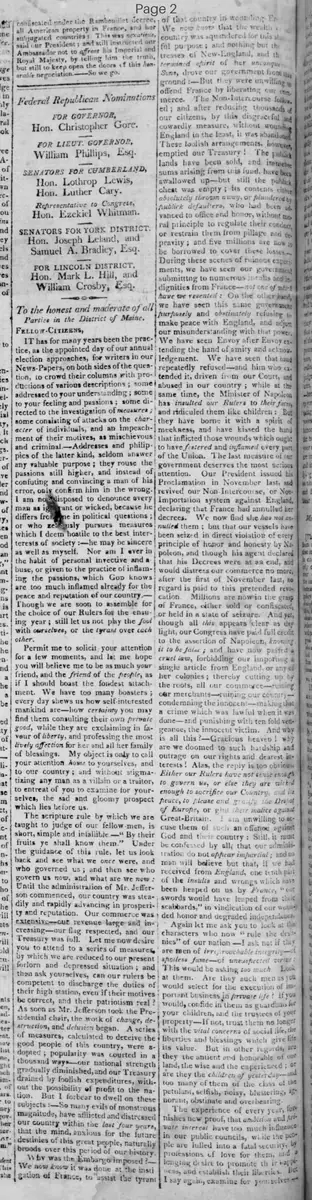
Fellow-Citizens,
IT has for many years been the practice, as the appointed day of our annual election approaches, for writers in our News-Papers, on both sides of the question, to crowd their columns with productions of various descriptions; some addressed to your understanding; some to your feeling and passions; some directed to the investigation of measures; some consisting of attacks on the character of individuals, and an impeachment of their motives, as mischievous and criminal.—Addresses and philippics of the latter kind, seldom answer any valuable purpose; they rouse the passions still higher, and instead of confuting and convincing a man of his error, only confirm him in the wrong. I am not disposed to denounce every man as a rant or wicked, because he differs from me in political questions; or who zealously pursues measures which I deem hostile to the best interests of society:—he may be sincere as well as myself. Nor am I ever in the habit of personal invective and abuse, or given to the practice of inflaming the passions, which God knows are too much inflamed already for the peace and reputation of our country.—Though we are soon to assemble for the choice of our Rulers for the ensuing year; still let us not play the fool with ourselves, or the tyrant over each other.
Permit me to solicit your attention for a few moments, and let me hope you will believe me to be as much your friend, and the friend of the people, as if I should boast the fondest attachment. We have too many boasters; every day shews us how self-interested mankind are—how certainly you may find them consulting their own private good, while they are exclaiming in favour of liberty, and professing the most lively affection for her and all her family of blessings. My object is only to call your attention home to yourselves, and to our country; and without stigmatizing any man as a villain or a traitor, to entreat of you to examine for yourselves, the sad and gloomy prospect which lies before us.
The scripture rule by which we are taught to judge of our fellow-men, is short, simple and infallible—"By their fruits ye shall know them." Under the guidance of this rule, let us look back and see what we once were, and who governed us; and then see who govern us now, and what are we now: Until the administration of Mr. Jefferson commenced, our country was steadily and rapidly advancing in prosperity and reputation. Our commerce was extensive—our revenue large and increasing—our flag respected, and our Treasury was full. Let me now desire you to attend to a series of measures, by which we are reduced to our present forlorn and depressed situation; and then ask yourselves, can our rulers be competent to discharge the duties of their high station, even if their motives be correct, and their patriotism real?
As soon as Mr. Jefferson took the Presidential chair, the work of change, destruction, and delusion began. A series of measures, calculated to deceive the good people of this country, were adopted; popularity was courted in a thousand ways—our national strength gradually diminished, and our Treasury drained by foolish expenditures, without the possibility of profit to the nation. But I forbear to dwell on these subjects: So many evils of monstrous magnitude, have afflicted and distressed our country within the last four years, that the mind, anxious for the future destinies of this great people, naturally broods over this period of our history. Why was the Embargo imposed ?—We now know it was done at the instigation of France, to assist the tyrant of that country in wounding England. We now know that the wealth of our country was squandered for this sinful purpose; and nothing but the distresses of New-England, and the determined spirit of her unconquered Sons, drove our government from this ground:—But they were unwilling to offend France by liberating our commerce. The Non-Intercourse followed; and after reducing thousands of our citizens, by this disgraceful and cowardly measure, without wounding England in the least, it was abandoned. These foolish arrangements, however, emptied our Treasury! The public lands have been sold, and immense sums arising from this fund, have been swallowed up—but still the public chest was empty; its contents either absolutely thrown away, or pillaged by public defaulters, who had been advanced to office and honor, without moral principle to regulate their conduct, or restrain them from pillage and depravity; and five millions are now to be borrowed to cover these losses.—During these scenes of ruinous experiments, we have seen our government submitting to numerous insults and indignities from France—not one of which have we resented: On the other hand, we have seen this same government purposely and obstinately refusing to make peace with England, and adjust our misunderstanding with that power. We have seen Envoy after Envoy extending the hand of amity and acknowledgement. We have seen that hand repeatedly refused—and him who extended it, driven from our Court, and abused in our country; while at the same time, the Minister of Napoleon has insulted our Rulers to their face, and ridiculed them like children: But they have borne it with a spirit of meekness, and have kissed the hand that inflicted those wounds which ought to have festered and inflamed every part of the Union. The last measure of our government deserves the most serious attention. Our President issued his Proclamation in November last, and revived our Non-Intercourse, or Non-Importation system against England, declaring that France had annulled her decrees. We now find she has not annulled them; but that our vessels have been seized in direct violation of every principle of honor and honesty by Napoleon, and though his agent declared that his Decrees were at an end, and would distress our commerce no more, after the first of November last, no regard is paid to this pretended revocation. Millions are now in the grasp of France, either sold or confiscated, or held in a state of seizure. And yet, though all this appears clear as day light, our Congress have paid full credit to the assertion of Napoleon, knowing it to be false; and have now passed a cruel law, forbidding our importing a single article from England, or any of her colonies; thereby cutting up by the roots, all our commerce—ruining our merchants—ruining our country—condemning the innocent—making that a crime which was lawful when it was done—and punishing with ten fold vengeance, the innocent victim. And why is all this?—Gracious heaven! why are we doomed to such hardship and outrage on our rights and dearest interests! Alas, the reply is too obvious Either our Rulers have not sense enough to govern us, or else they are wicked enough to sacrifice our Country, and its peace, to please and gratify the Despot of Europe, or glut their malice against Great-Britain. I am unwilling to accuse them of such an offence against God and their country: Still, it must be confessed by all, that our administration do not appear impartial; and no man will believe but that, if we had received from England, one tenth part of the insults and wrongs which have been heaped on us by France, "our swords would have leaped from their scabbards," in vindication of our wounded honor and degraded independence. Again let me ask you to look at the characters who now "rule the destinies" of our nation—I ask not if they are men of irreproachable integrity—of spotless fame—of unsuspected virtue: This would be asking too much Look at them. Are they such men as you would select for the execution of important business in private life? if you would, confide in them as guardians for your children, and the trustees of your property—If not, trust them no longer with the vital concerns of social life, the liberties and blessings which give life its value. But in other regards, are they the ancient and honorable of our land, the wise and the experienced; or are they the children of yesterday—and too many of them of the class of the petulant, selfish, noisy, blustering, ignorant, obstinate and overbearing The experience of every year, furnishes new proof, that ambition and private interest have too much influence in our public councils, while the people are lulled into a fatal security, by professions of love for them, and longing desire to promote their happiness, and establish their liberties. But I say again, examine for yourselves—
Is the love of Bonaparte and France the love of liberty? Is our peace to be wantoned certain by a union with tyrants? Are republican principles to be cherished by devotion to that despot, who frowns at every thing resembling the rights of the people, and blasts the freedom of every country within his mighty grasp? No, my friends. There is some charm which we do not fully understand, which has thus humbled our administration and debilitated the nation. So Switzerland and Venice were prepared gradually for that destruction which overtook and overwhelmed them. Both those countries played the coward or the hypocrite—attempted to pacify their mortal enemy—made a show of resistance and wavered in their councils:—And while they were thus disgracing themselves, they sickened, pined away, and lost their liberties and their lives.—May Heaven guard our land from similar destruction.
I will suggest one other idea for your notice. For what purpose do you believe, certain men among us, lately agitated the question of a separation of Maine? Not four years since an immense majority opposed it. Now, the friends of the people have again attempted to gain their point and hoist themselves into office at your expense: tho' they expressly opposed every measure that should ascertain the real sentiments of the people on the question. In this proceeding we see nothing but selfish ness, intrigue, false patriotism, and inordinate ambition. By this you may judge of other more important measures. But I will detain you no longer—but merely observe that I will name to you no candidates for office the ensuing year. I wish you to judge for yourselves—to give honor to whom honor is due—to place confidence in the honest and deserving—to prove by your actions that you have more pleasure in discharging your duty as good and intelligent citizens, than in gratifying resentful feelings, or sacrificing on the altar of party spirit, the peace and honor of our country and the noblest feelings of the human heart.
A MODERATE MAN.
March 21, 1811.
What sub-type of article is it?
What themes does it cover?
What keywords are associated?
What entities or persons were involved?
Letter to Editor Details
Author
A Moderate Man.
Recipient
To The Honest And Moderate Of All Parties In The District Of Maine.
Main Argument
criticizes the jefferson administration's policies, including the embargo and non-intercourse acts instigated by france, for ruining commerce, draining the treasury, and submitting to french insults while antagonizing england; urges maine voters to elect competent, honest, impartial rulers based on merits rather than party loyalty or passion.
Notable Details