Thank you for visiting SNEWPapers!
Sign up free
Martinsburgh Gazette
Martinsburg, Berkeley County, West Virginia
What is this article about?
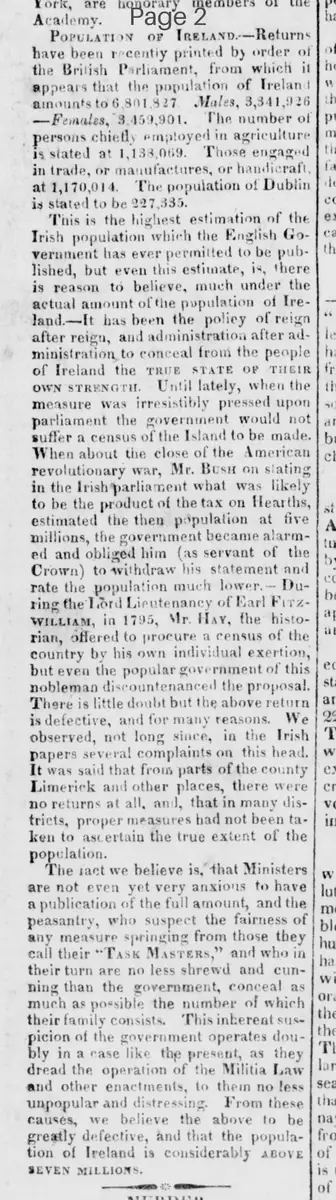
British parliamentary returns estimate Ireland's population at 6,801,827, with 1,133,069 in agriculture and 1,170,014 in trade/manufactures; Dublin at 227,335. The figure is believed underestimated due to longstanding government policy to conceal true numbers, with historical examples from 1783 and 1795 cited.
Clipping
OCR Quality
Full Text
This is the highest estimation of the Irish population which the English Government has ever permitted to be published, but even this estimate, is, there is reason to believe, much under the actual amount of the population of Ireland.—It has been the policy of reign after reign, and administration after administration to conceal from the people of Ireland the TRUE STATE OF THEIR OWN STRENGTH. Until lately, when the measure was irresistibly pressed upon parliament the government would not suffer a census of the Island to be made. When about the close of the American revolutionary war, Mr. Bushe on stating in the Irish parliament what was likely to be the product of the tax on Hearths, estimated the then population at five millions, the government became alarmed and obliged him (as servant of the Crown) to withdraw his statement and rate the population much lower.—During the Lord Lieutenancy of Earl Fitzwilliam, in 1795, Mr. Hay, the historian, offered to procure a census of the country by his own individual exertion, but even the popular government of this nobleman discountenanced the proposal. There is little doubt but the above return is defective, and for many reasons. We observed, not long since, in the Irish papers several complaints on this head. It was said that from parts of the county Limerick and other places, there were no returns at all, and, that in many districts, proper measures had not been taken to ascertain the true extent of the population. The fact we believe is, that Ministers are not even yet very anxious to have a publication of the full amount, and the peasantry, who suspect the fairness of any measure springing from those they call their "Task Masters," and who in their turn are no less shrewd and cunning than the government, conceal as much as possible the number of which their family consists. This inherent suspicion of the government operates doubly in a case like the present, as they dread the operation of the Militia Law and other enactments, to them no less unpopular and distressing. From these causes, we believe the above to be greatly defective, and that the population of Ireland is considerably above SEVEN MILLIONS.
What sub-type of article is it?
What keywords are associated?
What entities or persons were involved?
Where did it happen?
Foreign News Details
Primary Location
Ireland
Key Persons
Outcome
population estimated at 6,801,827 but believed to exceed seven million due to underreporting and historical concealment policies.
Event Details
Recent parliamentary returns state Ireland's population at 6,801,827 (males 3,341,926, females 3,459,901), with 1,133,069 in agriculture, 1,170,014 in trade/manufactures/handicraft, and Dublin at 227,335. This is viewed as the highest permitted estimate but still defective, stemming from government policy to hide true population strength. Historical examples include suppression of Mr. Bushe's 1783 estimate of five million and rejection of Mr. Hay's 1795 census proposal under Earl Fitzwilliam. Complaints note missing returns from Limerick and other areas, with peasantry concealing numbers due to suspicion of government motives like the Militia Law.