Thank you for visiting SNEWPapers!
Sign up free
The Atlanta Inquirer
Atlanta, Fulton County, Georgia
What is this article about?
Dr. Joseph Sende, a 24-year-old scholar from French Cameroons, visits Atlanta and expresses shock at U.S. racial segregation, viewing it as moral immaturity amid economic progress. He attributes the Congolese army revolt to Belgian economic dominance and blames them for Katanga's secession to evade colonialism stigma.
Clipping
OCR Quality
Full Text
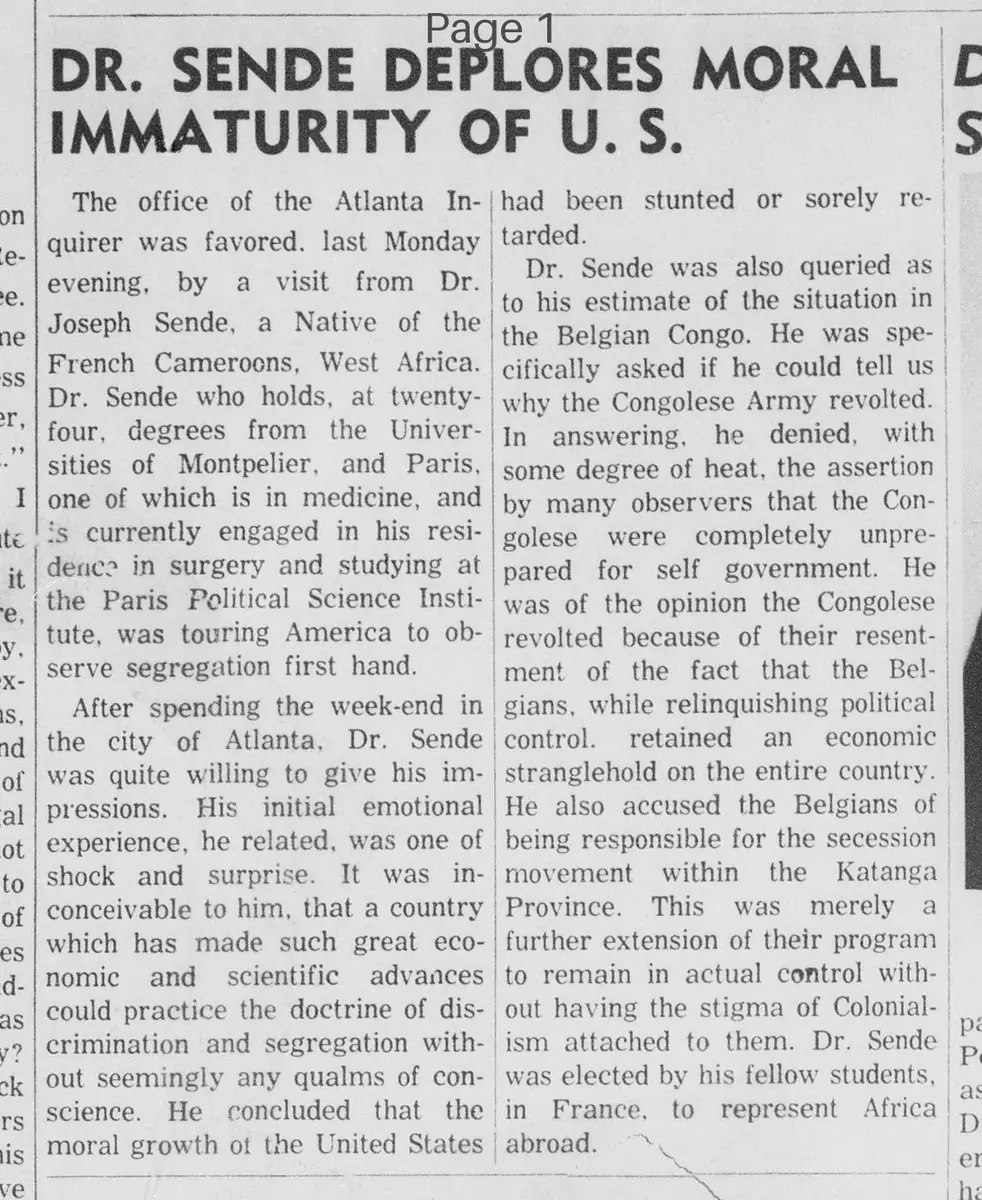
The office of the Atlanta Inquirer was favored last Monday evening by a visit from Dr. Joseph Sende, a Native of the French Cameroons, West Africa. Dr. Sende who holds, at twenty-four, degrees from the Universities of Montpelier, and Paris, one of which is in medicine, and is currently engaged in his residence in surgery and studying at the Paris Political Science Institute, was touring America to observe segregation first hand.
After spending the week-end in the city of Atlanta, Dr. Sende was quite willing to give his impressions. His initial emotional experience, he related, was one of shock and surprise. It was inconceivable to him, that a country which has made such great economic and scientific advances could practice the doctrine of discrimination and segregation without seemingly any qualms of conscience. He concluded that the moral growth of the United States had been stunted or sorely retarded.
Dr. Sende was also queried as to his estimate of the situation in the Belgian Congo. He was specifically asked if he could tell us why the Congolese Army revolted. In answering, he denied, with some degree of heat, the assertion by many observers that the Congolese were completely unprepared for self government. He was of the opinion the Congolese revolted because of their resentment of the fact that the Belgians, while relinquishing political control, retained an economic stranglehold on the entire country.
He also accused the Belgians of being responsible for the secession movement within the Katanga Province. This was merely a further extension of their program to remain in actual control without having the stigma of Colonialism attached to them. Dr. Sende was elected by his fellow students, in France, to represent Africa abroad.
What sub-type of article is it?
What themes does it cover?
What keywords are associated?
What entities or persons were involved?
Where did it happen?
Story Details
Key Persons
Location
Atlanta; Belgian Congo; Katanga Province
Event Date
Last Monday Evening
Story Details
Dr. Sende, a young African doctor and scholar touring the U.S., visits Atlanta and shares shock at segregation, deeming U.S. morally immature. He explains Congolese revolt as resentment against Belgian economic control post-independence and accuses Belgians of engineering Katanga secession to maintain influence without colonial label.