Thank you for visiting SNEWPapers!
Sign up free
Literary
April 25, 1811
Virginia Argus
Richmond, Virginia
What is this article about?
In fall 1810, the narrator encounters a venerable 80-year-old planter by a river, who invites him home. The old man enjoys health, family affection, and rural simplicity, contrasting with urban woes. Reflections on nature, age, death, and virtuous country life.
Clipping
OCR Quality
95%
Excellent
Full Text
FOR THE ARGUS.
THE PHILANTHROPIST.
(No. V.)
Fortunate Senex! Thrice happy Old Man!
Virgil, Ecl. 1.
L. S.
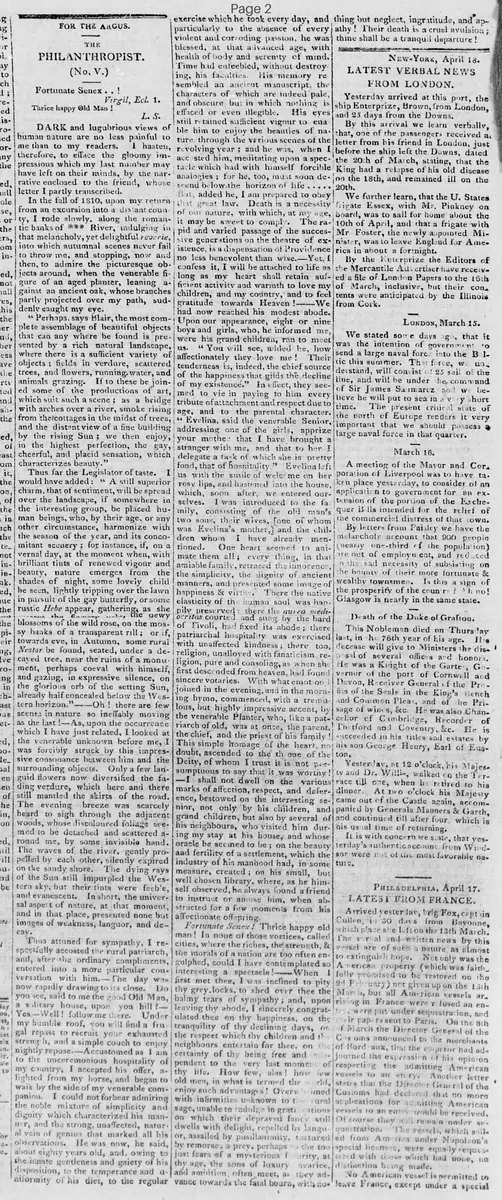
DARK and lugubrious views of human nature are no less painful to me than to my readers. I hasten, therefore, to efface the gloomy impressions which my last number may have left on their minds, by the narrative enclosed to the friend, whose letter I partly transcribed.
In the fall of 1810, upon my return from an excursion into a distant county, I rode slowly along the romantic banks of *** River, indulging in that melancholy, yet delightful reverie, into which autumnal scenes never fail to throw me, and stopping, now and then, to admire the picturesque objects around, when the venerable figure of an aged planter, leaning against an ancient oak, whose branches partly projected over my path, suddenly caught my eye.
"Perhaps, says Blair, the most complete assemblage of beautiful objects that can any where be found is presented by a rich natural landscape, where there is a sufficient variety of objects; fields in verdure, scattered trees, and flowers, running-water, and animals grazing. If to these be joined some of the productions of art, which suit such a scene; as a bridge with arches over a river, smoke rising from the cottages in the midst of trees, and the distant view of a fine building by the rising Sun; we then enjoy, in the highest perfection, the gay, cheerful, and placid sensation, which characterizes beauty."
Thus says the Legislator of taste. I would have added: "A still superior charm, that of sentiment, will be spread over the landscape, if somewhere in the interesting group, be placed human beings, who, by their age, or any other circumstance, harmonize with the season of the year, and its concomitant scenery; for instance, if, on a vernal day, at the moment when, with brilliant tints of renewed vigour and beauty, nature emerges from the shades of night, some lovely child be seen, lightly tripping over the lawn in pursuit of the gay butterfly, or some rustic Hebe appear, gathering the dewy blossoms of the wild rose, on the mossy banks of a transparent rill; or if, towards eve, in Autumn, some rural Nestor be found, seated, under a decayed tree, near the ruins of a monument, perhaps coeval with himself, and gazing, in expressive silence, on the glorious orb of the setting Sun, already half concealed below the Western horizon."--Oh! there are few scenes in nature so ineffably moving as the last!--As, upon the occurrence which I have just related, I looked at the venerable unknown before me, I was forcibly struck by this impressive consonance between him and the surrounding objects. Only a few languid flowers now diversified the fading verdure, which here and there still mantled the skirts of the road. The evening breeze was scarcely heard to sigh through the adjacent woods, whose discoloured foliage seemed to be detached and scattered around me, by some invisible hand. The waves of the river, gently propelled by each other, silently expired on the sandy shore. The dying rays of the Sun still impurpled the Western sky, but their tints were feeble, and evanescent. In short, the universal aspect of nature, at that moment, and in that place, presented none but images of weakness, languor, and decay.
Thus attuned for sympathy, I respectfully accosted the rural patriarch, and, after the ordinary compliments, entered into a more particular conversation with him. The day was now rapidly drawing to its close. Do you see, said to me the good Old Man, a solitary house, upon yon hill?--Yes--Well! follow me there. Under my humble roof, you will find a frugal repast to recruit your exhausted strength, and a simple couch to enjoy nightly repose.--Accustomed as I am to the unceremonious hospitality of my country, I accepted his offer, alighted from my horse, and began to walk by the side of my venerable companion. I could not forbear admiring the noble mixture of simplicity and dignity which characterized his manner, and the strong, unaffected, natural vein of genius that marked all his observations. He was now, he said, about eighty years old, and, owing to the innate gentleness and gaiety of his disposition, to the temperance and uniformity of his diet, to the regular exercise which he took every day, and particularly to the absence of every violent and corroding passion, he was blessed, at that advanced age, with health of body and serenity of mind. Time had enfeebled, without destroying, his faculties. His memory resembled an ancient manuscript, the characters of which are indeed pale and obscure, but in which nothing is effaced or even illegible. His eyes still retained sufficient vigour to enable him to enjoy the beauties of nature, through the various scenes of the revolving year; and he was, when I accosted him, meditating upon a spectacle which had with himself forcible analogies; for he, too, must soon descend below the horizon of life. But, added he, I am prepared to obey that great law. Death is a necessity of our nature, with which, at my age, it may be sweet to comply. The rapid and varied passage of the successive generations on the theatre of existence, is a dispensation of Providence no less benevolent than wise.--Yet, I confess it. I will be attached to life as long as my heart shall retain sufficient activity and warmth to love my children, and my country, and to feel gratitude towards Heaven!--We had now reached his modest abode. Upon our appearance, eight or nine boys and girls, who, he informed me, were his grand children, ran to meet us. "You will see, added he, how affectionately they love me! Their tenderness is, indeed, the chief source of the happiness that gilds the decline of my existence." In effect, they seemed to vie in paying to him every attention due to age. and to the parental character. "Evelina, said the venerable Senior, addressing one of the girls, apprize your mother that I have brought a stranger with me, and that to her I delegate a task of which she is pretty fond, that of hospitality." Evelina left us with the smile of welcome on her rosy lips, and hastened into the house, which, soon after, we entered ourselves. The family, consisting of the old man's two sons, their wives, [one of whom was Evelina's mother,] and the children themselves. I was introduced to the family whom I have already mentioned. One heart seemed to animate them all; every thing, in that amiable family, retraced the innocence, the simplicity, the dignity of ancient manners, and presented some image of happiness & virtue. There the native elasticity of the human soul was happily preserved: there the aurea mediocritas courted and sung by the bard of Tivoli, had fixed its abode; there patriarchal hospitality was exercised with unaffected kindness; there too, religion, unalloyed with fanaticism. religion, pure and consoling, as when she first descended from heaven. had found sincere votaries. With what emotion! joined in the evening, and in the morning hymn, commenced, with a tremulous, but highly impressive accent, by the venerable Planter, who, like a patriarch of old, was at once, the parent, the chief, and the priest of his family! This simple homage of the heart, no doubt. ascended to the throne of the Deity, of whom I trust it is not presumptuous to say that it was worthy!--I shall not dwell on the various marks of affection, respect, and deference, bestowed on the interesting senior, not only by his children, and grand children, but also by several of his neighbours, who visited him during my stay at his house, and whose oracle he seemed to be; on the beauty and fertility of a settlement, which the industry of his manhood had, in some measure, created; on his small, but well chosen library, where, as he himself observed, he always found a friend to instruct or amuse him, when abstracted for a few moments from his affectionate offspring.
Fortunate Senex! Thrice happy old man! In none of those vortices, called cities, where the riches, the strength, & the morals of a nation are too often engulfed, could I have contemplated so interesting a spectacle!--When I first met thee, I was inclined to pity thy grey locks. to shed over thee the balmy tears of sympathy; and, upon leaving thy abode, I sincerely congratulated thee on thy happiness. on the tranquility of thy declining days, on the respect which thy children and thy neighbours entertain for thee. on the certainty of thy being free and independent to the very last moment of thy life. How few, alas! how few old men, in what is termed the world, enjoy such advantages! Overwhelmed with infirmities unknown to the rural sage, unable to indulge in gratifications on which their depraved fancy still dwells with delight, repelled by languor, assailed by pusillanimity, tortured by remorse, a prey, perhaps, to too just fears of a mysterious futurity, at thy age, the sons of luxury avarice, and ambition, often meet, as they advance towards the fatal bourne, with nothing but neglect, ingratitude, and apathy! Their death is a cruel avulsion; thine shall be a tranquil departure!
THE PHILANTHROPIST.
(No. V.)
Fortunate Senex! Thrice happy Old Man!
Virgil, Ecl. 1.
L. S.
DARK and lugubrious views of human nature are no less painful to me than to my readers. I hasten, therefore, to efface the gloomy impressions which my last number may have left on their minds, by the narrative enclosed to the friend, whose letter I partly transcribed.
In the fall of 1810, upon my return from an excursion into a distant county, I rode slowly along the romantic banks of *** River, indulging in that melancholy, yet delightful reverie, into which autumnal scenes never fail to throw me, and stopping, now and then, to admire the picturesque objects around, when the venerable figure of an aged planter, leaning against an ancient oak, whose branches partly projected over my path, suddenly caught my eye.
"Perhaps, says Blair, the most complete assemblage of beautiful objects that can any where be found is presented by a rich natural landscape, where there is a sufficient variety of objects; fields in verdure, scattered trees, and flowers, running-water, and animals grazing. If to these be joined some of the productions of art, which suit such a scene; as a bridge with arches over a river, smoke rising from the cottages in the midst of trees, and the distant view of a fine building by the rising Sun; we then enjoy, in the highest perfection, the gay, cheerful, and placid sensation, which characterizes beauty."
Thus says the Legislator of taste. I would have added: "A still superior charm, that of sentiment, will be spread over the landscape, if somewhere in the interesting group, be placed human beings, who, by their age, or any other circumstance, harmonize with the season of the year, and its concomitant scenery; for instance, if, on a vernal day, at the moment when, with brilliant tints of renewed vigour and beauty, nature emerges from the shades of night, some lovely child be seen, lightly tripping over the lawn in pursuit of the gay butterfly, or some rustic Hebe appear, gathering the dewy blossoms of the wild rose, on the mossy banks of a transparent rill; or if, towards eve, in Autumn, some rural Nestor be found, seated, under a decayed tree, near the ruins of a monument, perhaps coeval with himself, and gazing, in expressive silence, on the glorious orb of the setting Sun, already half concealed below the Western horizon."--Oh! there are few scenes in nature so ineffably moving as the last!--As, upon the occurrence which I have just related, I looked at the venerable unknown before me, I was forcibly struck by this impressive consonance between him and the surrounding objects. Only a few languid flowers now diversified the fading verdure, which here and there still mantled the skirts of the road. The evening breeze was scarcely heard to sigh through the adjacent woods, whose discoloured foliage seemed to be detached and scattered around me, by some invisible hand. The waves of the river, gently propelled by each other, silently expired on the sandy shore. The dying rays of the Sun still impurpled the Western sky, but their tints were feeble, and evanescent. In short, the universal aspect of nature, at that moment, and in that place, presented none but images of weakness, languor, and decay.
Thus attuned for sympathy, I respectfully accosted the rural patriarch, and, after the ordinary compliments, entered into a more particular conversation with him. The day was now rapidly drawing to its close. Do you see, said to me the good Old Man, a solitary house, upon yon hill?--Yes--Well! follow me there. Under my humble roof, you will find a frugal repast to recruit your exhausted strength, and a simple couch to enjoy nightly repose.--Accustomed as I am to the unceremonious hospitality of my country, I accepted his offer, alighted from my horse, and began to walk by the side of my venerable companion. I could not forbear admiring the noble mixture of simplicity and dignity which characterized his manner, and the strong, unaffected, natural vein of genius that marked all his observations. He was now, he said, about eighty years old, and, owing to the innate gentleness and gaiety of his disposition, to the temperance and uniformity of his diet, to the regular exercise which he took every day, and particularly to the absence of every violent and corroding passion, he was blessed, at that advanced age, with health of body and serenity of mind. Time had enfeebled, without destroying, his faculties. His memory resembled an ancient manuscript, the characters of which are indeed pale and obscure, but in which nothing is effaced or even illegible. His eyes still retained sufficient vigour to enable him to enjoy the beauties of nature, through the various scenes of the revolving year; and he was, when I accosted him, meditating upon a spectacle which had with himself forcible analogies; for he, too, must soon descend below the horizon of life. But, added he, I am prepared to obey that great law. Death is a necessity of our nature, with which, at my age, it may be sweet to comply. The rapid and varied passage of the successive generations on the theatre of existence, is a dispensation of Providence no less benevolent than wise.--Yet, I confess it. I will be attached to life as long as my heart shall retain sufficient activity and warmth to love my children, and my country, and to feel gratitude towards Heaven!--We had now reached his modest abode. Upon our appearance, eight or nine boys and girls, who, he informed me, were his grand children, ran to meet us. "You will see, added he, how affectionately they love me! Their tenderness is, indeed, the chief source of the happiness that gilds the decline of my existence." In effect, they seemed to vie in paying to him every attention due to age. and to the parental character. "Evelina, said the venerable Senior, addressing one of the girls, apprize your mother that I have brought a stranger with me, and that to her I delegate a task of which she is pretty fond, that of hospitality." Evelina left us with the smile of welcome on her rosy lips, and hastened into the house, which, soon after, we entered ourselves. The family, consisting of the old man's two sons, their wives, [one of whom was Evelina's mother,] and the children themselves. I was introduced to the family whom I have already mentioned. One heart seemed to animate them all; every thing, in that amiable family, retraced the innocence, the simplicity, the dignity of ancient manners, and presented some image of happiness & virtue. There the native elasticity of the human soul was happily preserved: there the aurea mediocritas courted and sung by the bard of Tivoli, had fixed its abode; there patriarchal hospitality was exercised with unaffected kindness; there too, religion, unalloyed with fanaticism. religion, pure and consoling, as when she first descended from heaven. had found sincere votaries. With what emotion! joined in the evening, and in the morning hymn, commenced, with a tremulous, but highly impressive accent, by the venerable Planter, who, like a patriarch of old, was at once, the parent, the chief, and the priest of his family! This simple homage of the heart, no doubt. ascended to the throne of the Deity, of whom I trust it is not presumptuous to say that it was worthy!--I shall not dwell on the various marks of affection, respect, and deference, bestowed on the interesting senior, not only by his children, and grand children, but also by several of his neighbours, who visited him during my stay at his house, and whose oracle he seemed to be; on the beauty and fertility of a settlement, which the industry of his manhood had, in some measure, created; on his small, but well chosen library, where, as he himself observed, he always found a friend to instruct or amuse him, when abstracted for a few moments from his affectionate offspring.
Fortunate Senex! Thrice happy old man! In none of those vortices, called cities, where the riches, the strength, & the morals of a nation are too often engulfed, could I have contemplated so interesting a spectacle!--When I first met thee, I was inclined to pity thy grey locks. to shed over thee the balmy tears of sympathy; and, upon leaving thy abode, I sincerely congratulated thee on thy happiness. on the tranquility of thy declining days, on the respect which thy children and thy neighbours entertain for thee. on the certainty of thy being free and independent to the very last moment of thy life. How few, alas! how few old men, in what is termed the world, enjoy such advantages! Overwhelmed with infirmities unknown to the rural sage, unable to indulge in gratifications on which their depraved fancy still dwells with delight, repelled by languor, assailed by pusillanimity, tortured by remorse, a prey, perhaps, to too just fears of a mysterious futurity, at thy age, the sons of luxury avarice, and ambition, often meet, as they advance towards the fatal bourne, with nothing but neglect, ingratitude, and apathy! Their death is a cruel avulsion; thine shall be a tranquil departure!
What sub-type of article is it?
Essay
Prose Fiction
What themes does it cover?
Agriculture Rural
Nature
Moral Virtue
What keywords are associated?
Rural Life
Old Age
Family Affection
Nature Beauty
Moral Virtue
Autumnal Reverie
Patriarchal Family
Serene Death
What entities or persons were involved?
L. S.
Literary Details
Title
The Philanthropist. (No. V.)
Author
L. S.
Subject
Narrative Of A Happy Rural Old Age
Key Lines
Fortunate Senex! Thrice Happy Old Man!
Death Is A Necessity Of Our Nature, With Which, At My Age, It May Be Sweet To Comply.
Their Tenderness Is, Indeed, The Chief Source Of The Happiness That Gilds The Decline Of My Existence.
Fortunate Senex! Thrice Happy Old Man!
Their Death Is A Cruel Avulsion; Thine Shall Be A Tranquil Departure!