Thank you for visiting SNEWPapers!
Sign up free
Editorial
July 28, 1809
Virginia Argus
Richmond, Virginia
What is this article about?
This editorial defends the validity of the April 19, 1809, Erskine-Smith arrangement, arguing Mr. Erskine was authorized by Britain. It accuses Foreign Secretary Canning of perfidy, falsehoods, and a treacherous policy to dominate maritime trade by undermining US commerce. The piece praises the US administration under Madison for accepting the offer sincerely and criticizes Federalist attacks.
Clipping
OCR Quality
98%
Excellent
Full Text
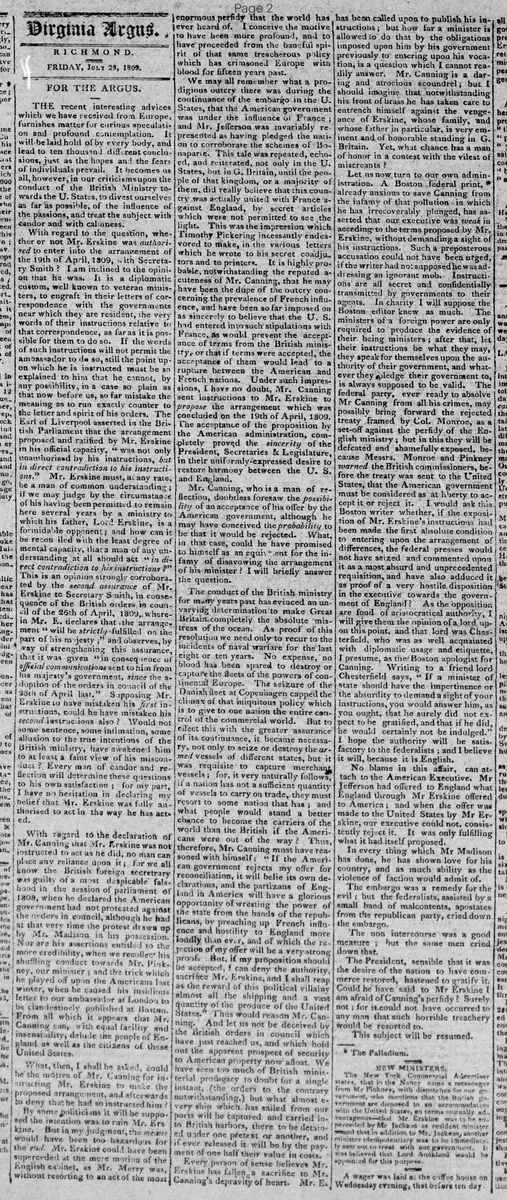
FOR THE ARGUS.
THE recent interesting advices which we have received from Europe, furnishes matter for curious speculation and profound contemplation. It will be laid hold of by every body, and lead to ten thousand different conclusions, just as the hopes and the fears of individuals prevail. It becomes us all, however, in our criticisms upon the conduct of the British Ministry towards the U. States, to divest ourselves as far as possible, of the influence of the passions, and treat the subject with candor and with calmness.
With regard to the question, whether or not Mr. Erskine was authorised to enter into the arrangement of the 19th of April, 1809, with Secretary Smith? I am inclined to the opinion that he was. It is a diplomatic custom, well known to veteran ministers, to engraft in their letters of correspondence with the governments near which they are resident, the very words of their instructions relative to that correspondence, as far as it is possible for them to do so. If the words of such instructions will not permit the ambassador to do so, still the point upon which he is instructed must be so explained to him that he cannot, by any possibility, in a case so plain as that now before us, so far mistake the meaning as to run exactly counter to the letter and spirit of his orders. The Earl of Liverpool asserted in the British Parliament that the arrangement proposed and ratified by Mr. Erskine in his official capacity, "was not only unauthorised by his instructions, but in direct contradiction to his instructions." Mr. Erskine must, at any rate, be a man of common understanding: if we may judge by the circumstance of his having been permitted to remain here several years by a ministry to which his father, Lord Erskine, is a formidable opponent; and how can it be reconciled with the least degree of mental capacity, that a man of any understanding at all should act "in direct contradiction to his instructions?" This is an opinion strongly corroborated by the second assurance of Mr. Erskine to Secretary Smith, in consequence of the British orders in council of the 26th of April, 1809, wherein Mr. E. declares that the arrangement "will be strictly fulfilled on the part of his majesty;" and observes, by way of strengthening this assurance, that it was given "in consequence of official communications sent to him from his majesty's government, since the adoption of the orders in council of the 26th of April last." Supposing Mr. Erskine to have mistaken his first instructions, could he have mistaken his second instructions also? Would not some sentence, some intimation, some allusion to the true intentions of the British ministry, have awakened him to at least a faint view of his misconduct? Every man of candor and reflection will determine these questions to his own satisfaction; for my part, I have no hesitation in declaring my belief that Mr. Erskine was fully authorised to act in the way he has acted.
With regard to the declaration of Mr. Canning that Mr. Erskine was not instructed to act as he did, no man can place any reliance upon it; for we all know the British foreign secretary was guilty of a most despicable falsehood in the session of parliament of 1808, when he declared the American government had not protested against the orders in council, although he had at that very time the protest drawn up by Mr. Madison in his possession. Nor are his assertions entitled to the more credibility, when we recollect his shuffling conduct towards Mr. Pinkney, our minister; and the trick which he played off upon the Americans last winter, when he caused his insidious letter to our ambassador at London to be clandestinely published at Boston. From all which it appears that Mr. Canning can, with equal facility and insensibility, delude the people of England as well as the citizens of these United States.
What, then, I shall be asked, could be the motive of Mr. Canning for instructing Mr. Erskine to make the proposed arrangement, and afterwards to deny that he had so instructed him? By some politicians it will be supposed the intention was to ruin Mr. Erskine. But in my judgment, the means would have been too hazardous for the end. Mr. Erskine could have been superceded at the mere motion of the English cabinet, as Mr. Merry was, without resorting to an act of the most enormous perfidy that the world has ever heard of. I conceive the motive to have been more profound, and to have proceeded from the baneful spirit of that same treacherous policy which has crimsoned Europe with blood for fifteen years past.
We may all remember what a prodigious outcry there was during the continuance of the embargo in the U. States, that the American government was under the influence of France; and Mr. Jefferson was invariably represented as having pledged the nation to corroborate the schemes of Bonaparte. This tale was repeated, echoed, and reiterated, not only in the U. States, but in G. Britain, until the people of that kingdom, or a majority of them, did really believe that this country was actually united with France against England, by secret articles which were not permitted to see the light. This was the impression which Timothy Pickering incessantly endeavored to make, in the various letters which he wrote to his secret coadjutors and to printers. It is highly probable, notwithstanding the reputed acuteness of Mr. Canning, that he may have been the dupe of the outcry concerning the prevalence of French influence, and have been so far imposed on as sincerely to believe that the U. S. had entered into such stipulations with France, as would prevent the acceptance of terms from the British ministry, or that if terms were accepted, the acceptance of them would lead to a rupture between the American and French nations. Under such impressions, I have no doubt, Mr. Canning sent instructions to Mr. Erskine to propose the arrangement which was concluded on the 19th of April, 1809. The acceptance of the proposition by the American administration, completely proved the sincerity of the President, Secretaries & Legislature, in their uniformly-expressed desire to restore harmony between the U. S. and England.
Mr. Canning, who is a man of reflection, doubtless foresaw the possibility of an acceptance of his offer by the American government, although he may have conceived the probability to be that it would be rejected. What, in that case, could he have promised to himself as an equivalent for the infamy of disavowing the arrangement of his minister? I will briefly answer the question.
The conduct of the British ministry for many years past has evinced an unwavering determination to make Great Britain completely the absolute mistress of the ocean. As proof of this resolution we need only to recur to the incidents of naval warfare for the last eight or ten years. No expense, no blood has been spared to destroy or capture the fleets of the powers of continental Europe. The seizure of the Danish fleet at Copenhagen capped the climax of that iniquitous policy which is to give to one nation the entire controul of the commercial world. But to effect this with the greater assurance of its continuance, it became necessary, not only to seize or destroy the armed vessels of different states, but it was requisite to capture merchant vessels; for, it very naturally follows, if a nation has not a sufficient quantity of vessels to carry on trade, they must resort to some nation that has; and what people would stand a better chance to become the carriers of the world than the British if the Americans were out of the way? Thus, therefore, Mr. Canning must have reasoned with himself: "If the American government rejects my offer for reconciliation, it will belie its own declarations, and the partizans of England in America will have a glorious opportunity of wresting the power of the state from the hands of the republicans, by preaching up French influence and hostility to England more loudly than ever, and of which the rejection of my offer will be a very strong proof. But, if my proposition should be accepted, I can deny the authority, sacrifice Mr. Erskine, and I shall reap as the reward of this political villainy almost all the shipping and a vast quantity of the produce of the United States." Thus would reason Mr. Canning. And let us not be deceived by the British orders in council which have just reached us, and which hold out the apparent prospect of security to American property now afloat. We have seen too much of British ministerial profligacy to doubt for a single instant, (the orders to the contrary notwithstanding,) but what almost every ship which has sailed from our ports will be captured and carried into British harbors, there to be detained under one pretext or another, and if ever released it will be by the payment of one half their value in costs. Every person of sense believes Mr. Erskine has fallen a sacrifice to Mr. Canning's depravity of heart. Mr. E. has been called upon to publish his instructions; but how far a minister is allowed to do that by the obligations imposed upon him by his government previously to entering upon his vocation, is a question which I cannot readily answer. Mr. Canning is a daring and atrocious scoundrel; but I should imagine that notwithstanding his front of brass he has taken care to entrench himself against the vengeance of Erskine, whose family, and whose father in particular, is very eminent and of honorable standing in G. Britain. Yet, what chance has a man of honor in a contest with the vilest of miscreants?
Let us now turn to our own administration. A Boston federal print, already anxious to save Canning from the infamy of that pollution in which he has irrecoverably plunged, has asserted that our executive was weak in acceding to the terms proposed by Mr. Erskine, without demanding a sight of his instructions. Such a preposterous accusation could not have been urged, if the writer had not supposed he was addressing an ignorant mob. Instructions are all secret and confidentially transmitted by governments to their agents. In charity I will suppose the Boston editor knew as much. The ministers of a foreign power are only required to produce the evidence of their being ministers; after that, let their instructions be what they may, they speak for themselves upon the authority of their government, and whatever they pledge their government to, is always supposed to be valid. The federal party, ever ready to absolve Mr Canning from all his crimes, may possibly bring forward the rejected treaty framed by Col. Monroe, as a set-off against the perfidy of the English ministry; but in this they will be defeated and shamefully exposed, because Messrs. Monroe and Pinkney warned the British commissioners, before the treaty was sent to the United States, that the American government must be considered as at liberty to accept it or reject it. I would ask this Boston writer whether, if the exposition of Mr. Erskine's instructions had been made the first absolute condition to entering upon the arrangement of differences, the federal presses would not have seized and commented upon it as a most absurd and unprecedented requisition, and have also adduced it as proof of a very hostile disposition in the executive towards the government of England? As the opposition are fond of aristocratical authority, I will give them the opinion of a lord upon this point, and that lord was Chesterfield, who was as well acquainted with diplomatic usage and etiquette, I presume, as the Boston apologist for Canning. Writing to a friend lord Chesterfield says, "If a minister of state should have the impertinence or the absurdity to demand a sight of your instructions, you would answer him, as you ought, that he surely did not expect to be gratified, and that if he did, he would certainly not be indulged."
I hope the authority will be satisfactory to the federalists; and I believe it will, because it is English.
No blame in this affair, can attach to the American Executive. Mr Jefferson had offered to England what England through Mr Erskine offered to America: and when the offer was made to the United States by Mr Erskine, our executive could not, consistently reject it. It was only fulfilling what it had itself proposed.
In every thing which Mr Madison has done, he has shown love for his country, and as much ability as the violence of faction would admit of. The embargo was a remedy for the evil; but the federalists, assisted by a small band of malcontents, apostates from the republican party, cried down the embargo.
The non intercourse was a good measure; but the same men cried down that.
The President, sensible that it was the desire of the nation to have commerce restored, hastened to gratify it. Could he have said to Mr Erskine I am afraid of Canning's perfidy? Surely not; for it could not have occurred to any man that such horrible treachery would be resorted to.
This subject will be resumed.
THE recent interesting advices which we have received from Europe, furnishes matter for curious speculation and profound contemplation. It will be laid hold of by every body, and lead to ten thousand different conclusions, just as the hopes and the fears of individuals prevail. It becomes us all, however, in our criticisms upon the conduct of the British Ministry towards the U. States, to divest ourselves as far as possible, of the influence of the passions, and treat the subject with candor and with calmness.
With regard to the question, whether or not Mr. Erskine was authorised to enter into the arrangement of the 19th of April, 1809, with Secretary Smith? I am inclined to the opinion that he was. It is a diplomatic custom, well known to veteran ministers, to engraft in their letters of correspondence with the governments near which they are resident, the very words of their instructions relative to that correspondence, as far as it is possible for them to do so. If the words of such instructions will not permit the ambassador to do so, still the point upon which he is instructed must be so explained to him that he cannot, by any possibility, in a case so plain as that now before us, so far mistake the meaning as to run exactly counter to the letter and spirit of his orders. The Earl of Liverpool asserted in the British Parliament that the arrangement proposed and ratified by Mr. Erskine in his official capacity, "was not only unauthorised by his instructions, but in direct contradiction to his instructions." Mr. Erskine must, at any rate, be a man of common understanding: if we may judge by the circumstance of his having been permitted to remain here several years by a ministry to which his father, Lord Erskine, is a formidable opponent; and how can it be reconciled with the least degree of mental capacity, that a man of any understanding at all should act "in direct contradiction to his instructions?" This is an opinion strongly corroborated by the second assurance of Mr. Erskine to Secretary Smith, in consequence of the British orders in council of the 26th of April, 1809, wherein Mr. E. declares that the arrangement "will be strictly fulfilled on the part of his majesty;" and observes, by way of strengthening this assurance, that it was given "in consequence of official communications sent to him from his majesty's government, since the adoption of the orders in council of the 26th of April last." Supposing Mr. Erskine to have mistaken his first instructions, could he have mistaken his second instructions also? Would not some sentence, some intimation, some allusion to the true intentions of the British ministry, have awakened him to at least a faint view of his misconduct? Every man of candor and reflection will determine these questions to his own satisfaction; for my part, I have no hesitation in declaring my belief that Mr. Erskine was fully authorised to act in the way he has acted.
With regard to the declaration of Mr. Canning that Mr. Erskine was not instructed to act as he did, no man can place any reliance upon it; for we all know the British foreign secretary was guilty of a most despicable falsehood in the session of parliament of 1808, when he declared the American government had not protested against the orders in council, although he had at that very time the protest drawn up by Mr. Madison in his possession. Nor are his assertions entitled to the more credibility, when we recollect his shuffling conduct towards Mr. Pinkney, our minister; and the trick which he played off upon the Americans last winter, when he caused his insidious letter to our ambassador at London to be clandestinely published at Boston. From all which it appears that Mr. Canning can, with equal facility and insensibility, delude the people of England as well as the citizens of these United States.
What, then, I shall be asked, could be the motive of Mr. Canning for instructing Mr. Erskine to make the proposed arrangement, and afterwards to deny that he had so instructed him? By some politicians it will be supposed the intention was to ruin Mr. Erskine. But in my judgment, the means would have been too hazardous for the end. Mr. Erskine could have been superceded at the mere motion of the English cabinet, as Mr. Merry was, without resorting to an act of the most enormous perfidy that the world has ever heard of. I conceive the motive to have been more profound, and to have proceeded from the baneful spirit of that same treacherous policy which has crimsoned Europe with blood for fifteen years past.
We may all remember what a prodigious outcry there was during the continuance of the embargo in the U. States, that the American government was under the influence of France; and Mr. Jefferson was invariably represented as having pledged the nation to corroborate the schemes of Bonaparte. This tale was repeated, echoed, and reiterated, not only in the U. States, but in G. Britain, until the people of that kingdom, or a majority of them, did really believe that this country was actually united with France against England, by secret articles which were not permitted to see the light. This was the impression which Timothy Pickering incessantly endeavored to make, in the various letters which he wrote to his secret coadjutors and to printers. It is highly probable, notwithstanding the reputed acuteness of Mr. Canning, that he may have been the dupe of the outcry concerning the prevalence of French influence, and have been so far imposed on as sincerely to believe that the U. S. had entered into such stipulations with France, as would prevent the acceptance of terms from the British ministry, or that if terms were accepted, the acceptance of them would lead to a rupture between the American and French nations. Under such impressions, I have no doubt, Mr. Canning sent instructions to Mr. Erskine to propose the arrangement which was concluded on the 19th of April, 1809. The acceptance of the proposition by the American administration, completely proved the sincerity of the President, Secretaries & Legislature, in their uniformly-expressed desire to restore harmony between the U. S. and England.
Mr. Canning, who is a man of reflection, doubtless foresaw the possibility of an acceptance of his offer by the American government, although he may have conceived the probability to be that it would be rejected. What, in that case, could he have promised to himself as an equivalent for the infamy of disavowing the arrangement of his minister? I will briefly answer the question.
The conduct of the British ministry for many years past has evinced an unwavering determination to make Great Britain completely the absolute mistress of the ocean. As proof of this resolution we need only to recur to the incidents of naval warfare for the last eight or ten years. No expense, no blood has been spared to destroy or capture the fleets of the powers of continental Europe. The seizure of the Danish fleet at Copenhagen capped the climax of that iniquitous policy which is to give to one nation the entire controul of the commercial world. But to effect this with the greater assurance of its continuance, it became necessary, not only to seize or destroy the armed vessels of different states, but it was requisite to capture merchant vessels; for, it very naturally follows, if a nation has not a sufficient quantity of vessels to carry on trade, they must resort to some nation that has; and what people would stand a better chance to become the carriers of the world than the British if the Americans were out of the way? Thus, therefore, Mr. Canning must have reasoned with himself: "If the American government rejects my offer for reconciliation, it will belie its own declarations, and the partizans of England in America will have a glorious opportunity of wresting the power of the state from the hands of the republicans, by preaching up French influence and hostility to England more loudly than ever, and of which the rejection of my offer will be a very strong proof. But, if my proposition should be accepted, I can deny the authority, sacrifice Mr. Erskine, and I shall reap as the reward of this political villainy almost all the shipping and a vast quantity of the produce of the United States." Thus would reason Mr. Canning. And let us not be deceived by the British orders in council which have just reached us, and which hold out the apparent prospect of security to American property now afloat. We have seen too much of British ministerial profligacy to doubt for a single instant, (the orders to the contrary notwithstanding,) but what almost every ship which has sailed from our ports will be captured and carried into British harbors, there to be detained under one pretext or another, and if ever released it will be by the payment of one half their value in costs. Every person of sense believes Mr. Erskine has fallen a sacrifice to Mr. Canning's depravity of heart. Mr. E. has been called upon to publish his instructions; but how far a minister is allowed to do that by the obligations imposed upon him by his government previously to entering upon his vocation, is a question which I cannot readily answer. Mr. Canning is a daring and atrocious scoundrel; but I should imagine that notwithstanding his front of brass he has taken care to entrench himself against the vengeance of Erskine, whose family, and whose father in particular, is very eminent and of honorable standing in G. Britain. Yet, what chance has a man of honor in a contest with the vilest of miscreants?
Let us now turn to our own administration. A Boston federal print, already anxious to save Canning from the infamy of that pollution in which he has irrecoverably plunged, has asserted that our executive was weak in acceding to the terms proposed by Mr. Erskine, without demanding a sight of his instructions. Such a preposterous accusation could not have been urged, if the writer had not supposed he was addressing an ignorant mob. Instructions are all secret and confidentially transmitted by governments to their agents. In charity I will suppose the Boston editor knew as much. The ministers of a foreign power are only required to produce the evidence of their being ministers; after that, let their instructions be what they may, they speak for themselves upon the authority of their government, and whatever they pledge their government to, is always supposed to be valid. The federal party, ever ready to absolve Mr Canning from all his crimes, may possibly bring forward the rejected treaty framed by Col. Monroe, as a set-off against the perfidy of the English ministry; but in this they will be defeated and shamefully exposed, because Messrs. Monroe and Pinkney warned the British commissioners, before the treaty was sent to the United States, that the American government must be considered as at liberty to accept it or reject it. I would ask this Boston writer whether, if the exposition of Mr. Erskine's instructions had been made the first absolute condition to entering upon the arrangement of differences, the federal presses would not have seized and commented upon it as a most absurd and unprecedented requisition, and have also adduced it as proof of a very hostile disposition in the executive towards the government of England? As the opposition are fond of aristocratical authority, I will give them the opinion of a lord upon this point, and that lord was Chesterfield, who was as well acquainted with diplomatic usage and etiquette, I presume, as the Boston apologist for Canning. Writing to a friend lord Chesterfield says, "If a minister of state should have the impertinence or the absurdity to demand a sight of your instructions, you would answer him, as you ought, that he surely did not expect to be gratified, and that if he did, he would certainly not be indulged."
I hope the authority will be satisfactory to the federalists; and I believe it will, because it is English.
No blame in this affair, can attach to the American Executive. Mr Jefferson had offered to England what England through Mr Erskine offered to America: and when the offer was made to the United States by Mr Erskine, our executive could not, consistently reject it. It was only fulfilling what it had itself proposed.
In every thing which Mr Madison has done, he has shown love for his country, and as much ability as the violence of faction would admit of. The embargo was a remedy for the evil; but the federalists, assisted by a small band of malcontents, apostates from the republican party, cried down the embargo.
The non intercourse was a good measure; but the same men cried down that.
The President, sensible that it was the desire of the nation to have commerce restored, hastened to gratify it. Could he have said to Mr Erskine I am afraid of Canning's perfidy? Surely not; for it could not have occurred to any man that such horrible treachery would be resorted to.
This subject will be resumed.
What sub-type of article is it?
Foreign Affairs
Partisan Politics
War Or Peace
What keywords are associated?
Erskine Arrangement
Canning Perfidy
British Diplomacy
Us Foreign Policy
Maritime Dominance
Federalist Criticism
Orders In Council
What entities or persons were involved?
Mr. Erskine
Mr. Canning
Secretary Smith
Earl Of Liverpool
Mr. Madison
Mr. Jefferson
Timothy Pickering
British Ministry
American Executive
Federalists
Editorial Details
Primary Topic
Defense Of Erskine Smith Arrangement And Accusation Of Canning's Perfidy
Stance / Tone
Strongly Supportive Of Us Administration And Critical Of British Ministry
Key Figures
Mr. Erskine
Mr. Canning
Secretary Smith
Earl Of Liverpool
Mr. Madison
Mr. Jefferson
Timothy Pickering
British Ministry
American Executive
Federalists
Key Arguments
Mr. Erskine Was Authorized To Make The April 19, 1809 Arrangement
Diplomatic Custom Supports Erskine's Actions Aligning With Instructions
Canning's Disavowal Is Unreliable Due To Past Falsehoods
British Motive Is To Dominate Ocean Commerce By Capturing Us Shipping
Us Acceptance Proves Sincerity In Seeking Harmony With Britain
No Need To Demand Sight Of Instructions Per Diplomatic Etiquette
Embargo And Non Intercourse Were Valid Measures Cried Down By Federalists
Madison Acted With Patriotism And Ability