Thank you for visiting SNEWPapers!
Sign up free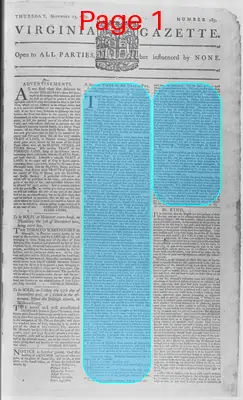
Literary
November 23, 1769
The Virginia Gazette
Williamsburg, Virginia
What is this article about?
This essay, the second paper on smallpox, discusses its contagion limits in Virginia, prevention strategies, causes of spread, and the author's 1760 experiments yielding a mild inoculation method. It argues against extirpating the disease, viewing it as beneficial, and critiques other treatments.
Clipping
OCR Quality
95%
Excellent
Full Text
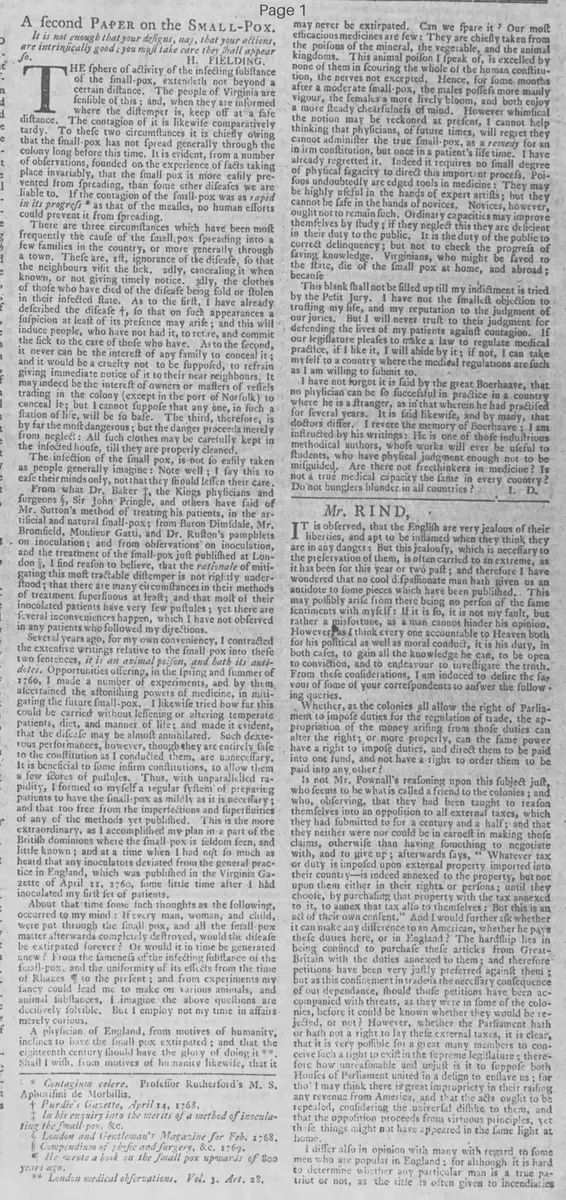
A second PAPER on the Small-Pox.
It is not enough that your designs, nay, that your actions, are intrinsically good; you must take care they shall appear so.
H. FIELDING.
The sphere of activity of the infecting substance of the small-pox, extendeth not beyond a certain distance. The people of Virginia are sensible of this; and, when they are informed where the distemper is, keep off at a safe distance. The contagion of it is likewise comparatively tardy. To these two circumstances it is chiefly owing that the small-pox has not spread generally through the colony long before this time. It is evident, from a number of observations, founded on the experience of facts taking place invariably, that the small pox is more easily prevented from spreading, than some other diseases we are liable to. If the contagion of the small-pox was as rapid in its progress as that of the measles, no human efforts could prevent it from spreading.
There are three circumstances which have been most frequently the cause of the small-pox spreading into a few families in the country, or more generally through a town. These are, 1st, ignorance of the disease, so that the neighbours visit the sick. 2dly, concealing it when known, or not giving timely notice. 3dly, the clothes of those who have died of the disease being sold or stolen in their infected state. As to the first, I have already described the disease, so that on such appearances a suspicion at least of its presence may arise: and this will induce people, who have not had it, to retire, and commit the sick to the care of those who have. As to the second, it never can be the interest of any family to conceal it: and it would be a cruelty not to be supposed, to refrain giving immediate notice of it to their near neighbours. It may indeed be the interest of owners or masters of vessels trading in the colony (except in the port of Norfolk) to conceal it; but I cannot suppose that any one, in such a station of life, will be so base. The third, therefore, is by far the most dangerous; but the danger proceeds merely from neglect: All such clothes may be carefully kept in the infected house, till they are properly cleaned.
The infection of the small pox, is not so easily taken as people generally imagine: Note well; I say this to ease their minds only, not that they should lessen their care. From what Dr. Baker, the King's physicians and surgeons, Sir John Pringle, and others have said of Mr. Sutton's method of treating his patients, in the artificial and natural small-pox; from Baron Dimsdale, Mr. Bromfield, Monsieur Gatti, and Dr. Ruston's pamphlets on inoculation; and from observations on inoculation, and the treatment of the small-pox just published at London, I find reason to believe, that the rationale of mitigating this most tractable distemper is not rightly understood; that there are many circumstances in their methods of treatment superfluous at least; and that most of their inoculated patients have very few pustules; yet there are several inconveniences happen, which I have not observed in any patients who followed my directions.
Several years ago, for my own convenience, I contracted the extensive writings relative to the smallpox into these two sentences, it is an animal poison, and hath its antidotes. Opportunities offering, in the spring and summer of 1760, I made a number of experiments, and by them ascertained the astonishing powers of medicine, in mitigating the future small-pox. I likewise tried how far this could be carried without lessening or altering temperate patients, diet, and manner of life: and made it evident, that the disease may be almost annihilated. Such dexterous performances, however, though they are entirely safe to the constitution as I conducted them, are unnecessary. It is beneficial to some infirm constitutions, to allow them a few scores of pustules. Thus, with unparallelled rapidity, I formed to myself a regular system of preparing patients to have the small-pox as mildly as it is necessary; and that too free from the imperfections and superfluities of any of the methods yet published. This is the more extraordinary, as I accomplished my plan in a part of the British dominions where the small pox is seldom seen, and little known; and at a time when I had not so much as heard that any inoculators deviated from the general practice in England, which was published in the Virginia Gazette of April 11, 1760, some little time after I had inoculated my first set of patients.
About that time some such thoughts as the following, occurred to my mind: If every man, woman, and child, were put through the small pox, and all the smallpox matter afterwards completely destroyed, would the disease be extirpated forever? Or would it in time be generated anew? From the sameness of the infecting substance of the small-pox, and the uniformity of its effects from the time of Rhazes to the present: and from experiments my fancy could lead me to make on various animals, and animal substances, I imagine the above questions are decisively solvable. But I employ not my time in assays merely curious.
A physician of England, from motives of humanity, inclines to have the small pox extirpated; and that the eighteenth century should have the glory of doing it. Shall I wish, from motives of humanity likewise, that it may never be extirpated. Can we spare it? Our most efficacious medicines are few: They are chiefly taken from the poisons of the mineral, the vegetable, and the animal kingdoms. This animal poison I speak of, is excelled by none of them in coursing the whole of the human constitution, the nerves not excepted. Hence, for some months after a moderate small-pox, the males possess more manly vigour, the females a more lively bloom, and both enjoy a more steady cheerfulness of mind. However whimsical the notion may be reckoned at present, I cannot help thinking that physicians, of future times, will regret they cannot administer the true small-pox, as a remedy for an infirm constitution, but once in a patient's life time. I have already regretted it. Indeed it requires no small degree of physical sagacity to direct this important process. Poisons undoubtedly are edged tools in medicine: They may be highly useful in the hands of expert artists; but they cannot be safe in the hands of novices. Novices, however, ought not to remain such. Ordinary capacities may improve themselves by study; if they neglect this they are deficient in their duty to the public. It is the duty of the public to correct delinquency: but not to check the progress of saving knowledge. Virginians, who might be saved to the state, die of the smallpox at home, and abroad: because
This blank shall not be filled up till my indictment is tried by the Petit Jury. I have not the smallest objection to trusting my life, and my reputation to the judgment of our juries. But I will never trust to their judgment for defending the lives of my patients against contagion. If our legislature pleases to make a law to regulate medical practice, if I like it, I will abide by it; if not, I can take myself to a country where the medical regulations are such as I am willing to submit to.
I have not forgot it is said by the great Boerhaave, that no physician can be so successful in practice in a country where he is a stranger, as in that wherein he had practised for several years. It is said likewise, and by many, that doctors differ. I revere the memory of Boerhaave: I am instructed by his writings: He is one of those industrious methodical authors, whose works will ever be useful to students, who have physical judgment enough not to be misguided. Are there not freethinkers in medicine? Is not a true medical capacity the same in every country? Do not bunglers blunder in all countries?
I. D.
* Contagion in celere. Professor Rutherford's M.S.
Aphrodisia de Morbillis.
+ Purdie's Gazette, April 14, 1768.
|| In his enquiry into the merits of a method of inoculating the small-pox; &c.
|| London and Gentleman's Magazine for Feb. 1768.
|| Compendium of physic and surgery, &c. 1757.
. He wrote a book on the small pox upwards of 80 years ago.
** London medical observations: Vol. 3. Art. 23.
It is not enough that your designs, nay, that your actions, are intrinsically good; you must take care they shall appear so.
H. FIELDING.
The sphere of activity of the infecting substance of the small-pox, extendeth not beyond a certain distance. The people of Virginia are sensible of this; and, when they are informed where the distemper is, keep off at a safe distance. The contagion of it is likewise comparatively tardy. To these two circumstances it is chiefly owing that the small-pox has not spread generally through the colony long before this time. It is evident, from a number of observations, founded on the experience of facts taking place invariably, that the small pox is more easily prevented from spreading, than some other diseases we are liable to. If the contagion of the small-pox was as rapid in its progress as that of the measles, no human efforts could prevent it from spreading.
There are three circumstances which have been most frequently the cause of the small-pox spreading into a few families in the country, or more generally through a town. These are, 1st, ignorance of the disease, so that the neighbours visit the sick. 2dly, concealing it when known, or not giving timely notice. 3dly, the clothes of those who have died of the disease being sold or stolen in their infected state. As to the first, I have already described the disease, so that on such appearances a suspicion at least of its presence may arise: and this will induce people, who have not had it, to retire, and commit the sick to the care of those who have. As to the second, it never can be the interest of any family to conceal it: and it would be a cruelty not to be supposed, to refrain giving immediate notice of it to their near neighbours. It may indeed be the interest of owners or masters of vessels trading in the colony (except in the port of Norfolk) to conceal it; but I cannot suppose that any one, in such a station of life, will be so base. The third, therefore, is by far the most dangerous; but the danger proceeds merely from neglect: All such clothes may be carefully kept in the infected house, till they are properly cleaned.
The infection of the small pox, is not so easily taken as people generally imagine: Note well; I say this to ease their minds only, not that they should lessen their care. From what Dr. Baker, the King's physicians and surgeons, Sir John Pringle, and others have said of Mr. Sutton's method of treating his patients, in the artificial and natural small-pox; from Baron Dimsdale, Mr. Bromfield, Monsieur Gatti, and Dr. Ruston's pamphlets on inoculation; and from observations on inoculation, and the treatment of the small-pox just published at London, I find reason to believe, that the rationale of mitigating this most tractable distemper is not rightly understood; that there are many circumstances in their methods of treatment superfluous at least; and that most of their inoculated patients have very few pustules; yet there are several inconveniences happen, which I have not observed in any patients who followed my directions.
Several years ago, for my own convenience, I contracted the extensive writings relative to the smallpox into these two sentences, it is an animal poison, and hath its antidotes. Opportunities offering, in the spring and summer of 1760, I made a number of experiments, and by them ascertained the astonishing powers of medicine, in mitigating the future small-pox. I likewise tried how far this could be carried without lessening or altering temperate patients, diet, and manner of life: and made it evident, that the disease may be almost annihilated. Such dexterous performances, however, though they are entirely safe to the constitution as I conducted them, are unnecessary. It is beneficial to some infirm constitutions, to allow them a few scores of pustules. Thus, with unparallelled rapidity, I formed to myself a regular system of preparing patients to have the small-pox as mildly as it is necessary; and that too free from the imperfections and superfluities of any of the methods yet published. This is the more extraordinary, as I accomplished my plan in a part of the British dominions where the small pox is seldom seen, and little known; and at a time when I had not so much as heard that any inoculators deviated from the general practice in England, which was published in the Virginia Gazette of April 11, 1760, some little time after I had inoculated my first set of patients.
About that time some such thoughts as the following, occurred to my mind: If every man, woman, and child, were put through the small pox, and all the smallpox matter afterwards completely destroyed, would the disease be extirpated forever? Or would it in time be generated anew? From the sameness of the infecting substance of the small-pox, and the uniformity of its effects from the time of Rhazes to the present: and from experiments my fancy could lead me to make on various animals, and animal substances, I imagine the above questions are decisively solvable. But I employ not my time in assays merely curious.
A physician of England, from motives of humanity, inclines to have the small pox extirpated; and that the eighteenth century should have the glory of doing it. Shall I wish, from motives of humanity likewise, that it may never be extirpated. Can we spare it? Our most efficacious medicines are few: They are chiefly taken from the poisons of the mineral, the vegetable, and the animal kingdoms. This animal poison I speak of, is excelled by none of them in coursing the whole of the human constitution, the nerves not excepted. Hence, for some months after a moderate small-pox, the males possess more manly vigour, the females a more lively bloom, and both enjoy a more steady cheerfulness of mind. However whimsical the notion may be reckoned at present, I cannot help thinking that physicians, of future times, will regret they cannot administer the true small-pox, as a remedy for an infirm constitution, but once in a patient's life time. I have already regretted it. Indeed it requires no small degree of physical sagacity to direct this important process. Poisons undoubtedly are edged tools in medicine: They may be highly useful in the hands of expert artists; but they cannot be safe in the hands of novices. Novices, however, ought not to remain such. Ordinary capacities may improve themselves by study; if they neglect this they are deficient in their duty to the public. It is the duty of the public to correct delinquency: but not to check the progress of saving knowledge. Virginians, who might be saved to the state, die of the smallpox at home, and abroad: because
This blank shall not be filled up till my indictment is tried by the Petit Jury. I have not the smallest objection to trusting my life, and my reputation to the judgment of our juries. But I will never trust to their judgment for defending the lives of my patients against contagion. If our legislature pleases to make a law to regulate medical practice, if I like it, I will abide by it; if not, I can take myself to a country where the medical regulations are such as I am willing to submit to.
I have not forgot it is said by the great Boerhaave, that no physician can be so successful in practice in a country where he is a stranger, as in that wherein he had practised for several years. It is said likewise, and by many, that doctors differ. I revere the memory of Boerhaave: I am instructed by his writings: He is one of those industrious methodical authors, whose works will ever be useful to students, who have physical judgment enough not to be misguided. Are there not freethinkers in medicine? Is not a true medical capacity the same in every country? Do not bunglers blunder in all countries?
I. D.
* Contagion in celere. Professor Rutherford's M.S.
Aphrodisia de Morbillis.
+ Purdie's Gazette, April 14, 1768.
|| In his enquiry into the merits of a method of inoculating the small-pox; &c.
|| London and Gentleman's Magazine for Feb. 1768.
|| Compendium of physic and surgery, &c. 1757.
. He wrote a book on the small pox upwards of 80 years ago.
** London medical observations: Vol. 3. Art. 23.
What sub-type of article is it?
Essay
What keywords are associated?
Smallpox
Contagion
Inoculation
Virginia
Treatment
Prevention
Medical Experiment
What entities or persons were involved?
I. D.
Literary Details
Title
A Second Paper On The Small Pox.
Author
I. D.
Subject
Small Pox In Virginia Colony
Form / Style
Prose Medical Essay
Key Lines
It Is Not Enough That Your Designs, Nay, That Your Actions, Are Intrinsically Good; You Must Take Care They Shall Appear So.
I Contracted The Extensive Writings Relative To The Smallpox Into These Two Sentences, It Is An Animal Poison, And Hath Its Antidotes.
Shall I Wish, From Motives Of Humanity Likewise, That It May Never Be Extirpated. Can We Spare It?