Thank you for visiting SNEWPapers!
Sign up free
Editorial
July 15, 1791
Gazette Of The United States
New York, New York County, New York
What is this article about?
An editorial critiques an American newspaper article claiming 'religion is not virtue' using historical examples like pagan Rome vs. Christian Constantinople. It defends Christianity, arguing religion upholds morality, freedom, and national prosperity, warning against abandoning it for infidelity.
Clipping
OCR Quality
98%
Excellent
Full Text
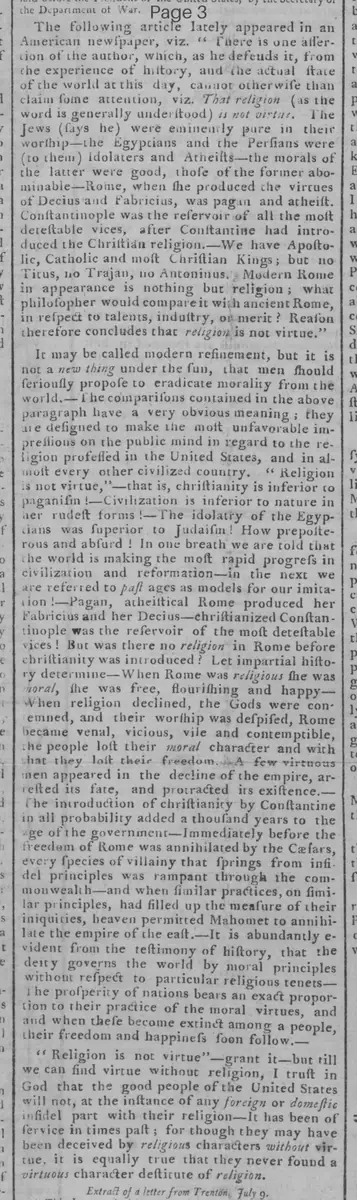
The following article lately appeared in an American newspaper, viz. "[There is one assertion of the author, which, as he defends it, from the experience of history, and the actual state of the world at this day, cannot otherwise than claim some attention, viz. That religion (as the word is generally understood) is not virtue. The Jews (says he) were eminently pure in their worship—the Egyptians and the Persians were (to them) Idolaters and Atheists—the morals of the latter were good, those of the former abominable—Rome, when she produced the virtues of Decius and Fabricius, was pagan and atheist. Constantinople was the reservoir of all the most detestable vices, after Constantine had introduced the Christian religion.—We have Apostolic, Catholic and most Christian Kings; but no Titus, no Trajan, no Antoninus. Modern Rome in appearance is nothing but religion; what philosopher would compare it with ancient Rome, in respect to talents, industry, or merit? Reason therefore concludes that religion is not virtue."
It may be called modern refinement, but it is not a new thing under the sun, that men should seriously propose to eradicate morality from the world.—The comparisons contained in the above paragraph have a very obvious meaning; they are designed to make the most unfavorable impressions on the public mind in regard to the religion professed in the United States, and in almost every other civilized country. "Religion is not virtue," that is, christianity is inferior to paganism!—Civilization is inferior to nature in her rudest forms! The idolatry of the Egyptians was superior to Judaism! How preposterous and absurd! In one breath we are told that the world is making the most rapid progress in civilization and reformation—in the next we are referred to past ages as models for our imitation!—Pagan, atheistical Rome produced her Fabricius and her Decius—christianized Constantinople was the reservoir of the most detestable vices! But was there no religion in Rome before christianity was introduced? Let impartial history determine—When Rome was religious she was moral, she was free, flourishing and happy—When religion declined, the Gods were contemned, and their worship was despised, Rome became venal, vicious, vile and contemptible, the people lost their moral character and with that they lost their freedom.—A few virtuous men appeared in the decline of the empire, arrested its fate, and protracted its existence.—The introduction of christianity by Constantine in all probability added a thousand years to the age of the government—Immediately before the freedom of Rome was annihilated by the Caesars, every species of villainy that springs from infidel principles was rampant through the commonwealth—and when similar practices, on similar principles, had filled up the measure of their iniquities, heaven permitted Mahomet to annihilate the empire of the east.—It is abundantly evident from the testimony of history, that the deity governs the world by moral principles without respect to particular religious tenets— The prosperity of nations bears an exact proportion to their practice of the moral virtues, and when these become extinct among a people, their freedom and happiness soon follow.—
"Religion is not virtue"—grant it—but till we can find virtue without religion, I trust in God that the good people of the United States will not, at the instance of any foreign or domestic infidel part with their religion—It has been of service in times past; for though they may have been deceived by religious characters without virtue, it is equally true that they never found a virtuous character destitute of religion.
It may be called modern refinement, but it is not a new thing under the sun, that men should seriously propose to eradicate morality from the world.—The comparisons contained in the above paragraph have a very obvious meaning; they are designed to make the most unfavorable impressions on the public mind in regard to the religion professed in the United States, and in almost every other civilized country. "Religion is not virtue," that is, christianity is inferior to paganism!—Civilization is inferior to nature in her rudest forms! The idolatry of the Egyptians was superior to Judaism! How preposterous and absurd! In one breath we are told that the world is making the most rapid progress in civilization and reformation—in the next we are referred to past ages as models for our imitation!—Pagan, atheistical Rome produced her Fabricius and her Decius—christianized Constantinople was the reservoir of the most detestable vices! But was there no religion in Rome before christianity was introduced? Let impartial history determine—When Rome was religious she was moral, she was free, flourishing and happy—When religion declined, the Gods were contemned, and their worship was despised, Rome became venal, vicious, vile and contemptible, the people lost their moral character and with that they lost their freedom.—A few virtuous men appeared in the decline of the empire, arrested its fate, and protracted its existence.—The introduction of christianity by Constantine in all probability added a thousand years to the age of the government—Immediately before the freedom of Rome was annihilated by the Caesars, every species of villainy that springs from infidel principles was rampant through the commonwealth—and when similar practices, on similar principles, had filled up the measure of their iniquities, heaven permitted Mahomet to annihilate the empire of the east.—It is abundantly evident from the testimony of history, that the deity governs the world by moral principles without respect to particular religious tenets— The prosperity of nations bears an exact proportion to their practice of the moral virtues, and when these become extinct among a people, their freedom and happiness soon follow.—
"Religion is not virtue"—grant it—but till we can find virtue without religion, I trust in God that the good people of the United States will not, at the instance of any foreign or domestic infidel part with their religion—It has been of service in times past; for though they may have been deceived by religious characters without virtue, it is equally true that they never found a virtuous character destitute of religion.
What sub-type of article is it?
Moral Or Religious
What keywords are associated?
Religion
Virtue
Morality
Christianity
Paganism
Rome
Constantinople
History
What entities or persons were involved?
Constantine
Fabricius
Decius
Mahomet
Titus
Trajan
Antoninus
Editorial Details
Primary Topic
Defense Of Religion Against Claim That It Is Not Virtue
Stance / Tone
Strongly Pro Religion And Pro Morality
Key Figures
Constantine
Fabricius
Decius
Mahomet
Titus
Trajan
Antoninus
Key Arguments
Historical Comparisons In The Quoted Article Falsely Portray Christianity As Inferior To Paganism
Rome Was Moral And Free When Religious, But Declined When Religion Waned
Introduction Of Christianity By Constantine Extended The Empire's Life
Prosperity Of Nations Depends On Moral Virtues Linked To Religion
Virtue Is Not Found Without Religion