Thank you for visiting SNEWPapers!
Sign up free
Literary
December 1, 1859
The Abbeville Banner
Abbeville, Abbeville County, South Carolina
What is this article about?
A correspondent recounts visiting David Hume's tomb in Edinburgh, highlighting inscriptions by his relatives affirming Christian faith and resurrection, in contrast to Hume's skepticism toward Christianity.
Clipping
OCR Quality
95%
Excellent
Full Text
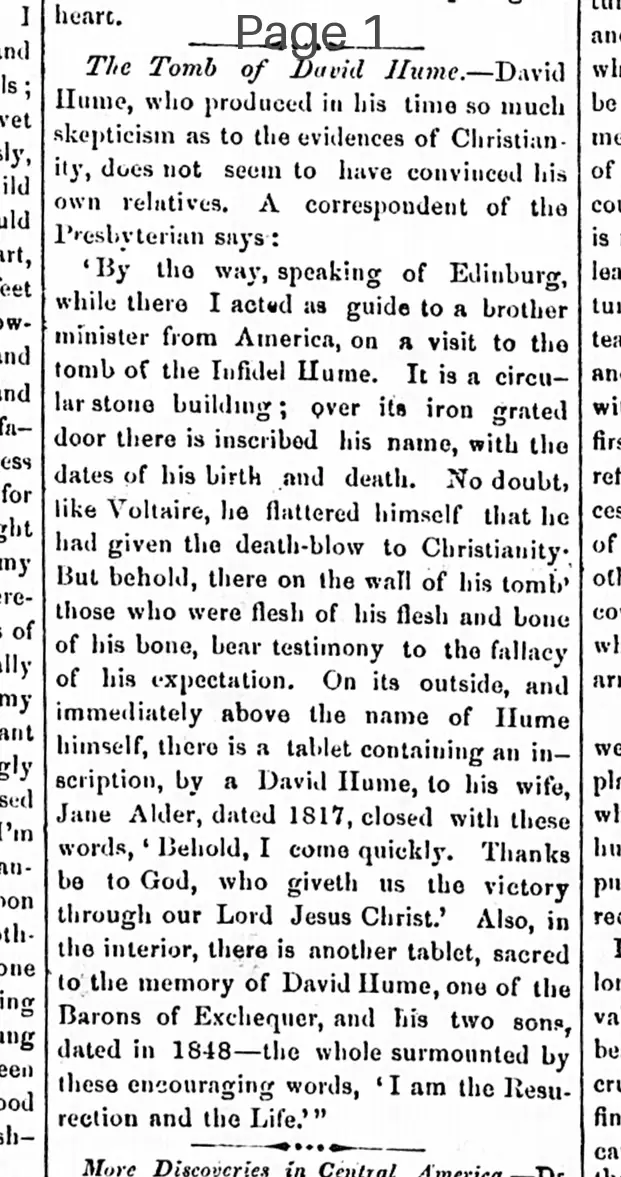
The Tomb of David Hume.—David Hume, who produced in his time so much skepticism as to the evidences of Christianity, does not seem to have convinced his own relatives. A correspondent of the Presbyterian says:
"By the way, speaking of Edinburgh, while there I acted as guide to a brother minister from America, on a visit to the tomb of the Infidel Hume. It is a circular stone building; over its iron grated door there is inscribed his name, with the dates of his birth and death. No doubt, like Voltaire, he flattered himself that he had given the death-blow to Christianity. But behold, there on the wall of his tomb those who were flesh of his flesh and bone of his bone, bear testimony to the fallacy of his expectation. On its outside, and immediately above the name of Hume himself, there is a tablet containing an inscription, by a David Hume, to his wife, Jane Alder, dated 1817, closed with these words, 'Behold, I come quickly. Thanks be to God, who giveth us the victory through our Lord Jesus Christ.' Also, in the interior, there is another tablet, sacred to the memory of David Hume, one of the Barons of Exchequer, and his two sons, dated in 1848—the whole surmounted by these encouraging words, 'I am the Resurrection and the Life.'"
"By the way, speaking of Edinburgh, while there I acted as guide to a brother minister from America, on a visit to the tomb of the Infidel Hume. It is a circular stone building; over its iron grated door there is inscribed his name, with the dates of his birth and death. No doubt, like Voltaire, he flattered himself that he had given the death-blow to Christianity. But behold, there on the wall of his tomb those who were flesh of his flesh and bone of his bone, bear testimony to the fallacy of his expectation. On its outside, and immediately above the name of Hume himself, there is a tablet containing an inscription, by a David Hume, to his wife, Jane Alder, dated 1817, closed with these words, 'Behold, I come quickly. Thanks be to God, who giveth us the victory through our Lord Jesus Christ.' Also, in the interior, there is another tablet, sacred to the memory of David Hume, one of the Barons of Exchequer, and his two sons, dated in 1848—the whole surmounted by these encouraging words, 'I am the Resurrection and the Life.'"
What sub-type of article is it?
Essay
What themes does it cover?
Religious
Death Mortality
What keywords are associated?
David Hume
Tomb
Christianity
Skepticism
Edinburgh
What entities or persons were involved?
A Correspondent Of The Presbyterian
Literary Details
Title
The Tomb Of David Hume.
Author
A Correspondent Of The Presbyterian
Subject
Visit To David Hume's Tomb In Edinburgh
Key Lines
Behold, I Come Quickly. Thanks Be To God, Who Giveth Us The Victory Through Our Lord Jesus Christ.
I Am The Resurrection And The Life.