Thank you for visiting SNEWPapers!
Sign up free
Nashville Union And American
Nashville, Davidson County, Tennessee
What is this article about?
Secretary Robeson's report to the President on the Polaris expedition investigation details rescues, accidental ship separation, Captain Hall's natural death, Buddington's competence despite lapses, Arctic discoveries, and plans for further relief, expressing optimism for the remaining crew.
Merged-components note: These two components form a continuous narrative on the Polaris expedition investigation, with the second picking up directly from the first in topic and flow.
Clipping
OCR Quality
Full Text
Result of Robeson's Investigation
His Report to the President.
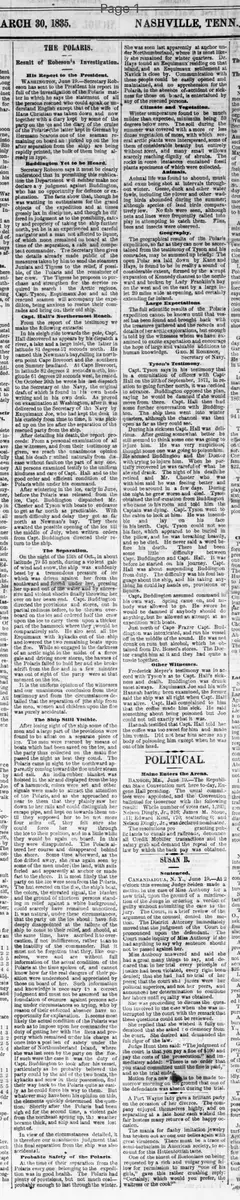
WASHINGTON, June 19.—Secretary Robeson has sent to the President his report in full of the investigation of the Polaris matter in which he says the statement of all the persons rescued who could speak or understand English except that of the wife of Hans Christian was taken down and now together with a diary kept by some of the party on the ice and the diary of the cruise of the Polaris (the latter kept in German by Hermann Seerons one of the seamen remaining on board and picked up on the ice after separation from the ship) are being rapidly printed, the bulk of them being already in type.
Secretary Robeson says it must be clearly understood that in permitting this publication the Department will neither make nor declare any judgment against Buddington, who has no opportunity for defence or explanation. The facts show that, though he was wanting in enthusiasm for the grand objects of the expedition and at times grossly lax in discipline, and though he differed in judgment as to the possibility, safety and propriety of taking the ship further north, yet he is an experienced and careful navigator and a man not addicted to liquor, of which none remained on board at the time of the separation, a safe and competent commander. The Secretary then gives the details already made public of the measures taken by him to send the steamers Juniata and Tigress to the relief, if possible, of the Polaris and the remainder of her crew. The Tigress he proposes to purchase and strengthen for the service required in search in the Arctic regions. Capt. Tyson, Esquimaux Joe and all the rescued seamen will accompany the expedition, being anxious to rescue their comrades and bring on their old ship.
Capt. Hall's Northernmost Reach
From the report of the testimony we make the following extracts:
In his sleigh-ride towards the pole, Capt. Hall discovered as appears by his dispatch a river, a lake and a large inlet, the latter in latitude 81 degrees 57 seconds north. He named this Newman's bay, calling its northern point Cape Brevoort and the southern one Sumner headland. At Cape Brevoort, in latitude 82 degrees 2 seconds north, longitude 61 degrees 20 seconds west, he rested. On October 20th he wrote his last dispatch to the Secretary of the Navy, the original draft of which is found in his own hand writing and in his own desk. As proved on examination at Washington, after it was delivered to the Secretary of the Navy by Esquimaux Joe, who had kept the desk in his custody from time to time, it was picked up on the ice after the separation of the rescued party from the ship. After detailing his death, the report proceeds: From a personal examination of all the witnesses, and from their testimony as given, we reach the unanimous opinion that his death resulted naturally from disease without fault on the part of any one. All persons examined testify to the uniform kindness and care of Capt. Hall and to the good order and efficient condition of the Polaris while under his command. After wintering in the ice, early in June, before the Polaris was released from the ice, Capt. Buddington dispatched Mr. Chester and Tyson with boats to endeavor to get as far north as practicable. With much difficulty and delay they got as far north as Newman's bay. They there awaited the possible opening of the ice till the middle of July, when written orders from Capt. Buddington directed their return to the ship.
The Separation,
On the night of the 15th of Oct., in about latitude 79 53 north, during a violent gale of wind and snow, the ship was suddenly beset by a tremendous pressure of ice which was driven against her from the southward and forced under her, pressing her up and out of the water and by successive and violent shocks finally throwing her over on her beam end. Capt. Buddington directed the provisions and stores, out in partial readiness before, to be thrown overboard on the ice and ordered half the crew upon the ice to carry them upon a thicker part of the hummock where they would be comparatively safe. He also sent all the Esquimaux with kayaks out of the ship and lowered the two remaining boats upon the floe. While so engaged in the darkness of an arctic night in the midst of a fierce gale and driving snow storm, the hawses of the Polaris failed to hold her and she broke adrift from the floe and in a few minutes was out of sight of the party who at that moment on the ice. It is the uniform opinion of the witnesses and our unanimous conclusion from their testimony and from the circumstances detailed that the separation of the ship from the men, women and children upon the floe was purely accidental.
The Ship Still Visible.
After losing sight of the ship some of the men and a large part of the provisions were found to be afloat on a separate piece of ice. The men were rescued by means of boats which had been saved on the ice, and the party thus collected on the main floe passed the night as best they could. The Polaris came in sight to the northward apparently coming toward the floe under steam and sail. An india-rubber blanket was hoisted in the air and displayed from the top of a hummock, colors were set and other signals were made to attract the attention of the Polaris, and as she approached so near to them that they plainly saw her down to her rails and could distinguish her escape pipe, and kept on towards them until they supposed her to be not more than four miles off, they felt sure she could force her way through the ice to their position, and in a little while they would be again on board. In this they were disappointed. The Polaris altered her course and disappeared behind the shore. Some time afterward, as the floe drifted away, she was again seen by some of the men under the land, with sails furled and apparently at anchor or made fast to the shore. It is most likely that the party on the ice were seen from the Polaris. The hut erected on the floe, the ship's boat, the colors, the elevated signal, the blanket and the group of nineteen persons standing in relief against a white background, could scarcely have remained unnoticed. It was natural, under these circumstances, that the party on the ice should have felt deeply disappointed at the failure of the ship to come to their relief, and should, at the same time, have ascribed it to over-caution, if not indifference, rather than to the inability of the commander. But it must not be forgotten that they, like ourselves, were and are without full information of the actual condition of the Polaris at the time spoken of, and cannot know how far the real dangers of their position were understood and appreciated by those on board of her. Such information and knowledge is necessary to a correct judgment and must not be assumed as the foundation of censure against persons acting under circumstances so trying, who by reason of their enforced absence have no opportunity for explanation. It seems most likely the actual condition of the Polaris was such as to impose upon her commander the duty of getting her with the lives and property which remained under his charge at once into a position of safety under the shelter of Northumberland Island, where she was last seen by the party on the floe. If such were the case it was the duty of Capt. Buddington to look after his vessel, particularly as he probably believed the party could by the aid of the two boats, the kayaks and scow in their possession, find their way back to the Polaris quite as easily as he could force his way to them. But whatever may have been his opinion on this, the elements quickly determined the question. Shortly after the Polaris had been sighted for the second time, a violent gale from the northeast sprung up, the weather became thick, and ship and land were lost sight of. In view of the circumstances detailed, it is therefore our unanimous judgment that this final separation from the ship was also accidental.
Probable Safety of the Polaris.
At the time of their separation from the Polaris every one belonging to the expedition was in good health. The Polaris had plenty of provisions, but not much coal—probably enough to last through the winter.
She was seen last apparently at anchor under Northumberland, where it is most likely she remained for winter quarters. Dr. Hays found an Esquimaux residing on that island, and an Esquimaux settlement at Navick is close by. Communication with these people could be easily opened and maintained, and no apprehension for the Polaris, in the absence of accident or sickness for those on board, is entertained by any of the rescued persons.
Climate and Vegetation.
Winter temperature found to be much milder than expected, minimum being 59 degrees below zero. The soil during the summer was covered with a more or less dense vegetation of moss, with which several arctic plants were interspersed, some of them of considerable beauty but entirely without scent, and many small willows scarcely reaching dignity of shrubs. The rocks in some instances contained fossil plants specimens of which were collected.
Animals.
Animal life was found to abound, musk and oxen being shot at intervals throughout winter. Geese, duck and other water fowls, including the plover and other wading birds abounded during the summer although species of land birds comparatively few. No fish were seen, although nets and lines were frequently called into play in attempting to catch them. Flies, bees and insects were observed.
Geography.
The geographical results of the Polaris expedition, so far as they can now be ascertained from the testimony of Tyson and his comrades, may be summed up briefly: The open Polar sea laid down by Kane and Hays, is found to be in reality a sound of considerable extent, formed by the abrupt expansion of Kennedy channel to the northward and broken by Lady Franklin's bay on the west and on the east by a large inlet 20 miles wide at opening, and certainly extending far inland.
Large Expectations.
The full scientific results of the Polaris expedition cannot be known until that vessel has been found and brought back with the treasures gathered and the records and details of her arctic explorations, but enough is told by the witnesses whom we have examined to excite expectation and encourage the hope of large and valuable additions to human knowledge.
Geo. M. Robeson,
Secretary of Navy
Tyson's Testimony.
Capt. Tyson says in his testimony that in a consultation of officers with Capt. Hall on the 20th of September, 1871, in relation to going further north, it was decided to advance. Buddington opposed the plan, saying he would be damned if she would move from there. Capt. Hall then had some further conversation with Buddington. The ship then went into winter quarters, although the channel was then open as far as they could see. During his sickness Capt. Hall was delirious. After getting somewhat better he still seemed to think some one was going to injure him. He was very suspicious; thought some one was going to poison him. He accused Buddington and the Doctor with trying to injure him. When he partially recovered he was careful of what he ate and drank. The night of his death he retired and Mr. Chester who was with him said he was feeling better and would be around in a few days. During the night he grew worse and died. Tyson obtained the information from Buddington who came to his room and told him the Captain was dying. Capt. Tyson went to the cabin to look at him. He was insensible and lay on his face in his berth. Capt. Tyson could not see his face, which appeared to be buried in the pillow, and he was breathing heavily, and so he died. He never said a word before his death. There had been some little difficulty between Capt. Buddington and Capt. Hall. It was before he started on his journey. Capt. Hall was about suspending Buddington from duty. The difficulty was his foul language about the ship, and his taking anything he could lay hands on, provisions or liquors. Capt. Buddington assumed command in his own way. Spring came on, and nobody was allowed to go. He swore he would be damned if anybody should do anything, but he allowed an attempt at an expedition with boats. Just north of Cape Frazer Capt. Buddington was intoxicated, and run his vessel off in the middle of the sound. He was not drunk on rum but alcohol, which he obtained from Dr. Bessel's stores. The Doctor caught him at it and they had quite a tussle together.
Other Witnesses.
Frederick Meyer's testimony was in accord with Tyson's as to Capt. Hall's sickness and death. Buddington was drunk most always. Esquimaux Joe and his wife Hannah having been examined, the former said the ship was all right when Capt. Hall was alive. Capt. Hall complained to him that the coffee made him sick. He said something about being poisoned but Joe could not tell exactly what it was. Hannah testified that Capt. Hall told her the coffee was too sweet for him and made him vomit. Did not hear him accuse anybody of poisoning him except when he was out of his head.
What sub-type of article is it?
What themes does it cover?
What keywords are associated?
What entities or persons were involved?
Where did it happen?
Story Details
Key Persons
Location
Arctic Regions, Near The North Pole, Northumberland Island
Event Date
June 19; Events From September 1871 To October
Story Details
Investigation report on Polaris expedition details accidental separation from ship during gale, natural death of Capt. Hall, Arctic geographical discoveries, and plans for rescue of remaining crew.