Thank you for visiting SNEWPapers!
Sign up free
The New Hampshire Gazette
Portsmouth, Rockingham County, New Hampshire
What is this article about?
French bulletins detail the political tensions, military preparations, and diplomatic failures leading to the 1812 invasion of Russia by Napoleon's Grand Army, culminating in the crossing of the Niemen River and a proclamation to French troops.
Merged-components note: Continuation of the same foreign news article about the French Grand Army and Napoleon's proclamation across pages 1 and 2.
Clippings
1 of 2
OCR Quality
Full Text
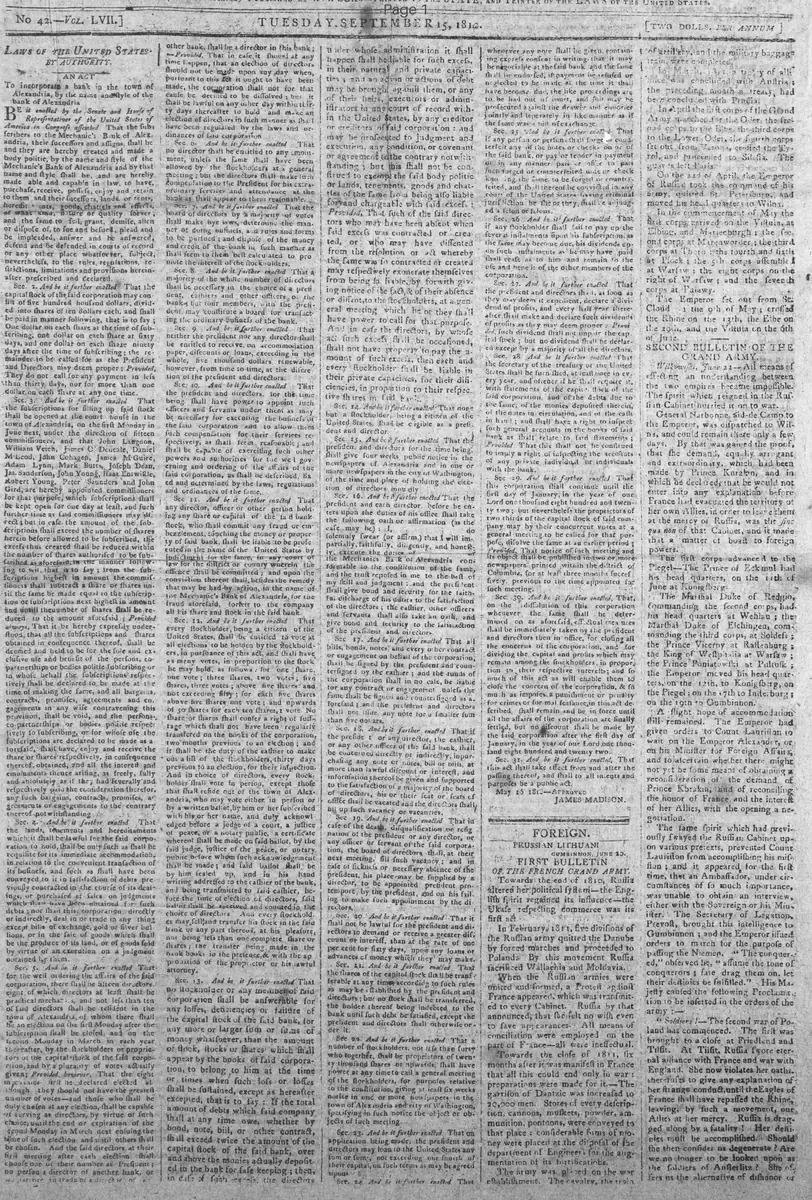
PRUSSIAN LITHUANIA
GUMBINNON, JUNE 2.
FIRST BULLETIN
OF THE FRENCH GRAND ARMY.
Towards the end of 1810, Russia altered her political system—the English party regained its influence—the Ukase respecting commerce was its first act.
In February, 1811, five divisions of the Russian army quitted the Danube by forced marches and proceeded to Poland. By this movement Russia sacrificed Wallachia and Moldavia.
When the Russian armies were united and formed, a Protest against France appeared, which was transmitted to every Cabinet. Russia by that announced that she felt no wish even to save appearances. All means of conciliation were employed on the part of France—all were ineffectual.
Towards the close of 1811, six months after it was manifest in France that all this could end only in war, preparations were made for it. The garrison of Dantzic was increased to 20,000 men. Stores of every description, cannons, muskets, powder, ammunition, pontoons, were conveyed to that place: considerable sums of money were placed at the disposal of the department of Engineer for the augmentation of its fortifications.
The army was placed on the war establishment. The cavalry, the train of artillery, and the military baggage train, were completed.
In March, 1812, a treaty of alliance was concluded with Austria; the preceding month a treaty had been concluded with Prussia.
In April the 1st corps of the Grand Army marched for the Oder, the second corps up the Elbe, the third corps to the Lower Oder, the fourth corps set out from Verona crossed the Tyrol, and proceeded to Silesia. The guard is left Paris.
On the 9th of March, the Emperor of Russia took the command of his army, quitted St. Petersburgh, and moved his head quarters to Wilna.
In the commencement of May the first corps, arrived on the Vistula, at Elbing, and Marienburgh: the second corps at Marienwerder; the third corps at Thorn: the fourth and sixth at Plock; the fifth corps assemble at Warsaw; the eighth corps on the right of Warsaw; and the seventh corps at Pulawy.
The Emperor set out from St. Cloud on the 9th of May: crossed the Rhine on the 13th, the Elbe on the 20th, and the Vistula on the 9th of June.
SECOND BULLETIN OF THE GRAND ARMY.
Wilkowiski, June 22—All means of effecting an understanding between the two empires became impossible.
The spirit which reigned in the Russian Cabinet hurried it on to war.
General Narbonne aide-de-camp to the Emperor, was dispatched to Wilna, and could remain there only a few days. By that was gained the proof, that the demand, equally arrogant and extraordinary, which had been made by Prince Kurakin, and in which he declared that he would not enter into any explanation before France had evacuated the territory of her own Allies, in order to leave them at the mercy of Russia, was the sine qua non of that Cabinet, and it made that a matter of boast to foreign powers.
The first corps advanced to the Pregel—The Prince of Eckmulh had his head quarters, on the 11th of June at Konigsberg.
The Marshal Duke of Reggio, commanding the second corps, had his head quarters at Wehlau; the Marshal Duke of Elchingen, commanding the third corps, at Soldau; the Prince Viceroy at Rastenburg; the King of Westphalia at Warsaw; the Prince Poniatowski at Pulusk; the Emperor moved his head quarters, on the 12th, to Konigsberg, on the Pregel; on the 17th to Insterburg; on the 19th to Gumbinnen.
A slight hope of accommodation still remained. The Emperor had given orders to Count Lauriston to wait on the Emperor Alexander, or on his Minister for Foreign Affairs, and to ascertain whether there might not yet be some means of obtaining a reconsideration of the demands of Prince Kurakin; and of reconciling the honor of France, and the interest of her Allies, with the opening a negotiation.
The same spirit which had previously swayed the Russian Cabinet upon various pretexts, prevented Count Lauriston from accomplishing his mission; and it appeared for the first time, that an Ambassador, under circumstances of so much importance, was unable to obtain an interview, either with the Sovereign or his Minister. The Secretary of Legation Prevot, brought this intelligence to Gumbinnen; and the Emperor issued orders to march for the purpose of passing the Niemen. "The conquered," observed he, "assume the tone of conquerors; fate drags them on, let their destinies be fulfilled." His Majesty caused the following Proclamation to be inserted in the orders of the army:
"Soldiers! The second war of Poland has commenced. The first was brought to a close at Friedland and Tilsit. At Tilsit, Russia swore eternal alliance with France and war with England. She now violates her oaths. She refuses to give any explanation of her strange conduct, until the Eagles of France shall have repassed the Rhine, leaving, by such a movement, our Allies at her mercy. Russia is dragged along by a fatality! Her destinies must be accomplished. Should she then consider us degenerate? Are we no longer to be looked upon as the soldiers of Austerlitz? She offers us the alternative of dishonor or war. Choose!"
war. The choice cannot admit of hesitation—Let us then march forward! Let us pass the Niemen! Let us carry the war into her territory. The second war of Poland will be as glorious to the French arms as the first; but the peace which we shall conclude will be its own guarantee, and will put an end to that proud and haughty influence which Russia has for fifty years exercised in the affairs of Europe.
“At our head quarters, at Wilna, June 22, 1812."
An extraordinary Diet was assembled at Warsaw on the 15th of June, for the purpose, as was supposed, of carrying into effect the project of Napoleon for the re-establishment of the Kingdom of Poland.
What sub-type of article is it?
What keywords are associated?
What entities or persons were involved?
Where did it happen?
Foreign News Details
Primary Location
Gumbinnen
Event Date
June 1812
Key Persons
Outcome
french forces ordered to cross the niemen river into russian territory, commencing the second war of poland; diplomatic negotiations fail; assembly of diet at warsaw for potential re-establishment of kingdom of poland.
Event Details
Russia's political shift in 1810-1811 leads to troop movements and protests against France. France prepares the Grand Army, allies with Austria and Prussia, and deploys corps to Polish borders. Diplomatic efforts by Narbonne and Lauriston fail due to Russian demands. Napoleon issues proclamation declaring war and orders crossing of Niemen on June 22, 1812.