Thank you for visiting SNEWPapers!
Sign up free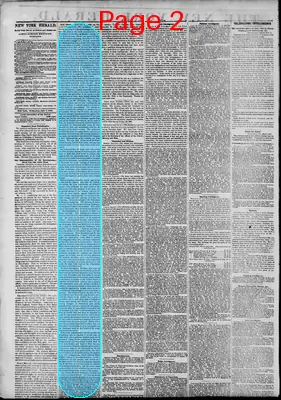
The New York Herald
New York, New York County, New York
What is this article about?
Editorial analyzes New York Irish demonstration as political ploy by Democrats and Whigs to sway Irish voters in upcoming Presidential election, warns against forming separate Irish party like Bishop Hughes' past effort that led to riots and bloodshed.
Clipping

OCR Quality
Full Text
The demonstration, which was apparently made with the view of expressing sympathy to the Irish people in their struggle for a separate nationality, and affording them help in money and means, to as great an extent as possible, consistent with a due observance of the laws of the land, had likewise another object in view, and that object may be attended hereafter with consequences of a very serious nature. In a word, the other, and as we think the principal, object in view of the getters up and prime movers of this demonstration, was a political one; and in order to illustrate it, we must premise our exposition of the real objects of this meeting by simply laying down two propositions: First, that we are on the eve of a Presidential election; and second, that there is in the United States a large number of Irish voters, who, by their union in support of, or in opposition to, the respective candidates, can either elect or defeat them.
The nominees of the democratic party are already before the world; and those of the whigs will be blazoned forth to-morrow or the next day. About election times, the Irish people are hugged and caressed almost to death, by the two great parties. Patrick O'Flaherty, a highly respectable carrier of bricks and mortar, who, in the course of his life, has had many ups and downs in the world, in a professional point of view, finds himself dubbed Mr. O'Flaherty, and occasionally Mr. O'Flaherty, Esq., and no less; and Mr. O'Flaherty, Esq., being an American citizen, and his vote counting one, as well as all others, is politely applied to by each to cast his ballot for its candidate. The various occasions on which the candidate in question (or, if the candidate has not had the honor, the party to which he belongs,) has advocated the rights of Ireland, and poured forth his sympathies for her misfortunes, and his fire and brimstone against England and the English government, as the cause of them, are eloquently pourtrayed; and Pat's heart being touched, he innocently gulps down the dose prepared for him, and immediately votes for the champion of his native country. The democrats practised this game to a great extent; and it is not assuming too much to say, that in many elections—city, state, and national—they owed their triumphs to their electioneering policy towards our Irish citizens. We are, then, on the eve of the Presidential election, and the Irish voters, who are very important about election times, must not be overlooked.
But it happens that the whigs have taken a leaf out of the locofoco manual of election tactics, and seem to think that, as all is fair in politics, they might as well try and procure some of the Irish votes, so as to counterbalance the number inveigled away by the democrats. Apt scholars, as politicians of all parties are, in the learning of trickery and deception, they have become as efficient in wheedling the Irish, about election times, into the support of their candidates, as the locofocos have been in times past: so that, in that respect, the two parties are on a par; for both can now point to the services which their respective parties have done towards Ireland.
Both parties have, therefore, tacitly agreed that he who bids the highest, who talks the loudest, who dilates the most pathetically, on Ireland's wrongs; who attributes the most virtue to the Irish people—the most integrity to her men, and the greatest charms to her women, and who declaims the most bitterly against England—her Queen, Lords, and Commons—on account of Ireland's wrongs and Irish injuries, shall have the Irish votes. Hence the struggle at the Tabernacle on Monday evening last. The old hunkers, represented by Mayor Havemeyer, Senator Hannegan, and Benjamin F. Butler, did wonders. They made a great impression—they decidedly had the best of it. The barnburners, in the person of John Van Buren, bid high. That distinguished burner of granaries did very well; but his sentences were too long. He made up, however, in the matter of 'arms.' That reached the point, and as long as it lasted, Prince John was in a fair way of throwing Hannegan, Butler and McKeon in the shade: but it must be recollected that Hannegan went into the 'poor Irish boy' business, and very pathetically alluded to O'Connell's heart, and Emmett's monument. There Hannegan had the best of it, and demolished the 'arms,' and the right under the constitution to ship them to Ireland.
The whigs had their turn, and were represented by the white coat and that battered hat. The hat and coat, however, remained too long in the rear. Their owner endeavored to bring up and reach the point accomplished by his predecessors of the other factions, but the hour was too late—it was approaching midnight—the audience got thin—he lagged, got behind, and the meeting adjourned.
The hunkers, therefore, as far as the Irish demonstration is concerned, made the most capital thus far; and according to present appearances, will carry the most Irish votes at the Presidential election in November next.
In sober seriousness, therefore, this Irish demonstration was nothing but an attempt, by the different political factions and parties, to get the Irish vote next November, and may justly, in our opinion, be looked upon as the second grand attempt in the history of politics in the United States, to organize our Irish fellow citizens into a separate and independent party, and, we fear, one likely to result in consequences similar to those which succeeded the organization brought about by our reverend friend, Bishop Hughes, a few years since, in this city. The school system of the State of New York did not meet his views; and, therefore, he issued his dictum to the faithful that it must be amended; and in view of the right of suffrage being the most speedy and efficient agent for producing changes, he determined upon availing himself of that weapon to accomplish his purpose. From the altar he immediately descended, with the perfume of the holy incense around him, to the floor of Carroll Hall, and there he organized his party of Irish voters, who were to vote as he dictated, and for the purposes which he had in view.
He succeeded in organizing a separate Irish party: and what were the consequences? History tells us there was a counter organization—there was conflict—there was bloodshed—there was murder; and the blackened walls of the Church of St. Augustine pointed the moral.
If this Irish demonstration was the prelude—the preliminary step to organize a second time the Irish voters into a separate political party, for the purpose of voting for the candidates of the party whose leaders and wire-pullers bedaub them the most with flattery, and beslaver them the most with the saliva of humbug philanthropy for political purposes—it ought to be denounced by all right thinking men and by all good citizens, who desire not a repetition of the fearful scenes, the murders, riots, and conflagrations, which followed Bishop Hughes' attempt in the same direction. It will, if commenced for that purpose, and carried out to the same extent—if it result in a separate organization of the Irish as a political party—be attended with counter-organization, and the other consequences which we have alluded to; for we can have no distinct foreign party of votes in this country.
One word to the Irish themselves—let them vote as their consciences dictate. Let them not be carried away by the pseudo philanthropy of professional politicians, who care no more for Ireland and Irishmen, except as voters in the advancement of their purposes, than they do for the woolly head African on the shores of the salt lakes in California. But above all things, let them avoid being led into a separate political organization, pledged to support a particular ticket, or a particular candidate. Politicians care not for the consequences that might result from an opposite course. If they secure the votes, the voters may go to Barnegat, and the long oppressed isle of the ocean, be depopulated by
What sub-type of article is it?
What themes does it cover?
What keywords are associated?
What entities or persons were involved?
Where did it happen?
Story Details
Key Persons
Location
Tabernacle, In This City
Event Date
Monday Evening Last
Story Details
The Irish demonstration at the Tabernacle expressed sympathy for Irish nationality struggle and aid, but primarily aimed to influence Irish voters for the upcoming Presidential election through political flattery by Democrats (Hunkers and Barnburners) and Whigs, warned as potential prelude to separate Irish political party like Bishop Hughes' past organization leading to violence.