Thank you for visiting SNEWPapers!
Sign up free
Literary
January 17, 1846
Alexandria Gazette
Alexandria, Alexandria County, District Of Columbia
What is this article about?
Descriptive essay on the Isle of Bute, Scotland, highlighting its scenery from the Printing Office and a walk to Ascog. It commemorates Montague Stanley, a former Edinburgh actor who became a painter, left the stage on moral grounds, succumbed to illness, and is buried at the Free Church in Ascog, leaving his family in hardship.
Clipping
OCR Quality
95%
Excellent
Full Text
Alexandria Gazette:
SATURDAY, JANUARY 17
THE PRINTING OFFICE.
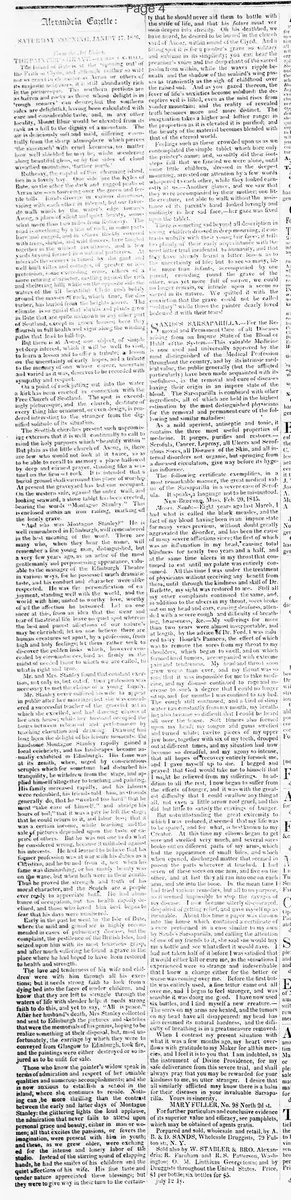
The position of the Printing Office is not so favorable as to the prospect from its windows as that of many others; but it is situated in a healthy spot, and though neither so wild nor so grand in character as Arran or others of its majestic neighbors, it is still abundantly rich in the picturesque. The northern portions are as barren and rocky as those whose delight is in 'rough scenery' can desire; but the southern sides are delightful, having been cultivated with care and considerable taste, and, in any other locality, Mount Blair would be elevated from its rank as a hill to the dignity of a mountain. The air is deliciously soft and mild, differing essentially from the sharp atmosphere which pierces 'the sassenach' with cruel keenness, no matter how well shielded he may be, while wandering along beautiful glens, or by the sides of cloud-wreathed mountains, 'farther north.'
It lies in a lovely bay. On one side are the heights of Rothesay, the capital of this charming island, Bute, on the other the dark and rugged peaks of Arran are seen towering over the green and fertile hills. Roads diverge in various directions, vieing with each other in interest, but our favorite walk winds by the water's edge towards Ascog, a place of silent and quiet beauty, somewhat more than two miles from Rothesay. The road is overhung by a haze of rock, in some parts bare and rugged, and in others thickly covered with trees, shrubs, and wild flowers, here tangled together in the wildest luxuriance, and at a few intervals the scenery is tamed by the neat and tasteful villas and cottages, of greater or less pretension, some exceeding ornate, others of a more retiring character, nestling against the rich and sheltering hill; while on the opposite side the waters of the Clyde rush boldly around the masses of rock, which time, the great disturber, has hurled from the heights above. The climate is so genial that shrubs and plants grow in Bute that are quite unknown in any other part of Scotland, except in green houses; here they flourish in full health and vigor along the winding paths that lead to hill-top.
But there is at Ascog one object, of simple yet deep interest, which it will be well to visit, to learn a lesson and to offer a tribute; a lesson on the uncertainty of early hopes, and a tribute to the memory of one whose career, uncertain and varied as it was, deserves to be recorded with sympathy and respect.
On a point of rock jutting out into the water a kirk has been erected in connexion with the Free Church of Scotland. The spot is exceedingly picturesque; and the church, destitute of everything like ornament, or even design, is rendered interesting to the stranger from the dignified solitude of its situation. The Scottish churches present such unpromising exteriors that it is well continually to call to mind the holy purposes which 'beautify within.' But plain as the little church of Ascog is, there are few who would not look at it twice, so as to be able to recall to memory a place hallowed by deep and earnest prayer, standing like a sentinel on the firm set rock. It is intended that a burial ground shall surround this place of worship. On the western side, against the outer wall, and looking seaward, a stone tablet has been erected, bearing the words 'Montague Stanley.' This is enclosed within an iron railing, marking off the lonely grave. At present the graveyard has but one occupant.
'And who was Montague Stanley?' He is well remembered in Edinburgh, well remembered in the best meaning of the word. There are many who, when they hear the name, will remember a fine young man, distinguished, but gentlemanly and prepossessing appearance, valuable to the manager of the Edinburgh Theatre in various ways, for he possessed much dramatic taste, and his conduct and character were alike respected. He was the personification of enjoyment, standing well with the world, and the world with him; united to worthy love, worthy of all the affection he bestowed. Let no one sneer at this, from an idea that the wear and tear of theatrical life leave no quiet spot wherein the best and purest affections of our nature may be cherished; let no one believe there are human creatures set apart, by a profession, from high and holy feelings; let them rather seek to discover the golden links which, however concealed by circumstances, bind us firmly in the midst of needed labor to which we are called, to what is right and true.
Mr. and Mrs. Stanley found that constant exertion, not only in, but out of, their profession was necessary to meet the claims of a young family. Mr. Stanley never suffered his wife to appear in public after her marriage; but she was considered a successful teacher of the graceful art in which she excelled, and had dancing classes at her own house; while her husband occupied the hours between rehearsal and performance by teaching elocution and drawing. Drawing had long been the delight of his leisure moments: the handsome Montague Stanley rapidly gained a local celebrity, and his landscapes became annually exhibited in Edinburgh. His fame was at its zenith, when, urged by conscientious scruples which for some time had disturbed his tranquility, he withdrew from the stage, and applied himself altogether to teaching and painting. His family increased rapidly, and his labors were redoubled, his friends told him, as friends generally do, that he 'worked too hard' that he 'should take care of himself,' and abridge his hours of toil; that it was a pity he left the stage; that he could return to it, and labor less; that it was a certain income, while teaching and the sale of pictures depended upon the taste or caprice of others. But he was not one to do what he considered wrong, because it militated against his interests. He had learned to believe that his former profession was at war with his duties as a Christian, and he turned from it, not when his fame was diminishing, or his manly beauty was on the wane, but when both were in their zenith. Thus he proved the strength and truth of his moral character, and the Scotch are a people ever ready to appreciate both. He had abundance of occupation, but his health rapidly declined, and those who loved him best began to fear that his days were numbered.
Early in the past he went to the Isle of Bute, where the mild and genial air is highly recommended in cases of pulmonary disease, but the complaint, the pestilence of the British Isles, had seized upon him with its most tenacious grasp, and after much suffering he found a grave in the place where he had hoped to have been restored to health and strength.
The love and tenderness of his wife and children were with him through all his exertions; but it needs strong faith to look from a dying bed into the faces of tender children, and know that they are left to struggle through the waters of life with slender help: it needs strong faith to do this, and yet to say, 'All is peace.' After her husband's death, Mrs. Stanley collected and sent to Edinburgh the pictures and sketches that were the memorials of his genius, hoping to realize something at their disposal, but, most unfortunately, the carriage by which they were to be conveyed from Glasgow to Edinburgh, took fire, and the paintings were either destroyed or so injured as to be unfit for sale.
Those who know the painter's widow speak in terms of admiration and respect of her amiable qualities and numerous accomplishments; and she is now anxious to establish a school in the island; where she continues to reside. Nothing can be more thrilling than the contrast between the early and latter days of Montague Stanley: the glittering lights the loud applause, the admiration that never fails to attend upon personal grace and beauty, either in man or woman; all that excites the passions, or fevers the imagination, were present with him in youth; and these, as we grow older, were exchanged for the intense and lonely labor of the studio. Instead of the stirring sound of clapping hands, he had the smiles of his children and the quiet affections of his wife. His fine taste and tender nature appreciated these blessings; but they were to give way in their turn to the certainty that he should never aid them to battle with the strife of life, and that his future must very soon deepen into eternity. On his deathbed, we have heard, he desired to be buried in the church yard of Ascog, within sound of the Clyde. And a fitting spot it is for a painter's grave so solitary and sublime in its simplicity; you can hear the preacher's voice and the deep chant of the sacred psalm from within, while the waves ripple beneath and the shadow of the seabird's wing passes as transiently as the sigh of childhood over the raised sod. And as you gaze thereon, the fever of life's anxieties become subdued: the deceptive veil is lifted, even as the mist rises from yonder mountain; and the reality of revealed truth becomes more and more distinct. The imagination takes a higher and loftier range: in the proportion as it is elevated it is purified; and that of the material becomes blended with that of the eternal world.
Feelings such as these crowded upon us as we contemplated the simple tablet which bore only the painter's name; and, so softly did their footsteps fall that we fancied we were alone, until some little children, dressed in the deepest mourning, arrested our attention by a few words whispered to each other, while they looked earnestly at us.--Another glance, and we saw that they were accompanied by their mother; one little creature, not able to walk without the assistance of its parent's hand looked lovingly and smilingly in her sad face,--her gaze was fixed upon the tablet. There is something sad beyond all description in seeing children dressed in deep mourning, it contrasts wofully with their young fair faces; it tells too plainly of their early acquaintance with the worst bitter trial incidental to humanity, and that they have already learnt a bitter lesson as to the uncertainty of life; but to see so many, little more than infants, accompanied by one parent, crowding round the grave of the other, was yet more full of sorrow, we could no longer remain, or intrude upon a scene so sacred in its nature. We quitted it with the conviction that the grave could not be called 'solitary' while those the painter dearly loved bedewed it with their tears!
SATURDAY, JANUARY 17
THE PRINTING OFFICE.
The position of the Printing Office is not so favorable as to the prospect from its windows as that of many others; but it is situated in a healthy spot, and though neither so wild nor so grand in character as Arran or others of its majestic neighbors, it is still abundantly rich in the picturesque. The northern portions are as barren and rocky as those whose delight is in 'rough scenery' can desire; but the southern sides are delightful, having been cultivated with care and considerable taste, and, in any other locality, Mount Blair would be elevated from its rank as a hill to the dignity of a mountain. The air is deliciously soft and mild, differing essentially from the sharp atmosphere which pierces 'the sassenach' with cruel keenness, no matter how well shielded he may be, while wandering along beautiful glens, or by the sides of cloud-wreathed mountains, 'farther north.'
It lies in a lovely bay. On one side are the heights of Rothesay, the capital of this charming island, Bute, on the other the dark and rugged peaks of Arran are seen towering over the green and fertile hills. Roads diverge in various directions, vieing with each other in interest, but our favorite walk winds by the water's edge towards Ascog, a place of silent and quiet beauty, somewhat more than two miles from Rothesay. The road is overhung by a haze of rock, in some parts bare and rugged, and in others thickly covered with trees, shrubs, and wild flowers, here tangled together in the wildest luxuriance, and at a few intervals the scenery is tamed by the neat and tasteful villas and cottages, of greater or less pretension, some exceeding ornate, others of a more retiring character, nestling against the rich and sheltering hill; while on the opposite side the waters of the Clyde rush boldly around the masses of rock, which time, the great disturber, has hurled from the heights above. The climate is so genial that shrubs and plants grow in Bute that are quite unknown in any other part of Scotland, except in green houses; here they flourish in full health and vigor along the winding paths that lead to hill-top.
But there is at Ascog one object, of simple yet deep interest, which it will be well to visit, to learn a lesson and to offer a tribute; a lesson on the uncertainty of early hopes, and a tribute to the memory of one whose career, uncertain and varied as it was, deserves to be recorded with sympathy and respect.
On a point of rock jutting out into the water a kirk has been erected in connexion with the Free Church of Scotland. The spot is exceedingly picturesque; and the church, destitute of everything like ornament, or even design, is rendered interesting to the stranger from the dignified solitude of its situation. The Scottish churches present such unpromising exteriors that it is well continually to call to mind the holy purposes which 'beautify within.' But plain as the little church of Ascog is, there are few who would not look at it twice, so as to be able to recall to memory a place hallowed by deep and earnest prayer, standing like a sentinel on the firm set rock. It is intended that a burial ground shall surround this place of worship. On the western side, against the outer wall, and looking seaward, a stone tablet has been erected, bearing the words 'Montague Stanley.' This is enclosed within an iron railing, marking off the lonely grave. At present the graveyard has but one occupant.
'And who was Montague Stanley?' He is well remembered in Edinburgh, well remembered in the best meaning of the word. There are many who, when they hear the name, will remember a fine young man, distinguished, but gentlemanly and prepossessing appearance, valuable to the manager of the Edinburgh Theatre in various ways, for he possessed much dramatic taste, and his conduct and character were alike respected. He was the personification of enjoyment, standing well with the world, and the world with him; united to worthy love, worthy of all the affection he bestowed. Let no one sneer at this, from an idea that the wear and tear of theatrical life leave no quiet spot wherein the best and purest affections of our nature may be cherished; let no one believe there are human creatures set apart, by a profession, from high and holy feelings; let them rather seek to discover the golden links which, however concealed by circumstances, bind us firmly in the midst of needed labor to which we are called, to what is right and true.
Mr. and Mrs. Stanley found that constant exertion, not only in, but out of, their profession was necessary to meet the claims of a young family. Mr. Stanley never suffered his wife to appear in public after her marriage; but she was considered a successful teacher of the graceful art in which she excelled, and had dancing classes at her own house; while her husband occupied the hours between rehearsal and performance by teaching elocution and drawing. Drawing had long been the delight of his leisure moments: the handsome Montague Stanley rapidly gained a local celebrity, and his landscapes became annually exhibited in Edinburgh. His fame was at its zenith, when, urged by conscientious scruples which for some time had disturbed his tranquility, he withdrew from the stage, and applied himself altogether to teaching and painting. His family increased rapidly, and his labors were redoubled, his friends told him, as friends generally do, that he 'worked too hard' that he 'should take care of himself,' and abridge his hours of toil; that it was a pity he left the stage; that he could return to it, and labor less; that it was a certain income, while teaching and the sale of pictures depended upon the taste or caprice of others. But he was not one to do what he considered wrong, because it militated against his interests. He had learned to believe that his former profession was at war with his duties as a Christian, and he turned from it, not when his fame was diminishing, or his manly beauty was on the wane, but when both were in their zenith. Thus he proved the strength and truth of his moral character, and the Scotch are a people ever ready to appreciate both. He had abundance of occupation, but his health rapidly declined, and those who loved him best began to fear that his days were numbered.
Early in the past he went to the Isle of Bute, where the mild and genial air is highly recommended in cases of pulmonary disease, but the complaint, the pestilence of the British Isles, had seized upon him with its most tenacious grasp, and after much suffering he found a grave in the place where he had hoped to have been restored to health and strength.
The love and tenderness of his wife and children were with him through all his exertions; but it needs strong faith to look from a dying bed into the faces of tender children, and know that they are left to struggle through the waters of life with slender help: it needs strong faith to do this, and yet to say, 'All is peace.' After her husband's death, Mrs. Stanley collected and sent to Edinburgh the pictures and sketches that were the memorials of his genius, hoping to realize something at their disposal, but, most unfortunately, the carriage by which they were to be conveyed from Glasgow to Edinburgh, took fire, and the paintings were either destroyed or so injured as to be unfit for sale.
Those who know the painter's widow speak in terms of admiration and respect of her amiable qualities and numerous accomplishments; and she is now anxious to establish a school in the island; where she continues to reside. Nothing can be more thrilling than the contrast between the early and latter days of Montague Stanley: the glittering lights the loud applause, the admiration that never fails to attend upon personal grace and beauty, either in man or woman; all that excites the passions, or fevers the imagination, were present with him in youth; and these, as we grow older, were exchanged for the intense and lonely labor of the studio. Instead of the stirring sound of clapping hands, he had the smiles of his children and the quiet affections of his wife. His fine taste and tender nature appreciated these blessings; but they were to give way in their turn to the certainty that he should never aid them to battle with the strife of life, and that his future must very soon deepen into eternity. On his deathbed, we have heard, he desired to be buried in the church yard of Ascog, within sound of the Clyde. And a fitting spot it is for a painter's grave so solitary and sublime in its simplicity; you can hear the preacher's voice and the deep chant of the sacred psalm from within, while the waves ripple beneath and the shadow of the seabird's wing passes as transiently as the sigh of childhood over the raised sod. And as you gaze thereon, the fever of life's anxieties become subdued: the deceptive veil is lifted, even as the mist rises from yonder mountain; and the reality of revealed truth becomes more and more distinct. The imagination takes a higher and loftier range: in the proportion as it is elevated it is purified; and that of the material becomes blended with that of the eternal world.
Feelings such as these crowded upon us as we contemplated the simple tablet which bore only the painter's name; and, so softly did their footsteps fall that we fancied we were alone, until some little children, dressed in the deepest mourning, arrested our attention by a few words whispered to each other, while they looked earnestly at us.--Another glance, and we saw that they were accompanied by their mother; one little creature, not able to walk without the assistance of its parent's hand looked lovingly and smilingly in her sad face,--her gaze was fixed upon the tablet. There is something sad beyond all description in seeing children dressed in deep mourning, it contrasts wofully with their young fair faces; it tells too plainly of their early acquaintance with the worst bitter trial incidental to humanity, and that they have already learnt a bitter lesson as to the uncertainty of life; but to see so many, little more than infants, accompanied by one parent, crowding round the grave of the other, was yet more full of sorrow, we could no longer remain, or intrude upon a scene so sacred in its nature. We quitted it with the conviction that the grave could not be called 'solitary' while those the painter dearly loved bedewed it with their tears!
What sub-type of article is it?
Essay
What themes does it cover?
Death Mortality
Moral Virtue
Religious
What keywords are associated?
Montague Stanley
Isle Of Bute
Ascog Church
Painter Biography
Actor Retirement
Moral Principles
Family Grief
Scottish Scenery
Literary Details
Title
The Printing Office.
Key Lines
'And Who Was Montague Stanley?' He Is Well Remembered In Edinburgh, Well Remembered In The Best Meaning Of The Word.
He Had Learned To Believe That His Former Profession Was At War With His Duties As A Christian, And He Turned From It, Not When His Fame Was Diminishing, Or His Manly Beauty Was On The Wane, But When Both Were In Their Zenith.
On His Deathbed, We Have Heard, He Desired To Be Buried In The Church Yard Of Ascog, Within Sound Of The Clyde.
There Is Something Sad Beyond All Description In Seeing Children Dressed In Deep Mourning, It Contrasts Wofully With Their Young Fair Faces;