Thank you for visiting SNEWPapers!
Sign up free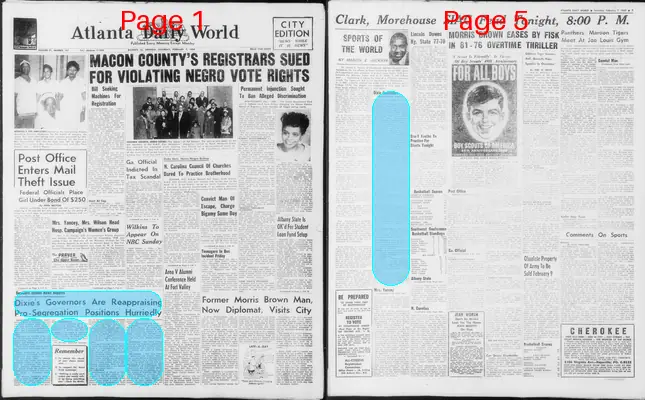
Atlanta Daily World
Atlanta, Fulton County, Georgia
What is this article about?
Southern School News reports Virginia's court-ordered end to massive resistance spurs other Southern states to reappraise segregation stances, with legislative actions to maintain or soften integration impacts, including tuition grants and new laws.
Merged-components note: Continuation of the Southern School News story across pages; merge for complete article.
Clippings
1 of 2
OCR Quality
Full Text
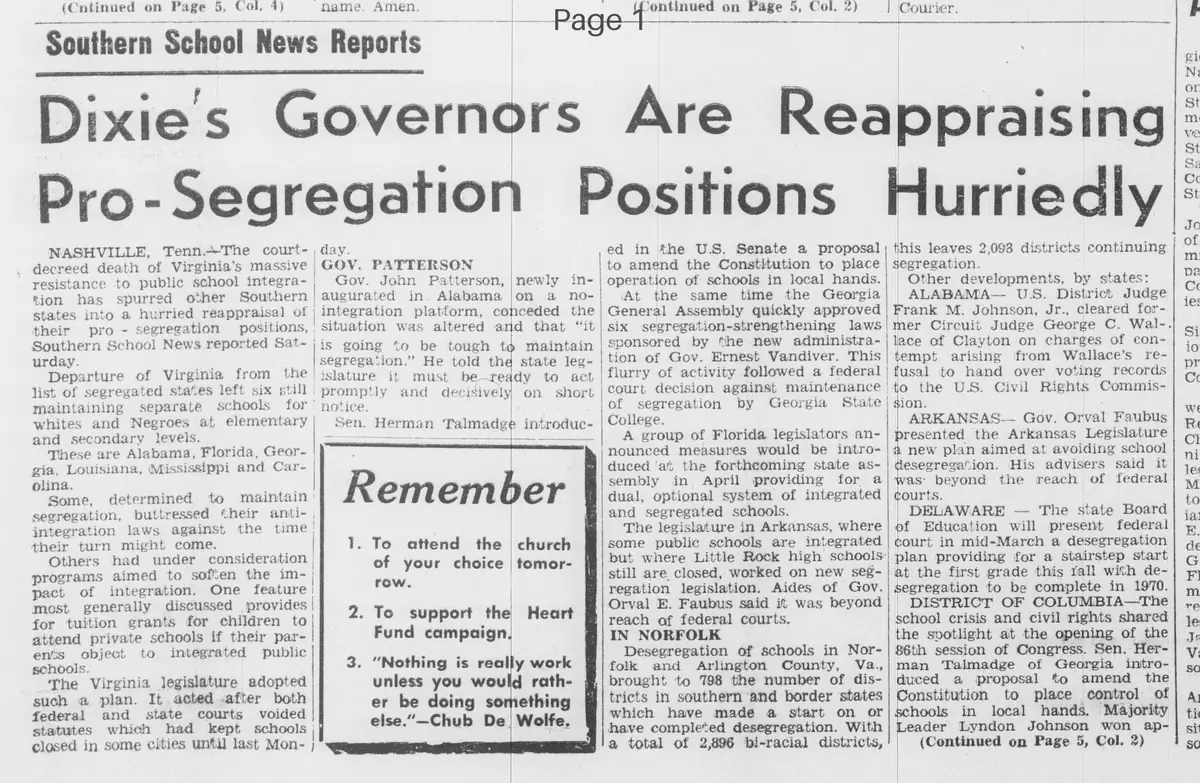
NASHVILLE, Tenn.—The court-decreed death of Virginia's massive resistance to public school integration has spurred other Southern states into a hurried reappraisal of their pro-segregation positions, Southern School News reported Saturday.
Departure of Virginia from the list of segregated states left six still maintaining separate schools for whites and Negroes at elementary and secondary levels.
These are Alabama, Florida, Georgia, Louisiana, Mississippi and South Carolina.
Some, determined to maintain segregation, buttressed their anti-integration laws against the time their turn might come.
Others had under consideration programs aimed to soften the impact of integration. One feature most generally discussed provides for tuition grants for children to attend private schools if their parents object to integrated public schools.
The Virginia legislature adopted such a plan. It acted after both federal and state courts voided statutes which had kept schools closed in some cities until last Monday.
Gov. John Patterson, newly inaugurated in Alabama on a no-integration platform, conceded the situation was altered and that "it is going to be tough to maintain segregation." He told the state legislature it must be ready to act promptly and decisively on short notice.
Sen. Herman Talmadge introduced in the U.S. Senate a proposal to amend the Constitution to place operation of schools in local hands.
At the same time the Georgia General Assembly quickly approved six segregation-strengthening laws sponsored by the new administration of Gov. Ernest Vandiver. This flurry of activity followed a federal court decision against maintenance of segregation by Georgia State College.
A group of Florida legislators announced measures would be introduced at the forthcoming state assembly in April providing for a dual, optional system of integrated and segregated schools.
The legislature in Arkansas, where some public schools are integrated but where Little Rock high schools still are closed, worked on new segregation legislation. Aides of Gov. Orval E. Faubus said it was beyond reach of federal courts.
IN NORFOLK
Desegregation of schools in Norfolk and Arlington County, Va., brought to 798 the number of districts in southern and border states which have made a start on or have completed desegregation. With a total of 2,896 bi-racial districts, this leaves 2,098 districts continuing segregation.
Other developments, by states:
ALABAMA—U.S. District Judge Frank M. Johnson, Jr., cleared former Circuit Judge George C. Wallace of Clayton on charges of contempt arising from Wallace's refusal to hand over voting records to the U.S. Civil Rights Commission.
ARKANSAS—Gov. Orval Faubus presented the Arkansas Legislature a new plan aimed at avoiding school desegregation. His advisers said it was beyond the reach of federal courts.
DELAWARE—The State Board of Education will present federal court in mid-March a desegregation plan providing for a stairstep start at the first grade this fall with desegregation to be complete in 1970.
DISTRICT OF COLUMBIA—The school crisis and civil rights shared the spotlight at the opening of the 86th session of Congress. Sen. Herman Talmadge of Georgia introduced a proposal to amend the Constitution to place control of schools in local hands. Majority Leader Lyndon Johnson won approval of his compromise filibuster measure.
(Continued on Page 5, Col. 2)
Dixie Governors (Continued from Page One)
FLORIDA- Members of the state Legislature prepared for presentation at the April session a dual state school system, superimposing a voluntary integrated system on top of the present segregated schools.
GEORGIA- The state's first ruling against public school segregation came from a federal judge who directed Georgia State College to stop refusing admission to qualified Negroes. The new Legislature quickly adopted six major segregation-tightening bills sent up by newly-inaugurated Gov. Ernie Vandiver.
KENTUCKY- The 1959 gubernatorial campaign began to warm up with Gov. A. B. Chandler's presidential ambitions an interesting issue but with school segregation not an issue. Better than 90 per cent of the state's Negro school-age population now is in desegregated classrooms.
LOUISIANA - The U.S. Civil Rights Commission voted it would look no closer into denied voting rights. Mal G- ca leaves premise a joint ish, 51 :hr :! rits i.. L.
MARYLAND. MONDAY CMUH- .li stadie ievei..
Mississippi - The state Dem xra:ie Exeeu:iv (am- mi:iee mvied N.onal D modrunic Ciairman Paul Bu:ior to crte 1o. Msspai and asloui:e i" al- Jacdiy tolne the Souh to arcapt Bu:ler declnned. saving ir hudnt bea thr biunt.
MISSOURI- KAnS CAV, vIn 1 sxar on dergregition in iord, re- poried miein of i munils and faculs ind proresed :var bv veir.
NORTH CAROLINA GOV I- ther Hodges predie ed North Caro- ung's Pearsall Plan for deallugd w:th sehool desegregntion wotld Sand up despite the knockout of mdsive resistnnce in neiohboring Virkinia.
OKLAHOMA- Although segrevi- tion is legally dead in Oklehomd evidence appeared in Janunty o! continued and lively opposit on to itegralion.
SOUTH CAROLINA- FOMEr Lt Gov. Ernes F. Hollings took over as 'he state's new governo: with all inaugural pledge to maintain racial separation in public schools.
TENNESSEE- Negro parents op- prealed to federal cour: for immedi- are total desegregation in place of the previously court-approved stair- step plan in Nashville.
TEXAS-A new survey showed 40 Texas colleges desegregated with 13 o'ners willing to accep: Negrods but with no applicants.
VIRGINIA - White and Negro pupils qulesiy entered integrated classes for the first time. The Gen- eral Assembly adopted Gov. J. Lind- say Almond's legislative program a.m d to ea e the impact of de- segregation.
WFST VIRGINIA-The Legisla- 'ue opened its laog session with d speech n which the governor made no memion of the Iacial issue and with the question expected to draw litle or no aitention at this ses- sion.
What sub-type of article is it?
What keywords are associated?
What entities or persons were involved?
Where did it happen?
Domestic News Details
Primary Location
Southern United States
Key Persons
Outcome
virginia ends massive resistance, leading to desegregation in norfolk and arlington; six states maintain segregation; various legislative actions to strengthen or adapt segregation policies; 798 districts start or complete desegregation out of 2896.
Event Details
Following federal and state court decisions voiding Virginia's massive resistance laws, reopening schools, other Southern states hurriedly reappraise pro-segregation positions. Alabama's Gov. Patterson warns of challenges; Georgia passes six segregation laws; Florida considers dual school system; Arkansas works on new legislation; proposals for tuition grants to private schools and constitutional amendments to localize school control. Developments reported by state including court rulings, gubernatorial pledges, and desegregation plans.