Thank you for visiting SNEWPapers!
Sign up free
The New York Herald
New York, New York County, New York
What is this article about?
In a 1856 letter to the New York Herald, George Lew replies to G.A. Scroggs, denouncing Millard Fillmore's presidency for subservience to Southern slave interests, betrayal of Whig principles, and support for the Fugitive Slave Law; he equates Fillmore's actions to those of Pierce and Buchanan, positioning Fremont as the candidate for freedom and constitutional rights.
Clipping
OCR Quality
Full Text
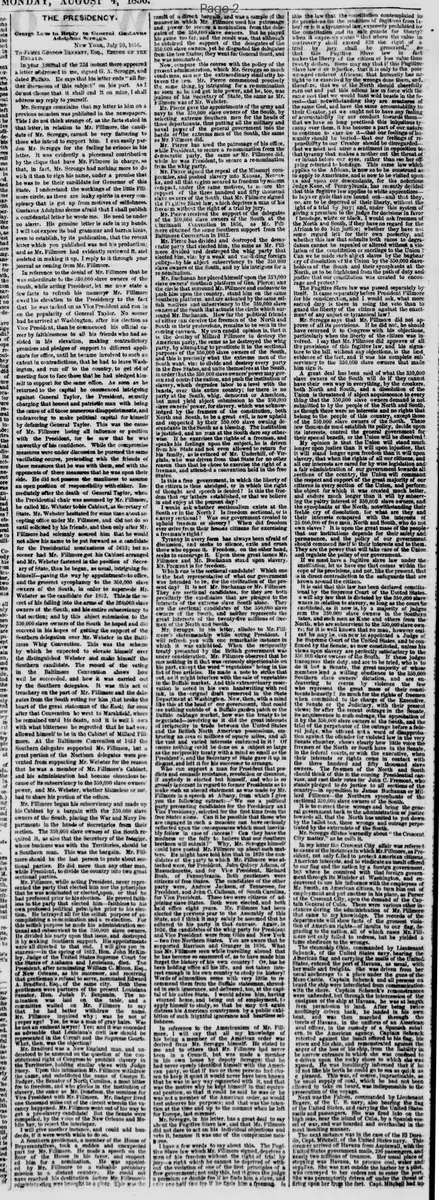
In Reply to General Gustavus Adolphus Scroggs.
NEW YORK, July 30, 1856.
To JAMES GORDON BENNETT, Esq., Editor of The HERALD.
In your journal of the 22d instant there appeared a letter addressed to me, signed G. A. Scroggs, and dated Buffalo. He says that his letter ends "all further discussion of this subject" on his part. As I do not choose that it shall end it on mine, I shall address my reply to yourself.
Mr. Scroggs complains that my letter to him on a previous occasion was published in the newspapers. This I do not think strange of, as the facts stated in that letter, in relation to Mr. Fillmore, the candidate of Mr. Scroggs, cannot be very flattering to those who intend to support him. I can easily pardon Mr. Scroggs for the feeling he evinces in his letter. It was evidently a piecemeal contribution by the clique that have Mr. Fillmore in charge, so that, in fact, Mr. Scroggs had nothing more to do with it than to sign his name, under a promise that he was to be their candidate for Governor of this State. I understand the workings of the little Fillmore circle, as there are leaky spirits in every conspiracy that is got up from motives of selfishness.
Gustavus Adolphus seems afraid that I shall publish a confidential letter he wrote me. He need be under no alarm. His genuine letter is safe in my hands. I will not expose its bad grammar and barren ideas, even to establish, by its publication, that the recent letter which you published was not his production; and as Mr. Fillmore had evidently reviewed it, and assisted in making it up, I reply to it through your journal as coming from Mr. Fillmore.
In reference to the denial of Mr. Fillmore that he was subordinate to the 350,000 slave owners of the South, while acting President, let me now state a few facts to refresh his memory. Mr. Fillmore owed his elevation to the Presidency to the fact that he was tacked on as Vice President and run in on the popularity of General Taylor. No sooner had he arrived at Washington, after his election as Vice President, than he commenced his official career by faithlessness to all his friends who had assisted in his elevation, making contradictory promises and pledges of support to different applicants for office, until he became involved to such an extent in contradictions, that he had to leave Washington, and run off to the country, to get rid of meeting face to face those that he had pledged himself to support for the same office. As soon as he returned to the capital he commenced intriguing against General Taylor, the President, secretly charging that honest and patriotic man with being the cause of all these numerous disappointments, and endeavoring to make political capital for himself by defaming General Taylor. This was the cause of Mr. Fillmore losing all influence or position with the President, for he saw that he was unworthy of his confidence. While the compromise measures were under discussion he pursued the same vacillating course, pretending with the friends of these measures that he was with them, and with the opponents of these measures that he was upon their side. He did not possess the manliness to assume an open position of responsibility with either. Immediately after the death of General Taylor, when the Presidential chair was assumed by Mr. Fillmore, he called Mr. Webster to his Cabinet, as Secretary of State. Mr. Webster hesitated for some time about accepting office under Mr. Fillmore, and did not do so until solicited by his friends, and then only after Mr. Fillmore had solemnly assured him that he would not allow his name to be put forward as candidate for the Presidential nominations of 1852; but no sooner had Mr. Fillmore got his Cabinet arranged and Mr. Webster fastened in the position of Secretary of State, than he began, as usual, intriguing for himself—paving the way by appointments to office, and the grossest sycophancy to the 350,000 slave owners of the South, in order to supersede Mr. Webster as the candidate for 1852. This is the secret of his falling into the arms of the 350,000 slave owners of the South, and his entire subserviency to that section; and by this abject submission to the 350,000 slave owners of the South he hoped and did succeed in his hopes of getting the support of the Southern delegation over Mr. Webster in the Baltimore Whig Convention. This was the scheme by which he expected to elevate himself over the distinguished Webster and make himself the Southern candidate. The record of the voting in the Baltimore Convention shows how well he succeeded, and how it was carried out by the Southern delegates. It was this act of treachery on the part of Mr. Fillmore and the delegates from the South voting for him that broke the heart of the great statesman of the East; for soon after that Convention he went to Marshfield, where he remained until his death, and it is well known with what bitterness he regretted that he had ever allowed himself to be in the Cabinet of Millard Fillmore. At the Baltimore Convention of 1852 the Southern delegates supported Mr. Fillmore, but a great portion of the Northern delegates were prevented from supporting Mr. Webster for the reason that he was a member of Mr. Fillmore's Cabinet, and his administration had become obnoxious because of its subserviency to the 350,000 slave owners' power, and Mr. Webster, whether blameless or not, had to share his portion of the odium.
Mr. Fillmore began his subserviency and made up his Cabinet by a bargain with the 350,000 slave owners of the South, placing the War and Navy Departments in the hands of Secretaries from their section. The 350,000 slave owners of the South required it, as also that the Secretary of the Interior, whose business was with the Territories, should be a Southern man. This was the bargain. Mr. Fillmore should be the last person to prate about sectional parties. He did more than any other man, while President, to divide the country into two great sectional parties.
Mr. Fillmore, while acting President, never represented the party that elected him nor the principles that he was nominated or elected upon, or that he had professed prior to his election. "He proved faithless to the party that elected him—faithless to his own professed political principles prior to his election. He betrayed all for the selfish purpose of accomplishing a re-nomination and a re-election. For this selfish purpose he made his administration sectional and subservient to the 350,000 slave owners. He divided his party upon that issue, and destroyed it by seeking Southern support. His appointments were all directed to that end. I will give you instances: In the spring of 1852, Hon. John McKinley, Judge of the United States Supreme Court for the States of Alabama and Louisiana, died. The President, after nominating William C. Micou, Esq., of New Orleans, as his successor, and receiving that gentleman's refusal to serve, nominated Edward A. Bradford, Esq., of the same city. Both these gentlemen were partners of the present Louisiana Senator, Hon. Judah P. Benjamin. The nomination was laid on the table, and a committee waited on Mr. Fillmore to say that he had better withdraw the name. Mr. Fillmore inquired why: was he not of proper age? Yes, he was a man of gray hairs. Was he not an eminent lawyer? Yes and it was conceded as advisable that Louisiana's civil law should be represented in the Circuit and the Supreme Courts. What, then, was the objection? Mr. Bradford was a New England man, and understood to be unsound on the question of the constitutional right of Congress to prohibit slavery in the Territories, holding similar views with Judge Story. Upon this intimation Mr. Fillmore withdrew the name and substituted the name George Badger, the Senator of North Carolina, a most bitter foe to freedom, and who glories in the institution of slavery, the same as Mr. Donelson, the nominee for Vice President with Mr. Fillmore. Mr. Badger lived one thousand miles out of the circuit wherein the vacancy happened. Mr. Fillmore went out of his way to get a pro-slavery candidate! But the Senate were compelled, by the voice of the New Orleans and Mobile bar, to reject the interloper.
I will give another instance, and could add hundreds, if it were worth while to do so. A Southern gentleman, a member of the House of Representatives, took a sudden and unexpected part for Mr. Fillmore. He made a speech on the floor of the House in his favor, and supported him for a nomination. He was appointed by Mr. Fillmore to a valuable pecuniary mission. He reached his destination before Mr. Fillmore's administration was brought to a close. This was the result of a direct bargain, and was a sample of the manner in which Mr. Fillmore used his patronage and power to secure a nomination from the delegates of the 350,000 slave owners. But he played his game too far, and the result was, that although he obtained the support of the delegates of the 350,000 slave owners, yet he disgusted the delegates from the free States; they went for General Scott, and he was nominated.
Now, compare this course with the policy of the present administration, which Mr. Scroggs so much condemns, and see the extraordinary similarity between the two. Mr. Pierce commenced precisely the same thing, by intriguing for a re-nomination as soon as he had got into power, and he, too, was jealous of his Secretary of State, the same as Mr. Fillmore was of Mr. Webster.
Mr. Pierce gave the appointments of the army and navy to the 350,000 slave owners of the South, by selecting extreme Southern men for the heads of those departments, thus putting all the military and naval power of the general government into the hands of the extreme men of the South, the same as Mr. Fillmore did.
Mr. Pierce has used the patronage of his office, while President, to secure a re-nomination from the democratic party, the same as Mr. Fillmore did, while he was President, to secure a re-nomination from the whig party.
Mr. Pierce signed the repeal of the Missouri compromise, and pushed slavery into Kansas, Nebraska, and all that region secured to freedom by solemn compact, under the same motives, to secure the support of the three hundred and fifty thousand slave owners of the South, that Mr. Fillmore signed the Fugitive Slave law, which deprives a man of his freedom without the right of a trial by jury.
Mr. Pierce received the support of the delegates of the 350,000 slave owners of the South at the Cincinnati Convention in 1856, as Mr. Fillmore obtained the same Southern support from the Baltimore Convention in 1852.
Mr. Pierce has divided and destroyed the democratic party that elected him, the same as Mr. Fillmore divided and destroyed the whig party that elected him, viz: by a weak and vacillating foreign policy—by his abject subserviency to the 350,000 slave owners of the South, and by his intrigues for a re-nomination.
Mr. Buchanan has placed himself upon the 350,000 slave owners' Southern platform of Gen. Pierce; and the circle that surround Mr. Fillmore and endeavor to push him upon the country, stand him on the same Southern platform, and are actuated by the same selfish motives and subserviency to the 350,000 slave owners of the South that actuate the circle which surround Mr. Buchanan. How far the political friends of either can deceive the freemen of the North and South in their professions, remains to be seen in the coming canvass. My own candid opinion is, that it is the destiny of Millard Fillmore to destroy the American party, the same as he destroyed the whig party, by attempting to prostitute it to the sectional purposes of the 350,000 slave owners of the South, and this is precisely what the extreme men of the South want, viz: to divide and destroy every party in the free States, and unite themselves at the South in order that the 350,000 slave owners' power may govern and control the nation, and push the institution of slavery, which degrades labor to a level with the beasts, over this entire country; for there is no party at the South, whig, democrat or American, but must yield abject submission to the 350,000 slave owners' power, for slavery, which was acknowledged by the framers of the constitution, both North and South, to be a great evil, is now upheld and supported by their 350,000 slave owning descendants in the South as a blessing. The institution is justified, and no man at the South dare say otherwise. If he exercises the rights of a freeman, and speaks his feelings upon the subject, he is driven from his State and not even allowed to return for his family, as is evinced of Mr. Underhill, of Virginia, who was driven from that State for no other reason than that he chose to exercise the right of a freeman, and attended a convention held in the free States.
Is this a free government, in which the liberty of the citizen is thus abridged, or in which the right of thought and speech is denied? Is this the freedom that our fathers established, or that we believe in and enjoy at the present day?
I would ask whether sectionalism exists at the South or in the North? Is freedom sectional, or is slavery sectional? Was our government created to uphold freedom or slavery? When did freedom ever drive from their homes citizens for exercising a freeman's right?
Tyranny in every form has always been afraid of discussion, and seeks to silence, exile and crush those who oppose it. Freedom, on the other hand, seeks to encourage it. Upon these great issues Mr. Fillmore and Mr. Buchanan stand upon slavery. Mr. Fremont is for freedom.
Which one is the sectional candidate? Which one is the best representative of what our government was intended to be, for the civilization of the present day? It is not Mr. Buchanan or Mr. Fillmore. They are sectional candidates, for they are both peculiarly the candidates that are pledged to the interests of the extreme slave South alone. They are the sectional candidates of the 350,000 slave owners of the South, and neither represents the great interests of the twenty-five millions of freemen of the North and South.
Mr. Scroggs, in his letter, alludes to Mr. Fillmore's statesmanship while acting President. I will refresh you with one remarkable instance in which it was exhibited. When the reciprocity treaty presented by the British government was under consideration, Mr. Fillmore observed that he saw nothing in it that was seriously objectionable on his part, except the word "vegetables" being in the list of free articles. He made a note to strike that out, as it might interfere with the sale of vegetables in the Buffalo market. And this extraordinary reservation is noted in his own handwriting with red ink, in the original draft preserved in the State Department at Washington. Now, then, with a mind like this at the head of our government, that could see nothing outside of a Buffalo garden patch or the Buffalo cabbage market, how was the treaty to be negotiated—involving as it did the great interests of reciprocity in trade between the United States and the British North American possessions, embracing an area of millions of square miles, and all the vast and varied interests embraced in it? Of course nothing could be done on a subject so large as the reciprocity treaty with a mind so small as the President's, and the Secretary of State gave it up in disgust, and left it for his successor to arrange.
Who can support a man for President that predicts and counsels resistance, revolution or disunion, if anybody is elected but himself, and who is so grossly ignorant in regard to former Presidents as to make such an absurd statement as was made by Mr. Fillmore in a speech at Albany, from which I give you the following extract: "We see a political party presenting candidates for the Presidency and Vice Presidency, selected for the first time from the free States alone. Can it be possible that those who are engaged in such a measure can have seriously reflected upon the consequences which must inevitably follow in case of success? Can they have the madness or the folly to believe that our Southern brethren will submit?"
Why, Mr. Scroggs himself could have posted Mr. Fillmore up about such matters. He might have told him that in 1828 the candidates of the party to which Mr. Fillmore was attached were, for President, John Quincy Adams, of Massachusetts, and for Vice President, Richard Rush, of Pennsylvania. Both gentlemen were citizens of free States. The candidates of the other party were, Andrew Jackson, of Tennessee, for President, and John C. Calhoun, of South Carolina, for Vice President. These two were citizens of adjoining slave States. Both were elected, and both held office eight years.
Mr. Fillmore had been elected the previous year to the Assembly of this State, and I think it may safely be assumed that he adhered to his party in that canvass.
Again, in 1836, the candidates of the whig party for President and Vice President were from Ohio and New York—two free Northern States. You are aware that he supported Harrison and Granger in 1836. What has Mr. Fillmore seen while travelling abroad that he has become so enamored of, as to have made him forget the history of his own country? Or, has he been holding office all his life, and not taken interest enough in his own country to study its history?
Words of admonition come with very little to recommend them from the Buffalo statesman, shrouded in such ignorance, and delivered, too, at the capital of his native State. I would advise him, having returned home, and being out of employment, to apply himself to study, so that he may not again distress his American countrymen by a public exhibition of such frightful ignorance and heartless selfishness.
In reference to the Americanism of Mr. Fillmore, I will say that all my knowledge of his being a member of the American order was derived from Mr. Scroggs himself. He stated to me and to others that Mr. Fillmore had never been in a Council, but was made a member in his own house by deputy Scroggs; that he had never openly identified himself with the American party, so that if two or three persons had chosen to keep it quiet it would never have been known that he was in any way connected with it, and that was the motive why he kept himself in that equivocal position, so that it could be said he was or he was not a member of the American order, as would best subserve his purposes; and that was the intention at the time and up to the moment when he left for Europe, last summer.
Mr. Scroggs, in his letter, has a great deal to say about the Fugitive Slave law, and that Mr. Fillmore did not dare to act on his individual objections and veto it, because it was one of the compromise measures.
I have a few words to say about this. The Fugitive Slave law which Mr. Fillmore signed, deprives a man of his freedom without the right of trial by jury—a right which he cannot be deprived of without the violation of one of the first principles of a free government; not only this, but it gives the judge a premium or double fee if he finds him a slave, and only one half the fee if he finds him a freeman. Is this the law that the constitution contemplated in its provisions for the rendition of fugitives from labor? or is it a tyrannical law, expressly prohibited by the constitution and its safeguards for liberty? when it expressly states "that where the value in controversy shall exceed $20 the right of a trial by jury shall be preserved," so that this Fugitive Slave law in fact makes the liberty of the citizen of less value than twenty dollars. Some may say that if this Fugitive Slave law does injustice, that it is only to the poor wronged enslaved Africans; that humanity has no right to be exercised by the wrongs done them, and, therefore, that we of the North should cheerfully turn out and put this odious law in force with the same zeal that we would hunt wild beasts in the forest—that notwithstanding they are creatures of the same God, and have the same accountability to their Creator, yet we ought not to have any feeling of accountability for our conduct towards them that we have so long practised this iniquitous tyranny over them has become part of our nature to continue to exercise it—that our feelings of humanity should be buried—that our feelings of responsibility to our Creator should be disregarded—that we must not utter a sentiment in opposition to that tyranny that makes a mother cut the throat of her infant before our eyes, rather than see her offspring returned to bondage.
This same law which applies to the African, is now so to be construed as to apply to Americans, and is now to be visited upon us and upon our descendants, for the notorious Judge Kane, of Pennsylvania, has recently decided that this fugitive law applies to white apprentices—to boys or girls that are bound out—and that they, too, are to be deprived of their liberty, without the right of a trial by jury; and, under this system of giving a premium to the judge for decisions in favor of bondage, white or black, I would ask freemen of the North and South, if they have no regard for the African to do his justice; whether they have not some regard left for their own posterity, and whether this law that submits both races to degradation cannot be repealed or altered without a violation of the constitution or sacrilege to the Union?
Can we be made such abject slaves by the bugbear cry of dissolution of the Union by the 350,000 slave-holders of the South and their sycophants at the North, as to be frightened from the path of duty and justice that our constitution was created to encourage and protect?
The Fugitive Slave law was passed separately by itself. It came separately before President Fillmore for his consideration, and I would ask, what more sacred duty is there in using the veto than to guard the liberty of the citizen against the enactment of any unjust or tyrannical law?
Mr. Scroggs says that Mr. Fillmore did not approve of all its provisions. If he did not, he should have returned it to Congress with his objections, particularly when the liberty of the citizen was involved. I say that Mr. Fillmore did approve of all the provisions of this fugitive law, and his signature to the bill, without any objections, is the best evidence of the fact, and it was his complete subserviency to the 350,000 slave owners that made him sign it.
A great deal has been said of what the 350,000 slave owners of the South will do if they cannot have their own way in everything, by the croakers, both North and South, and a dissolution of the Union is threatened if abject acquiescence to every thing that the 350,000 slave owners demand is not submitted to by the people of the North and South, as though there were no interests and no rights that belong to the people of this country, except those of the 350,000 slave owners of the South. These few thousands must establish its policy, decide upon its interests, control the general government for their special benefit, or the Union will be dissolved!
My opinion is that the Union will stand much longer upon justice than it will upon injustice, that it will stand longer upon freedom than it will upon slavery, that when the rights of all our citizens, and all our interests are cared for by wise legislation and a fair administration of our government towards all sections of the country, the Union will command the respect and support of the great majority of our citizens in every section of the Union, and perform the object for which it was created much better, and endure much longer than it will by subserving the paltry interest of 350,000 slave owners, and the sycophants of the North, notwithstanding their feeble cry of dissolution, for what are they and their interests compared with the interests of 25,000,000 of free men, North and South, who do not own slaves? It is upon the great mass of the people that our institutions depends for their safety and permanence, and the policy of our government should commend itself to their interests and to them. They are the power that will take care of the Union, and regulate the policy of our government.
If we must have a fugitive slave law under the constitution, let us have one that comes within the scope of its provisions, and not, like the present, that is in direct contradiction to the safeguards that are thrown around the citizen.
It is said that this law has been declared constitutional by the Supreme Court of the United States. Who will any law that is dictated by the 350,000 slave owners in relation to slavery, so long as the court is constituted, as it now is, by a majority of judges from the 350,000 slave owners in the Southern States, and such men as Kane and others from the North, who are subservient to the 350,000 slave owners: for it is well known that no man, however eminent he may be, can now be appointed a Judge of the Supreme Court of the United States, and be confirmed by the Senate, as now constituted, unless his views upon slavery are perfectly satisfactory to the 350,000 slave owners of the South. If these judges transgress their duty, and are to be tried, who is to do it but a Senate, the great majority of whose members lend a willing obedience to the 350,000 Southern slave owners dictation, and are endeavoring to coerce by violence the few who represent the great mass of their constituents honestly? So much for the rights of freemen when committed to the charge of the Executive, the Senate or the Judiciary, with their present views; for after the recent outrage in the Senate its acquiescence in such outrage, the approbation of it by the 350,000 slave owners of the South, and the trial of the perpetrator of the outrage before a federal judge, who uttered not a word of disapprobation against the offender for violated law in the very Senate chamber, shows clearly how little voice the freemen of the North or South have in the Senate in the federal courts, or with the executive, when their interests or rights come in contact with the three hundred and fifty thousand slave owners. The freemen of the North and South should think of this in the coming Presidential canvass, and cast their votes for John C. Fremont, who stands pledged to do justice to all sections of the country—in opposition to James Buchanan or Millard Fillmore the Northern sycophants of the sectional 350,000 slave owners of the South.
It is to correct these wrongs and bring the general government back to the administration of justice towards all, that the North has united to put down by the ballot box, these wrongs and outrage perpetrated by the extremists of the South.
Mr. Scroggs dilates learnedly about "the Crescent City matter," as he calls it.
In my letter the Crescent City affair was referred to as one of the instances in which Mr. Fillmore, as President, not only failed to protect American citizens American interests, and to vindicate an insult offered to our flag and the nation by a foreign government, but where he connived with that foreign government through its Minister at Washington, and endeavored to use his influence with the employees of Mr. Smith, an American citizen, to turn him out of employment and put another in his place, as Purser of the Crescent City, upon the demand of the Captain General of Cuba. There were various other instances during the administration of Mr. Fillmore that came to my knowledge. The records of the departments will show facts of the grossest violation of American rights—of insults to our flag, degrading to the nation, all of which cases Mr. Fillmore not only failed to redress, but he yielded a tame obedience to the wrongs.
The steamship Ohio, commanded by Lieutenant Schenck, of the United States navy, bearing the American flag and carrying the mails of the United States, entered the port of Havana, as usual, with her mails and freights. She was driven from her usual anchorage to a place under the guns of the Moro Castle. Captain Schenck and all persons on board the ship were interdicted from communication with the shore. Captain Schenck's remonstrances were unheeded, but through the intercession of the consignee of the ship at Havana, he was at length given permission to land. After being twice insultingly driven back, he landed in his own boat, and was then marched through the streets of Havana, in the uniform of an American naval officer, in the custody of a Spanish subaltern, to the American agency. Captain Schenck protested against the insult offered to his flag, his person and his ship, and remonstrated against the danger of the loss of his ship, from the liability in the narrow entrance in which she was confined to be driven upon the rocky shore to which she was exposed. He was insultingly informed that if he did not like his berth he could go to sea as quick as he pleased. This was, of course, impracticable, as the usual supply of coal, which he had not been allowed to take on board, was indispensable to the prosecution of the voyage.
Next was the Falcon, commanded by Lieutenant Rogers, of the U. S. navy, also bearing the flag of the United States, and carrying the United States mails and passengers. She was fired into on the high seas near the island of Cuba by Spanish vessel of war, and was boarded and overhauled in the most insulting manner.
The next instance was in the case of the El Dorado, Capt. Mitchell, of the United States navy. This steamer arrived off Havana from Aspinwall, with the United States government mails, 200 passengers, and nearly two millions of treasure. Her usual place of stopping was Havana, to procure coal, water and supplies. She was met outside the harbor by a pilot, who conveyed to her orders not to enter the port. She was peremptorily driven off under the threat of firing upon her from the fort. Capt. Mitchell had no alternative but to go to Matanzas, where he was allowed to land his passengers and obtain supplies.
What sub-type of article is it?
What themes does it cover?
What keywords are associated?
What entities or persons were involved?
Letter to Editor Details
Author
George Lew
Recipient
James Gordon Bennett, Esq., Editor Of The Herald
Main Argument
george lew accuses millard fillmore of betraying his party and principles through subservience to southern slave owners to secure personal political gain, compares this to the actions of presidents pierce and buchanan, and argues that fillmore and buchanan are sectional candidates while fremont represents freedom and justice for all.
Notable Details