Thank you for visiting SNEWPapers!
Sign up free
The Liberator
Boston, Suffolk County, Massachusetts
What is this article about?
The Louisville Journal comments on the Senate debate on slavery from February 18, 1837, supporting Henry Clay's position on receiving abolition petitions. It reprints Clay's and John C. Calhoun's resolutions affirming states' rights over slavery and opposing federal interference.
Merged-components note: Continuation of the same article discussing the debate on slavery in the Senate, including Clay's and Calhoun's resolutions.
Clipping
OCR Quality
Full Text
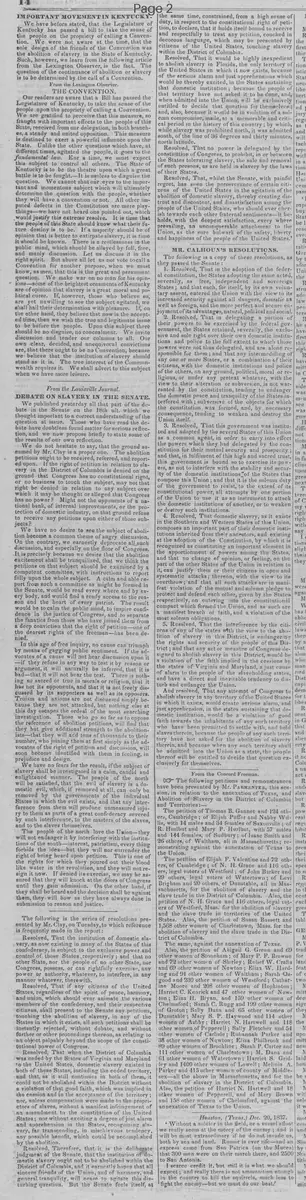
DEBATE ON SLAVERY IN THE SENATE.
We published yesterday all that part of the debate in the Senate on the 18th ult. which we thought important to a correct understanding of the question at issue. Those who have read the debate have doubtless found matter for serious reflection, and we now propose briefly to state some of the results of our own reflection.
We do not hesitate to say, that the ground assumed by Mr. Clay is a proper one. The abolition petitions ought to be received, referred, and reported upon. If the right of petition in relation to slavery in the District of Columbia is denied on the ground that Congress has no constitutional right, or no business to touch the subject, may not that right be denied in relation to any subject over which it may be thought or alleged that Congress has no power? Might not the opponents of a national bank, of internal improvements, or the protection of domestic industry, on that ground refuse to receive any petitions upon either of those subjects?
We have no desire to see the subject of abolition become a common theme of angry discussion. On the contrary, we earnestly deprecate all such discussion, and especially on the floor of Congress. It is precisely because we desire that the abolition excitement shall be tranquilized, that we think the petitions on that subject should be examined by a competent committee, with instructions to report fully upon the whole subject. A calm and able report from such a committee as might be formed in the Senate, would be read everywhere and by everybody, and would find a ready access to the reason and the heart of every patriot. The result would be to calm the public mind, to inspire confidence in the justice of Congress, and to separate the fanatics from those who have joined them from a deep conviction that the right of petition—one of the dearest rights of the freeman—has been denied.
In this age of free inquiry, no cause can triumph by means of gagging public sentiment. If the advocates of a cause will not hear discussion upon it—if they refuse in any way to test it by reason or argument, it will naturally be inferred, that it is bad—that it will not bear the test. There is nothing so sacred or true in morals or religion, that it has not its opponents, and that it is not freely discussed by its supporters as well as its opposers. Truisms and axioms are not discussed simply because they are not attacked, but nothing else at this day escapes the ordeal of the most searching investigation. Those who go so far as to oppose the reference of abolition petitions, will find that they but give additional strength to the abolitionists—that they will add tens of thousands to their number, who joining them at first simply as the advocates of the right of petition and discussion, will soon become identified with them in feeling, in prejudice and design.
We have no fears for the result, if the subject of slavery shall be investigated in a calm, candid and enlightened manner. The people of the north will be satisfied, that the evil of slavery is a domestic evil, which, if removed at all, can only be removed by the governments of the individual States in which the evil exists, and that any interference from them will produce unmeasured injury to them as parts of a great confederacy severed by such interference, to the masters of the slaves, and to the slaves themselves.
The people of the north love the Union—they will not endanger it by interfering with the institutions of the south—interest, patriotism, every thing forbids the idea—but they will not surrender the right of being heard upon petition. This is one of the rights for which they poured out their blood like water in the revolution, and they will not resign it now. If denied its exercise, we may be assured that they will knock at the doors of Congress until they gain admission. On the other hand, if they shall be heard and the decision shall be against them, they will bow as they have always done in submission to reason and justice.
The following is the series of resolutions presented by Mr. Clay, on Tuesday, to which reference is frequently made in the report:
Resolved, That the institution of domestic slavery, as now existing in many of the States of this confederacy, is subject to the exclusive power and control of those States respectively; and that no other State, nor the people of no other State, nor Congress, possess, or can rightfully exercise, any power or authority, whatever, to interfere, in any manner whatever, therewith.
Resolved, That if any citizens of the United States, regardless of the spirit of peace, harmony, and union, which should ever animate the various members of the confederacy, and their respective citizens, shall present to the Senate any petitions, touching the abolition of slavery, in any of the States in which it exists, all such petitions shall be instantly rejected, without debate, and without further or other proceedings thereon, as relating to an object palpably beyond the scope of the constitutional power of Congress.
Resolved, That when the District of Columbia was ceded by the States of Virginia and Maryland to the United States, domestic slavery existed in both of these States, including the ceded territory, and that, as it still continues in both of them, it could not be abolished within the District without a violation of that good faith, which was implied in the cession and in the acceptance of the territory; nor, unless compensation were made to the proprietors of slaves, without a manifest infringement of an amendment to the constitution of the United States; nor without exciting a degree of just alarm and apprehension in the States, recognizing slavery, far transcending, in mischievous tendency, any possible benefit, which could be accomplished by the abolition.
Resolved, Therefore, that it is the deliberate judgment of the Senate, that the institution of domestic slavery ought not to be abolished within the District of Columbia, and it earnestly hopes that all sincere friends of the Union, and of harmony, and general tranquility, will cease to agitate this disturbing question. But the Senate feels itself, at
the same time, constrained, from a high sense of duty, in respect to the constitutional right of petition, to declare, that it holds itself bound to receive and respectfully to treat any petition, couched in decorous language, which may be presented by citizens of the United States, touching slavery within the District of Columbia.
Resolved, That it would be highly inexpedient to abolish slavery in Florida, the only territory of the United States in which it now exists, because of the serious alarm and just apprehensions which would be thereby excited, in the States sustaining that domestic institution; because the people of that territory have not asked it to be done, and, when admitted into the Union, will be exclusively entitled to decide that question for themselves; and, also, because it would be in violation of a solemn compromise, made, at a memorable and critical period in the history of this country; by which, while slavery was prohibited north, it was admitted south, of the line of 36 degrees and thirty minutes, north latitude.
Resolved, That no power is delegated by the constitution of Congress, to prohibit, in or between the States tolerating slavery, the sale and removal of such persons, as are held in slavery by the laws of their States.
Resolved, That, whilst the Senate, with painful regret, has seen the perseverance of certain citizens of the United States in the agitation of the abolition of domestic slavery, thereby creating distrust and discontent, and dissatisfaction among the people of the United States, who should ever cherish towards each other fraternal sentiments—it beholds, with the deepest satisfaction, everywhere prevailing, an unconquerable attachment to the Union, as the sure bulwark of the safety, liberty and happiness of the people of the United States.
MR. CALHOUN'S RESOLUTIONS.
The following is a copy of these resolutions, as they passed the Senate:
1. Resolved, That in the adoption of the federal constitution, the States adopting the same acted, severally, as free, independent and sovereign States; and that each, for itself, by its own voluntary assent, entered the Union with the view to its increased security against all dangers, domestic as well as foreign, and the more perfect and secure enjoyment of its advantages, natural, political and social.
2. Resolved, That in delegating a portion of their powers to be exercised by the federal government, the States retained, severally, the exclusive and sole right over their own domestic institutions and police to the full extent to which those powers were not thus delegated, and are alone responsible for them; and that any intermeddling of any one or more States, or a combination of their citizens, with the domestic institutions and police of the others, on any ground, political, moral or religious, or under any pretext whatever, with the view to their alteration or subversion, is not warranted by the constitution, tending to endanger the domestic peace and tranquility of the States interfered with; subversive of the objects for which the constitution was formed, and, by necessary consequence, tending to weaken and destroy the Union itself.
3. Resolved, That this government was instituted and adopted by the several States of this Union as a common agent, in order to carry into effect the powers which they had delegated by the constitution for their mutual security and prosperity; and that, in fulfilment of this high and sacred trust, this government is bound so to exercise its powers, as not to interfere with the stability and security of the domestic institutions of the States that compose this Union; and that it is the solemn duty of the government to resist, to the extent of its constitutional power, all attempts by one portion of the Union to use it as an instrument to attack the domestic institutions of another, or to weaken or destroy such institutions.
4. Resolved, That domestic slavery, as it exists in the Southern and Western States of this Union, composes an important part of their domestic institutions inherited from their ancestors, and existing at the adoption of the Constitution, by which it is recognized as constituting an important element in the apportionment of powers among the States, and that no change of opinion, or feeling, on the part of the other States of the Union in relation to it, can justify them or their citizens in open and systematic attacks thereon, with the view to its overthrow; and that all such attacks are in manifest violation of the mutual and solemn pledge to protect and defend each other, given by the States respectively, on entering into the constitutional compact which formed the Union, and as such are a manifest breach of faith, and a violation of the most solemn obligations.
5. Resolved, That the interference by the citizens of any of the states with the view to the abolition of slavery in this District, is endangering the rights and security of the people of this District; and that any act or measure of Congress designed to abolish slavery in this District, would be a violation of the faith implied in the cessions by the states of Virginia and Maryland, a just cause of alarm to the people of the slaveholding states, and have a direct and inevitable tendency to disturb and endanger the Union.
And resolved, That any attempt of Congress to abolish slavery in any territory of the United States in which it exists, would create serious alarm, and just apprehension, in the states sustaining that domestic institution, would be a violation of good faith towards the inhabitants of any such territory who have been permitted to settle with, and hold slaves therein, because the people of any such territory have not asked for the abolition of slavery therein, and because when any such territory shall be admitted into the Union as a state, the people thereof will be entitled to decide that question exclusively for themselves.
What sub-type of article is it?
What keywords are associated?
What entities or persons were involved?
Where did it happen?
Domestic News Details
Primary Location
United States Senate
Event Date
18th Ult.
Key Persons
Outcome
resolutions presented by mr. clay on tuesday; mr. calhoun's resolutions passed the senate, affirming states' exclusive control over slavery and opposing federal abolition efforts.
Event Details
Debate in the Senate on abolition petitions and slavery, with commentary from the Louisville Journal supporting reception and examination of petitions to uphold the right of petition while defending states' rights. Includes full text of resolutions by Mr. Clay and Mr. Calhoun emphasizing non-interference in domestic slavery.