Thank you for visiting SNEWPapers!
Sign up free
Editorial
February 7, 1855
The Kaleidoscope : A Family Journal, Devoted To Literature, Temperance And Education
Petersburg, Virginia
What is this article about?
Editorial 'Political Peeps at Russia' by 'Minerva' critiques European monarchies' instability amid war, traces Russia's imperial rise from Peter the Great to Catherine II, condemns aggressive policies, and praises influential Russian women while noting parallels to American feminists.
Clipping
OCR Quality
98%
Excellent
Full Text
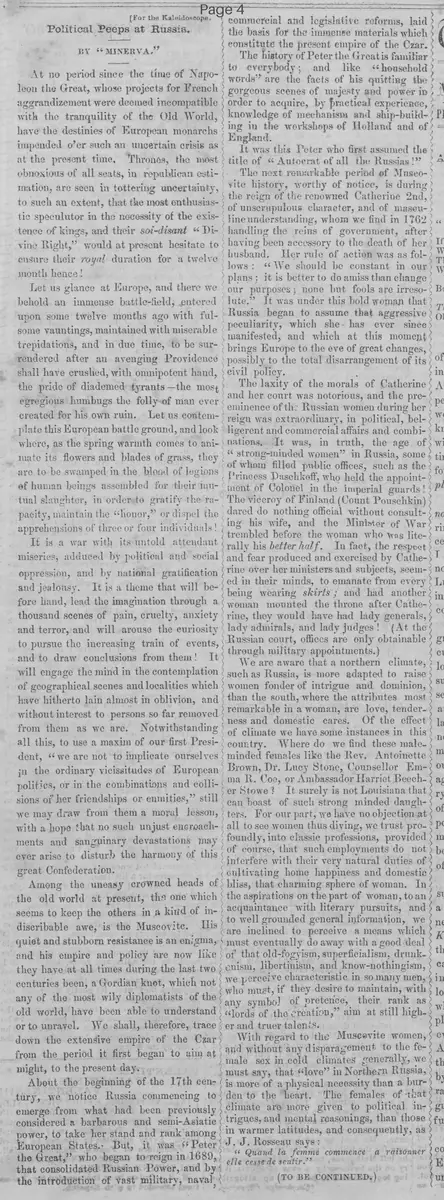
(For the Kaleidoscope.
Political Peeps at Russia.
By "Minerva."
At no period since the time of Napoleon the Great, whose projects for French aggrandizement were deemed incompatible with the tranquility of the Old World, have the destinies of European monarchs impended o'er such an uncertain crisis as at the present time. Thrones, the most obnoxious of all seats, in republican estimation, are seen in tottering uncertainty to such an extent that the most enthusiastic speculator in the necessity of the existence of kings and their soi-disant "Divine Right," would at present hesitate to ensure their royal duration for a twelvemonth hence!
Let us glance at Europe, and there we behold an immense battle-field, entered upon some twelve months ago with fulsome vauntings, maintained with miserable trepidations, and in due time, to be surrendered after an avenging Providence shall have crushed, with omnipotent hand, the pride of diademed tyrants—the most egregious humbugs the folly of man ever created for his own ruin. Let us contemplate this European battle ground, and look where, as the spring warmth comes to animate its flowers and blades of grass, they are to be swamped in the blood of legions of human beings assembled for their mutual slaughter, in order to gratify the rapacity, maintain the "honor," or dispel the apprehensions of three or four individuals!
It is a war with its untold attendant miseries, induced by political and social oppression, and by national gratification and jealousy. It is a theme that will, beforehand, lead the imagination through a thousand scenes of pain, cruelty, anxiety and terror, and will arouse the curiosity to pursue the increasing train of events, and to draw conclusions from them! It will engage the mind in the contemplation of geographical scenes and localities which have hitherto lain almost in oblivion, and without interest to persons so far removed from them as we are. Notwithstanding all this, to use a maxim of our first President, "we are not to implicate ourselves in the ordinary vicissitudes of European politics, or in the combinations and collisions or her friendships or enmities," still we may draw from them a moral lesson, with a hope that no such unjust encroachments and sanguinary devastations may ever arise to disturb the harmony of this great Confederation.
Among the uneasy crowned heads of the old world at present, the one which seems to keep the others in a kind of indescribable awe, is the Muscovite. His quiet and stubborn resistance is an enigma, and his empire and policy are now like they have at all times during the last two centuries been, a Gordian knot, which not any of the most wily diplomatists of the old world have been able to understand or to unravel. We shall, therefore, trace down the extensive empire of the Czar from the period it first began to aim at might, to the present day.
About the beginning of the 17th century, we notice Russia commencing to emerge from what had been previously considered a barbarous and semi-Asiatic power, to take her stand and rank among European States. But, it was "Peter the Great," who began to reign in 1689, that consolidated Russian Power, and by the introduction of vast military, naval commercial and legislative reforms, laid the basis for the immense materials which constitute the present empire of the Czar.
The history of Peter the Great is familiar to everybody; and like "household words" are the facts of his quitting the gorgeous scenes of majesty and power in order to acquire, by practical experience, knowledge of mechanism and ship-building in the workshops of Holland and of England.
It was this Peter who first assumed the title of "Autocrat of all the Russias!"
The next remarkable period of Muscovite history, worthy of notice, is during the reign of the renowned Catherine 2nd, of unscrupulous character, and of masculine understanding, whom we find in 1762 handling the reins of government, after having been accessory to the death of her husband. Her rule of action was as follows: "We should be constant in our plans; it is better to do amiss than change our purposes; none but fools are irresolute." It was under this bold woman that Russia began to assume that aggressive peculiarity, which she has ever since manifested, and which at this moment brings Europe to the eve of great changes, possibly to the total disarrangement of its civil policy.
The laxity of the morals of Catherine and her court was notorious, and the pre-eminence of the Russian women during her reign was extraordinary, in political, belligerent and commercial affairs and combinations. It was, in truth, the age of "strong-minded women" in Russia, some of whom filled public offices, such as the Princess Daschkoff, who held the appointment of Colonel in the imperial guards!
The viceroy of Finland (Count Pouschkin) dared do nothing official without consulting his wife, and the Minister of War trembled before the woman who was literally his better half. In fact, the respect and fear produced and exercised by Catherine over her ministers and subjects, seemed in their minds, to emanate from every being wearing skirts; and had another woman mounted the throne after Catherine, they would have had lady generals, lady admirals, and lady judges! (At the Russian court, offices are only obtainable through military appointments.)
We are aware that a northern climate, such as Russia, is more adapted to raise women fonder of intrigue and dominion, than the south, where the attributes most remarkable in a woman, are love, tenderness and domestic cares. Of the effect of climate we have some instances in this country. Where do we find these male-minded females like the Rev. Antoinette Brown, Dr. Lucy Stone, Counsellor Emma R. Coe, or Ambassador Harriet Beecher Stowe? It surely is not Louisiana that can boast of such strong minded daughters. For our part, we have no objection at all to see women thus diving, we trust profoundly, into classic professions, provided of course, that such employments do not interfere with their very natural duties of cultivating home happiness and domestic bliss, that charming sphere of woman. In the aspirations on the part of woman, to an acquaintance with literary pursuits, and to well grounded general information, we are inclined to perceive a means which must eventually do away with a good deal of that old-fogyism, superficialism, drunkenism, libertinism, and know-nothingism, we perceive characteristic in so many men, who must, if they desire to maintain, with any symbol of pretence, their rank as "lords of the creation," aim at still higher and truer talents.
With regard to the Muscovite women, and without any disparagement to the female sex in cold climates generally, we must say, that "love" in Northern Russia, is more of a physical necessity than a burden to the heart. The females of that climate are more given to political intrigues, and mental reasonings, than those in warmer latitudes, and consequently, as J. J. Rousseau says:
"Quand la femme commence a raisonner elle cesse de sentir."
Political Peeps at Russia.
By "Minerva."
At no period since the time of Napoleon the Great, whose projects for French aggrandizement were deemed incompatible with the tranquility of the Old World, have the destinies of European monarchs impended o'er such an uncertain crisis as at the present time. Thrones, the most obnoxious of all seats, in republican estimation, are seen in tottering uncertainty to such an extent that the most enthusiastic speculator in the necessity of the existence of kings and their soi-disant "Divine Right," would at present hesitate to ensure their royal duration for a twelvemonth hence!
Let us glance at Europe, and there we behold an immense battle-field, entered upon some twelve months ago with fulsome vauntings, maintained with miserable trepidations, and in due time, to be surrendered after an avenging Providence shall have crushed, with omnipotent hand, the pride of diademed tyrants—the most egregious humbugs the folly of man ever created for his own ruin. Let us contemplate this European battle ground, and look where, as the spring warmth comes to animate its flowers and blades of grass, they are to be swamped in the blood of legions of human beings assembled for their mutual slaughter, in order to gratify the rapacity, maintain the "honor," or dispel the apprehensions of three or four individuals!
It is a war with its untold attendant miseries, induced by political and social oppression, and by national gratification and jealousy. It is a theme that will, beforehand, lead the imagination through a thousand scenes of pain, cruelty, anxiety and terror, and will arouse the curiosity to pursue the increasing train of events, and to draw conclusions from them! It will engage the mind in the contemplation of geographical scenes and localities which have hitherto lain almost in oblivion, and without interest to persons so far removed from them as we are. Notwithstanding all this, to use a maxim of our first President, "we are not to implicate ourselves in the ordinary vicissitudes of European politics, or in the combinations and collisions or her friendships or enmities," still we may draw from them a moral lesson, with a hope that no such unjust encroachments and sanguinary devastations may ever arise to disturb the harmony of this great Confederation.
Among the uneasy crowned heads of the old world at present, the one which seems to keep the others in a kind of indescribable awe, is the Muscovite. His quiet and stubborn resistance is an enigma, and his empire and policy are now like they have at all times during the last two centuries been, a Gordian knot, which not any of the most wily diplomatists of the old world have been able to understand or to unravel. We shall, therefore, trace down the extensive empire of the Czar from the period it first began to aim at might, to the present day.
About the beginning of the 17th century, we notice Russia commencing to emerge from what had been previously considered a barbarous and semi-Asiatic power, to take her stand and rank among European States. But, it was "Peter the Great," who began to reign in 1689, that consolidated Russian Power, and by the introduction of vast military, naval commercial and legislative reforms, laid the basis for the immense materials which constitute the present empire of the Czar.
The history of Peter the Great is familiar to everybody; and like "household words" are the facts of his quitting the gorgeous scenes of majesty and power in order to acquire, by practical experience, knowledge of mechanism and ship-building in the workshops of Holland and of England.
It was this Peter who first assumed the title of "Autocrat of all the Russias!"
The next remarkable period of Muscovite history, worthy of notice, is during the reign of the renowned Catherine 2nd, of unscrupulous character, and of masculine understanding, whom we find in 1762 handling the reins of government, after having been accessory to the death of her husband. Her rule of action was as follows: "We should be constant in our plans; it is better to do amiss than change our purposes; none but fools are irresolute." It was under this bold woman that Russia began to assume that aggressive peculiarity, which she has ever since manifested, and which at this moment brings Europe to the eve of great changes, possibly to the total disarrangement of its civil policy.
The laxity of the morals of Catherine and her court was notorious, and the pre-eminence of the Russian women during her reign was extraordinary, in political, belligerent and commercial affairs and combinations. It was, in truth, the age of "strong-minded women" in Russia, some of whom filled public offices, such as the Princess Daschkoff, who held the appointment of Colonel in the imperial guards!
The viceroy of Finland (Count Pouschkin) dared do nothing official without consulting his wife, and the Minister of War trembled before the woman who was literally his better half. In fact, the respect and fear produced and exercised by Catherine over her ministers and subjects, seemed in their minds, to emanate from every being wearing skirts; and had another woman mounted the throne after Catherine, they would have had lady generals, lady admirals, and lady judges! (At the Russian court, offices are only obtainable through military appointments.)
We are aware that a northern climate, such as Russia, is more adapted to raise women fonder of intrigue and dominion, than the south, where the attributes most remarkable in a woman, are love, tenderness and domestic cares. Of the effect of climate we have some instances in this country. Where do we find these male-minded females like the Rev. Antoinette Brown, Dr. Lucy Stone, Counsellor Emma R. Coe, or Ambassador Harriet Beecher Stowe? It surely is not Louisiana that can boast of such strong minded daughters. For our part, we have no objection at all to see women thus diving, we trust profoundly, into classic professions, provided of course, that such employments do not interfere with their very natural duties of cultivating home happiness and domestic bliss, that charming sphere of woman. In the aspirations on the part of woman, to an acquaintance with literary pursuits, and to well grounded general information, we are inclined to perceive a means which must eventually do away with a good deal of that old-fogyism, superficialism, drunkenism, libertinism, and know-nothingism, we perceive characteristic in so many men, who must, if they desire to maintain, with any symbol of pretence, their rank as "lords of the creation," aim at still higher and truer talents.
With regard to the Muscovite women, and without any disparagement to the female sex in cold climates generally, we must say, that "love" in Northern Russia, is more of a physical necessity than a burden to the heart. The females of that climate are more given to political intrigues, and mental reasonings, than those in warmer latitudes, and consequently, as J. J. Rousseau says:
"Quand la femme commence a raisonner elle cesse de sentir."
What sub-type of article is it?
Foreign Affairs
Imperialism
Feminism
What keywords are associated?
Russia
European Politics
Peter The Great
Catherine Ii
Russian Women
Feminism
Imperialism
War Critique
What entities or persons were involved?
Napoleon The Great
Peter The Great
Catherine Ii
Czar
Princess Daschkoff
Count Pouschkin
Rev. Antoinette Brown
Dr. Lucy Stone
Counsellor Emma R. Coe
Harriet Beecher Stowe
Muscovite
Editorial Details
Primary Topic
Historical Overview Of Russian Empire And Women's Roles In Politics
Stance / Tone
Critical Of Monarchial Tyranny And War, Supportive Of Women's Intellectual Engagement
Key Figures
Napoleon The Great
Peter The Great
Catherine Ii
Czar
Princess Daschkoff
Count Pouschkin
Rev. Antoinette Brown
Dr. Lucy Stone
Counsellor Emma R. Coe
Harriet Beecher Stowe
Muscovite
Key Arguments
European Thrones In Uncertain Crisis Due To War
Russia's Rise From Barbarism Under Peter The Great's Reforms
Catherine Ii's Aggressive Policies Shaping Modern Russia
Influential Roles Of Women In Russian Politics During Catherine's Reign
Climate Influences Women's Traits, With Parallels In American Feminists
Women's Education Can Reform Male Vices Without Neglecting Domestic Duties