Thank you for visiting SNEWPapers!
Sign up free
Domestic News
September 8, 1875
Smyrna Times
Smyrna, Kent County, Delaware
What is this article about?
John Paul's letter details William C. Ralston's rise from humble beginnings to leading the powerful Bank of California, its monopolistic ambitions, recent collapse, and Ralston's suicide in San Francisco Bay in late August.
Clipping
OCR Quality
98%
Excellent
Full Text
Miscellaneous.
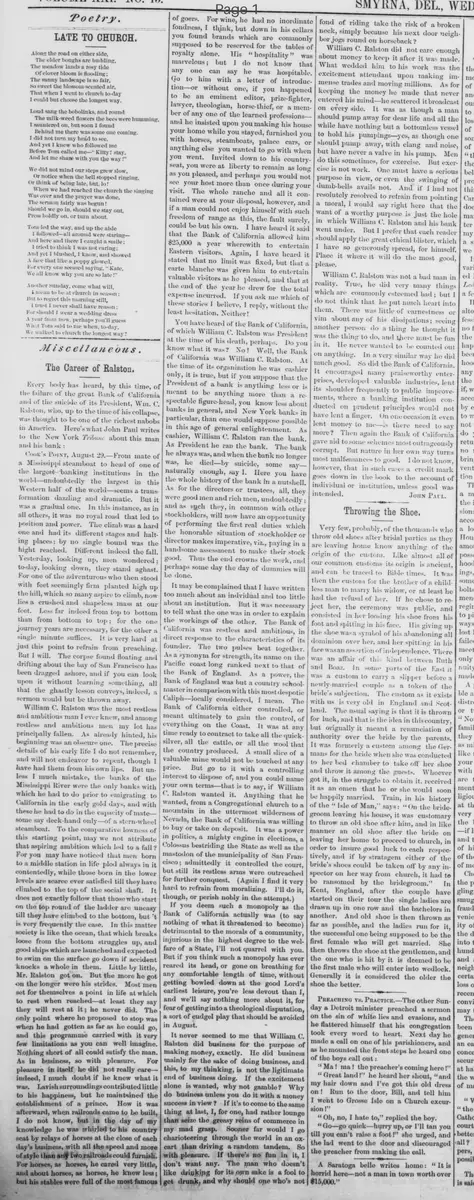
The Career of Ralston.
Everybody has heard, by this time, of the failure of the great Bank of California and of the suicide of its President, Wm. C. Ralston, who, up to the time of his collapse, was thought to be one of the richest nabobs in America. Here’s what John Paul writes to the New York Tribune about this man and his bank:
Cook’s Point, August 29.—From mate of a Mississippi steamboat to head of one of the largest banking institutions in the world—undoubtedly the largest in this Western half of the world—seems a transformation dazzling and dramatic. But it was a gradual one. In this instance, as in all others, it was no royal road that led to position and power. The climb was a hard one and had its different stages and halting places; by no single bound was the height reached. Different indeed the fall. Yesterday, looking up, men wondered; to-day, looking down, they stand aghast. For one of the adventurers who then stood with feet seemingly firm planted high up the hill, which so many aspire to climb, now lies a crushed and shapeless mass at our feet. Less far indeed from top to bottom than from bottom to top; for the one journey years are necessary, for the other a single minute suffices. It is very hard at just this point to refrain from preaching. But I will. The corpse found floating and drifting about the bay of San Francisco has been dragged ashore, and if you can look upon it without learning something, all that the ghastly lesson conveys, indeed, a sermon would but be thrown away.
William C. Ralston was the most restless and ambitious man I ever knew, and among restless and ambitious men my lot has principally fallen. As already hinted, his beginning was an obscure one. The precise details of his early life I do not remember, and will not endeavor to repeat, though I have had them from his own lips. But unless I much mistake, the banks of the Mississippi River were the only banks with which he had to do prior to emigrating to California in the early gold days, and with these he had to do in the capacity of mate—some say deck-hand only—of a stern-wheel steamboat. To the comparative lowness of this starting point, may we not attribute that aspiring ambition which led to a fall? For you may have noticed that men born to a middle station in life plod always in it contentedly, while those born in the lower levels are scarce ever satisfied till they have climbed to the top of the social shaft. It does not exactly follow that those who start on the top round of the ladder are uneasy till they have climbed to the bottom, but ’tis very frequently the case. In this matter society is like the ocean, that which breaks loose from the bottom struggles up, and good ships which are launched and expected to swim on the surface go down if accident knocks a hole in them. Little by little, Mr. Ralston got on. But the more he got on the longer were his strides. Most men set for themselves a point in life at which to rest when reached—at least they say they will rest at it; he never did. The only point where he proposed to stop was when he had gotten as far as he could go, and this programme carried with it very few limitations as you can well imagine. Nothing short of all could satisfy the man.
As in business, so with pleasure. For pleasure in itself he did not really care—indeed, I much doubt if he knew what it was. Lavish surroundings contributed little to his happiness, but he maintained the establishment of a prince. How it was afterward, when railroads came to be built, I do not know, but in the day of my knowledge he was whirled to his country seat by relays of horses at the close of each day’s business, with all the speed and more of style than any two railroads could furnish. For horses, as horses, he cared very little, and about horses, as horses, he knew less; but his stables were full of the most famous of goers. For wine, he had no inordinate fondness, I think, but down in his cellars you found brands which are commonly supposed to be reserved for the tables of royalty alone. His “hospitality” was marvelous; but I do not know that any one can say he was hospitable. Go to him with a letter of introduction—or without one, if you happened to be an eminent editor, prize-fighter, lawyer, theologian, horse-thief, or a member of any one of the learned professions—and he insisted upon you making his house your home while you stayed, furnished you with horses, steamboats, palace cars, or anything else you wanted to go with when you went. Invited down to his country-seat, you were at liberty to remain as long as you pleased, and perhaps you would not see your host more than once during your visit. The whole ranche and all it contained were at your disposal, however, and if a man could not enjoy himself with such freedom of range as this, the fault surely could be but his own. I have heard it said that the Bank of California allowed him $25,000 a year wherewith to entertain Eastern visitors. Again, I have heard it stated that no limit was fixed, but that a carte blanche was given him to entertain valuable visitors as he pleased, and that at the end of the year he drew for the total expense incurred. If you ask me which of these stories I believe, I reply, without the least hesitation, Neither!
You have heard of the Bank of California, of which William C. Ralston was President at the time of his death, perhaps. Do you know what it was? No! Well, the Bank of California was William C. Ralston. At the time of its organization he was cashier only, it is true, but if you suppose that the President of a bank is anything less or is meant to be anything more than a respectable figure-head, you know less about banks in general, and New York banks in particular, than one would suppose possible in this age of general enlightenment. As cashier, William C. Ralston ran the bank. As President he ran the bank. The bank he always was, and when the bank no longer was, he died—by suicide, some say—naturally enough, say I. Here you have the whole history of the bank in a nutshell. As for the directors or trustees, all, they were good men and rich men, undoubtedly; and as such they, in common with other stockholders, will now have an opportunity of performing the first real duties which the honorable situation of stockholder or director makes imperative, viz., paying in a handsome assessment to make their stock good. Thus the end crowns the work, and perhaps some day the day of dummies will be done.
It may be complained that I have written too much about an individual and too little about an institution. But it was necessary to tell what the one was in order to explain the workings of the other. The Bank of California was restless and ambitious, in direct response to the characteristics of its founder. The two pulses beat together. As a synonym for strength, its name on the Pacific coast long ranked next to that of the Bank of England. As a power, the Bank of England was but a country schoolmaster in comparison with this most despotic Caliph—locally considered, I mean. The Bank of California either controlled, or meant ultimately to gain the control, of everything on the Coast. It was at any time ready to contract to take all the quicksilver, all the cattle, or all the wool that the country produced. A small slice of a valuable mine would not be touched at any price. But go to it with a controlling interest to dispose of, and you could name your own terms—that is to say, if William C. Ralston wanted it. Anything that he wanted, from a Congregational church to a mountain in the uttermost wilderness of Nevada, the Bank of California was willing to buy or take on deposit. It was a power in politics, a mighty engine in elections, a Colossus bestriding the State as well as the mastodon of the municipality of San Francisco; admittedly it controlled the court, but still its restless arms were outstretched for further conquest. (Again I find it very hard to refrain from moralizing. I’ll do it, though, or perish nobly in the attempt.)
If you deem such a monopoly as the Bank of California actually was (to say nothing of what it threatened to become) detrimental to the morals of a community, injurious in the highest degree to the welfare of a State, I’ll not quarrel with you. But if you think such a monopoly has ever reared its head, or gone on breathing for any comfortable length of time, without getting bowled down at the good Lord’s earliest leisure, you’re less devout than I, and we’ll say nothing more about it, for fear of getting into a theological disputation, a sort of cudgel play that should be avoided in August.
It never seemed to me that William C. Ralston did business for the purpose of making money, exactly. He did business mainly for the sake of doing business, and this, to my thinking, is not the legitimate end of business doing. If the excitement alone is wanted, why not gamble? Why do business unless you do it with a money success in view? If it’s to come to the same thing at last, I, for one, had rather lounge than seize the greasy reins of commerce in my mad grasp. Sooner far would I go charioteering through the world in an ox-cart than driving a random tandem. So with pleasure. If there’s no fun in it, I don’t want any. The man who doesn’t like drinking for its own sake is a fool to get drunk, and why should one who’s not fond of riding take the risk of a broken neck, simply because his next door neighbor jogs round on horseback?
William C. Ralston did not care enough about money to keep it after it was made. What wedded him to his work was the excitement attendant upon making immense trades and moving millions. As for keeping the money he made that never entered his mind—he scattered it broadcast on every side. It was as though a man should pump away for dear life and all the while have nothing but a bottomless vessel to hold his pumpings—yes, as though one should pump away, with clang and noise, but have never a valve in his pump. Men do this sometimes, for exercise. But exercise is not work. One must have a serious purpose in view, or even the swinging of dumb-bells avails not. And if I had not resolutely resolved to refrain from pointing a moral, I would say right here that the want of a worthy purpose is just the hole in which William C. Ralston and his bank went under. But I prefer that each reader should apply the great ethical blister, which I have so generously spread, for himself. Place it where it will do the most good, please.
William C. Ralston was not a bad man in reality. True, he did very many things which are commonly esteemed bad; but I do not think that he put much heart into them. There was little of earnestness or vim about any of his dissipations; seeing another person do a thing he thought it was the thing to do, and there must be fun in it. He never wanted to be counted out on anything. In a very similar way he did much good. So did the Bank of California. It encouraged many praiseworthy enterprises, developed valuable industries, lent its shoulder frequently to public improvements, where a banking institution conducted on prudent principles would not have lent a finger. On one occasion it even lent money to me—is there need to say more? Then again the Bank of California gave aid to some schemes most outrageously corrupt. But nature in her own way turns most malfeasances to good. I do not know, however, that in such cases a credit mark goes down in the book to the account of individual or institution, unless good was intended.
John Paul.
The Career of Ralston.
Everybody has heard, by this time, of the failure of the great Bank of California and of the suicide of its President, Wm. C. Ralston, who, up to the time of his collapse, was thought to be one of the richest nabobs in America. Here’s what John Paul writes to the New York Tribune about this man and his bank:
Cook’s Point, August 29.—From mate of a Mississippi steamboat to head of one of the largest banking institutions in the world—undoubtedly the largest in this Western half of the world—seems a transformation dazzling and dramatic. But it was a gradual one. In this instance, as in all others, it was no royal road that led to position and power. The climb was a hard one and had its different stages and halting places; by no single bound was the height reached. Different indeed the fall. Yesterday, looking up, men wondered; to-day, looking down, they stand aghast. For one of the adventurers who then stood with feet seemingly firm planted high up the hill, which so many aspire to climb, now lies a crushed and shapeless mass at our feet. Less far indeed from top to bottom than from bottom to top; for the one journey years are necessary, for the other a single minute suffices. It is very hard at just this point to refrain from preaching. But I will. The corpse found floating and drifting about the bay of San Francisco has been dragged ashore, and if you can look upon it without learning something, all that the ghastly lesson conveys, indeed, a sermon would but be thrown away.
William C. Ralston was the most restless and ambitious man I ever knew, and among restless and ambitious men my lot has principally fallen. As already hinted, his beginning was an obscure one. The precise details of his early life I do not remember, and will not endeavor to repeat, though I have had them from his own lips. But unless I much mistake, the banks of the Mississippi River were the only banks with which he had to do prior to emigrating to California in the early gold days, and with these he had to do in the capacity of mate—some say deck-hand only—of a stern-wheel steamboat. To the comparative lowness of this starting point, may we not attribute that aspiring ambition which led to a fall? For you may have noticed that men born to a middle station in life plod always in it contentedly, while those born in the lower levels are scarce ever satisfied till they have climbed to the top of the social shaft. It does not exactly follow that those who start on the top round of the ladder are uneasy till they have climbed to the bottom, but ’tis very frequently the case. In this matter society is like the ocean, that which breaks loose from the bottom struggles up, and good ships which are launched and expected to swim on the surface go down if accident knocks a hole in them. Little by little, Mr. Ralston got on. But the more he got on the longer were his strides. Most men set for themselves a point in life at which to rest when reached—at least they say they will rest at it; he never did. The only point where he proposed to stop was when he had gotten as far as he could go, and this programme carried with it very few limitations as you can well imagine. Nothing short of all could satisfy the man.
As in business, so with pleasure. For pleasure in itself he did not really care—indeed, I much doubt if he knew what it was. Lavish surroundings contributed little to his happiness, but he maintained the establishment of a prince. How it was afterward, when railroads came to be built, I do not know, but in the day of my knowledge he was whirled to his country seat by relays of horses at the close of each day’s business, with all the speed and more of style than any two railroads could furnish. For horses, as horses, he cared very little, and about horses, as horses, he knew less; but his stables were full of the most famous of goers. For wine, he had no inordinate fondness, I think, but down in his cellars you found brands which are commonly supposed to be reserved for the tables of royalty alone. His “hospitality” was marvelous; but I do not know that any one can say he was hospitable. Go to him with a letter of introduction—or without one, if you happened to be an eminent editor, prize-fighter, lawyer, theologian, horse-thief, or a member of any one of the learned professions—and he insisted upon you making his house your home while you stayed, furnished you with horses, steamboats, palace cars, or anything else you wanted to go with when you went. Invited down to his country-seat, you were at liberty to remain as long as you pleased, and perhaps you would not see your host more than once during your visit. The whole ranche and all it contained were at your disposal, however, and if a man could not enjoy himself with such freedom of range as this, the fault surely could be but his own. I have heard it said that the Bank of California allowed him $25,000 a year wherewith to entertain Eastern visitors. Again, I have heard it stated that no limit was fixed, but that a carte blanche was given him to entertain valuable visitors as he pleased, and that at the end of the year he drew for the total expense incurred. If you ask me which of these stories I believe, I reply, without the least hesitation, Neither!
You have heard of the Bank of California, of which William C. Ralston was President at the time of his death, perhaps. Do you know what it was? No! Well, the Bank of California was William C. Ralston. At the time of its organization he was cashier only, it is true, but if you suppose that the President of a bank is anything less or is meant to be anything more than a respectable figure-head, you know less about banks in general, and New York banks in particular, than one would suppose possible in this age of general enlightenment. As cashier, William C. Ralston ran the bank. As President he ran the bank. The bank he always was, and when the bank no longer was, he died—by suicide, some say—naturally enough, say I. Here you have the whole history of the bank in a nutshell. As for the directors or trustees, all, they were good men and rich men, undoubtedly; and as such they, in common with other stockholders, will now have an opportunity of performing the first real duties which the honorable situation of stockholder or director makes imperative, viz., paying in a handsome assessment to make their stock good. Thus the end crowns the work, and perhaps some day the day of dummies will be done.
It may be complained that I have written too much about an individual and too little about an institution. But it was necessary to tell what the one was in order to explain the workings of the other. The Bank of California was restless and ambitious, in direct response to the characteristics of its founder. The two pulses beat together. As a synonym for strength, its name on the Pacific coast long ranked next to that of the Bank of England. As a power, the Bank of England was but a country schoolmaster in comparison with this most despotic Caliph—locally considered, I mean. The Bank of California either controlled, or meant ultimately to gain the control, of everything on the Coast. It was at any time ready to contract to take all the quicksilver, all the cattle, or all the wool that the country produced. A small slice of a valuable mine would not be touched at any price. But go to it with a controlling interest to dispose of, and you could name your own terms—that is to say, if William C. Ralston wanted it. Anything that he wanted, from a Congregational church to a mountain in the uttermost wilderness of Nevada, the Bank of California was willing to buy or take on deposit. It was a power in politics, a mighty engine in elections, a Colossus bestriding the State as well as the mastodon of the municipality of San Francisco; admittedly it controlled the court, but still its restless arms were outstretched for further conquest. (Again I find it very hard to refrain from moralizing. I’ll do it, though, or perish nobly in the attempt.)
If you deem such a monopoly as the Bank of California actually was (to say nothing of what it threatened to become) detrimental to the morals of a community, injurious in the highest degree to the welfare of a State, I’ll not quarrel with you. But if you think such a monopoly has ever reared its head, or gone on breathing for any comfortable length of time, without getting bowled down at the good Lord’s earliest leisure, you’re less devout than I, and we’ll say nothing more about it, for fear of getting into a theological disputation, a sort of cudgel play that should be avoided in August.
It never seemed to me that William C. Ralston did business for the purpose of making money, exactly. He did business mainly for the sake of doing business, and this, to my thinking, is not the legitimate end of business doing. If the excitement alone is wanted, why not gamble? Why do business unless you do it with a money success in view? If it’s to come to the same thing at last, I, for one, had rather lounge than seize the greasy reins of commerce in my mad grasp. Sooner far would I go charioteering through the world in an ox-cart than driving a random tandem. So with pleasure. If there’s no fun in it, I don’t want any. The man who doesn’t like drinking for its own sake is a fool to get drunk, and why should one who’s not fond of riding take the risk of a broken neck, simply because his next door neighbor jogs round on horseback?
William C. Ralston did not care enough about money to keep it after it was made. What wedded him to his work was the excitement attendant upon making immense trades and moving millions. As for keeping the money he made that never entered his mind—he scattered it broadcast on every side. It was as though a man should pump away for dear life and all the while have nothing but a bottomless vessel to hold his pumpings—yes, as though one should pump away, with clang and noise, but have never a valve in his pump. Men do this sometimes, for exercise. But exercise is not work. One must have a serious purpose in view, or even the swinging of dumb-bells avails not. And if I had not resolutely resolved to refrain from pointing a moral, I would say right here that the want of a worthy purpose is just the hole in which William C. Ralston and his bank went under. But I prefer that each reader should apply the great ethical blister, which I have so generously spread, for himself. Place it where it will do the most good, please.
William C. Ralston was not a bad man in reality. True, he did very many things which are commonly esteemed bad; but I do not think that he put much heart into them. There was little of earnestness or vim about any of his dissipations; seeing another person do a thing he thought it was the thing to do, and there must be fun in it. He never wanted to be counted out on anything. In a very similar way he did much good. So did the Bank of California. It encouraged many praiseworthy enterprises, developed valuable industries, lent its shoulder frequently to public improvements, where a banking institution conducted on prudent principles would not have lent a finger. On one occasion it even lent money to me—is there need to say more? Then again the Bank of California gave aid to some schemes most outrageously corrupt. But nature in her own way turns most malfeasances to good. I do not know, however, that in such cases a credit mark goes down in the book to the account of individual or institution, unless good was intended.
John Paul.
What sub-type of article is it?
Economic
Death Or Funeral
What keywords are associated?
Bank Of California
William Ralston
Suicide
Financial Failure
San Francisco Bank
What entities or persons were involved?
William C. Ralston
John Paul
Where did it happen?
San Francisco
Domestic News Details
Primary Location
San Francisco
Event Date
Late August
Key Persons
William C. Ralston
John Paul
Outcome
failure of the bank of california; suicide of president william c. ralston
Event Details
Biographical account of William C. Ralston's rise from steamboat mate to president of the Bank of California, the bank's ambitious expansion and control over Pacific Coast industries, its recent failure, and Ralston's suicide by drowning in San Francisco Bay.