Thank you for visiting SNEWPapers!
Sign up free
Story
September 7, 1950
The Potters Herald
East Liverpool, Columbiana County, Ohio
What is this article about?
President Truman signed the social security bill on Aug. 28 in Washington, expanding coverage to 45 million, increasing benefits, but Congress retained the opposed Knowland Amendment slowing federal oversight of state laws.
Clipping
OCR Quality
100%
Excellent
Full Text
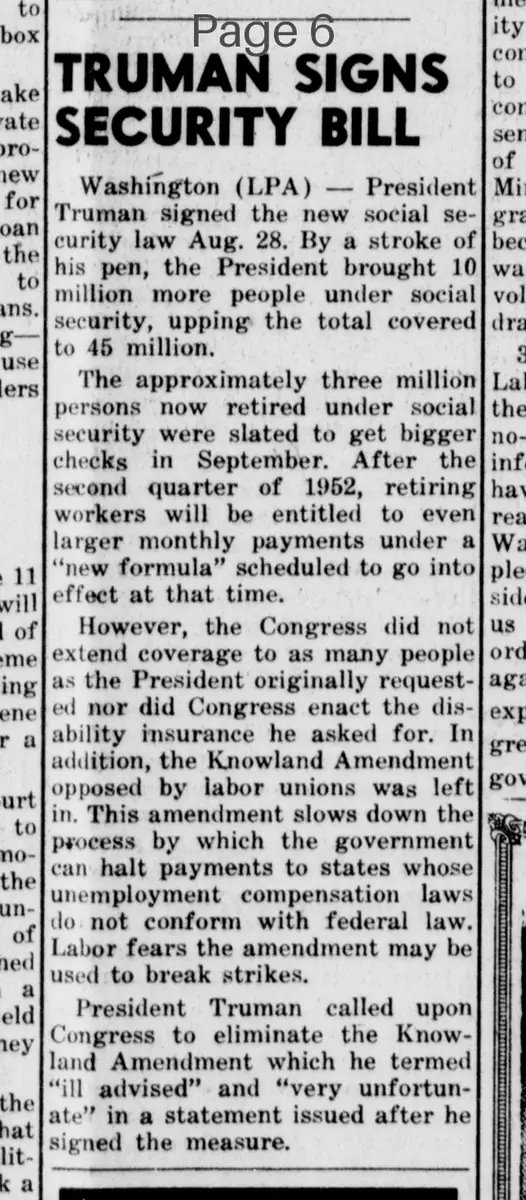
TRUMAN SIGNS
SECURITY BILL
Washington (LPA) - President Truman signed the new social security law Aug. 28. By a stroke of his pen, the President brought 10 million more people under social security, upping the total covered to 45 million.
The approximately three million persons now retired under social security were slated to get bigger checks in September. After the second quarter of 1952, retiring workers will be entitled to even larger monthly payments under a "new formula" scheduled to go into effect at that time.
However, the Congress did not extend coverage to as many people as the President originally requested nor did Congress enact the disability insurance he asked for. In addition, the Knowland Amendment opposed by labor unions was left in. This amendment slows down the process by which the government can halt payments to states whose unemployment compensation laws do not conform with federal law. Labor fears the amendment may be used to break strikes.
President Truman called upon Congress to eliminate the Know-land Amendment which he termed "ill advised" and "very unfortunate" in a statement issued after he signed the measure.
SECURITY BILL
Washington (LPA) - President Truman signed the new social security law Aug. 28. By a stroke of his pen, the President brought 10 million more people under social security, upping the total covered to 45 million.
The approximately three million persons now retired under social security were slated to get bigger checks in September. After the second quarter of 1952, retiring workers will be entitled to even larger monthly payments under a "new formula" scheduled to go into effect at that time.
However, the Congress did not extend coverage to as many people as the President originally requested nor did Congress enact the disability insurance he asked for. In addition, the Knowland Amendment opposed by labor unions was left in. This amendment slows down the process by which the government can halt payments to states whose unemployment compensation laws do not conform with federal law. Labor fears the amendment may be used to break strikes.
President Truman called upon Congress to eliminate the Know-land Amendment which he termed "ill advised" and "very unfortunate" in a statement issued after he signed the measure.
What sub-type of article is it?
Historical Event
What keywords are associated?
Social Security
Truman Signing
Knowland Amendment
Unemployment Compensation
Labor Unions
What entities or persons were involved?
President Truman
Knowland
Where did it happen?
Washington
Story Details
Key Persons
President Truman
Knowland
Location
Washington
Event Date
Aug. 28
Story Details
President Truman signed a new social security law, extending coverage to 10 million more people, totaling 45 million. Retirees get larger checks in September, with even larger payments after Q2 1952. Congress did not fully meet requests for coverage or disability insurance, and retained the Knowland Amendment, which labor opposes. Truman called for its elimination.