Thank you for visiting SNEWPapers!
Sign up free
Alexandria Daily Advertiser
Alexandria, Virginia
What is this article about?
Criticism in the Connecticut Courant of a congressional appropriation of two million dollars for undefined extraordinary foreign expenses, contradicting President Jefferson's 1801 principles of specific appropriations. Discusses potential French influence and failure to authorize military preparations against Spanish border violations.
Clipping
OCR Quality
Full Text
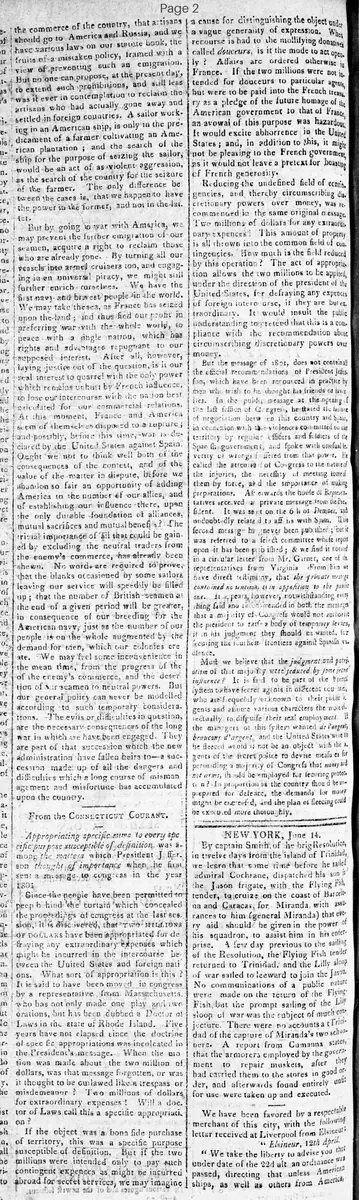
Appropriating specific sums to every specific purpose susceptible of definition, was among the matters which President Jefferson thought of importance when he first sent a message to congress in the year 1801.
Since the people have been permitted to peep behind the curtain which concealed the proceedings of congress at the last session, it is discovered that two millions of dollars have been appropriated for defraying any extraordinary expenses which might be incurred in the intercourse between the United States and foreign nations. What sort of appropriation is this?
It is said to have been moved in congress by a representative from Massachusetts, who has not only made one play and two orations, but has been dubbed a Doctor of Laws in the state of Rhode Island. Five years have not elapsed since the doctrine of specific appropriations was inculcated in the President's message. When the motion was made about the two million of dollars, was that message forgotten, or was it thought to be outlawed like a trespass or misdemeanor? Two millions of dollars for extraordinary expenses! Will a doctor of Laws call this a specific appropriation?
If the object was a bona fide purchase of territory, this was a specific purpose susceptible of definition. But if the two millions were intended only to pay such contingent expenses as might be incurred abroad for secret services, we may imagine a cause for distinguishing the object under a vague generality of expression. When recourse is had to the mollifying donatives called douceurs, is it the mode to act openly? Affairs are ordered otherwise in France. If the two millions were not intended for douceurs to particular agents, but were to be paid into the French treasury as a pledge of the future homage of the American government to that of France, an avowal of this purpose was hazardous. It would excite abhorrence in the United States; and, in addition to this, it might not be pleasing to the French government as it would not leave a pretext for boasting of French generosity.
Reducing the undefined field of contingencies, and thereby circumscribing discretionary powers over money, was recommended in the same original message. Two millions of dollars for any extraordinary expenses: this amount of property in all thrown into the common field of contingencies. How much is the field reduced by this operation? The act of appropriation allows the two millions to be applied under the direction of the president of the United States, for defraying any expenses of foreign intercourse, if they are bona fide extraordinary. It would insult the public understanding to pretend that this is a compliance with the recommendation about circumscribing discretionary powers over money.
But the message of 1801 does not contain all the official recommendations of President Jefferson, which have been renounced in practice by men who wish to be thought his friends or favorites. In the eighth message at the opening of the last session of Congress, he stated the nature of negotiation between this country and Spain in connection with the violences committed on our territory by regular officers and soldiers of the Spanish government, and spoke with unusual severity of wrongs suffered from that power. He called the attention of Congress to the nature of the injuries, the necessity of meeting some of them by force, and the importance of making preparations. Afterwards the house of Representatives received a private message from the President. It was sent on the 6th of December, and undoubtedly related to affairs with Spain. This second message has never been published; but it was referred to a select committee whose report upon it has been published: & we find it couched in a circular letter from Mr. Garnett, one of the representatives from Virginia. From him we have direct testimony, that the private message contained no sentiments in opposition to the public one.
It appears, however, notwithstanding everything said and recommended in both the messages that a majority of Congress would not authorize the president to raise a body of temporary levies, if in his judgment they should be wanted, for securing the southern frontiers against Spanish violence.
Must we believe that the judgment and patriotism of that majority were seduced by some secret influence? It is said to be part of the French system to have secret agents in different countries, who are frequently unknown to their public agents and assume various characters the more effectually to disguise their real employment. If the managers of this system wanted de argent, and the United States were to be fleeced it would not be an object with the agents of the secret police to devise measures for persuading a majority of Congress that money and not arms, should be employed for securing protection? In proportion as the country should be unprepared for defence, the demands for money might be increased, and the plan of fleecing could be executed more thoroughly.
What sub-type of article is it?
What keywords are associated?
What entities or persons were involved?
Domestic News Details
Event Date
Last Session Of Congress
Key Persons
Outcome
two million dollars appropriated for extraordinary foreign intercourse expenses under presidential direction; majority of congress refused to authorize temporary levies for southern frontier defense against spanish violence.
Event Details
Article criticizes congressional appropriation of two million dollars for vague extraordinary expenses in foreign relations, possibly for secret services or payments to France, contradicting Jefferson's 1801 message advocating specific appropriations. Discusses Jefferson's public and private messages on Spanish border violations and need for military preparations, which Congress did not authorize, suggesting possible French secret influence favoring money over arms.