Thank you for visiting SNEWPapers!
Sign up free
Letter to Editor
March 27, 1807
Alexandria Daily Advertiser
Alexandria, Virginia
What is this article about?
A letter criticizes President Jefferson's decision to return the Monroe-Pinkney British treaty without Senate review, alleging motives to undermine Monroe's reputation in favor of Madison's presidential candidacy and fear of French disapproval. It discusses treaty issues like impressment and hopes for public disclosure.
Clipping
OCR Quality
98%
Excellent
Full Text
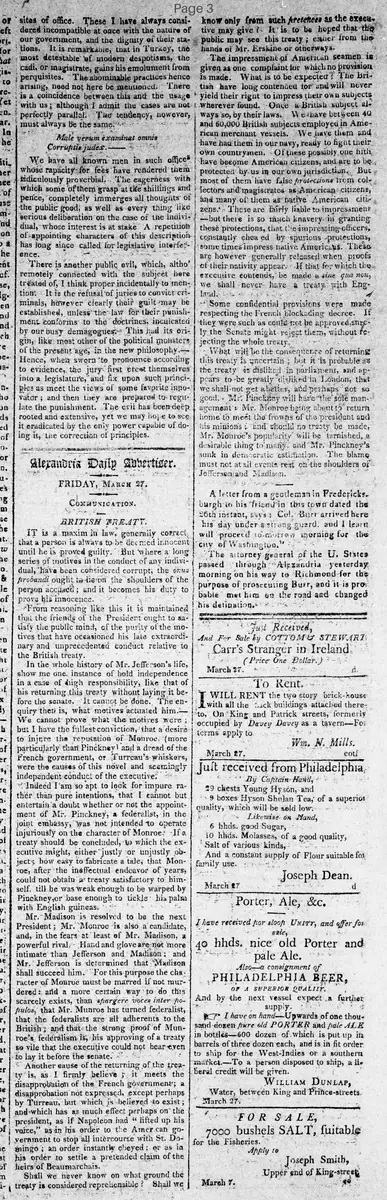
Alexandria Daily Advertiser.
FRIDAY, MARCH 27.
COMMUNICATION.
BRITISH TREATY.
It is a maxim in law, generally correct, that a person is always to be deemed innocent until he is proved guilty. But where a long series of motives in the conduct of any individual, have been considered corrupt; the onus probandi ought to lie on the shoulders of the person accused; and it becomes his duty to prove his innocence.
From reasoning like this it is maintained that the friends of the President ought to satisfy the public mind, of the purity of the motives that have occasioned his late extraordinary and unprecedented conduct relative to the British treaty.
In the whole history of Mr. Jefferson's life, show me one instance of bold independence in a case of high responsibility, like that of his returning this treaty without laying it before the senate. It cannot be done. The enquiry then is, what motives actuated him. We cannot prove what the motives were; but I have the fullest conviction, that a desire to injure the reputation of Monroe, (more particularly than Pinkney) and a dread of the French government, or Turreau's whiskers, were the causes of this novel and seemingly independent conduct of the executive.
Indeed I am so apt to look for impure rather than pure intentions, that I cannot but entertain a doubt whether or not the appointment of Mr. Pinkney, a federalist, in the joint embassy, was not intended to operate injuriously on the character of Monroe: If a treaty should be concluded, to which the executive might, either justly or unjustly object; how easy to fabricate a tale, that Monroe, after the ineffectual endeavor of years, could not obtain a treaty satisfactory to himself, till he was weak enough to be warped by Pinkney, or base enough to tickle his palm with English guineas.
Mr. Madison is resolved to be the next President; Mr. Monroe is also a candidate, and, in the fears at least of Mr. Madison, a powerful rival. Hand and glove are not more intimate than Jefferson and Madison: and Mr. Jefferson is determined that Madison shall succeed him. For this purpose the character of Monroe must be marred if not murdered: and a more certain way to do this scarcely exists, than sarge voce inter populos, that Mr. Monroe has turned federalist; that the federalists are all adherents to the British; and that the strong proof of Monroe's federalism is, his approving of a treaty so vile that the executive could not bear even to lay it before the senate.
Another cause of the returning of the treaty is, as I firmly believe, it meets the disapprobation of the French government; a disapprobation not expressed, except perhaps by Turreau, but which is believed to exist; and which has as much effect perhaps on the president, as if Napoleon had "lifted up his voice," as in his order to the American government to stop all intercourse with St. Domingo; an order instantly obeyed; or as in his order to settle a pretended claim of the heirs of Beaumarchais.
Shall we never know on what ground the treaty is considered reprehensible? Shall we know only from such intelligence as the executive may give? It is to be hoped that the public may see this treaty; either from the hands of Mr. Erskine or otherways.
The impressment of American seamen is given as one complaint for which no provision is made. What is to be expected? The British have long contended for and will never yield their right to impress their own subjects wherever found. Once a British subject always so, by their laws. We have between 40 and 60,000 British subjects employed in American merchant vessels. We have them and have had them in our navy, ready to fight their own countrymen. Of these possibly one half have become American citizens, and are to be protected by us in our own jurisdiction. But most of them have false protections from collectors and magistrates as American citizens, and many of them as native American citizens. These are fairly liable to impressment but there is so much knavery in granting these protections, that the impressing officers constantly cheated by spurious protections, sometimes impress native Americans. These are however generally released when proofs of their nativity appear. If that for which the executive contends, be made a sine qua non, we shall never have a treaty with England.
Some confidential provisions were made respecting the French blockading decree. If they were such as could not be approved, surely the Senate might reject them, without rejecting the whole treaty.
What will be the consequence of returning this treaty is uncertain: but it is probable as the treaty is disliked in parliament, and appears to be greatly disliked in London, that we shall not get a better, and perhaps not so good; Mr. Pinkney will have the sole management: Mr. Monroe being about to return home to meet the frowns of the president and his minions: and should no treaty be made, Mr. Monroe's popularity will be tarnished, a desirable thing to many, and Mr. Pinkney's sunk in democratic estimation. The blame must not at all events rest on the shoulders of Jefferson and Madison.
FRIDAY, MARCH 27.
COMMUNICATION.
BRITISH TREATY.
It is a maxim in law, generally correct, that a person is always to be deemed innocent until he is proved guilty. But where a long series of motives in the conduct of any individual, have been considered corrupt; the onus probandi ought to lie on the shoulders of the person accused; and it becomes his duty to prove his innocence.
From reasoning like this it is maintained that the friends of the President ought to satisfy the public mind, of the purity of the motives that have occasioned his late extraordinary and unprecedented conduct relative to the British treaty.
In the whole history of Mr. Jefferson's life, show me one instance of bold independence in a case of high responsibility, like that of his returning this treaty without laying it before the senate. It cannot be done. The enquiry then is, what motives actuated him. We cannot prove what the motives were; but I have the fullest conviction, that a desire to injure the reputation of Monroe, (more particularly than Pinkney) and a dread of the French government, or Turreau's whiskers, were the causes of this novel and seemingly independent conduct of the executive.
Indeed I am so apt to look for impure rather than pure intentions, that I cannot but entertain a doubt whether or not the appointment of Mr. Pinkney, a federalist, in the joint embassy, was not intended to operate injuriously on the character of Monroe: If a treaty should be concluded, to which the executive might, either justly or unjustly object; how easy to fabricate a tale, that Monroe, after the ineffectual endeavor of years, could not obtain a treaty satisfactory to himself, till he was weak enough to be warped by Pinkney, or base enough to tickle his palm with English guineas.
Mr. Madison is resolved to be the next President; Mr. Monroe is also a candidate, and, in the fears at least of Mr. Madison, a powerful rival. Hand and glove are not more intimate than Jefferson and Madison: and Mr. Jefferson is determined that Madison shall succeed him. For this purpose the character of Monroe must be marred if not murdered: and a more certain way to do this scarcely exists, than sarge voce inter populos, that Mr. Monroe has turned federalist; that the federalists are all adherents to the British; and that the strong proof of Monroe's federalism is, his approving of a treaty so vile that the executive could not bear even to lay it before the senate.
Another cause of the returning of the treaty is, as I firmly believe, it meets the disapprobation of the French government; a disapprobation not expressed, except perhaps by Turreau, but which is believed to exist; and which has as much effect perhaps on the president, as if Napoleon had "lifted up his voice," as in his order to the American government to stop all intercourse with St. Domingo; an order instantly obeyed; or as in his order to settle a pretended claim of the heirs of Beaumarchais.
Shall we never know on what ground the treaty is considered reprehensible? Shall we know only from such intelligence as the executive may give? It is to be hoped that the public may see this treaty; either from the hands of Mr. Erskine or otherways.
The impressment of American seamen is given as one complaint for which no provision is made. What is to be expected? The British have long contended for and will never yield their right to impress their own subjects wherever found. Once a British subject always so, by their laws. We have between 40 and 60,000 British subjects employed in American merchant vessels. We have them and have had them in our navy, ready to fight their own countrymen. Of these possibly one half have become American citizens, and are to be protected by us in our own jurisdiction. But most of them have false protections from collectors and magistrates as American citizens, and many of them as native American citizens. These are fairly liable to impressment but there is so much knavery in granting these protections, that the impressing officers constantly cheated by spurious protections, sometimes impress native Americans. These are however generally released when proofs of their nativity appear. If that for which the executive contends, be made a sine qua non, we shall never have a treaty with England.
Some confidential provisions were made respecting the French blockading decree. If they were such as could not be approved, surely the Senate might reject them, without rejecting the whole treaty.
What will be the consequence of returning this treaty is uncertain: but it is probable as the treaty is disliked in parliament, and appears to be greatly disliked in London, that we shall not get a better, and perhaps not so good; Mr. Pinkney will have the sole management: Mr. Monroe being about to return home to meet the frowns of the president and his minions: and should no treaty be made, Mr. Monroe's popularity will be tarnished, a desirable thing to many, and Mr. Pinkney's sunk in democratic estimation. The blame must not at all events rest on the shoulders of Jefferson and Madison.
What sub-type of article is it?
Persuasive
Political
Provocative
What themes does it cover?
Politics
Economic Policy
What keywords are associated?
British Treaty
Jefferson Motives
Monroe Reputation
Pinkney Embassy
Impressment Seamen
French Disapproval
Madison Candidacy
Letter to Editor Details
Main Argument
president jefferson's return of the british treaty without senate review stems from impure motives: to damage james monroe's reputation to favor james madison's presidential bid and due to fear of french disapproval, rather than principled independence.
Notable Details
References To Turreau's Whiskers
Allegation Of Monroe Turning Federalist
Discussion Of Impressment Of Seamen And False Protections
Mention Of Napoleon's Orders On St. Domingo And Beaumarchais Claim