Thank you for visiting SNEWPapers!
Sign up free
The New Hampshire Gazette
Portsmouth, Rockingham County, New Hampshire
What is this article about?
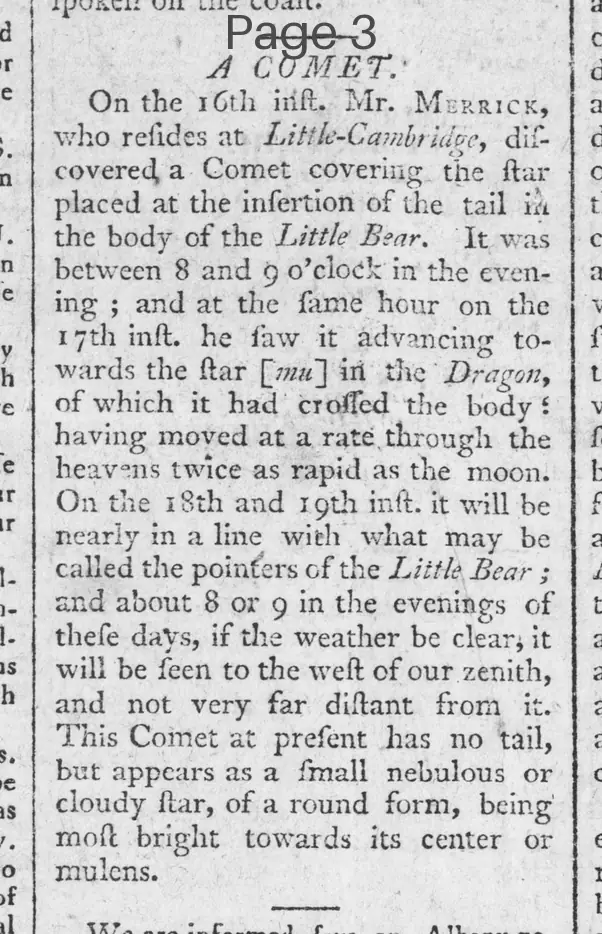
Mr. Merrick of Little-Cambridge discovered a tailless comet on the 16th inst., observed advancing rapidly on the 17th, predicted visible near the Little Bear on 18th and 19th evenings.
Clipping
OCR Quality
Full Text
On the 16th inst. Mr. Merrick,
who resides at Little-Cambridge, discovered
a Comet covering the star
placed at the insertion of the tail in
the body of the Little Bear. It was
between 8 and 9 o'clock in the evening;
and at the same hour on the
17th inst. he saw it advancing towards
the star mu in the Dragon,
of which it had crossed the body!
having moved at a rate through the
heavens twice as rapid as the moon.
On the 18th and 19th inst. it will be
nearly in a line with what may be
called the pointers of the Little Bear;
and about 8 or 9 in the evenings of
these days, if the weather be clear, it
will be seen to the west of our zenith,
and not very far distant from it.
This Comet at present has no tail,
but appears as a small nebulous or
cloudy star, of a round form, being
most bright towards its center or
nucleus.
What sub-type of article is it?
What keywords are associated?
What entities or persons were involved?
Where did it happen?
Domestic News Details
Primary Location
Little Cambridge
Event Date
16th Inst., 17th Inst., 18th And 19th Inst.
Key Persons
Event Details
Mr. Merrick discovered a comet covering a star in the Little Bear on the 16th inst. between 8 and 9 o'clock in the evening. On the 17th inst. at the same hour, he saw it advancing towards the star mu in the Dragon, having crossed its body and moved twice as rapidly as the moon. On the 18th and 19th inst., it will be nearly in line with the pointers of the Little Bear, visible to the west of the zenith around 8 or 9 in the evening if clear. The comet has no tail and appears as a small round nebulous star, brightest at its nucleus.