Thank you for visiting SNEWPapers!
Sign up free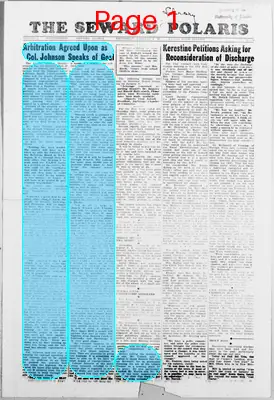
The Seward Polaris
Seward, Alaska
What is this article about?
In Seward, Alaska, a meeting at the Liberty Theater involving citizens, union representatives, National Labor Relations Board, Alaska Steamship Company, and Chambers of Commerce from Anchorage and Fairbanks announced a settlement to the dock tie-up. Longshoremen agreed to resume work pending NLRB arbitration, which may take 2-6 months or longer. Col. Johnson discussed broader impacts on Alaska Railroad and supply routes.
Clipping
OCR Quality
Full Text
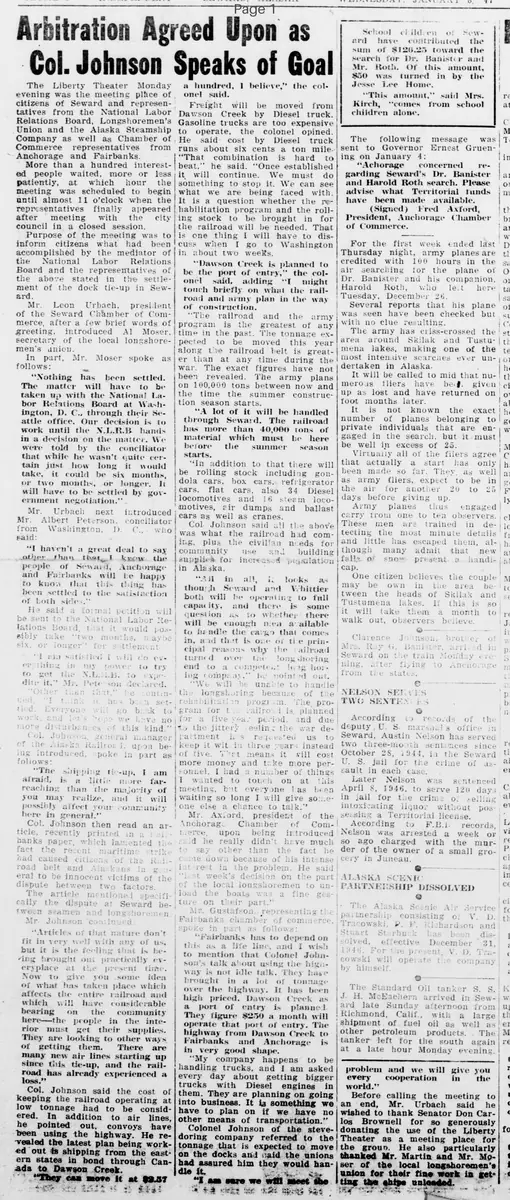
as Col. Johnson Speaks
of Goal
The Liberty Theater Monday evening was the meeting place of citizens of Seward and representatives from the National Labor Relations Board, Longshoremen's Union and the Alaska Steamship Company as well as Chamber of Commerce representatives from Anchorage and Fairbanks.
More than a hundred interested people waited, more or less patiently, at which hour the meeting was scheduled to begin until almost 11 o'clock when the representatives finally appeared after meeting with the city council in a closed session.
Purpose of the meeting was to inform citizens what had been accomplished by the mediator of the National Labor Relations Board and the representatives of the above stated in the settlement of the dock tie-up in Seward.
Mr. Leon Urbach, president of the Seward Chamber of Commerce, after a few brief words of greeting, introduced Al Moser, secretary of the local longshoremen's union.
In part, Mr. Moser spoke as follows:
"Nothing has been settled. The matter will have to be taken up with the National Labor Relations Board at Washington, D. C., through their Seattle office. Our decision is to work until the N.L.R.B. hands in a decision on the matter. We were told by the conciliator that while he wasn't quite certain just how long it would take, it could be six months, or two months, or longer. It will have to be settled by government negotiation."
Mr. Urbach next introduced Mr. Albert Peterson, conciliator from Washington, D. C., who said:
"I haven't a great deal to say other than that. I know the people of Seward, Anchorage and Fairbanks will be happy to know that this thing has been settled to the satisfaction of both sides."
He said a formal petition will be sent to the National Labor Relations Board, that it would possibly take "two months, maybe six, or longer" for settlement. "I am satisfied I will do everything in my power to try to get the N.L.R.B. to expedite it," Mr. Peterson declared.
"Other than that," he continued, "we have been set right. Everyone will go back to work, and let's hope we have no more disturbances of this kind."
Col. Johnson, general manager of the Alaska Railroad, upon being introduced, spoke in part as follows:
"The shipping tie-up, I am afraid, is a little more far-reaching than the majority of you may realize, and it will possibly affect your community here in general.
Col. Johnson then read an article, recently printed in a Fairbanks paper, which lamented the fact the recent maritime strike had caused citizens of the Railroad belt and Alaskans in general to be innocent victims of the dispute between two factions.
The article mentioned specifically the dispute at Seward between seamen and longshoremen.
Mr. Johnson continued, "Articles of that nature don't fit in very well with any of us, but it is the feeling that is being brought out practically everywhere at the present time.
Now to give you some idea of what has taken place which affects the entire railroad and which will have considerable bearing on the community here—the people in the interior must get their supplies. They are looking to other ways of getting them.
There are many new air lines starting up since this tie-up, and the railroad has already experienced a loss."
Col. Johnson said the cost of keeping the railroad operating at low tonnage had to be considered. In addition to air lines, he pointed out, convoys have been using the highway. He revealed the latest plan being worked out is shipping from the eastern states in bond through Canada to Dawson Creek.
"They can move a hundred, I believe," the colonel said.
Freight will be moved from Dawson Creek by Diesel truck. Gasoline trucks are too expensive to operate, the colonel opined.
He said cost by Diesel truck runs about six cents a ton mile.
"That combination is hard to beat," he said. "Once established it will continue. We must do something to stop it. We can see what we are being faced with.
It is a question whether the rehabilitation program and the rolling stock to be brought in for the railroad will be needed. That is one thing I will have to discuss when I go to Washington in about two weeks.
"Dawson Creek is planned to be the port of entry," the colonel said, adding "I might touch briefly on what the railroad and army plan in the way of construction.
"The railroad and the army program is the greatest of any time in the past. The tonnage expected to be moved this year along the railroad belt is greater than at any time during the war. The exact figures have not been revealed. The army plans on 100,000 tons between now and the time the summer construction season starts.
"A lot of it will be handled through Seward. The railroad has more than 40,000 tons of material which must be here before the summer season starts.
"In addition to that there will be rolling stock including gondola cars, box cars, refrigerator cars, flat cars, also 34 Diesel locomotives and 16 steam locomotives, air dumps and ballast cars as well as cranes.
Col. Johnson said all the above was what the railroad had coming, plus the civilian needs for community use and building supplies for increased population in Alaska.
"All in all, it looks as though Seward and Whittier both will be operating to full capacity, and there is some question as to whether there will be enough men available to handle the cargo that comes in, and that is one of the principal reasons why the railroad turned over the longshoring end to a contract longshoring company," he pointed out.
"We will be unable to handle the longshoring because of the rehabilitation program. The program for the railroad is planned for a five year period, and due to the jitter again the war department has requested us to keep it within three years instead of five. That means it will cost more money and take more personnel. I had a number of things I wanted to touch on at this meeting, but everyone has been waiting so long I will give someone else a chance to talk."
Mr. Axford, president of the Anchorage Chamber of Commerce, upon being introduced said he really didn't have much to say other than the fact he came down because of his intense interest in the problem. He said "Last week's decision on the part of the local longshoremen to unload the boats was a fine gesture on their part."
Mr. Gustafson representing the Fairbanks chamber of commerce, spoke in part as follows:
"Fairbanks has to depend on this as a life line, and I wish to mention that Colonel Johnson's talk about using the highway is not idle talk. They have brought in a lot of tonnage over the highway. It has been high priced. Dawson Creek as a port of entry is planned. They figure $250 a month will operate that port of entry. The highway from Dawson Creek to Fairbanks and Anchorage is in very good shape.
"My company happens to be handling trucks, and I am asked every day about getting bigger trucks with Diesel engines in them. They are planning on going into business. It is something we have to plan on if we have no other means of transportation."
Colonel Johnson of the stevedoring company referred to the tonnage that is expected to move on the docks and said the unions had assured him they would handle it.
problem and we will give you every cooperation in the world."
Before calling the meeting to an end, Mr. Urbach said he wished to thank Senator Don Carlos Brownell for so generously donating the use of the Liberty Theater as a meeting place for the group. He also particularly thanked Mr. Martin and Mr. Moser of the local longshoremen's union for their fine work in getting the ships unloaded.
What sub-type of article is it?
What keywords are associated?
What entities or persons were involved?
Where did it happen?
Domestic News Details
Primary Location
Seward
Event Date
Monday Evening
Key Persons
Outcome
longshoremen agreed to resume work pending national labor relations board decision, which may take two months, six months, or longer. ships were unloaded. broader impacts discussed including alternative supply routes via air, highway, and dawson creek.
Event Details
A meeting was held at the Liberty Theater in Seward with citizens, National Labor Relations Board representatives, Longshoremen's Union, Alaska Steamship Company, and Chambers of Commerce from Anchorage and Fairbanks to discuss settlement of the dock tie-up. Speakers including union secretary Al Moser, conciliator Albert Peterson, Alaska Railroad general manager Col. Johnson, and chamber presidents addressed the agreement for arbitration by the NLRB, resumption of work, and economic implications for Alaska's supply chains and railroad operations.